Works on paper
Alongside ceramics we handle a small number of Chinese works on paper: calligraphy and painting in the hanging-scroll format, and modern prints. They are chosen for the same reasons as the pots — a real hand, a real subject, a condition we can describe — and this page explains how we look at them, because paper needs a different eye from porcelain.
The hanging scroll
A Chinese hanging scroll is a work on paper or silk mounted onto a backing and bordered with silk, with a wooden stave at the top and a heavier roller at the bottom so that it hangs flat and rolls for storage. The mount is a later and replaceable part of the object: scrolls were and are remounted, and an old painting in a fresh mount is normal. What matters is the image, the signature and seals, and the condition of the paper itself.
Reading calligraphy
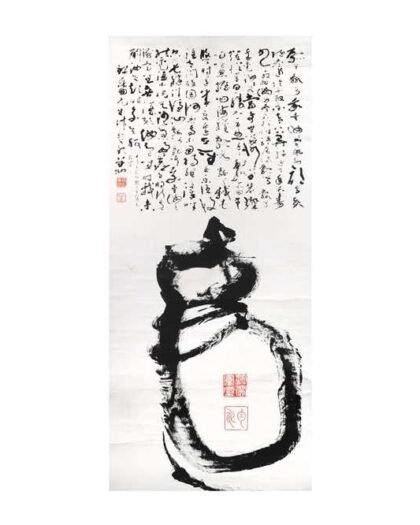
Chinese calligraphy is written in a handful of script types that a collector soon learns to recognise: seal script, the archaic form used on seals and for effect; clerical script, squarer and more formal; regular script, the clear standard hand; running script, a fluent cursive; and “grass” or wild cursive, in which characters are reduced to gesture. A single large character or a short phrase written in cursive, as in a Zen or literati scroll, is judged on the energy and control of the brush rather than on legibility. The artist signs, usually at the left, and impresses one or more red seals; collectors’ seals may be added over time and are part of the history. Daruma (Bodhidharma), the founder of Chan or Zen Buddhism, is a favourite subject of this kind of painting across China, Japan and Korea, typically shown as a bearded, glaring figure in a few strokes.
Condition on paper
Paper does not chip or craze, so the ceramics vocabulary does not apply, and we do not give works on paper a condition grade on the same scale. Instead we describe what we see: foxing (brown spots from mould or iron in the paper), toning (overall yellowing from light and acid), creases and cockling from rolling and humidity, tears, losses, old repairs, and the state of the mount and rollers. Where a signature or seal cannot be confirmed against a documented example, we say so.
Prints
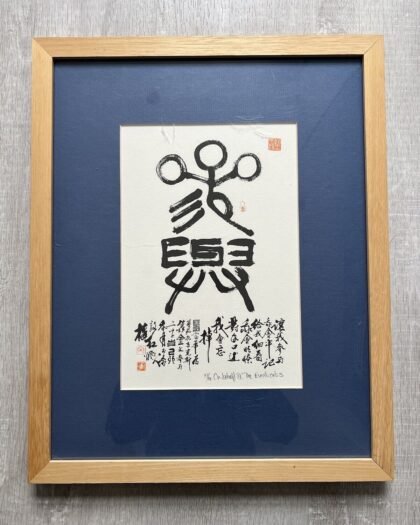
Modern limited-edition prints after Chinese calligraphy or painting are a different category: reproductions of an artist’s work, numbered and often signed, sold on the strength of the design and the edition rather than as originals. We describe them as prints, give the edition details we have, and price them as prints.
Care and display
Keep works on paper out of direct sunlight, away from radiators and damp walls, and off the wall for part of the year if you can — museums rotate scrolls for good reason. Roll from the bottom, loosely, with the image inward, and store flat in a box. Never tape, glue or laminate.
In the collection
Two works at present: a Daruma calligraphy scroll by Yang Caoxian and a limited-edition print by Fu Hua after a poem. Both are photographed in full and in detail.
Showing all 2 results