Reference
The words used on this site and in the trade, defined the way we use them. Where a term is contested or used loosely in sale catalogues, the entry says so. For the longer treatments, follow the links into the guides and ware pages. Reign dates follow the Metropolitan Museum’s List of Rulers of China.
A B C D E F G H I J K L M N O P Q R S T U W Y Z
A
Anhua 暗花, “hidden decoration”
Decoration incised or traced in slip so faintly that it disappears under the glaze and is read only in transmitted or raking light. Associated above all with the thin white wares of the early Ming, and revived in the Qing. A piece described as anhua should be held to a window before you believe it.
Apocryphal mark
A reign mark of an earlier emperor applied to a later piece. It is not in itself a sign of deceit: Kangxi potters put Chenghua and Xuande marks on wares made in homage, and nineteenth-century Jingdezhen used Qianlong and Yongzheng marks freely. The mark tells you what the potter admired, not when the pot was made. See reign marks and mark and period below.
Arita
The town in the old province of Hizen (Arita is now in Saga prefecture), Kyushu, where Japanese porcelain production began in the early seventeenth century. Arita wares were shipped through the nearby port of Imari, which is why the same porcelain is called by either name. Kakiemon and Nabeshima are Arita-area styles. See the Japanese marks guide.
B
Base
The underside of a pot, including the foot ring and the recessed area inside it. The single most informative surface on any Chinese ceramic: it shows the body unglazed, how the piece was supported in the kiln, the glaze’s edge, and any mark. Our guide to reading the base goes through it in order.
Biscuit
Fired but unglazed ceramic body. “Enamel on biscuit” describes a technique, common in the Kangxi period, in which coloured lead glazes were applied directly to the fired body without a clear glaze beneath, giving a thinner, less glossy surface than the same colours over glaze, through which incised decoration reads clearly.
Bleu de Hué
Blue and white porcelain made at Jingdezhen to the order of the Vietnamese court and elite, from the mid-eighteenth century into the nineteenth, often bearing Chinese-character marks and inscriptions ordered by the Lê–Trịnh and Nguyen courts, occasionally with verse in Vietnamese Nôm. It is Chinese porcelain by manufacture and Vietnamese by commission. See why Bleu de Hué is Chinese porcelain.
Blanc de Chine
The French trade name for the ivory-white porcelain of Dehua, Fujian province, produced from the Ming dynasty onward and exported in quantity from the seventeenth century. Figures of Guanyin, libation cups and small censers are the typical forms. The glaze fuses so completely with the body that no glaze line shows at the foot.
Blue and white qinghua 青花
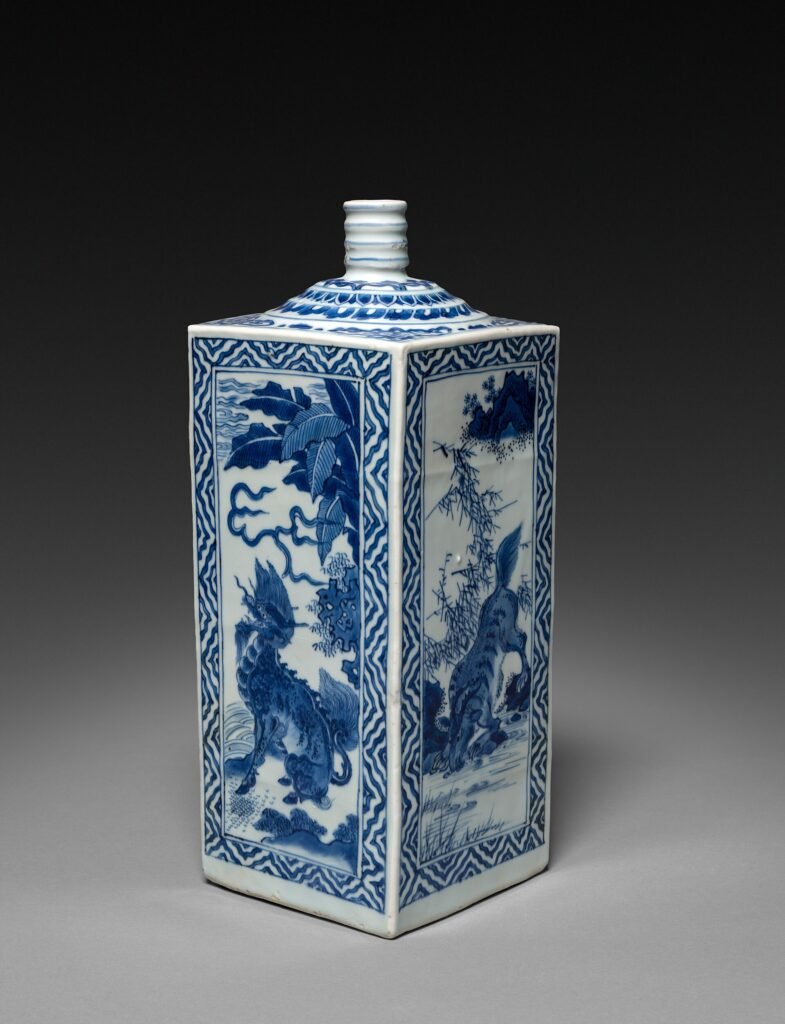
Porcelain painted in cobalt oxide on the unfired body and covered with a clear glaze, so that the blue lies under the glaze. Perfected at Jingdezhen in the fourteenth century using cobalt imported from the Middle East; domestic Chinese ores came into use later and give a different tone. See the ware page.
Buncheong 분청, punch’ŏng
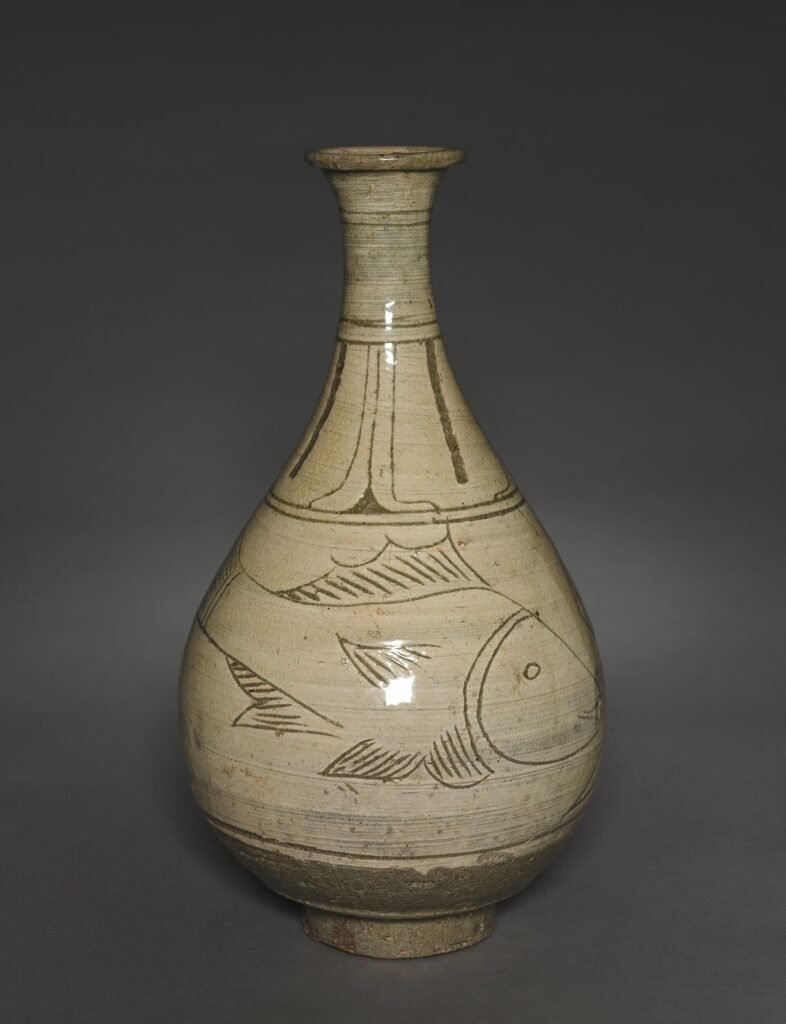
Korean stoneware of the fifteenth and sixteenth centuries, descended from Goryeo celadon, in which a grey body is coated or decorated with white slip by stamping, inlay, brushing or sgraffito, under a thin greenish glaze. Production faded as white porcelain became the Joseon court’s preference. See collecting Korean ceramics.
Bunwon 분원
The official kilns of the Joseon court at Gwangju, south-east of Seoul, which supplied white porcelain to the palace from the 1460s until they were privatised in the 1880s. “Bunwon” on a listing therefore means court-quality porcelain, not a private kiln. See Korean marks.
C
Celadon
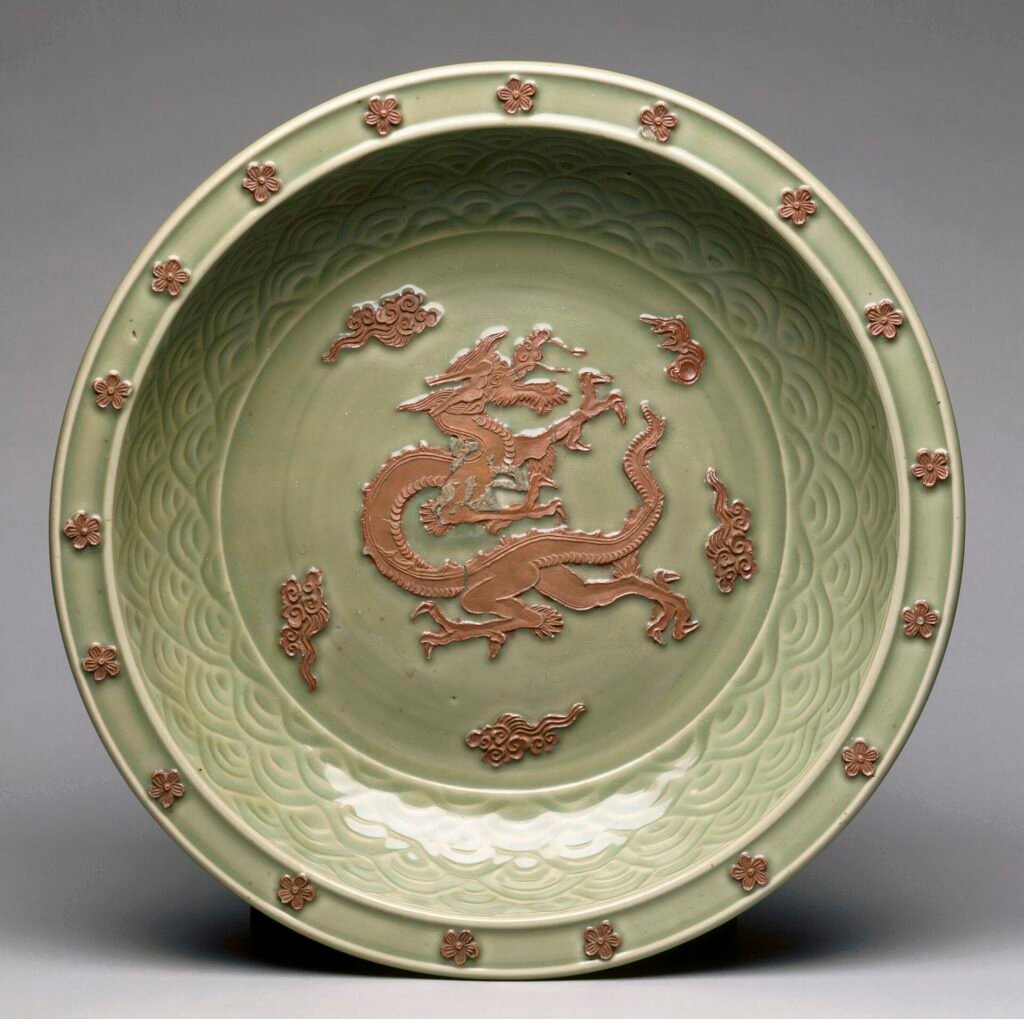
The Western name for a family of green to blue-green glazes coloured by a small amount of iron and fired in a reducing atmosphere. It covers Yue, Yaozhou, Longquan, Guan, Ru and Goryeo wares, which differ greatly in body, colour and date. “Celadon” describes the glaze; it is not an attribution. See the ware page and the terminology note.
Chatter marks
A regular rhythm of fine ridges left on a foot or base when the trimming tool vibrated against the leather-hard clay. Harmless, and sometimes useful: the rhythm of chatter on a base is hard for a copyist to reproduce convincingly.
Cizhou ware
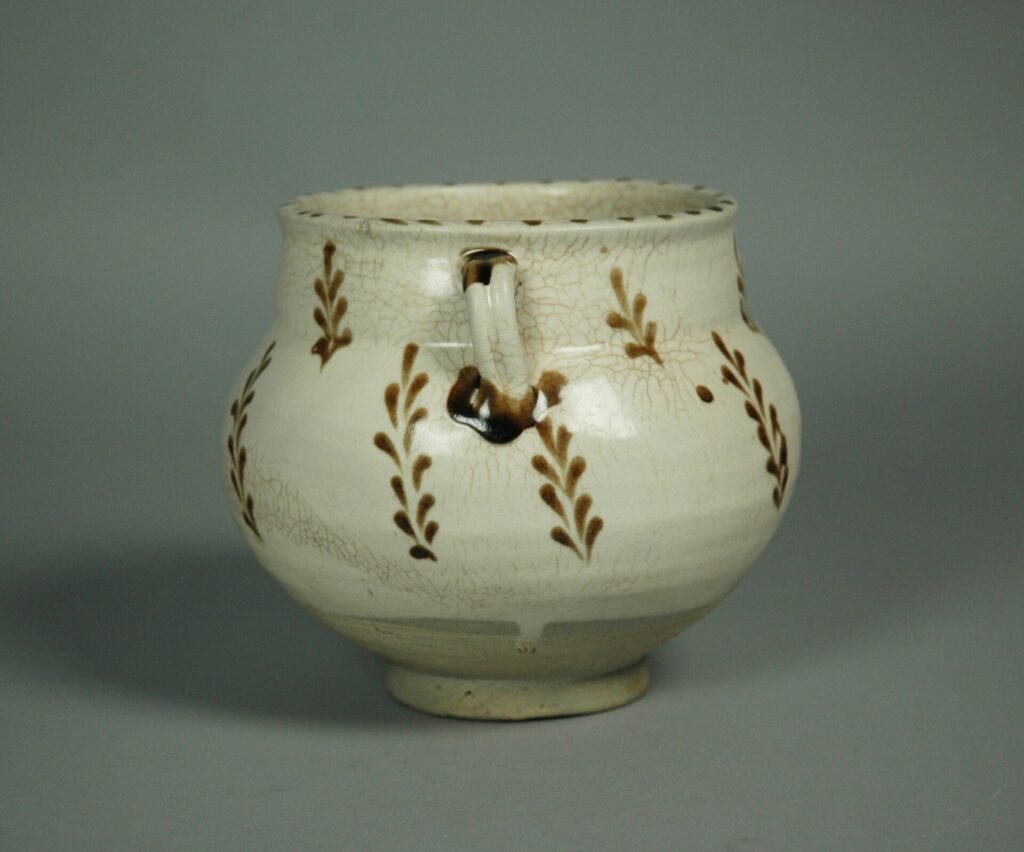
A broad family of northern Chinese stonewares, made in Hebei, Henan and neighbouring provinces from the Northern Song, with earlier antecedents, into the Ming, decorated with white slip that is then painted, carved or scratched through (sgraffito) under a clear glaze. Robust, popular wares rather than court porcelain; pillows, meiping vases and storage jars are typical.
Clair de lune tianlan 天藍
A pale, even lavender-blue monochrome glaze, coloured by cobalt, associated with the Kangxi, Yongzheng and Qianlong reigns and with small scholar’s objects. The French name is a nineteenth-century collector’s term.
Cobalt
The metallic oxide that gives blue and white its colour. Ores differ in their iron and manganese content: the imported cobalt of the Yuan and early Ming tends to fire with dark, speckled concentrations (see heaped and piled), while later domestic ores give a greyer or more purplish blue. Cobalt behaviour is one of the few dating clues that a mark cannot fake.
Crackle and crazing
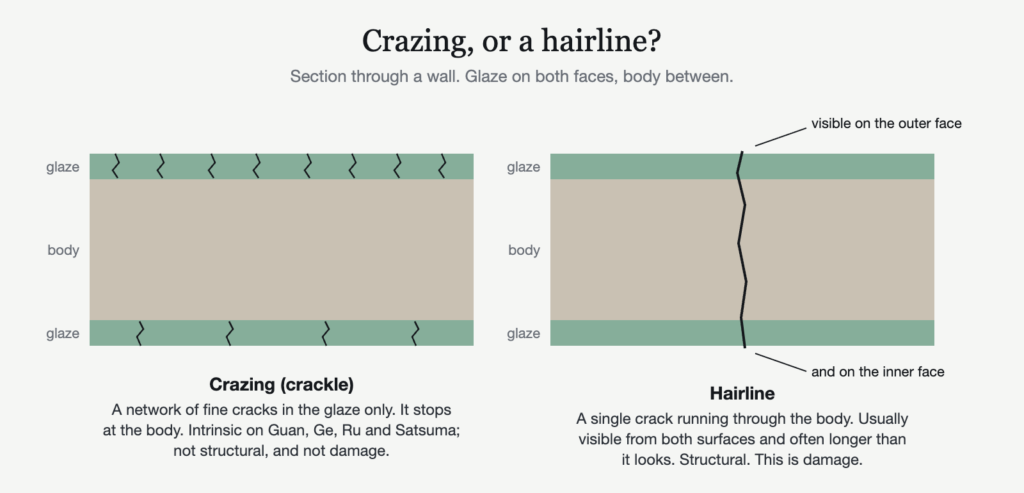
A network of fine cracks in the glaze only, caused by the glaze shrinking more than the body as the piece cools. Deliberate on Ge and Guan wares and on Qing imitations of them, where the potter controlled it and often stained it; incidental on much else, where it is called crazing. Neither affects the body. A crack that runs through the body is a hairline. See Ge and Guan crackle and what a hairline does to value.
D
Dehua
The kiln area in Fujian province that produced blanc de Chine. Dehua figures and cups were exported from the seventeenth century and copied in Europe at Meissen, Saint-Cloud and Bow; Dehua itself continues to produce white porcelain today, so a figure needs to be judged on body, glaze and modelling, not on type.
Ding ware
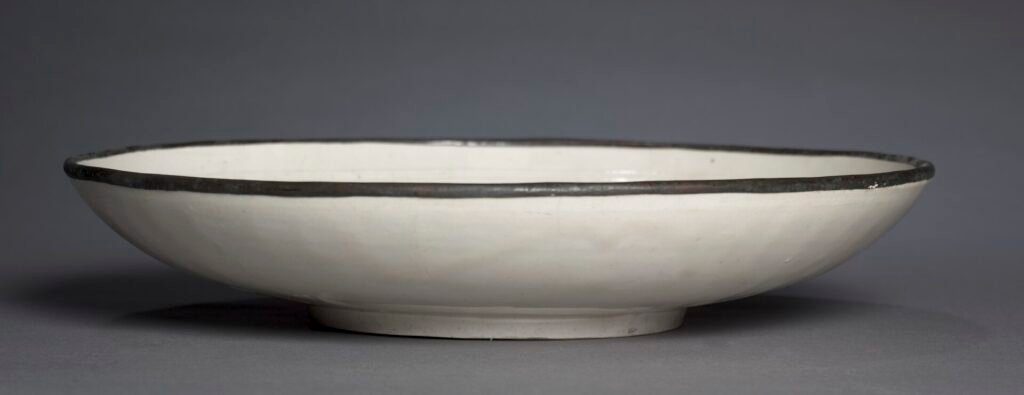
The fine white porcelain of Hebei province, at its height in the Northern Song. From the mid-Northern Song most Ding bowls and dishes were fired upside down on their rims to allow tighter stacking, leaving an unglazed rim that was often bound in copper or silver. The unglazed rim is a strong pointer to Song and Jin Ding; earlier Ding, fired upright, has a glazed rim and spur marks.
Doucai 鬥彩, “joined” or “contrasting” colours
A decorative scheme in which the outlines are drawn in underglaze cobalt blue and the colours filled in with overglaze enamels in a second, lower firing. Perfected under Chenghua (1465–87), whose “chicken cups” are the most famous examples, and revived under Yongzheng and Qianlong. Compare wucai, where blue is used as a colour in its own right rather than as outline.
Double circle
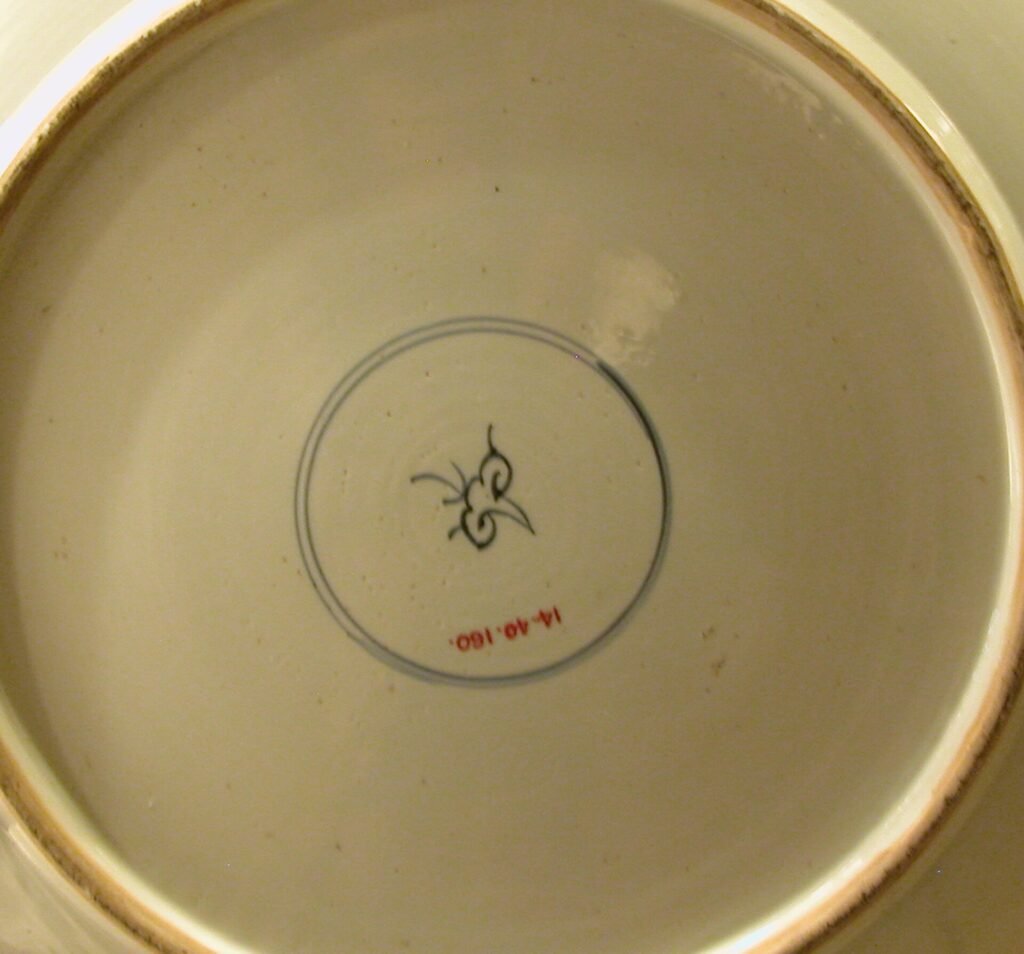
Two concentric rings painted in underglaze blue on the base, with or without a mark inside them. A double circle with nothing inside is common on Kangxi-period porcelain and is not a defect or an erased mark. See the reign marks guide.
E
Enamels
Coloured glass pigments painted onto an already-glazed and fired surface, then fixed in a second firing at a much lower temperature in a muffle kiln. Because enamel sits on the glaze rather than under it, it can be felt with a fingernail and can wear, flake or be later-added. The famille palettes, doucai, wucai and Satsuma decoration are all enamel work.
Export porcelain
Chinese and Japanese porcelain made for foreign markets rather than domestic or court use, from the Portuguese trade of the early sixteenth century through the Dutch and English East India companies to the American trade of the nineteenth. Forms, palettes and subjects follow the customer; kraak, Imari, Chinese Imari and armorial services are all export types.
F
Famille jaune
Famille verte enamels on a yellow ground. Scarce in genuine period examples, and a grouping that the nineteenth century enlarged by adding yellow grounds to earlier or plainer pieces; a piece described as famille jaune deserves examination under ultraviolet.
Famille noire
Famille verte enamels on a black ground, the black usually washed over with translucent green. Pieces are catalogued as Kangxi, but the dating of much famille noire is debated and a good deal of it is nineteenth-century. See the ware page and the palettes note.
Famille rose fencai 粉彩, yangcai 洋彩
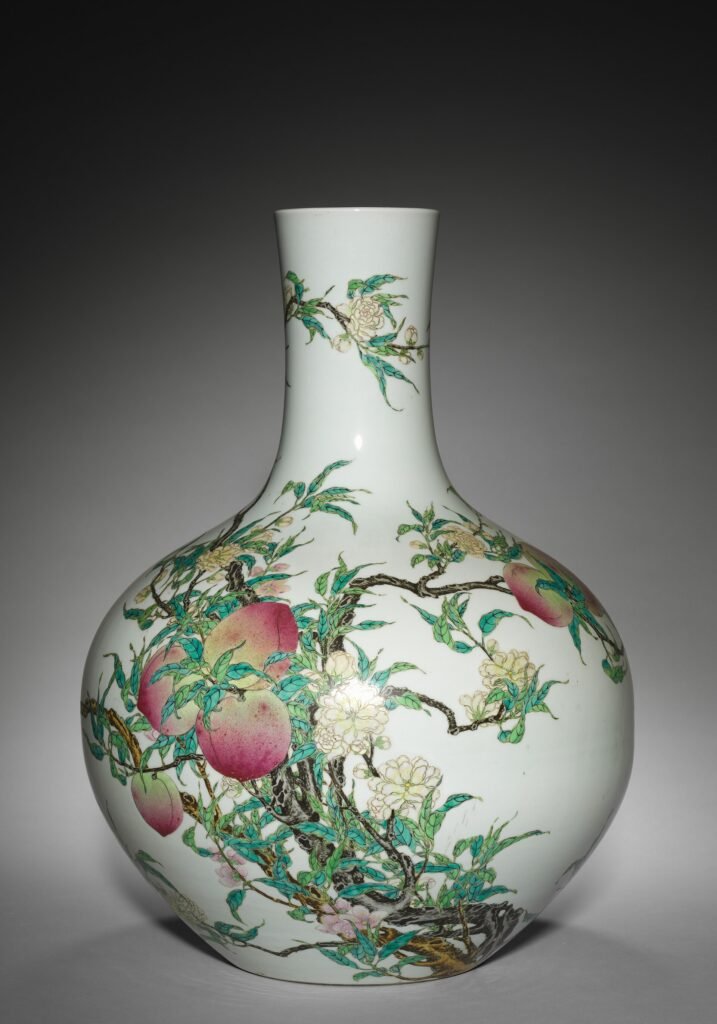
The opaque overglaze enamel palette introduced around 1720, in the late Kangxi reign, distinguished by a pink derived from colloidal gold and by the use of white to blend and shade colours. It became the dominant palette of the Yongzheng and Qianlong reigns and of nineteenth-century export porcelain. See the ware page.
Famille verte wucai 五彩 (Kangxi type)
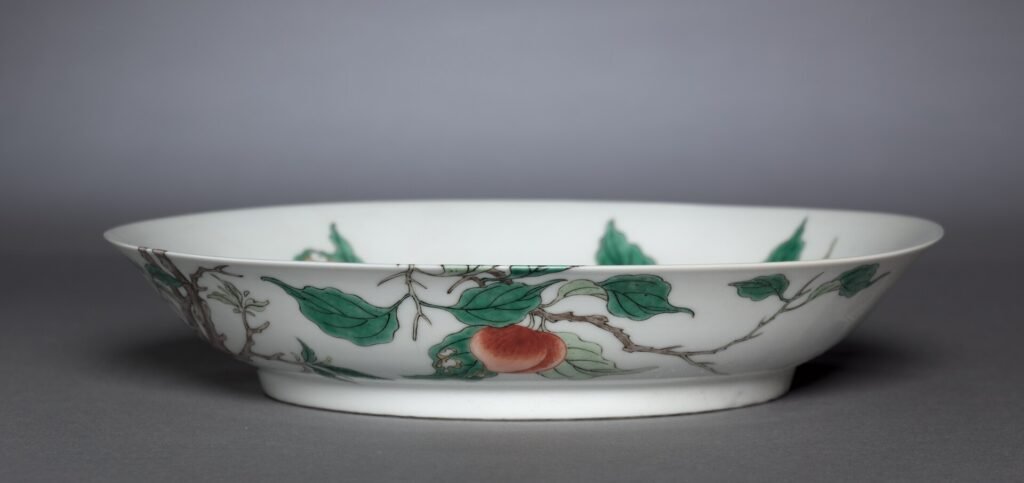
The translucent overglaze enamel palette of the Kangxi period, dominated by several greens with iron red, yellow, aubergine and a transparent overglaze blue. It grew out of Ming wucai and was displaced by famille rose. The “famille” names go back to the French writer Albert Jacquemart’s classification of the 1860s and are Western, not Chinese, categories. See the ware page.
Firing crack
A crack that opened in the kiln, usually where the body was thick or unevenly dried, and which the glaze has run into and sealed. The glazed edges distinguish it from later damage. Firing cracks are original to the piece and are recorded as such in our condition reports, not as damage.
Flambé yaobian 窯變
A copper-rich glaze fired to produce streaks and mottling of red, purple and blue, perfected at Jingdezhen under the supervisor Tang Ying in the Yongzheng reign in imitation of Song Jun ware and continued through the Qing and Republic. The name is French.
Foot ring foot rim
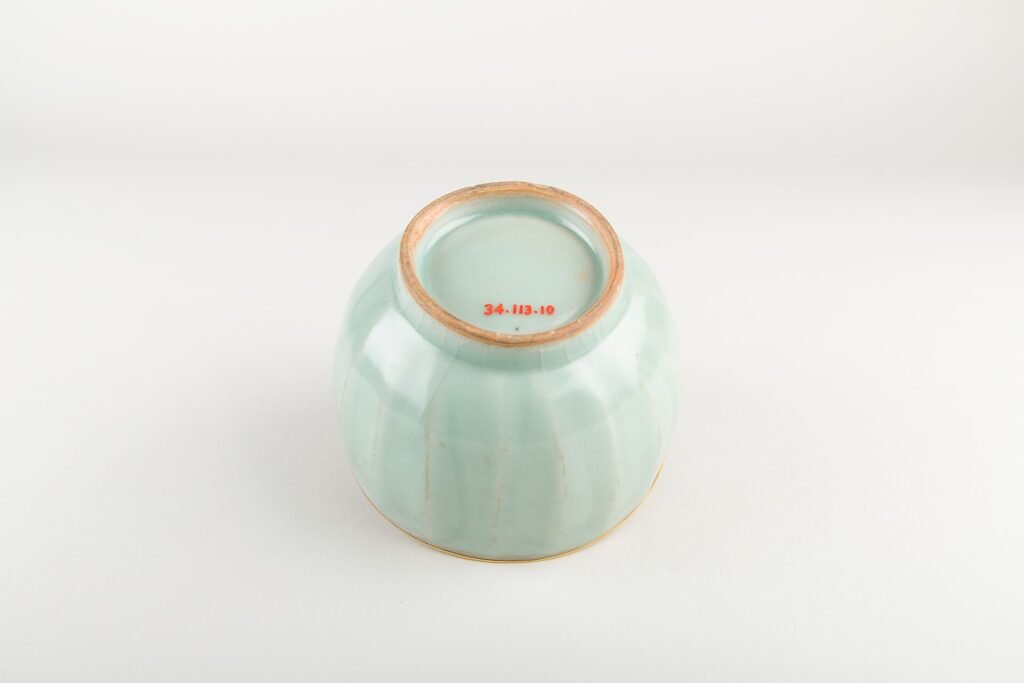
The ring of clay on which a pot stands, usually left unglazed so that the piece did not stick to the kiln floor. Its profile, the colour of the exposed body, the way the glaze stops above it and any grit or spur marks are read together to place a piece. See reading the base.
Foxing
Small brown or rust-coloured spots on paper or silk, caused by mould or by iron impurities in the sheet reacting with damp. The commonest condition issue on works on paper, and one that is graded by density and by whether it intrudes on the image.
Frit rim frit, fritting
Tiny flakes lost from the glaze along a rim or edge, exposing the body beneath. On thin-rimmed Ming and Transitional pieces some rim fritting is near-universal and is described, not hidden. Distinct from a chip, which takes body as well as glaze.
G
Ge ware 哥窯
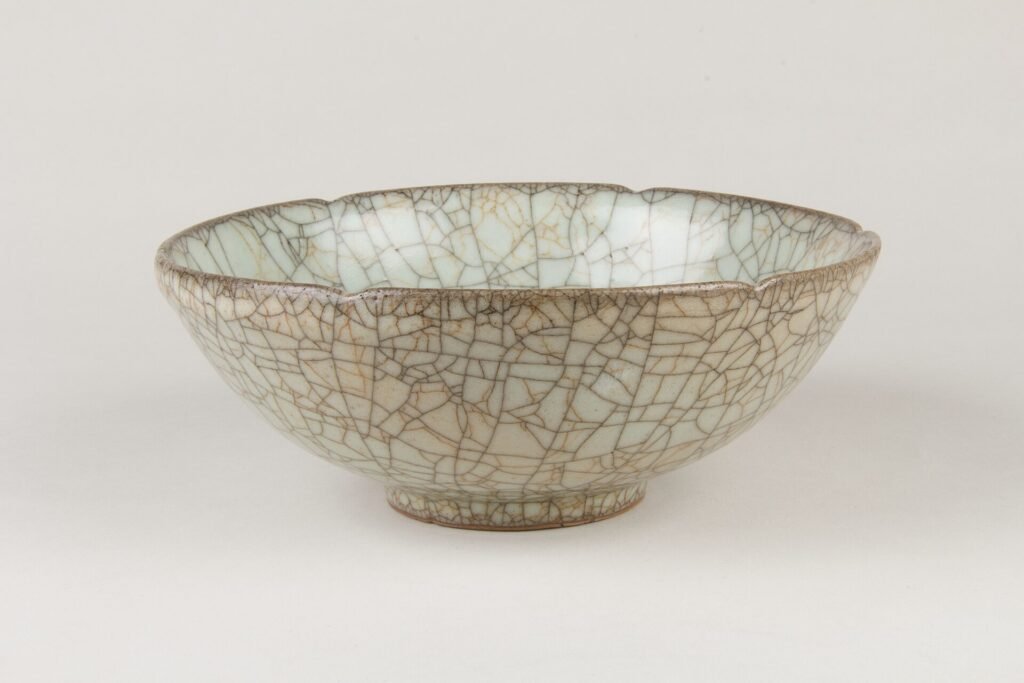
A stoneware with a grey body and a thick, crackled glaze in which two networks of crackle are stained differently, traditionally described as “iron wire and gold thread”. Ge is counted among the classic wares of the Song, but no kiln site has been securely identified, and museums date many “Ge” pieces to the Yuan or Ming. See the ware page and the journal note.
Gilding
Gold applied to a glazed surface and fixed by a low firing. Gilding wears first at rims, handles and high points of relief, and rubbed gilding is normal on eighteenth- and nineteenth-century wares. Bright, unworn gilding on an otherwise worn piece suggests re-gilding.
Glaze
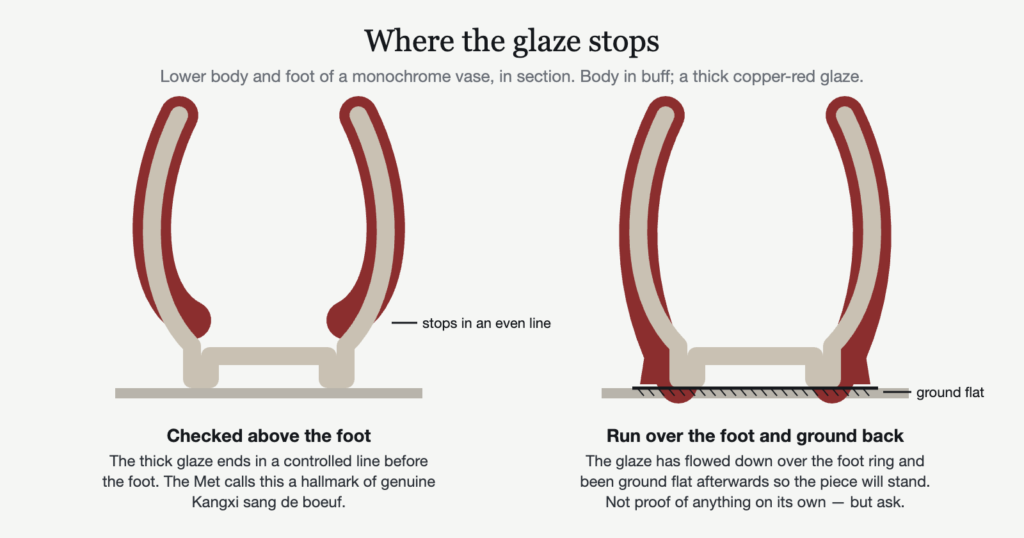
The glassy coating fused to the body in the kiln. Its colour comes from metal oxides (iron for celadon and browns, cobalt for blue, copper for red or green depending on the firing atmosphere), its texture from composition and temperature. Where the glaze stops, pools or runs is as informative as its colour.
Goryeo 고려, 918–1392
The Korean dynasty whose celadons, especially those with sanggam inlay, are the most admired Korean ceramics. Goryeo celadon has a distinctive blue-green glaze that Chinese connoisseurs of the Song themselves praised.
Guan ware 官窯, “official ware”
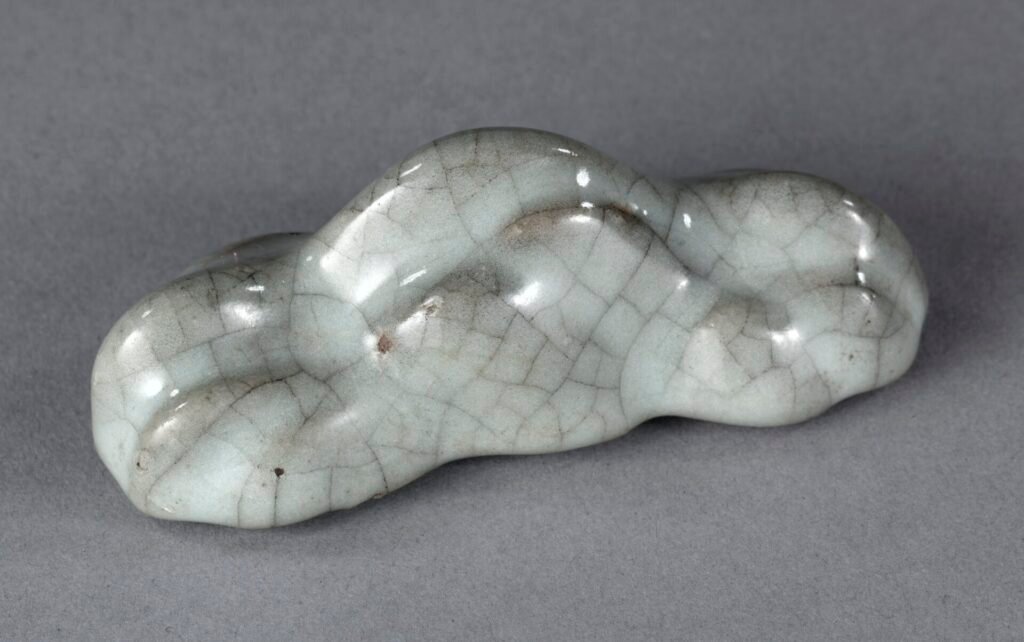
The ware made for the Southern Song court at Hangzhou after 1127: a dark, thin body under a thick, layered, crackled glaze, showing “purple mouth and iron foot” where the body burns dark at the rim and foot. Imitated at Longquan in its own day and at Jingdezhen under the Qing. Not to be confused with the general use of “guan” for any imperial kiln.
H
Hairline
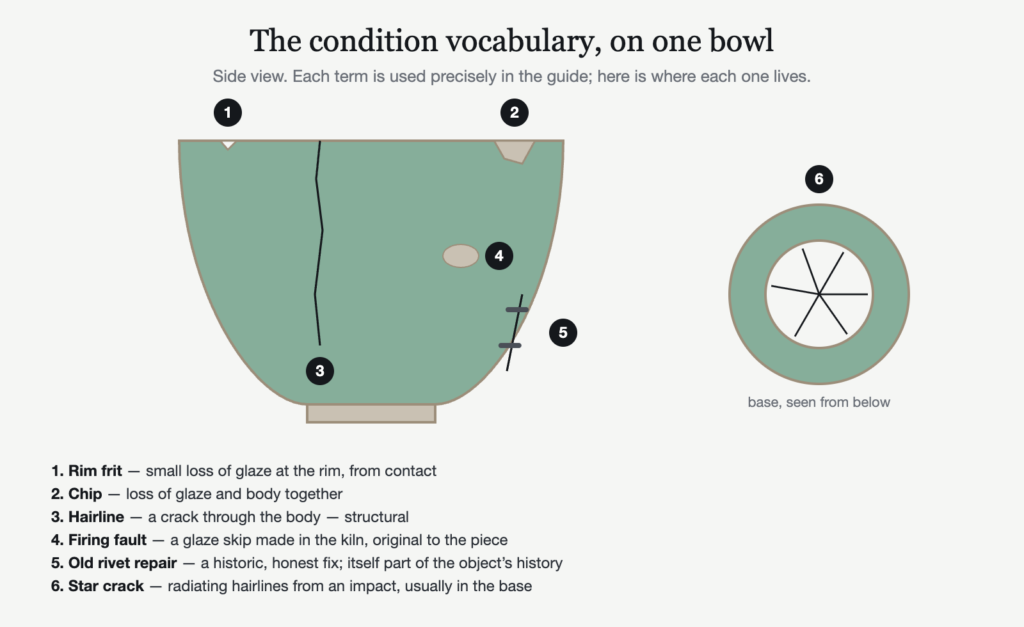
A fine crack running through the body, usually from a rim or a firing stress point, visible on both surfaces if you look. A hairline is damage, and its effect on value depends on the ware, the length and whether it is stable. See what a hairline does to value.
Hall mark tangming 堂名
A mark naming a studio, hall or residence rather than a reign, as in “made for the Hall of Prudent Virtue”. Hall marks appear on Ming and Qing porcelain made for private patrons and on some imperial commissions; on Kangxi wares they are common where a reign mark is absent.
Hanging scroll lizhou 立軸, kakemono 掛物
A painting or calligraphy mounted vertically on silk or paper with a roller at the foot, intended to be displayed for a period and then rolled for storage. The mounting is usually later than the work and is assessed separately.
Hare’s fur
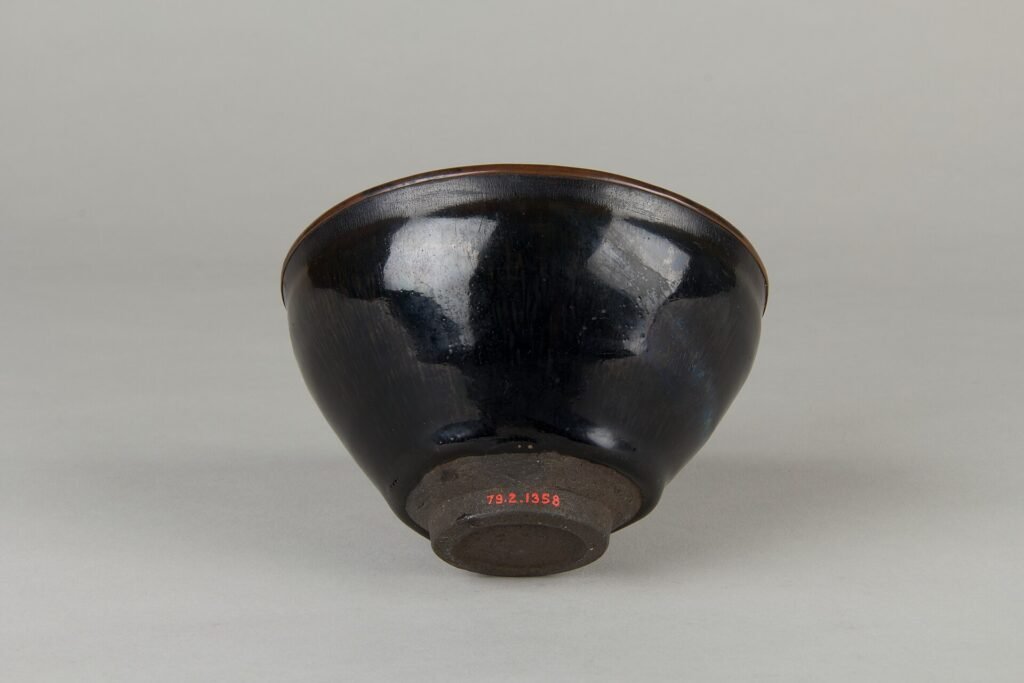
Fine radiating streaks of iron crystals in a black glaze, the characteristic surface of Song Jian ware tea bowls and of Japanese tenmoku after them.
Heaped and piled
Dark, sometimes blackish concentrations in underglaze blue where the cobalt was applied thickly and burned through the glaze surface, giving a faintly pitted texture. It is a feature of Yuan and early Ming blue and white and was deliberately imitated in the eighteenth century. It is not, on its own, proof of an early date.
I
Imari
Japanese porcelain from the Arita kilns, shipped through the port of Imari, and specifically the palette of underglaze blue with overglaze iron red and gilding that Europe bought in quantity from the late seventeenth century. “Chinese Imari” is the Jingdezhen imitation of that palette, made for the same customers.
Imperial yellow
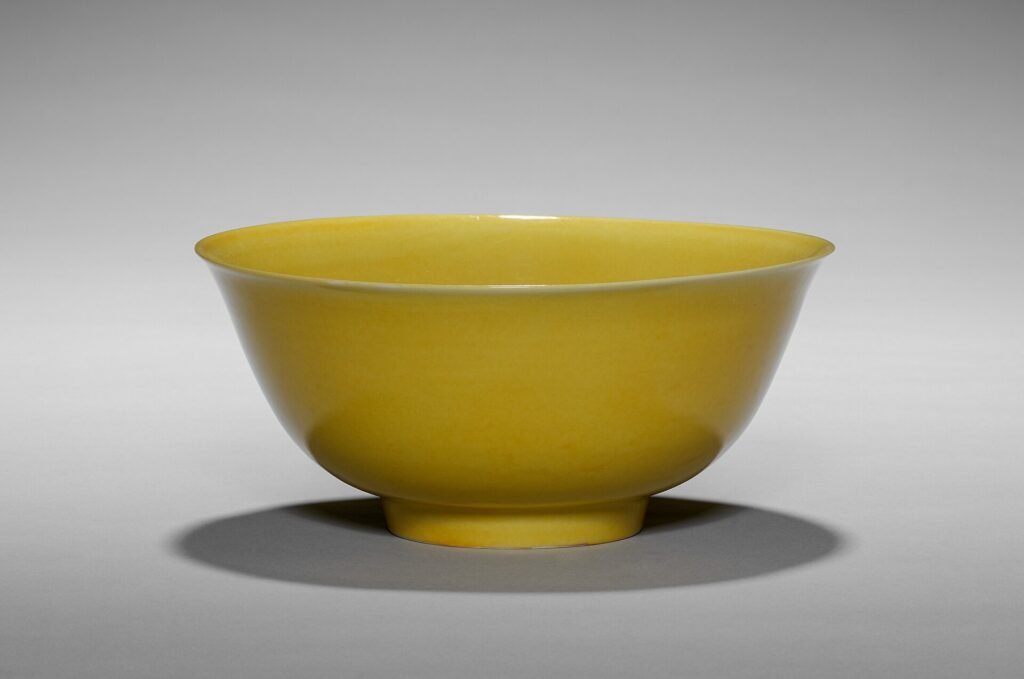
A low-fired iron-based yellow glaze whose use was restricted by regulation in the Ming and Qing courts, applied either directly to the biscuit or over a high-fired glaze. Tone, evenness and the glaze’s behaviour at the foot separate imperial from later provincial and Republic yellows.
Iron red fanhong 礬紅, rouge de fer
An overglaze enamel coloured by iron oxide, giving an orange-red that sits on the glaze and can be felt. Used on its own for dragon and lotus designs and as a component of wucai, famille verte and Imari palettes. Distinct from underglaze copper red, which lies beneath the glaze and is far harder to fire. See the ware page.
J
Jian ware
Black-glazed stoneware tea bowls from Fujian province, made in the Song for whisked tea, with hare’s fur or “oil spot” surfaces and a coarse, dark, iron-rich body. Exported to Japan, where they became tenmoku.
Jingdezhen
The porcelain city of Jiangxi province, the principal centre of Chinese porcelain from the Yuan dynasty onward and the site of the Ming and Qing imperial kilns. Nearly everything described on this site as Ming or Qing porcelain was made there, whether for the court, the domestic market or export.
Joseon 조선, 1392–1910
The Korean dynasty of white porcelain, buncheong and the moon jar. Joseon ceramics are plainer than Goryeo, with decoration in underglaze iron-brown, cobalt blue and, in the eighteenth century, copper red. See the Joseon collection.
Jun ware 鈞窯
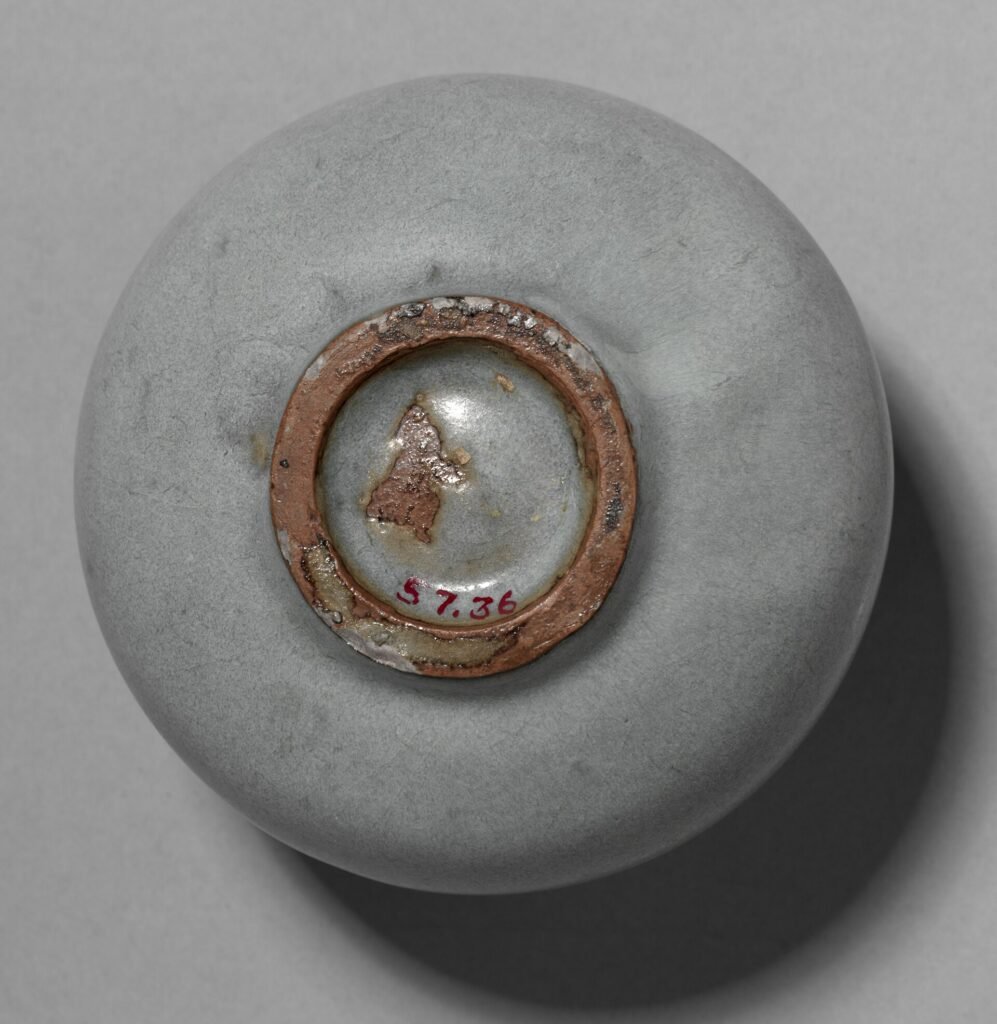
Northern Chinese stoneware of the Song, Jin and Yuan with a thick, opalescent blue glaze, often splashed with copper purple. The “numbered Jun” flower pots and bulb bowls carry a numeral from one to ten incised on the base, indicating size within a set.
K
Kakiemon
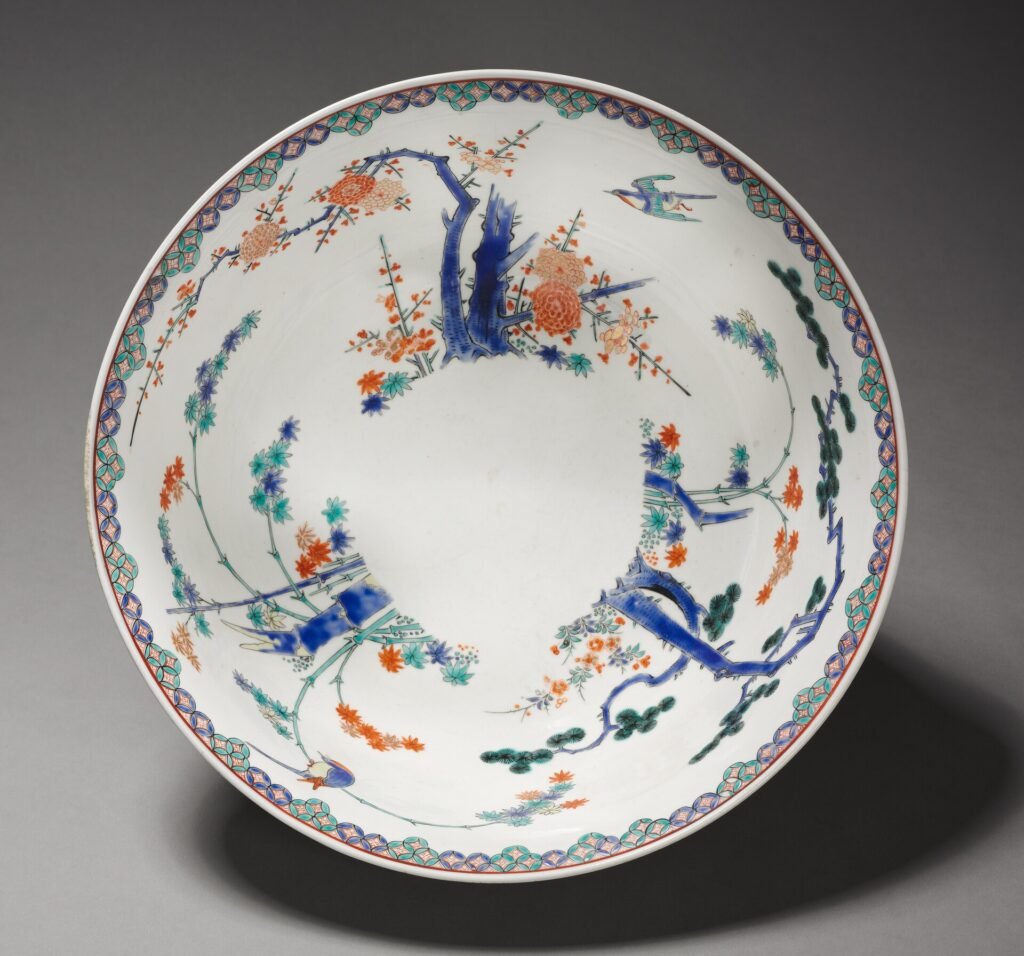
An Arita style of overglaze enamel decoration of the second half of the seventeenth century, named after the Sakaida Kakiemon family: sparse, asymmetric designs in iron red, blue, green and yellow on a milky-white body, leaving much of the surface plain. Widely copied at Meissen, Chantilly, Chelsea and Bow.
Kaolin china clay
The white, refractory clay that gives porcelain its strength in the kiln, named after Gaoling, the hill near Jingdezhen where it was dug. Combined with petuntse (porcelain stone) to make the porcelain body.
Kiln grit
Sand or grit from the kiln floor fused to the foot ring or base during firing. Typical of the Zhangzhou (Swatow) export wares of the late Ming and of many provincial pieces; rare on imperial porcelain, which was fired on prepared supports.
Kinrande 金襴手
The Japanese term for Chinese porcelain of the Jiajing and Wanli reigns decorated with gold leaf on red, green or blue overglaze grounds, prized in Japan, where the term originates. The gold is fragile and is usually worn.
Kintsugi 金継ぎ
The Japanese practice of repairing a broken ceramic with lacquer and dusting the join with gold, so that the repair is declared rather than disguised. A kintsugi repair on a Chinese or Korean piece usually means it passed through Japanese tea circles.
Kraak
Thinly potted Chinese export blue and white of the late Ming, roughly the Wanli reign to the 1640s, with the decoration divided into radiating panels around a central scene. The name comes from the Portuguese carrack, the ship type in which it was carried. Foot rims are often rough and glaze often has small firing flaws; both are normal.
Kutani
Japanese overglaze-enamelled porcelain associated with Kaga province. The early group, “Ko-Kutani”, is dated to the seventeenth century and its origin is debated; the great majority of pieces on the market are nineteenth-century revivals, often marked Kutani in red.
L
Longquan
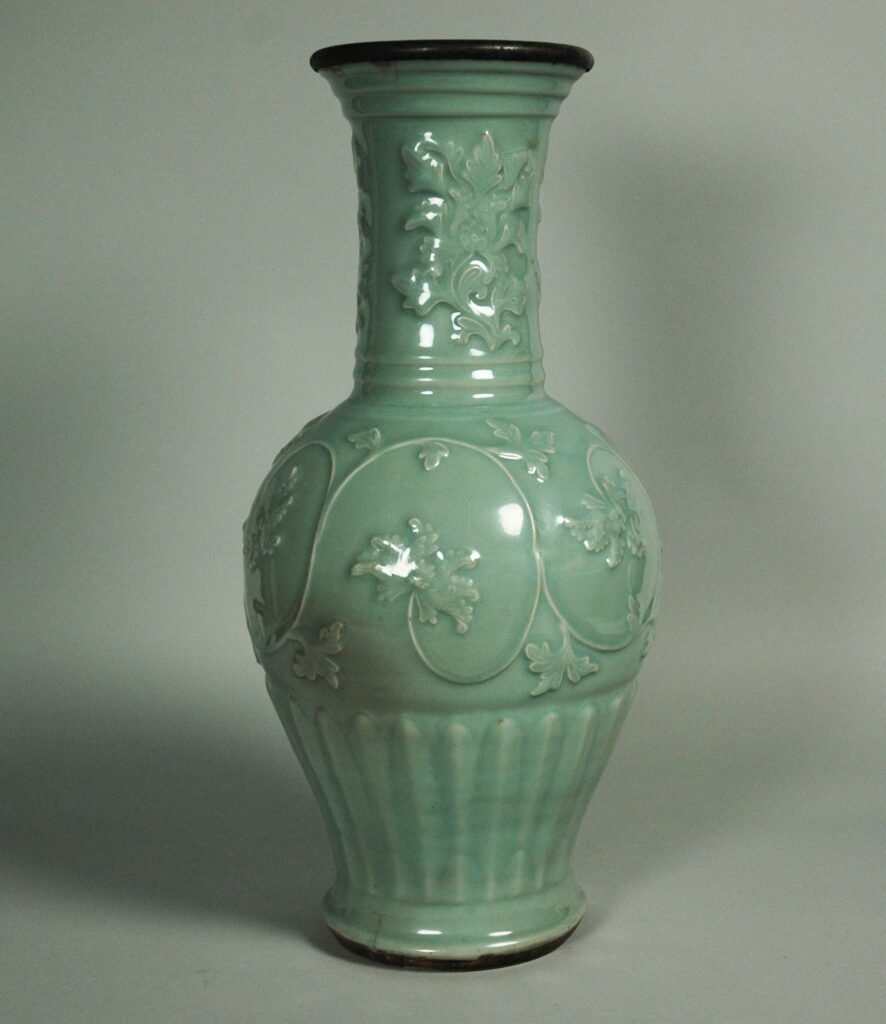
The celadon kilns of southern Zhejiang province, at their height from the Southern Song through the Ming, producing thick, unctuous blue-green to olive glazes on a grey body that burns orange where exposed. Exported across Asia in huge quantities. See the ware page.
M
Mark and period
The cataloguer’s phrase for a piece whose reign mark matches the reign in which it was made, as against an apocryphal mark. It is a conclusion drawn from body, glaze, cobalt, enamel, potting and foot, with the mark as one factor; the mark alone establishes nothing. See reign marks.
Meiji 明治, 1868–1912
The era of Japan’s modernisation, in which Satsuma, cloisonné, bronzes and export porcelain were made for the international exhibitions and the Western market at a level of finish never repeated. See the Meiji collection.
Mizusashi 水指
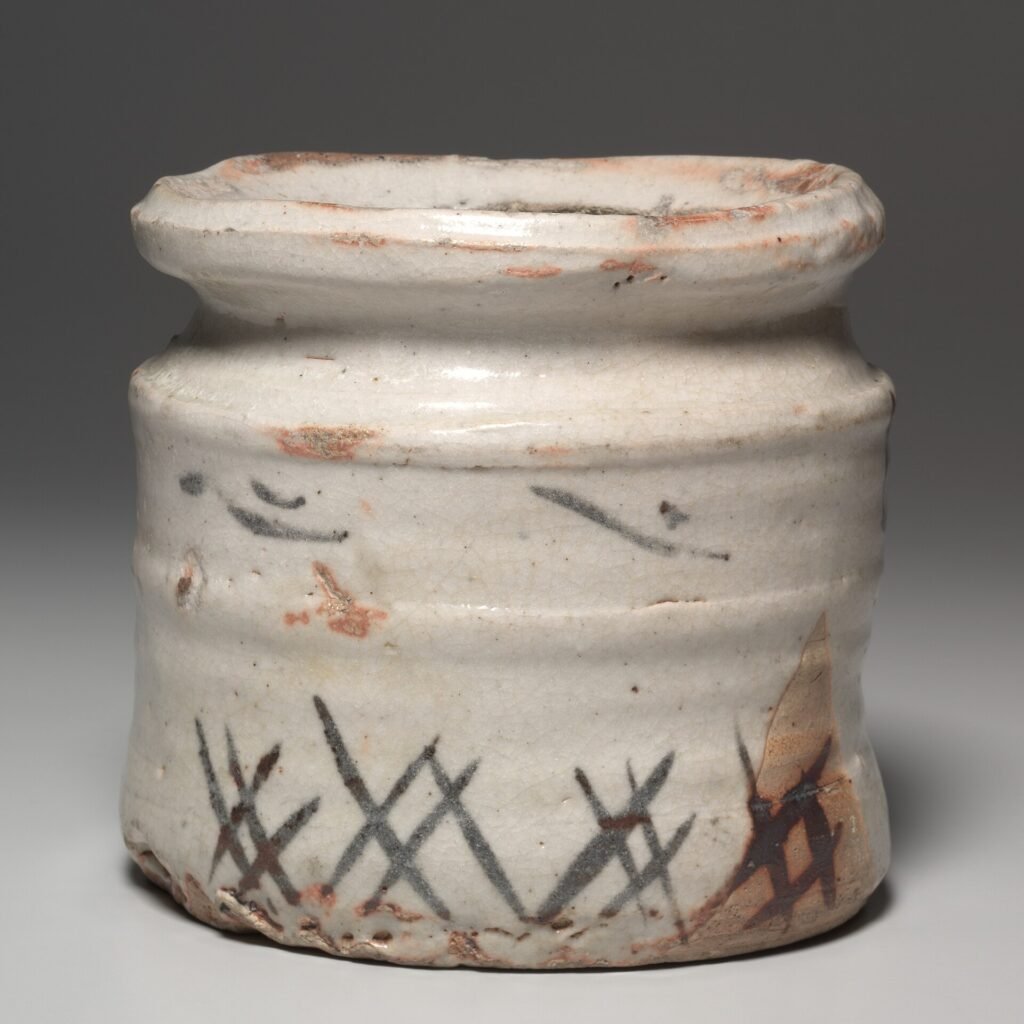
The fresh-water jar of the Japanese tea ceremony. Chinese and Korean pots were often adopted for the role and given lacquered lids and fitted boxes; a Korean jar described as a mizusashi has a Japanese tea history behind it.
Monochrome
A ware whose decoration is its single-colour glaze: celadon, imperial yellow, sacrificial blue, copper red, tea dust, clair de lune and the rest. Quality is judged by colour, evenness, the glaze’s stop at the foot and the potting beneath. See the ware page.
Moon jar dalhangari 달항아리
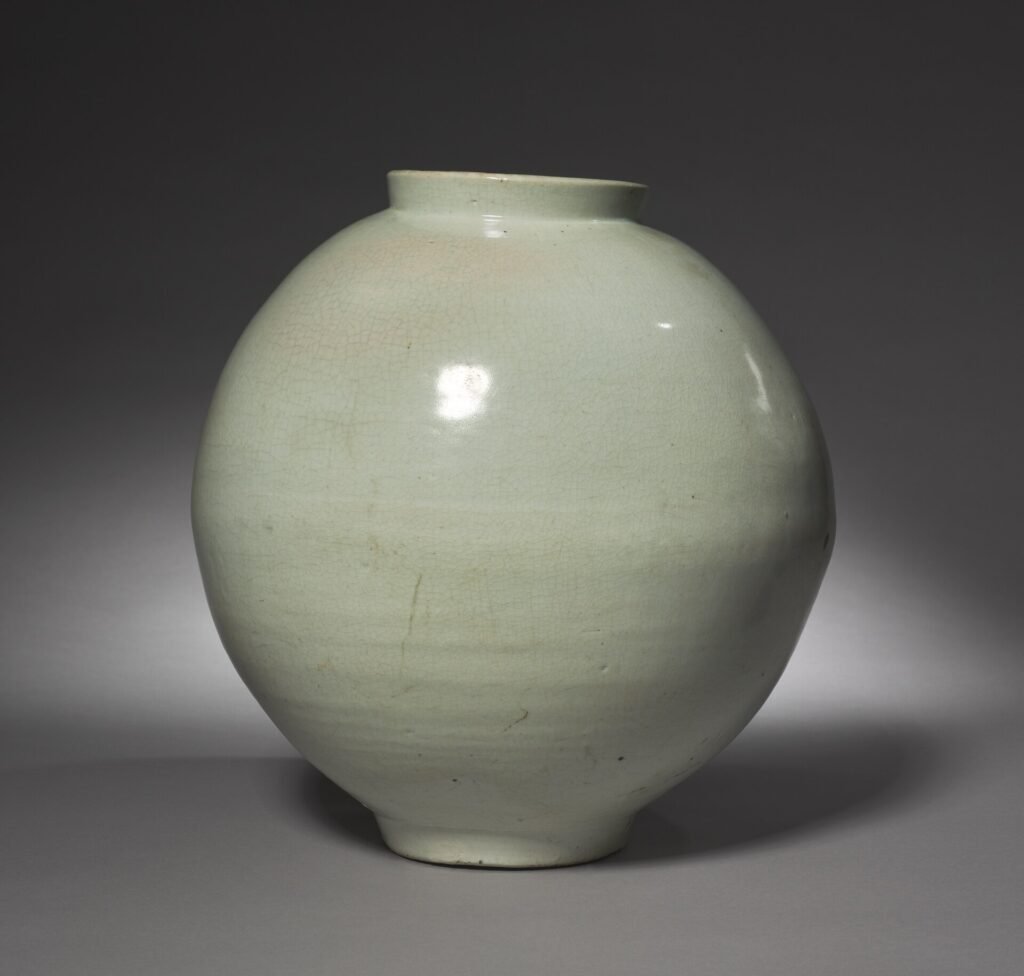
A large, plain white porcelain jar of the Joseon dynasty, made from the late seventeenth century and fashionable in the eighteenth, whose full shape and slight asymmetry come from throwing it as two hemispheres and joining them at the waist. See the moon jar and its join.
Muffle kiln
A small kiln in which the wares are shielded from direct flame, used for the low-temperature second firing that fixes overglaze enamels and gilding.
N
Nabeshima
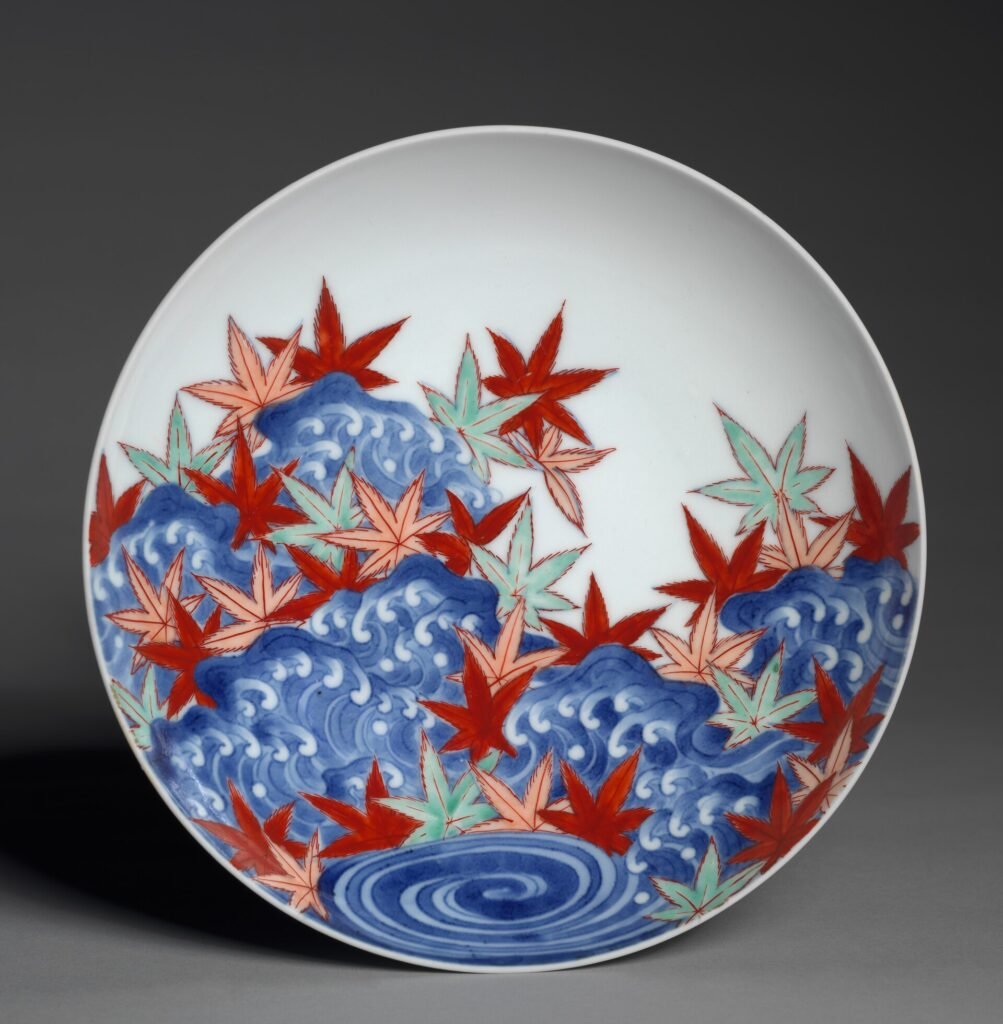
Porcelain made at the Okawachi kilns near Arita for the Nabeshima lords of Saga from the seventeenth to nineteenth centuries, for presentation rather than sale: precise designs in underglaze blue and enamels, a tall foot with a “comb-tooth” pattern, and no export until the domain system ended.
Nianhao 年號, reign title
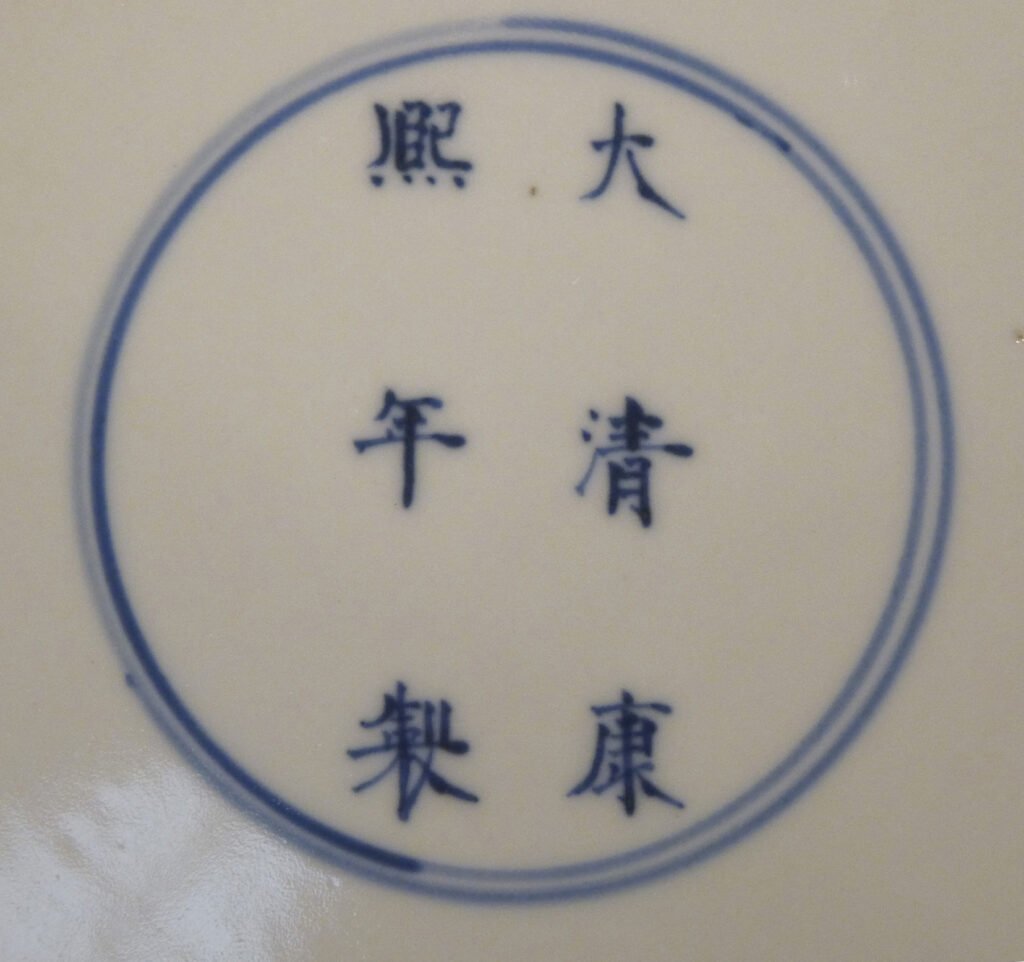
The name of an emperor’s reign, which is what a Chinese reign mark records. A six-character mark reads dynasty, reign name and “made in the years of”; a four-character mark drops the dynasty. See reign marks.
O
Overglaze
Decoration applied on top of the fired glaze and fixed in a second, lower firing: enamels and gilding. It sits proud of the surface and is vulnerable to wear. Compare underglaze.
Oxidation and reduction
The two kiln atmospheres. With plentiful oxygen (oxidation), iron fires yellow to brown and copper green; with oxygen starved (reduction), iron gives celadon green and copper gives red. The same glaze materials produce different colours depending on how the kiln was fired, which is why a “copper red” and a “copper green” can come from one recipe.
P
Petuntse baidunzi 白墩子, porcelain stone
Crushed feldspathic rock, the fusible half of the Jingdezhen porcelain body; kaolin is the refractory half. The name is an eighteenth-century French rendering of the Chinese.
Pooling
Glaze gathering more thickly in recesses, at the base of a neck or inside a foot, where it fires darker or more opaque. Pooling is normal and is one of the ways a glaze reveals how it was applied and fired.
Powder blue chuiqing 吹青
A cobalt ground applied by blowing dry pigment through a gauze-covered tube onto the raw body, giving a mottled, speckled blue under the glaze. Associated with the Kangxi reign, often with reserved panels decorated in famille verte or gilt.
Provenance
The recorded history of ownership of a piece: collections, sales, exhibitions and publications. Good provenance supports authenticity and adds value; it is documented, not asserted. Where a piece on this site has a provenance record it is stated in the Catalogue table. See published and exhibited.
Q
Qingbai 青白, “bluish white”; yingqing
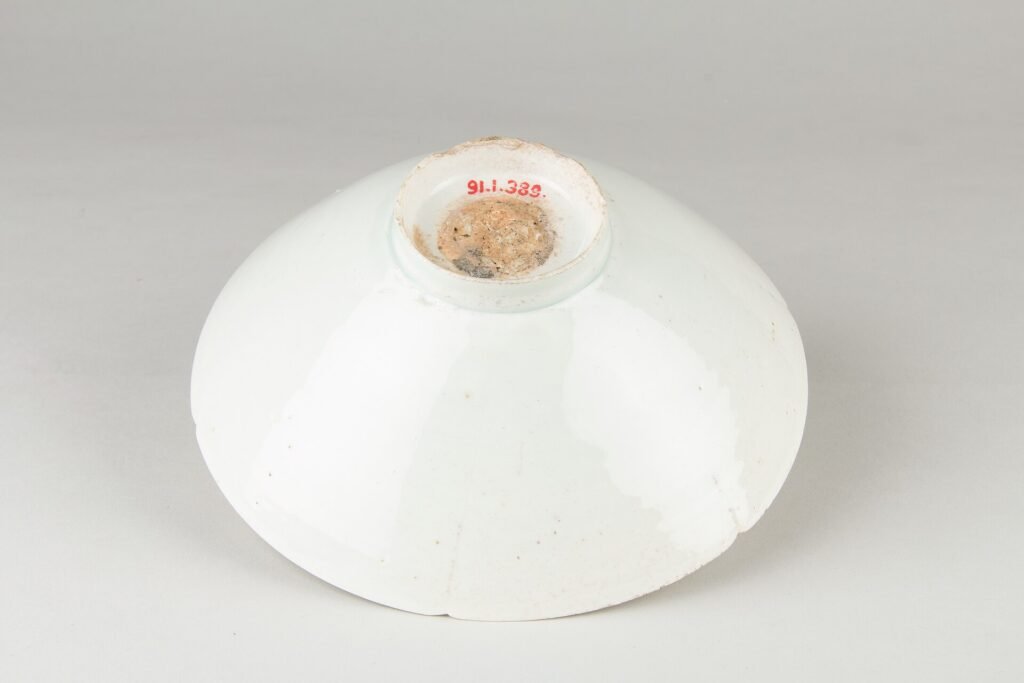
The thin, translucent Song and Yuan porcelain of Jingdezhen with a pale blue-tinged glaze that pools blue in carved decoration. The ancestor of Jingdezhen’s later white and blue and white porcelain.
R
Reign marks and reign dates
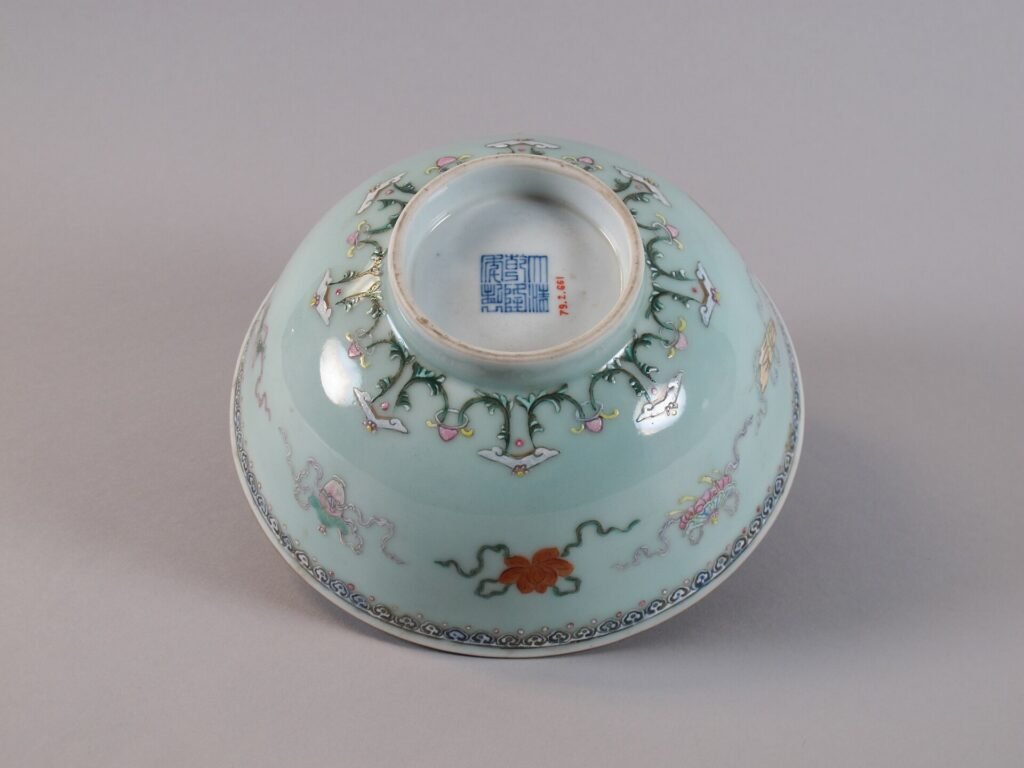
The marks most often met on Chinese porcelain, with the reigns they name. Ming: Yongle 1403–24, Xuande 1426–35, Chenghua 1465–87, Hongzhi 1488–1505, Zhengde 1506–21, Jiajing 1522–66, Wanli 1573–1620, Chongzhen 1628–44. Qing: Kangxi 1662–1722, Yongzheng 1723–35, Qianlong 1736–95, Jiaqing 1796–1820, Daoguang 1821–50, Xianfeng 1851–61, Tongzhi 1862–74, Guangxu 1875–1908, Xuantong 1909–11. A mark is a claim to be tested, not a date: see the reign marks guide.
Republic period 1912–49
The years between the fall of the Qing and the founding of the People’s Republic. Jingdezhen continued to make fine porcelain, some of it with Qianlong or Guangxu marks and some with Hongxian marks from Yuan Shikai’s brief imperial restoration of 1916. See Republic period porcelain.
Restoration
Any later intervention that replaces or conceals lost material: filled chips, over-painted cracks, replaced necks, re-fired enamels. Restoration is legitimate when disclosed. Where we find it, it is described in the Catalogue table and photographed.
Rivet repair staple repair
The historic method of mending a broken pot by drilling pairs of holes across the break and drawing them together with metal staples. Common on eighteenth- and nineteenth-century pieces that were valued enough to mend. A riveted piece is honestly damaged and is priced as such.
Ru ware 汝窯
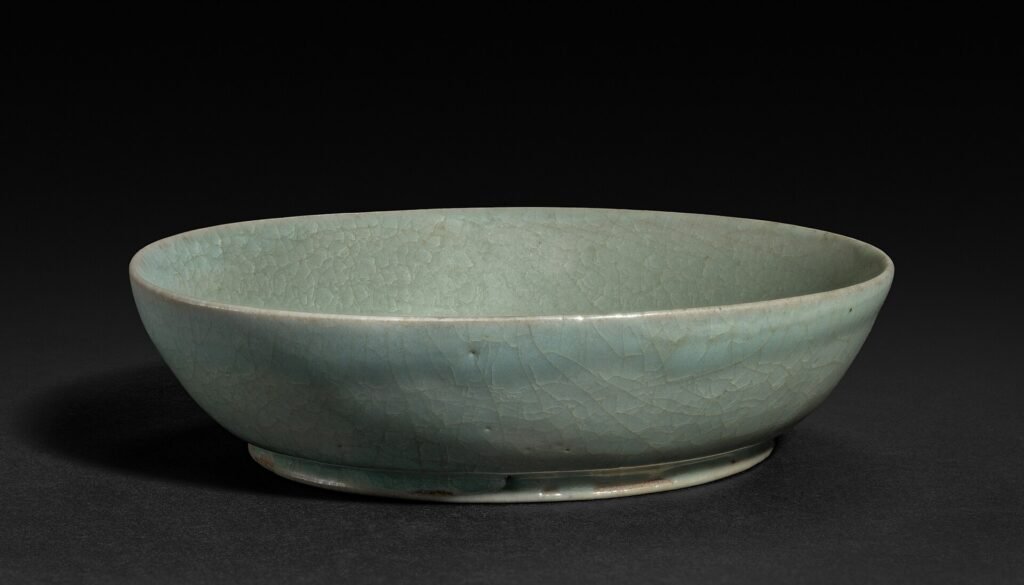
The rarest of the classic Song wares, made for the Northern Song court for a few decades around 1100 at Qingliangsi in Henan: a buff body under a thick blue-green glaze with fine crackle, fired on small spurs that leave tiny oval marks on the base. Fewer than a hundred pieces are generally accepted, almost all in museums.
S
Sancai 三彩, “three colours”
Lead glazes in amber, green and cream (with blue on the finest pieces) running together over an earthenware body, best known from Tang dynasty tomb figures and vessels. Later “Ming sancai” and “Liao sancai” use the same glazes on different bodies and forms.
Sanggam 상감, inlay
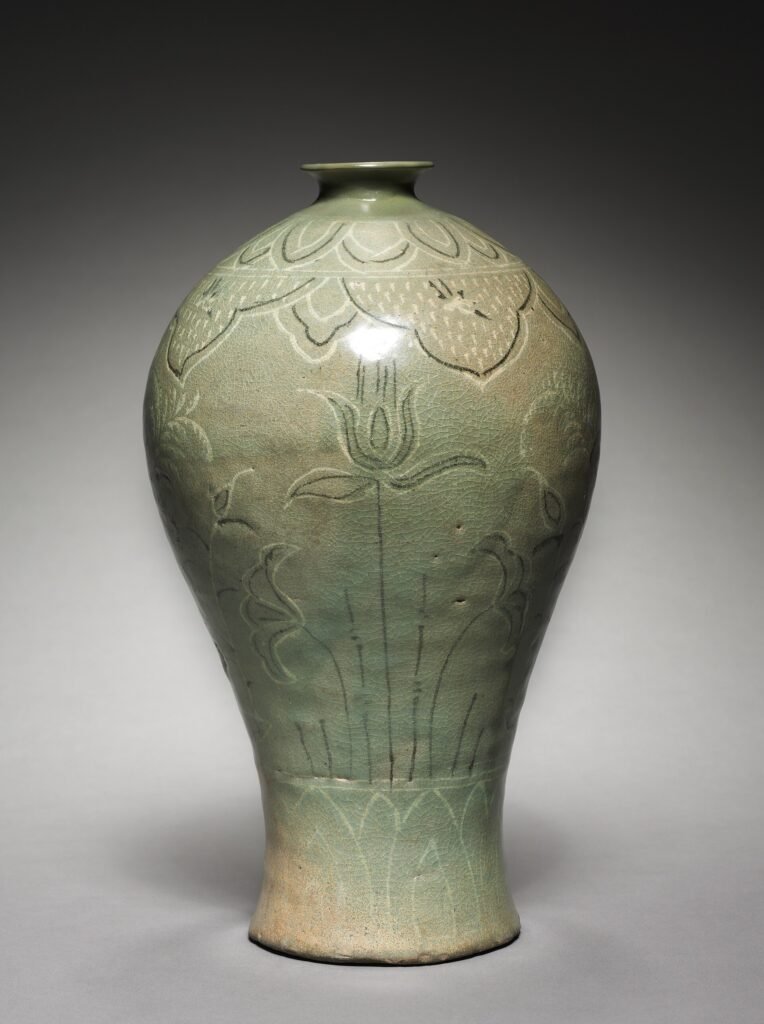
The Goryeo technique of incising a design into the clay and filling it with white and black slip before glazing, so that the decoration sits level with the surface under the celadon glaze. The most distinctive Korean contribution to ceramic decoration.
Satsuma
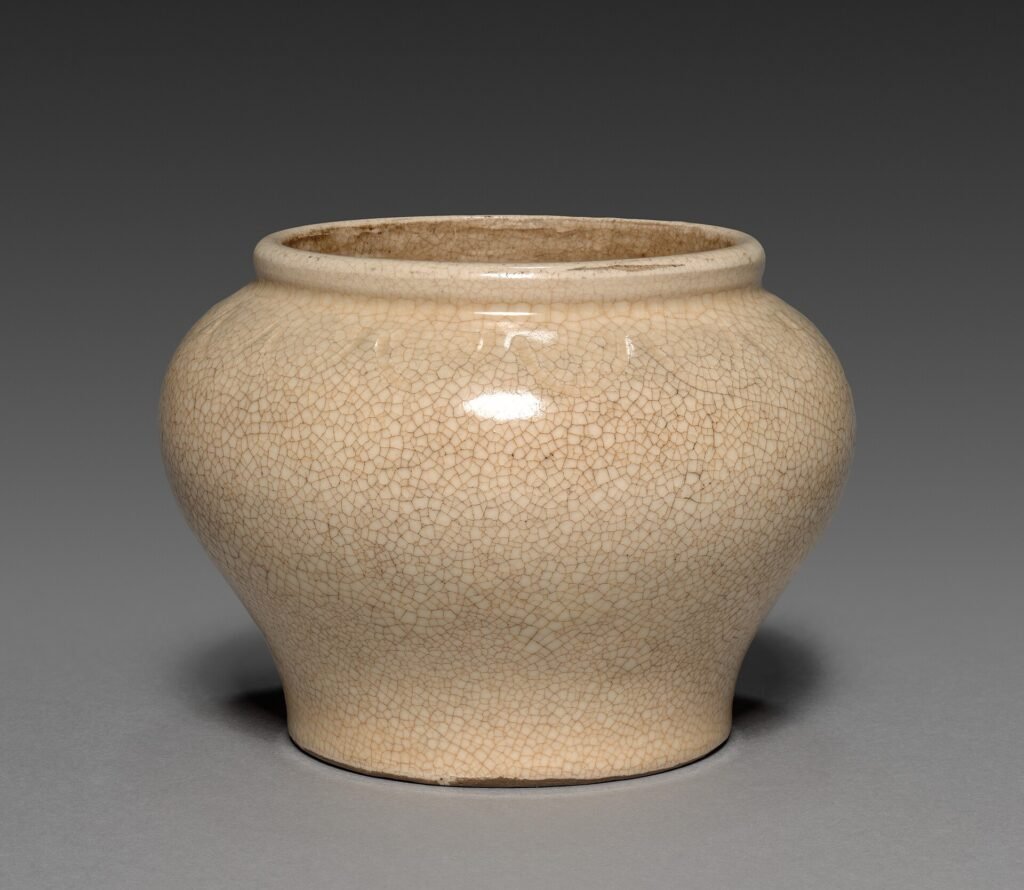
Japanese ceramics associated with the Satsuma domain in southern Kyushu: a low-fired, opaque, cream-coloured body under a finely crackled glaze, decorated with polychrome enamels and gilding. Catalogued variously as earthenware or stoneware, and never porcelain. The elaborately decorated export wares of the Meiji period were largely produced and decorated in Kyoto, Kobe and Yokohama as well as Kagoshima. See the ware page and why Satsuma is earthenware.
Seal on works on paper
The red impressions of carved stone or ivory seals on a painting or calligraphy: the artist’s own, and those of later owners and collectors. Seals are part of a work’s provenance and are read alongside the signature, not as a substitute for it.
Seal mark zhuanshu 篆書
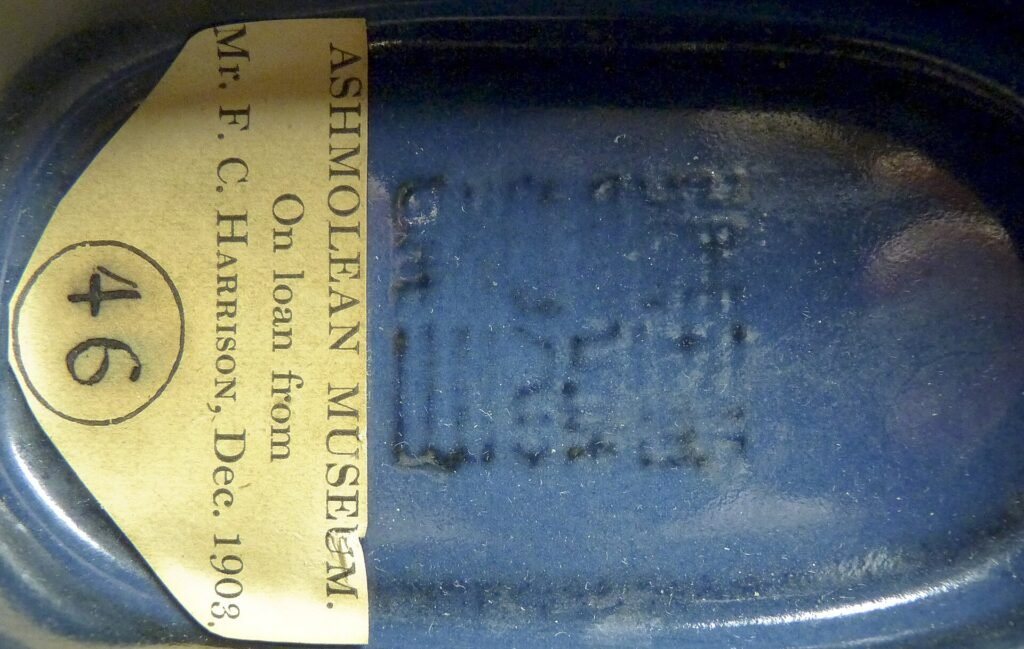
A reign mark written in archaic seal script, squared and formal, as against regular script (kaishu). Seal-script marks are standard on Qianlong porcelain and common on Jiaqing and Daoguang; regular-script marks dominate the Kangxi and Yongzheng reigns and return under Guangxu. See reign marks.
Sgraffito
Decoration made by scratching or carving through a layer of slip to expose the contrasting body beneath, as on Cizhou and buncheong wares.
Shipwreck cargo
Porcelain recovered from a documented wreck and sold with that history: the Hoi An cargo of Vietnamese wares (late fifteenth century), the Hatcher cargo of Transitional porcelain (c. 1643), the Vung Tau cargo (c. 1690), the Geldermalsen or “Nanking Cargo” (1752) and the Tek Sing (1822) are the best known. Sea-water and coral leave characteristic surfaces. See shipwreck cargo porcelain.
Spur marks
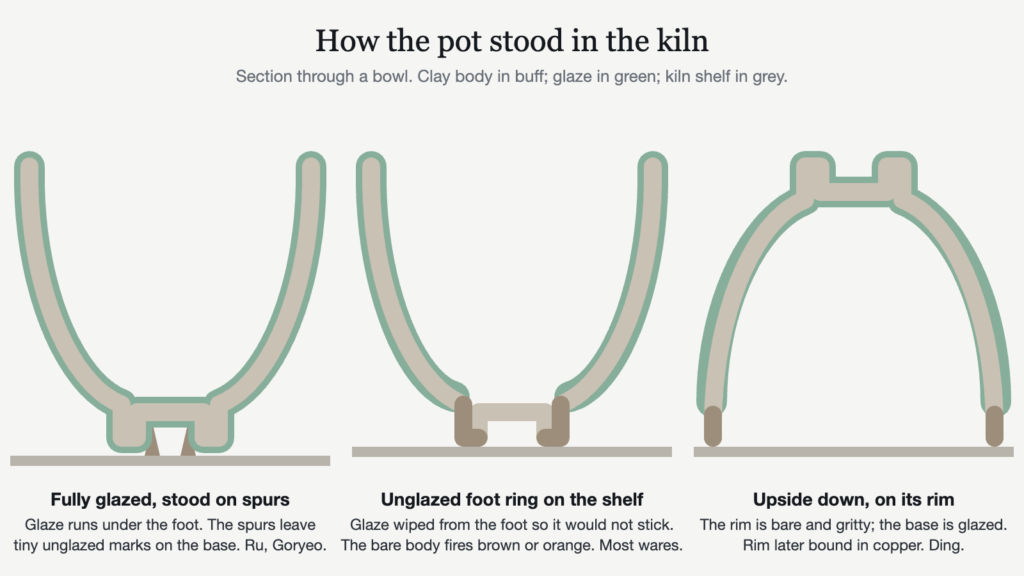
Small unglazed scars on a base or foot where the piece rested on pointed kiln supports. Their number, shape and placing are characteristic of particular kilns (Ru, Guan, Korean court wares) and are one of the base’s most reliable clues.
Star crack
A crack radiating from a single point of impact, usually on a base or the centre of a dish. Structurally more serious than a single hairline because it has several arms; it should always be disclosed and priced.
Stoneware, earthenware and porcelain
The three broad classes of ceramic body, distinguished by firing temperature and result. Earthenware is fired low, remains porous and must be glazed to hold liquid. Stoneware is fired higher, until the body vitrifies and becomes watertight. Porcelain is fired higher still from a kaolin-and-petuntse body and is white, fully vitrified and translucent where thin. The boundaries are gradual, and museum cataloguing of borderline bodies such as Satsuma varies.
Swatow Zhangzhou ware
Coarse, vigorous export porcelain and stoneware made at kilns around Zhangzhou in Fujian in the late Ming, for South-East Asian and Japanese markets: large dishes in blue and white, overglaze enamels or slip, with kiln grit fused to the foot. The old trade name comes from the port of Shantou.
T
Tea dust chaye mo 茶葉末
A speckled olive-green to brown iron glaze whose surface has crystallised on cooling, giving it the look of powdered tea. A Qing monochrome, especially of the Yongzheng and Qianlong reigns, often on archaistic bronze forms.
Tenmoku 天目
The Japanese name, from the Tianmu mountains in Zhejiang, for the black-glazed tea bowls of Song Jian ware and for Japanese bowls made in their manner.
Tobi seiji 飛青磁, “spotted celadon”
Longquan celadon with deliberate spots of iron-brown applied under the glaze, made in the Yuan dynasty and prized in Japan, where the name originates.
Tomobako 共箱
The fitted wooden box that accompanies a Japanese work of art, or a Chinese or Korean piece that has passed through Japanese hands, often inscribed by the maker, a previous owner or a tea master with the object’s name and history. An inscribed tomobako is part of the provenance and is kept with the piece.
Transitional period c. 1620–1683
The decades between the death of the Wanli emperor and the re-establishment of imperial control at Jingdezhen under Kangxi, when the kilns worked for merchants and export rather than the court and produced blue and white of unusual freedom, with landscape, narrative and scholar subjects. See the Ming collection.
U
Underglaze
Decoration painted on the raw body and sealed beneath the glaze in a single high firing: cobalt blue, copper red and iron brown. Underglaze decoration cannot wear off and cannot have been added later without re-firing the whole piece. Compare overglaze.
Ultraviolet examination
Inspection under long-wave ultraviolet light, under which modern fillers, adhesives and over-paint fluoresce differently from an original glaze. Standard practice in condition reporting. It does not detect everything, so it is used with a lens and a fingernail, not instead of them; ask before buying if you want a piece checked this way.
W
Wucai 五彩, “five colours”
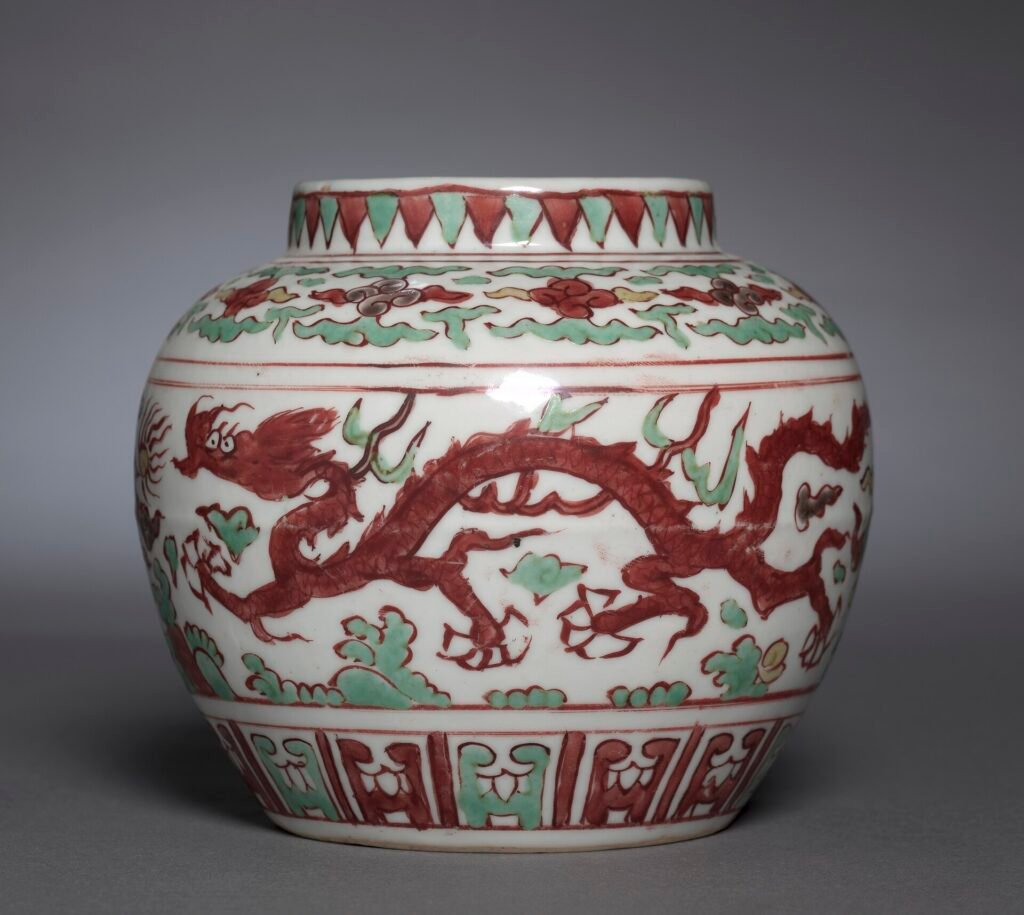
Overglaze enamels in red, green, yellow, aubergine and black combined with underglaze cobalt blue used as a colour in its own right, characteristic of the Jiajing and Wanli reigns. Kangxi wucai, with its overglaze rather than underglaze blue, is what the West calls famille verte.
Y
Yaozhou ware
The olive-green celadon of Shaanxi province, at its height in the Northern Song, with crisply carved or moulded decoration that the glaze pools into and emphasises. The northern counterpart of Longquan.
Yixing zisha 紫砂
Unglazed, fine-grained purple-brown stoneware from Yixing in Jiangsu province, used from the Ming for teapots and scholar’s objects and prized for the way it takes on the character of the tea brewed in it. Often signed by the potter with an impressed seal.
Yue ware
The earliest important celadon, made in northern Zhejiang from the Han dynasty to the Northern Song, with an olive to grey-green glaze over a grey stoneware body. The “secret colour” (mise) wares found at Famen Temple are its finest expression.
Z
Zhangzhou
The Fujian kiln region behind the export wares long known in the trade as Swatow. See that entry.