Nobody in the trade wants to write this page, which is precisely why it is worth writing. Condition is where most of the money is made and lost in Asian ceramics, and it is the thing least honestly described in online listings.
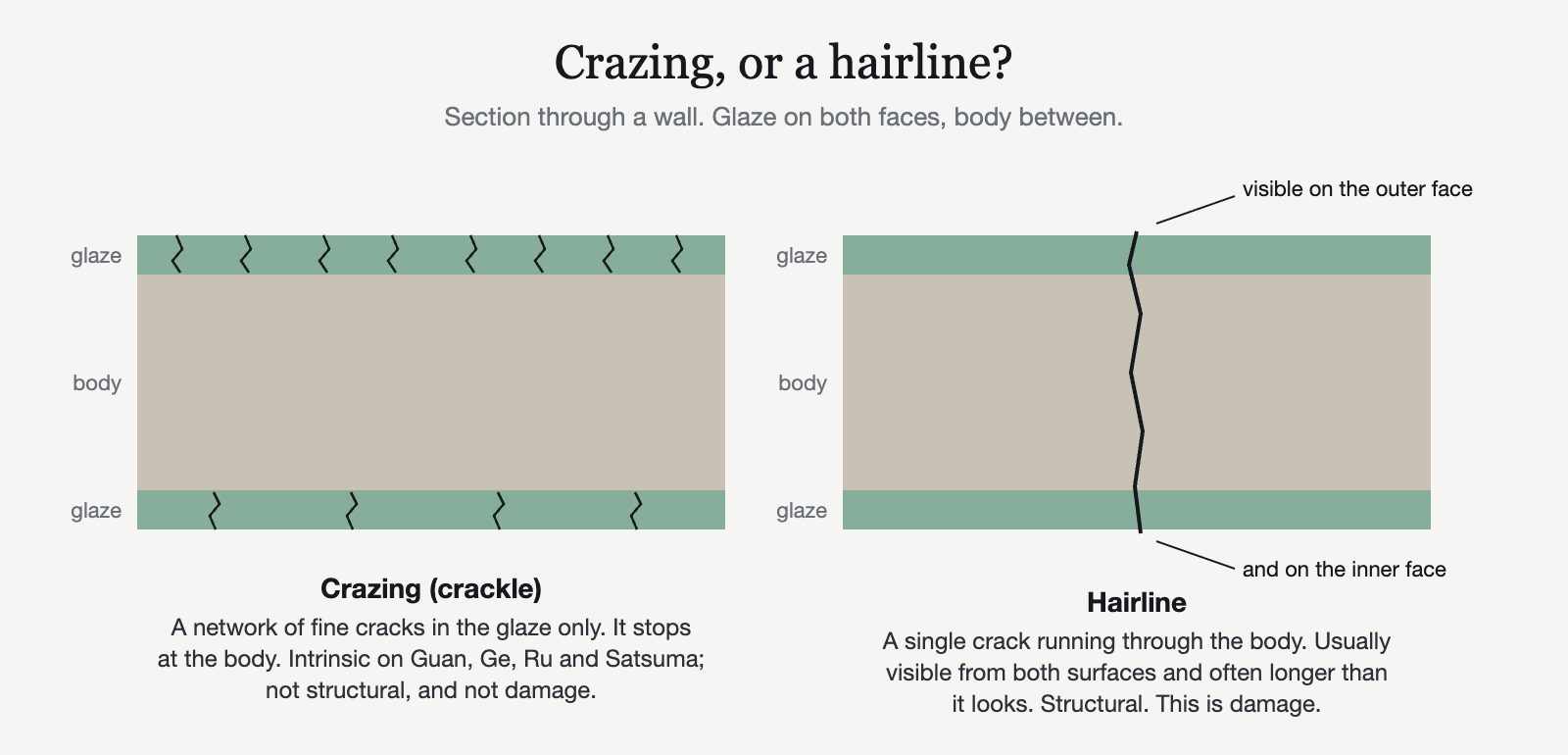
We are going to be careful about what follows. There is no museum-published table of what damage does to price — museums catalogue condition, they do not value it. So the sourced material below is about what the faults are and which are intrinsic; the commercial judgement is labelled as our judgement. And because a photograph of a crack tells you very little without knowing how deep it goes, the key distinctions are drawn in section rather than photographed.
First: is it damage at all?
The most expensive condition mistake we see is not a buyer overlooking a fault. It is a buyer discounting a feature.
- Crackle on Guan ware is deliberate. The Metropolitan Museum states of one of its dishes that the cracks were “made to resemble the accidental cracks that sometimes occurred during the firing of ceramics” and are intentional.
- Ge ware is defined by its crackle. The Palace Museum in Beijing describes the “gold thread and iron wire” network — what the trade reads as a two-tone crazing of varying size and depth — as the ware’s characteristic feature.
- Ru ware has a fine “broken-ice” crackle as standard, per the Palace Museum.
- Satsuma’s crackled cream glaze is intrinsic — the V&A catalogues it as “crackled cream glaze” in its materials and techniques field. Crazing on a Satsuma bowl is not a fault.
- Qing celadons are glossy with tiny bubbles, per the British Museum. Bubbles are not flaws.
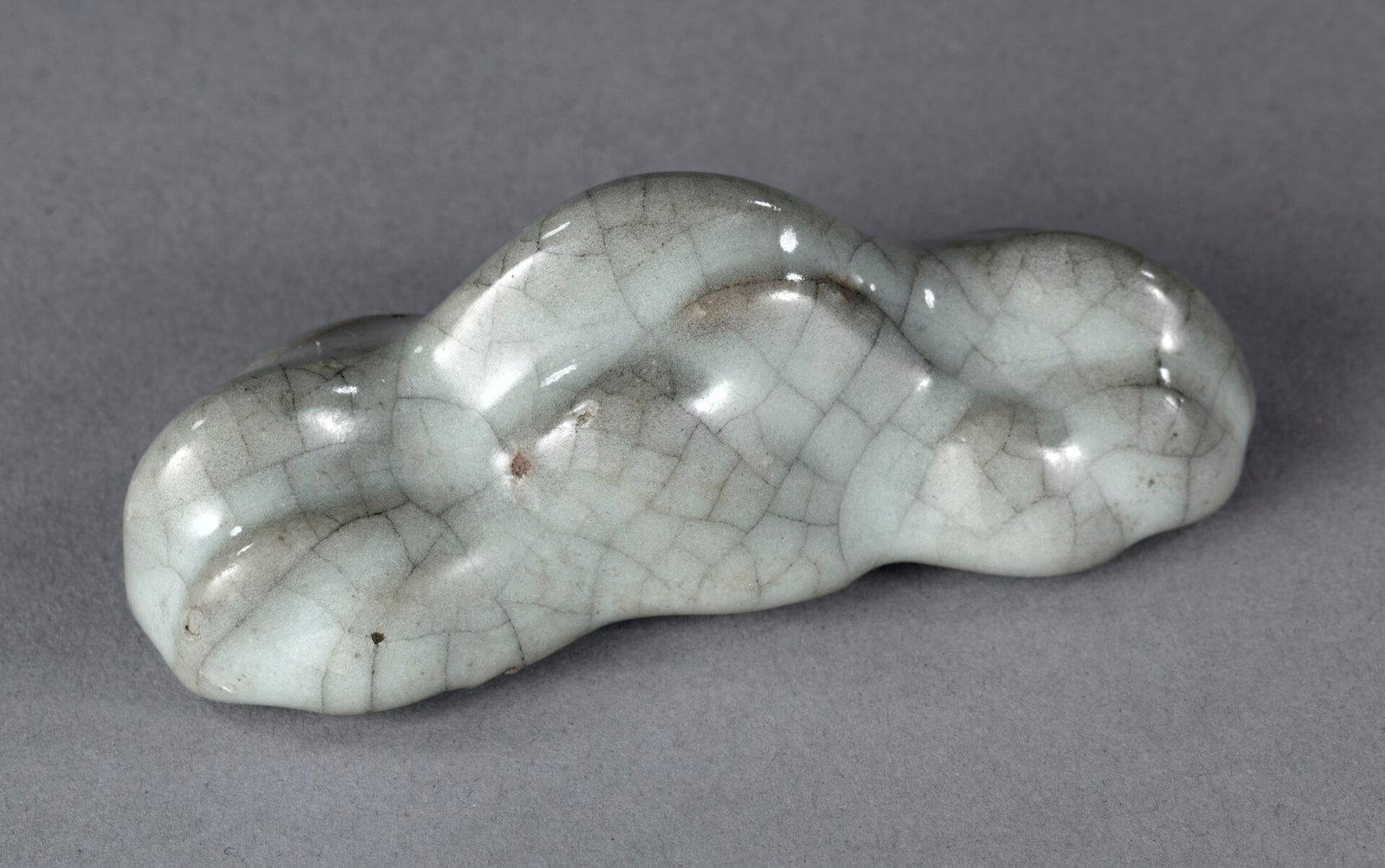
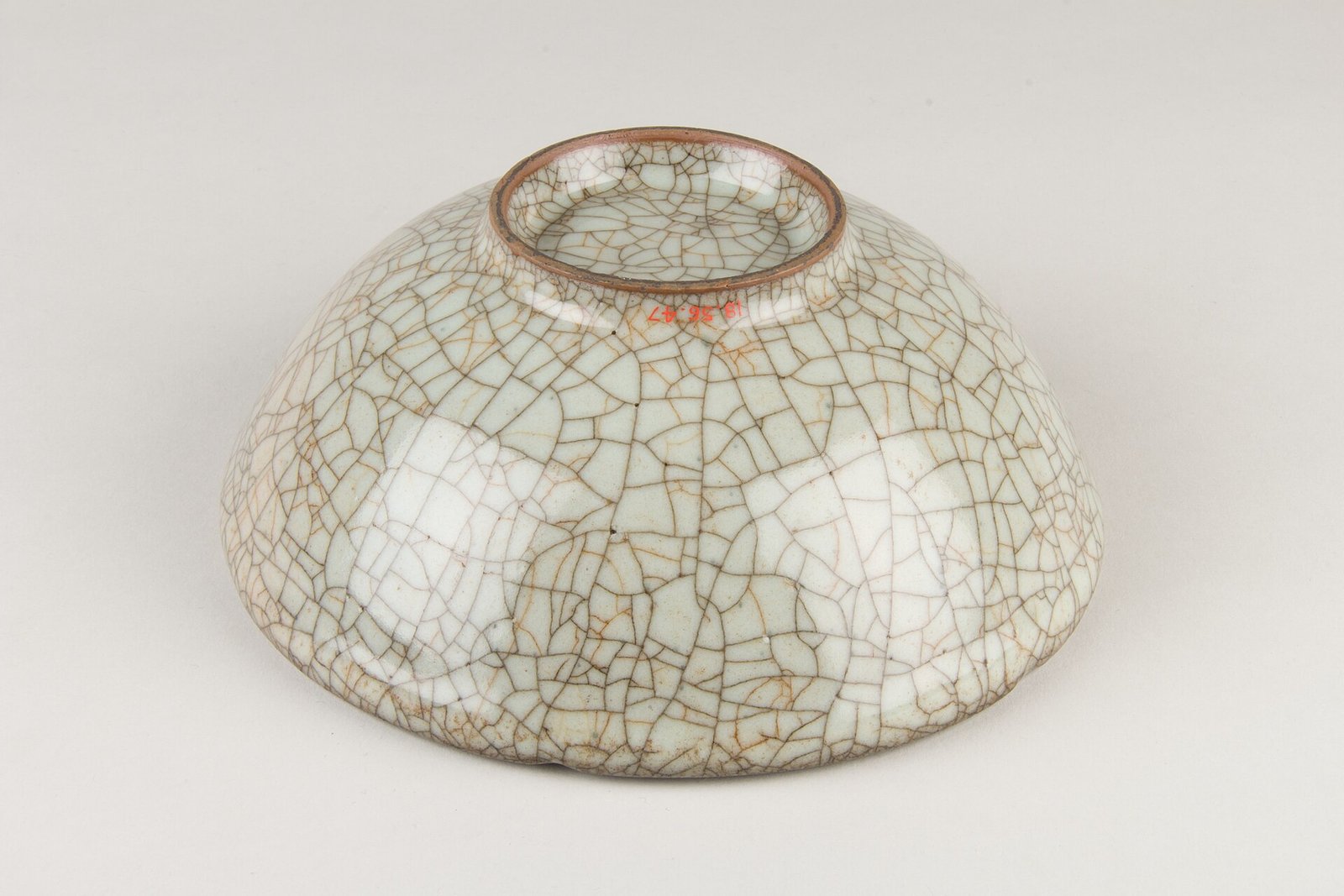
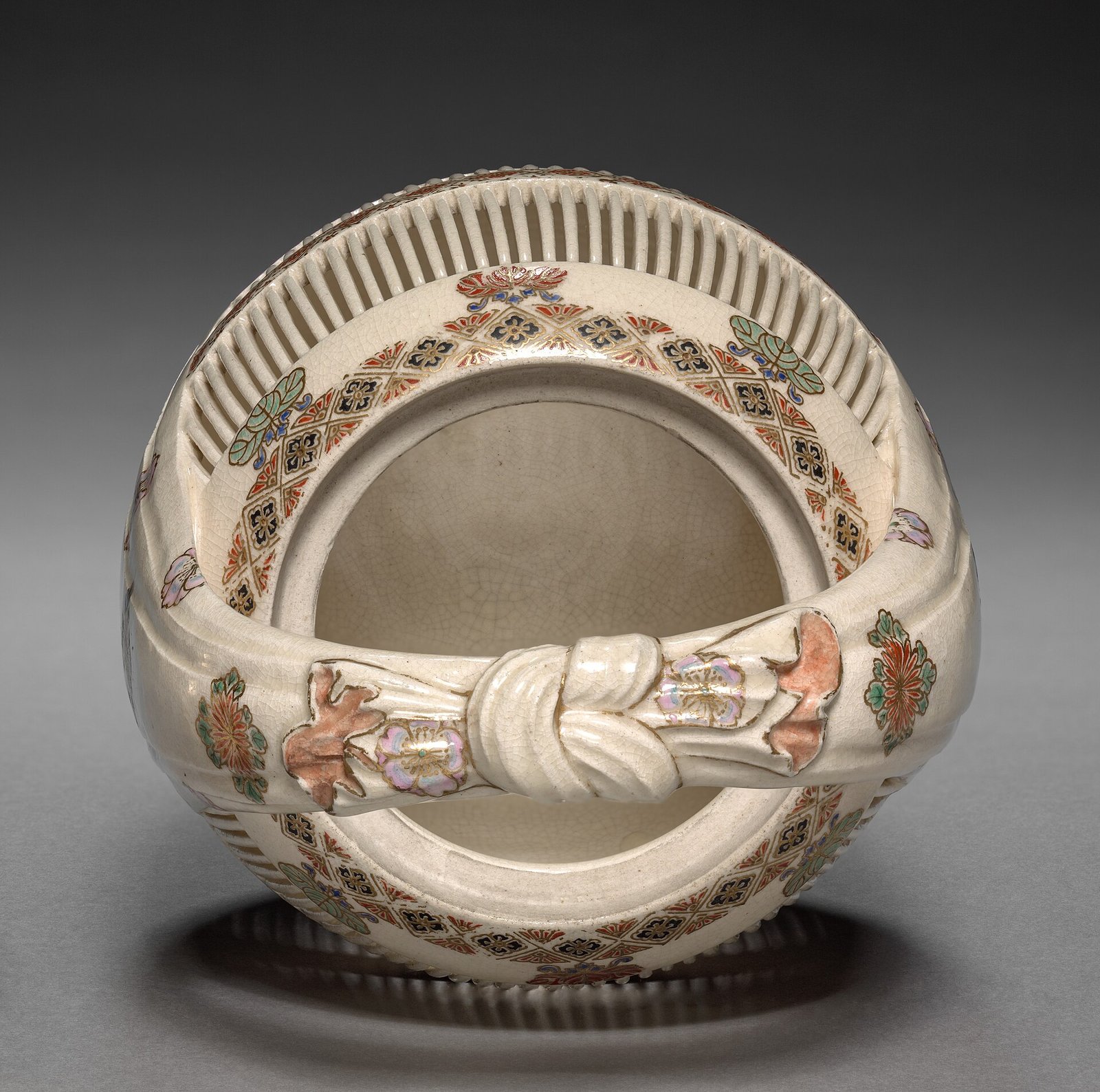
So the first question is never “is it cracked?” but “is this crackle in the glaze, or is this a crack through the body?” Glaze crazing stops at the glaze. A hairline goes through, and is usually visible on the other face.
The vocabulary, used precisely
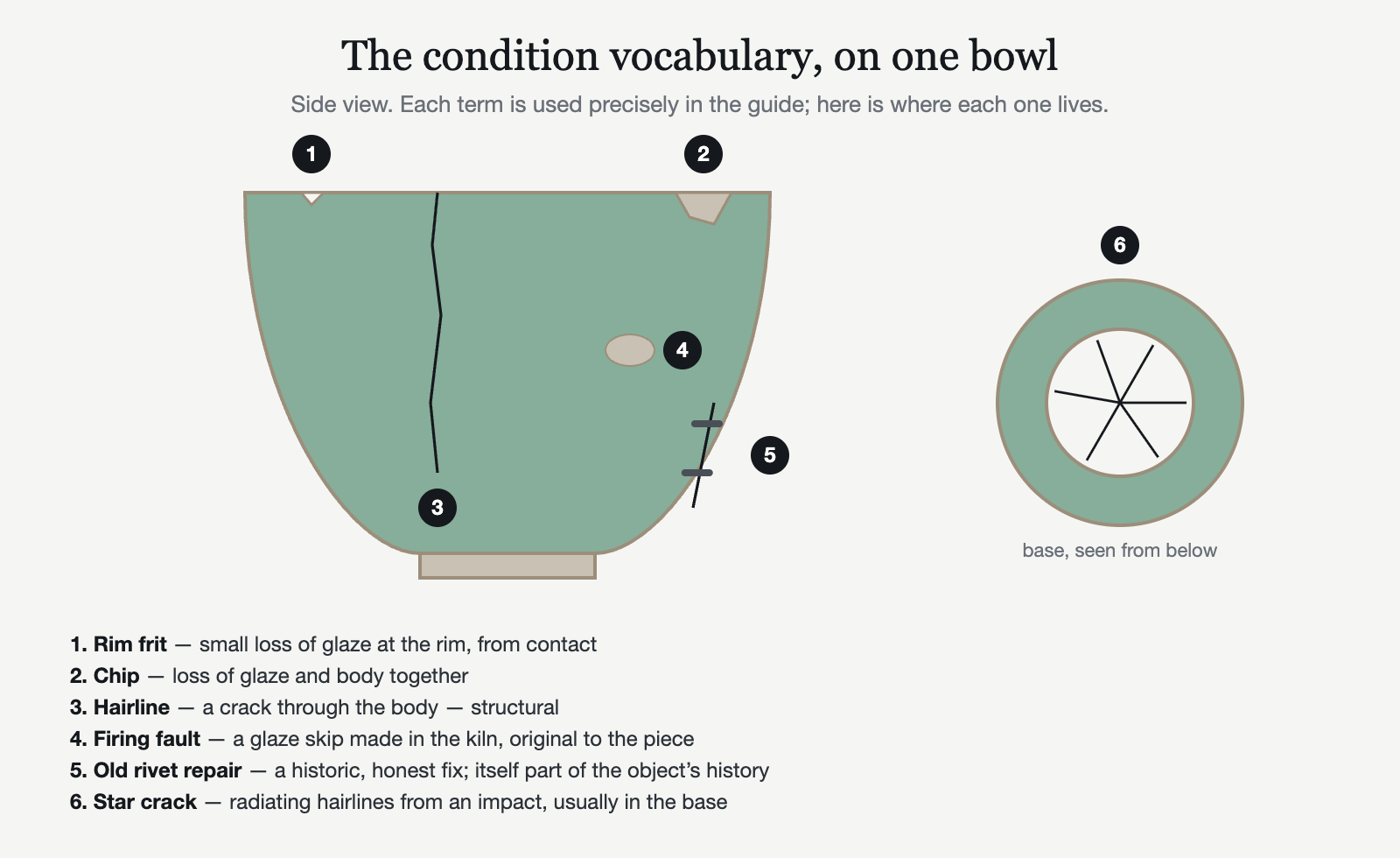
| Term | What it means |
|---|---|
| Crazing / crackle | A network of fine cracks in the glaze only. Intrinsic on several wares (above); age-related on others. Does not compromise structure. |
| Hairline | A single fine crack running through the body. Usually visible from both surfaces, catches light differently, and often extends further than it appears. Structural. |
| Star crack | Radiating hairlines from an impact point, usually in the base of a bowl or dish. Structural, and typically worse than it looks. |
| Frit / nibble | Small losses to the glaze at a rim or foot edge, from contact rather than impact. Very common on genuinely old pieces. |
| Chip | Loss of both glaze and body. |
| Firing fault | A flaw created in the kiln, not in use — a glaze skip, a kiln-grit adhesion, a firing crack sealed by glaze. Original to the object and a different matter from later damage. |
| Restoration | Any later intervention: fills, overpaint, replaced sections, rivets. Old rivet repairs are themselves collectable evidence of an object’s history. |
The distinction that matters most commercially is the last row but one. A firing fault is original to the object. A piece that left the kiln with a glaze skip has been that way for three hundred years, and on Song and Ming wares such faults are routine and largely discounted by the market. Later damage is a different conversation entirely.
And a word for the rivets. Before modern adhesives, a broken piece worth keeping was drilled and stapled with metal rivets. It is an honest, visible, historic repair — it tells you the object was valued enough to mend — and a good early riveted piece is collected as such. It is not the same thing as undisclosed modern restoration, and should never be described as if it were.
What we can honestly say about value
Labelled clearly: this section is dealer judgement, not museum fact. We are setting out how we price, so you can argue with it.
- Rarity insulates against condition, and it is not linear. With fewer than a hundred Ru pieces known worldwide, condition is not what determines whether a Ru object is significant. At the other end, a common late Qing bowl with a hairline is difficult to sell at any price, because a perfect one is available.
- Damage to the decorated surface costs more than damage to the foot. A chip under a foot rim that nobody will ever see is not the same as a frit through a painted panel.
- Structural faults are re-priced, not discounted. A hairline in a vase that will be displayed is a different object from a sound one, not a cheaper version of the same one.
- Undisclosed restoration is the real problem. Not because restoration is wrong — much of it is skilled and stabilising — but because a buyer who discovers it later loses trust in everything else in the description.
What we will not give you is a percentage table. “A hairline takes 30% off” is the kind of number that circulates because it sounds authoritative, and we have never seen it substantiated.
How to inspect, and what to ask for
Raking light across the surface at a shallow angle will show a hairline that flat light hides. Transmitted light — holding a thin piece against a lamp — shows cracks and fills as dark lines. Ultraviolet shows many modern restoration materials fluorescing differently from the original glaze; conservators use it as a first pass, and in our experience it catches most of what is out there, though it is not infallible and a determined restorer can defeat it. And sound: a light tap on a sound porcelain bowl rings; a cracked one thuds. Do this on your own pieces to learn the difference before you rely on it.
From a seller, ask for the fault photographed as a fault — lit to show it, not lit to hide it — plus the full base and the rim. If a listing has no condition statement at all, that is itself the condition statement. Our guide to reading the base shows what the underside should look like when it is photographed properly.
How we describe condition
Every piece in our catalogue carries a structured condition record rather than a sentence buried mid-paragraph: a grade, a summary, an itemised list of faults, and a separate note on any restoration. Faults are photographed deliberately. Where a piece has a hairline, the listing says hairline, in the first screen, not the fourth.
We do this because it is what we would want as a buyer, and because none of the dealers we compete with publishes structured condition data. If a condition report is missing from a listing you are interested in, ask — see our authenticity guarantee for what we stand behind.
Sources
- The Metropolitan Museum of Art, Guan ware dish 24.172.1
- The Palace Museum, Beijing, on Ge ware
- The Palace Museum, Beijing, on Ru ware
- V&A, Satsuma jar C.57-1969
- British Museum, Room 95 Chinese ceramics gallery guide
- Suzanne G. Valenstein, A Handbook of Chinese Ceramics, The Metropolitan Museum of Art
Written by James Treacher. The technical sections are museum-sourced; the valuation section is explicitly our own commercial judgement, because no institution publishes one. The diagrams are ours.