Almost every online listing photographs the front of the pot. The front is the least informative surface on it.
Turn a piece over and you are looking at the part the potter could not disguise: how it was supported in the kiln, how the glaze was stopped, what the body actually looks like where it is not covered up, and how the object has been handled for two or three hundred years. Marks lie. Feet are much harder to fake and much harder to misread.
This is a guide to what the underside tells you, using features documented by museums and illustrated from their own base photographs — the Metropolitan Museum photographs the underside of much of its Chinese collection and releases the images into the public domain, which makes it possible to show you real feet rather than describe them.
1. How was it supported in the kiln?
This single question separates several major wares before you have looked at anything else. There are three basic arrangements:
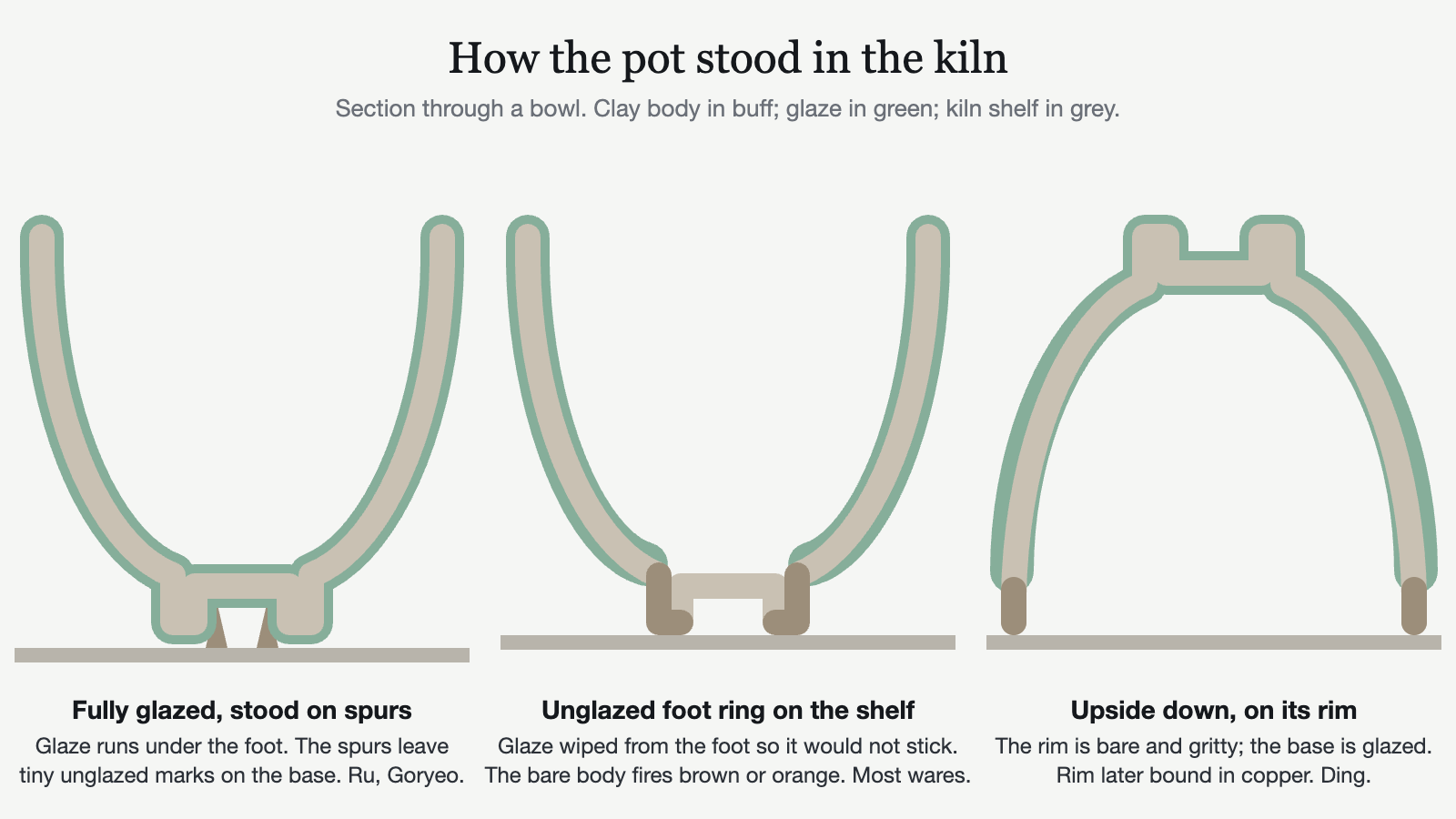
- Glazed all over, stood on spurs. The piece was fully glazed and rested on small supports, which leave tiny unglazed scars on the base. The British Museum describes Ru brush washers as fully glazed before firing on a support “which has left three tiny unglazed sesame seed-shaped marks on their bases”; its Ru bowl has five. Goryeo potters made close copies of Ru, and their spur-fired bases look the same. If the base is glazed and you can see spur scars, you are in a very short list of possibilities.
- Unglazed foot ring on the shelf. The commonest arrangement by far: the glaze was wiped or cut back from the foot so the piece would not stick. What matters then is what colour the exposed body fired — section 2.
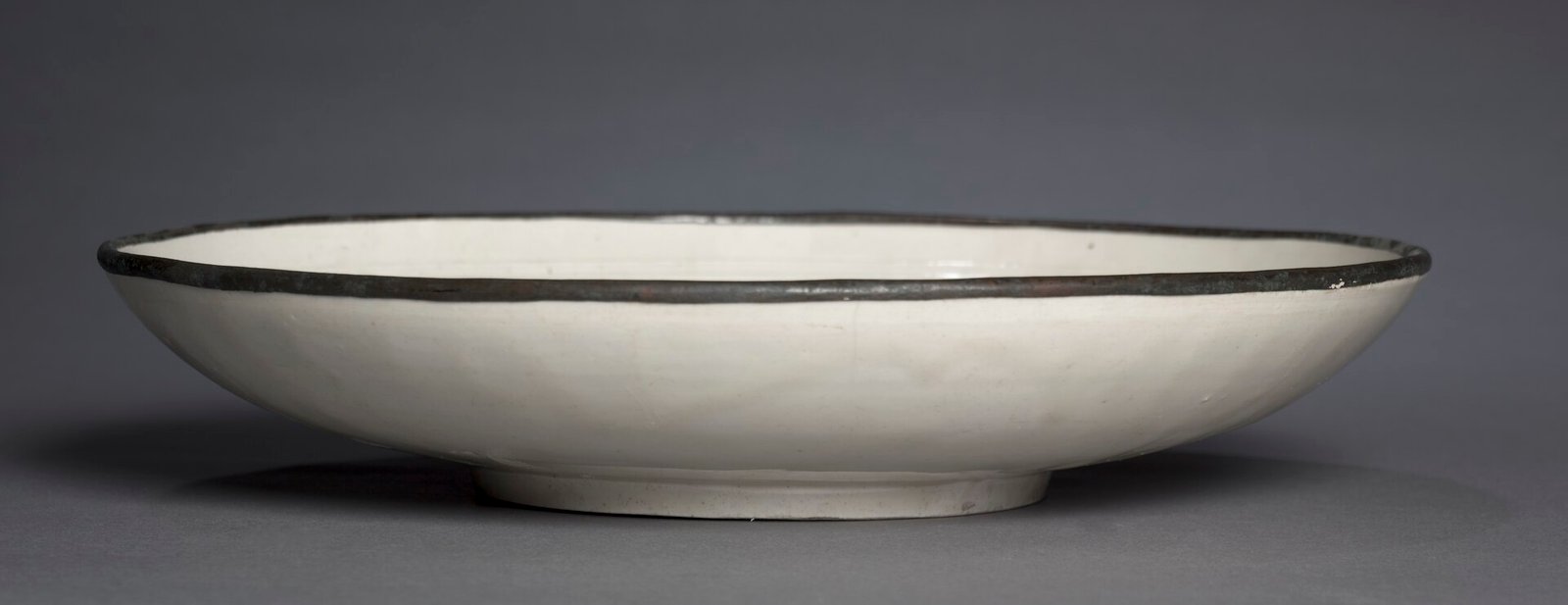
- Upside down, on the rim. The piece was fired on its mouth, so the rim is bare and the base is glazed. This is Ding from the late eleventh century onward — earlier Ding stood on its foot — and it is also Southern Song Jingdezhen qingbai, which was fired the same way (Harvard 2010.458: “the mouth rim was left unglazed so that the dish could be fired upside down”); the body colour then separates the two. The British Museum records that craftsmen used sheet copper, cut and heated to fit, to cover the resulting rough rim; the Smithsonian confirms “rim unglazed with brass binding” and “no spur marks” on a Jin dish, F1944.15. Run a fingertip round the mouth — gritty rim with a metal band means rim-fired Ding or qingbai.
2. What colour did the body fire?
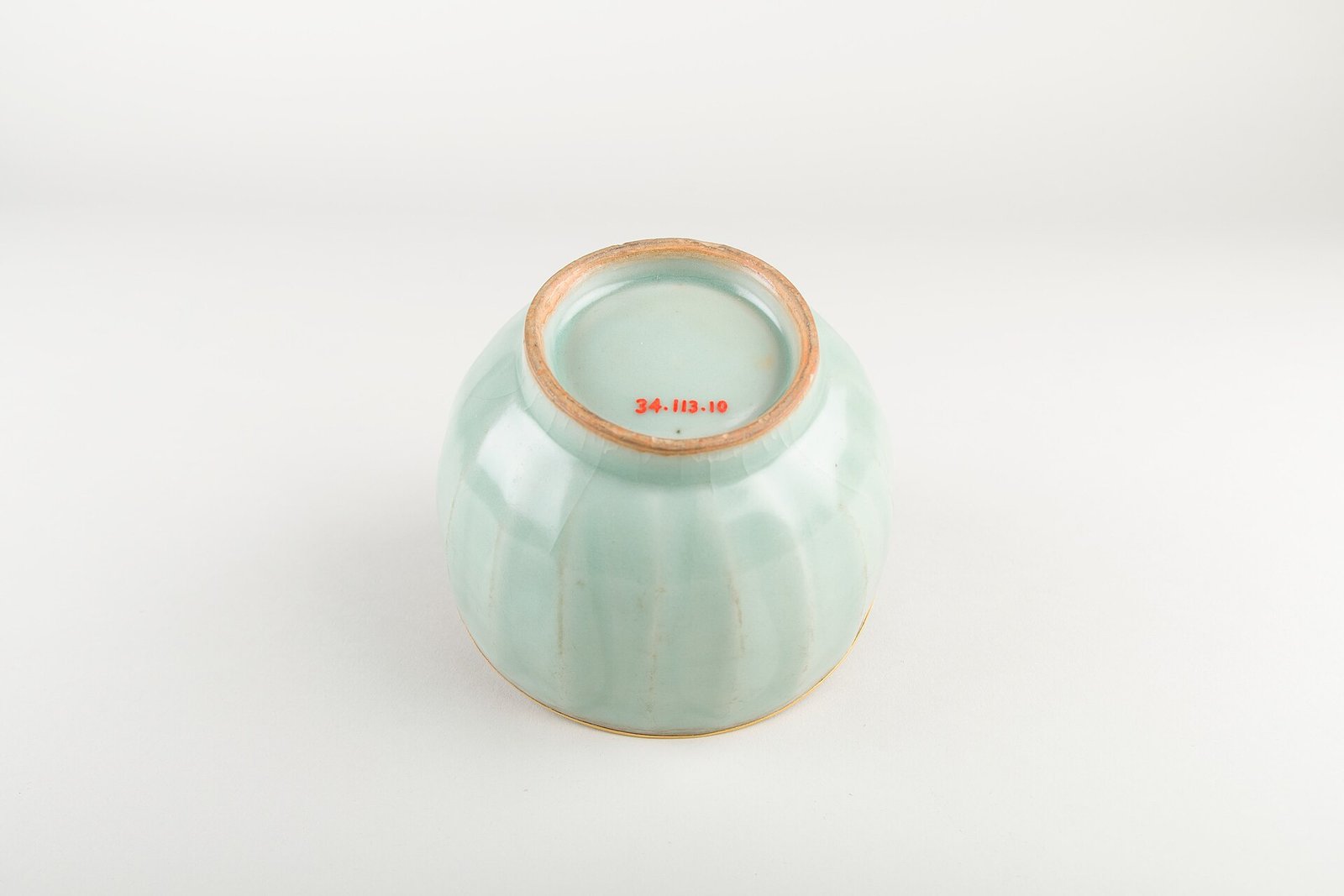
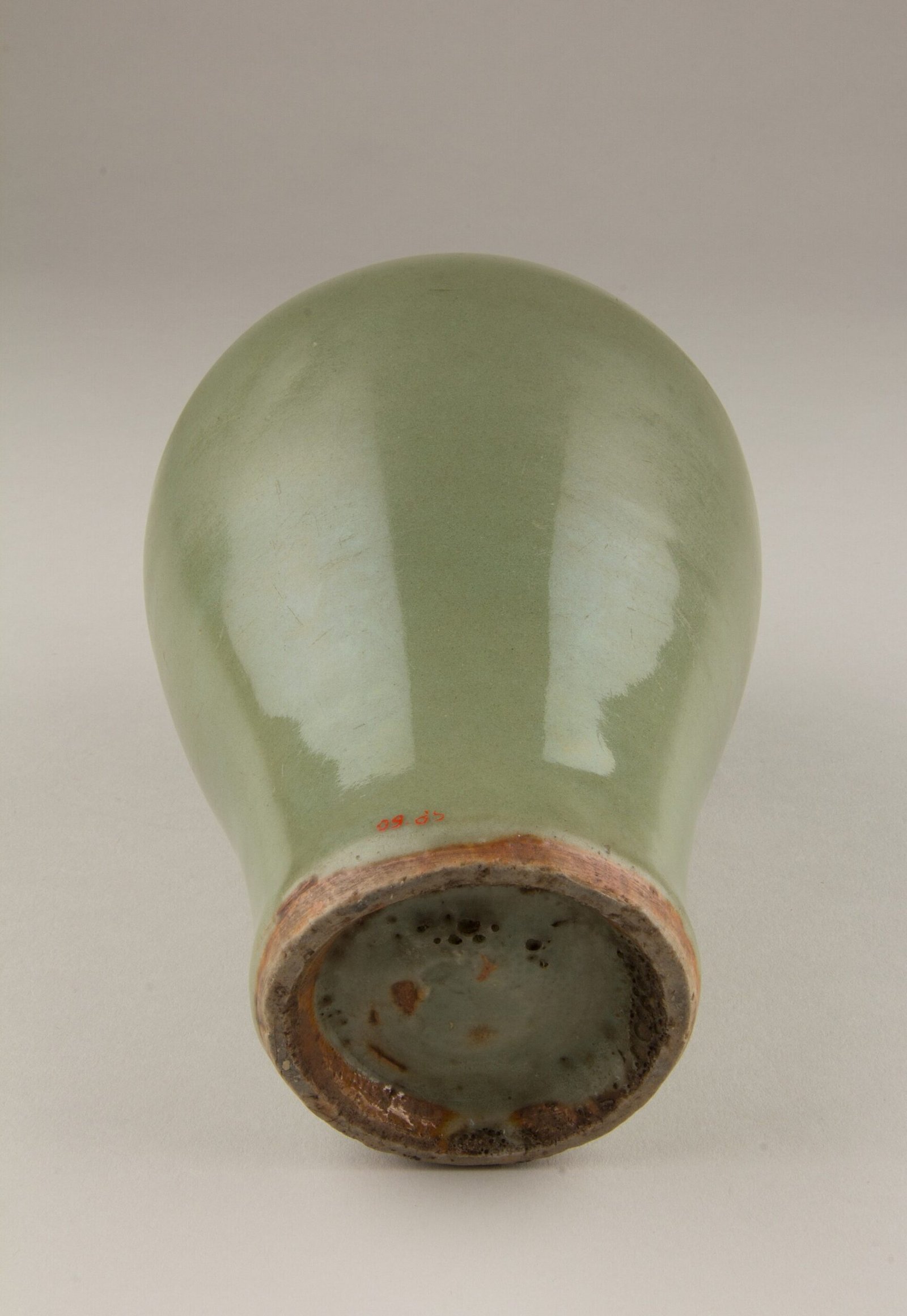
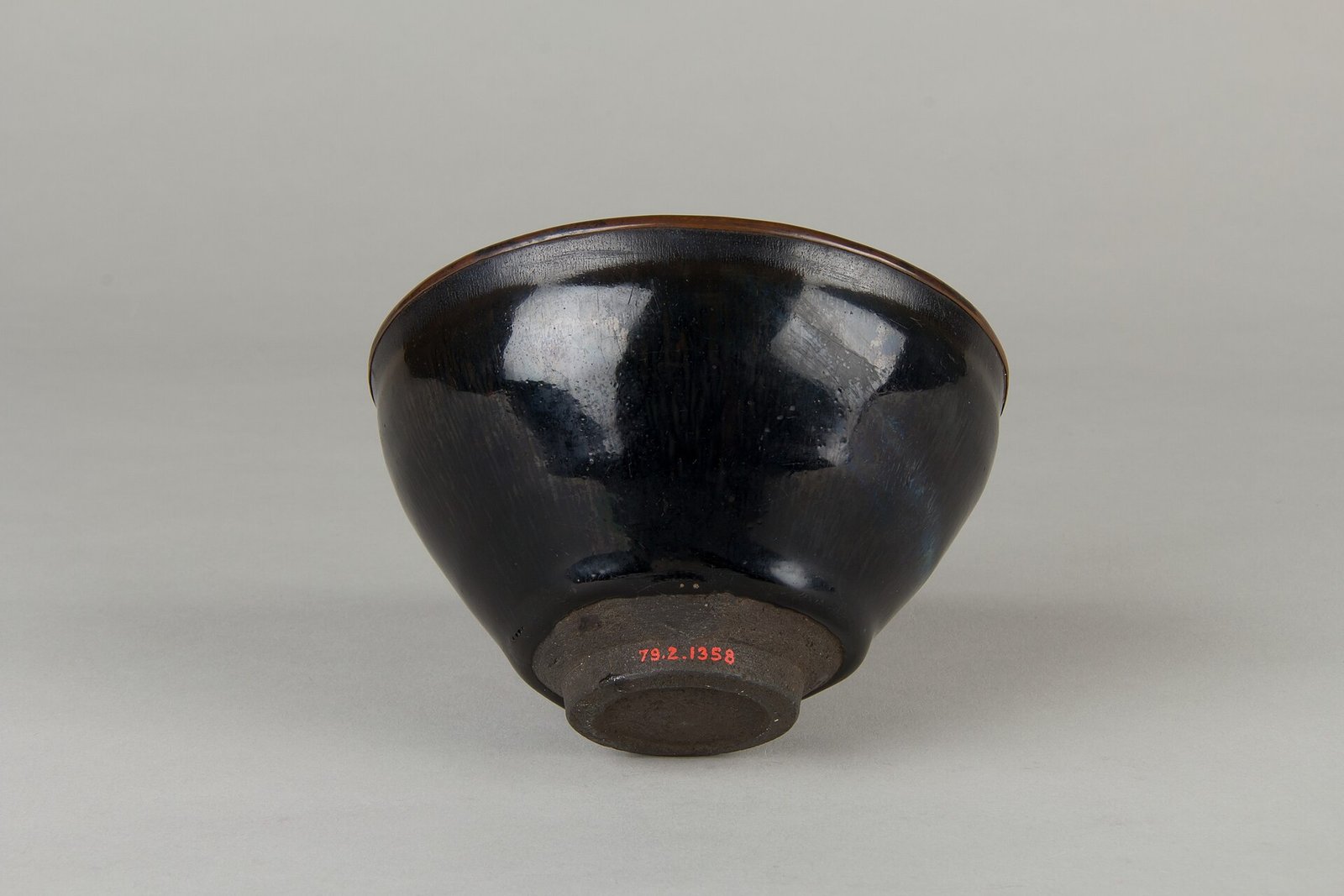
Where the glaze stops, the body is exposed to the kiln atmosphere and oxidises. That colour is a real material clue, and it is the one photograph most sellers omit. Here are four, all Song to Ming, all from the Met.
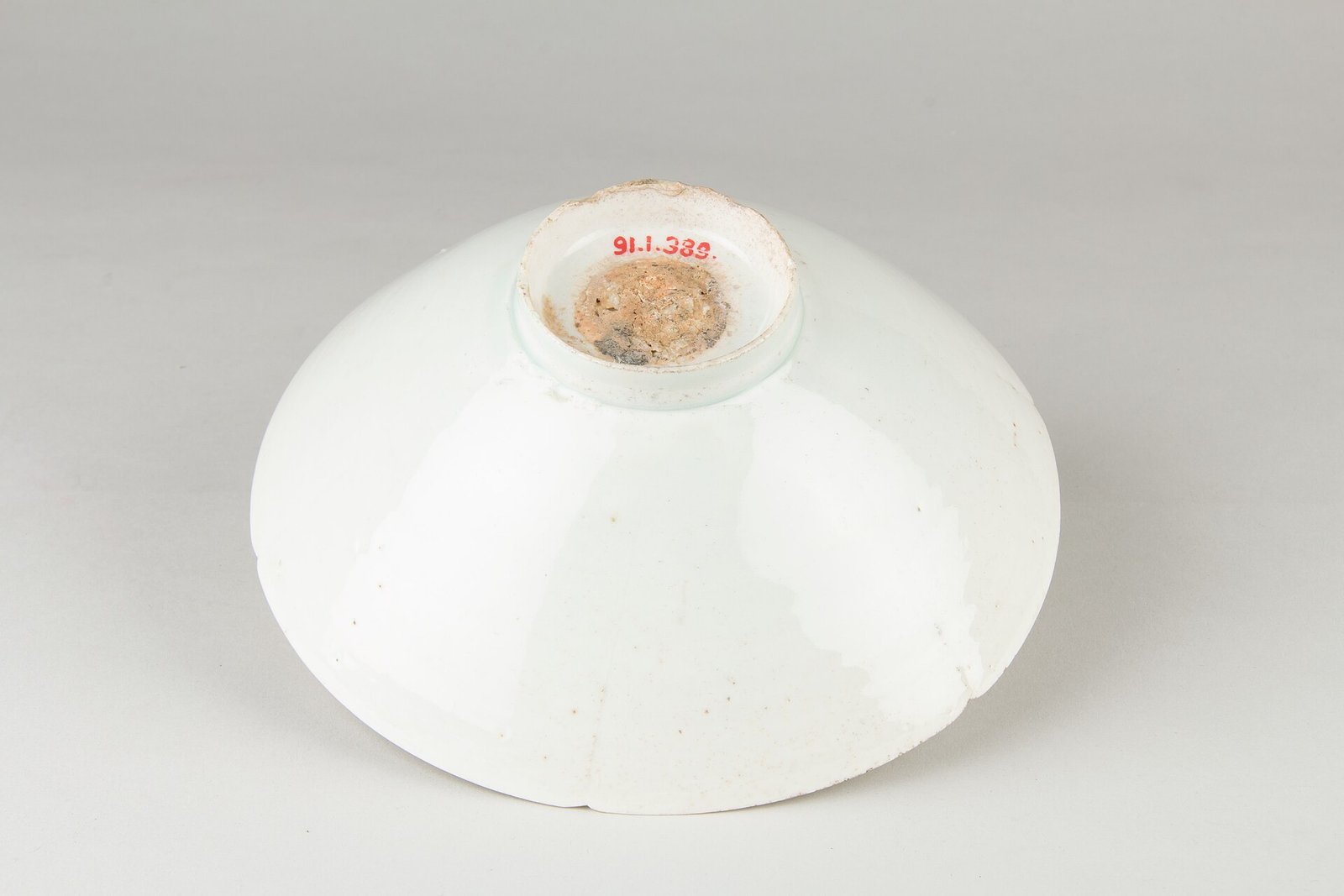
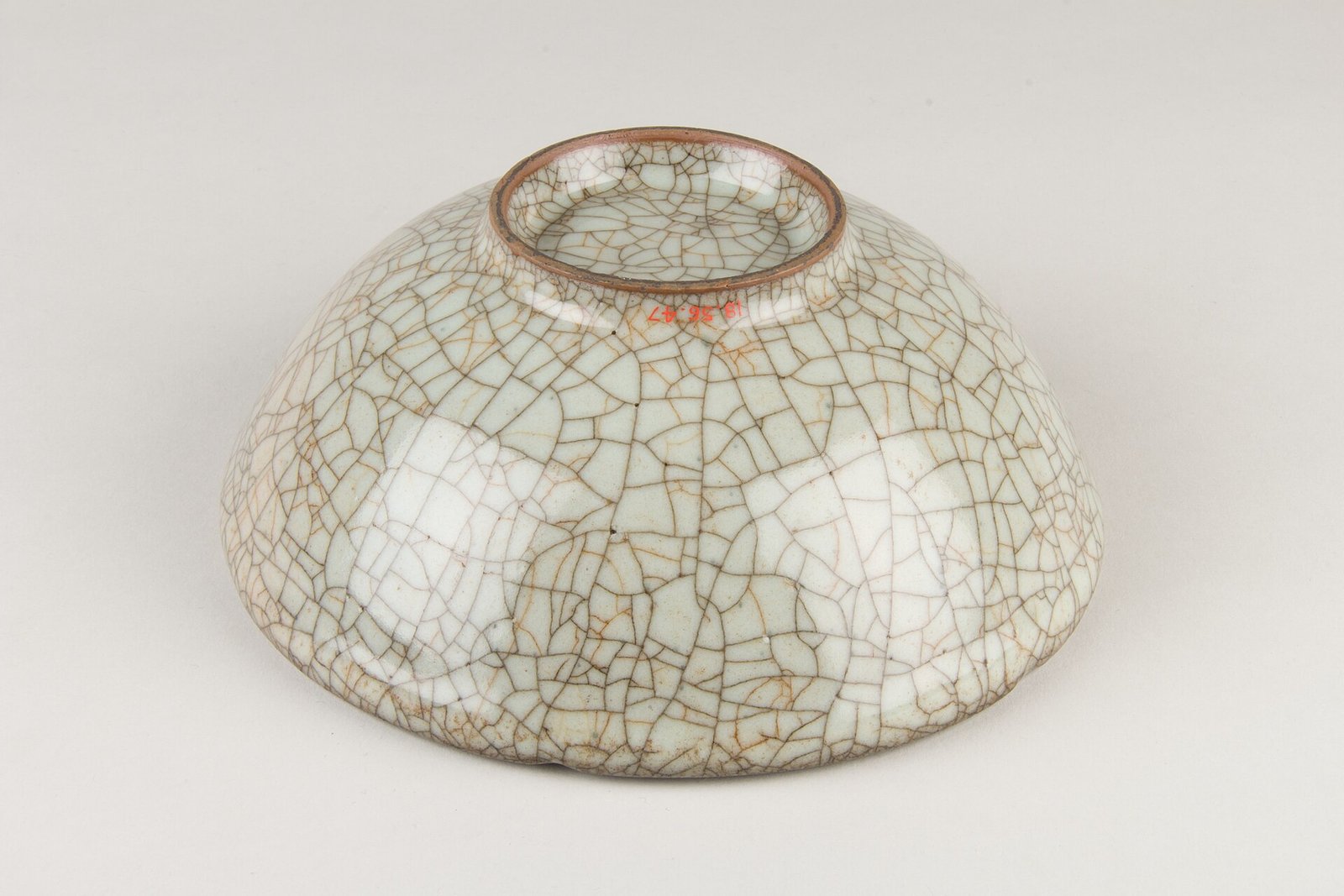
- Ferrous brown to purplish. Guan ware’s signature is 紫口鐵足 zikou tiezu — “purple mouth and iron foot”. The British Museum explains it plainly: the purplish-grey body shows through where the glaze runs thin at the rim, and the unglazed foot fires ferrous brown.
- Orange-brown. Longquan and much southern celadon, as above. The grey body fires orange where exposed, which is why a Longquan foot reads warm against a cool glaze.
- Buff-grey. Yaozhou — the Smithsonian describes a “buff grey porcellaneous ware” under an olive glaze.
- Coarse grey. Jun, on a body the British Museum calls “relatively coarse”. Jun is not a refined body and should not look like one.
- Dark and dense. Jian and other iron-rich southern stonewares, as in the tea bowl above.
- White and fine. Ding, qingbai, and Jingdezhen porcelain from the Ming onward.
3. What does the glaze do where it stops?
The line where a glaze ends is a record of how thick and how mobile it was, and it is genuinely hard to imitate.
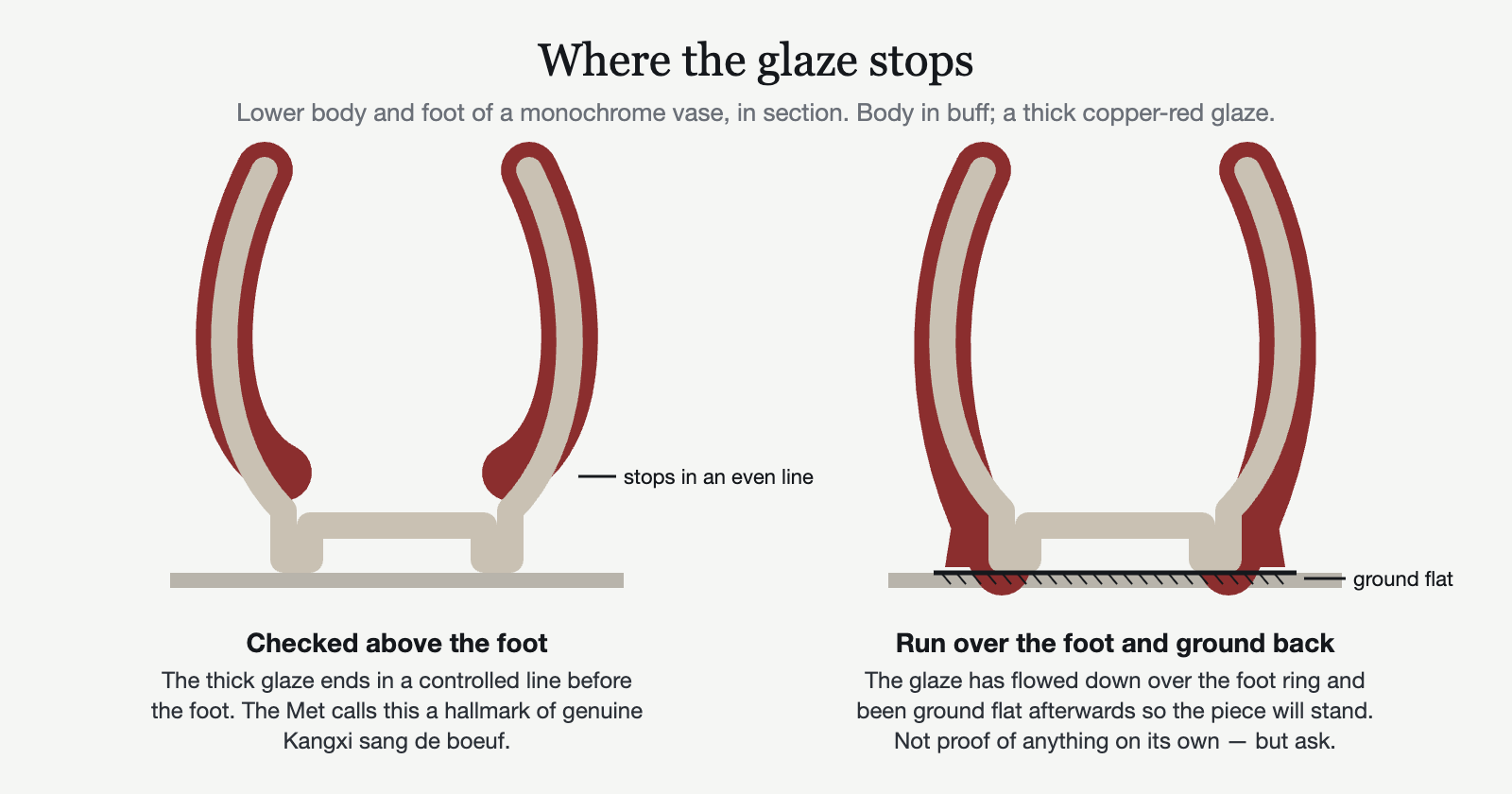
The best-documented example is a monochrome. Of Kangxi sang de boeuf, the Metropolitan Museum states that “a remarkable control of the thick glaze, which is checked in an even line where it stops above the foot, is considered to be a hallmark of genuine Kangxi sang de boeuf porcelains”. A thick red glaze that has run raggedly over the foot, or been ground back flat, is telling you something — not necessarily that the piece is wrong, but that the control the Met describes is absent.
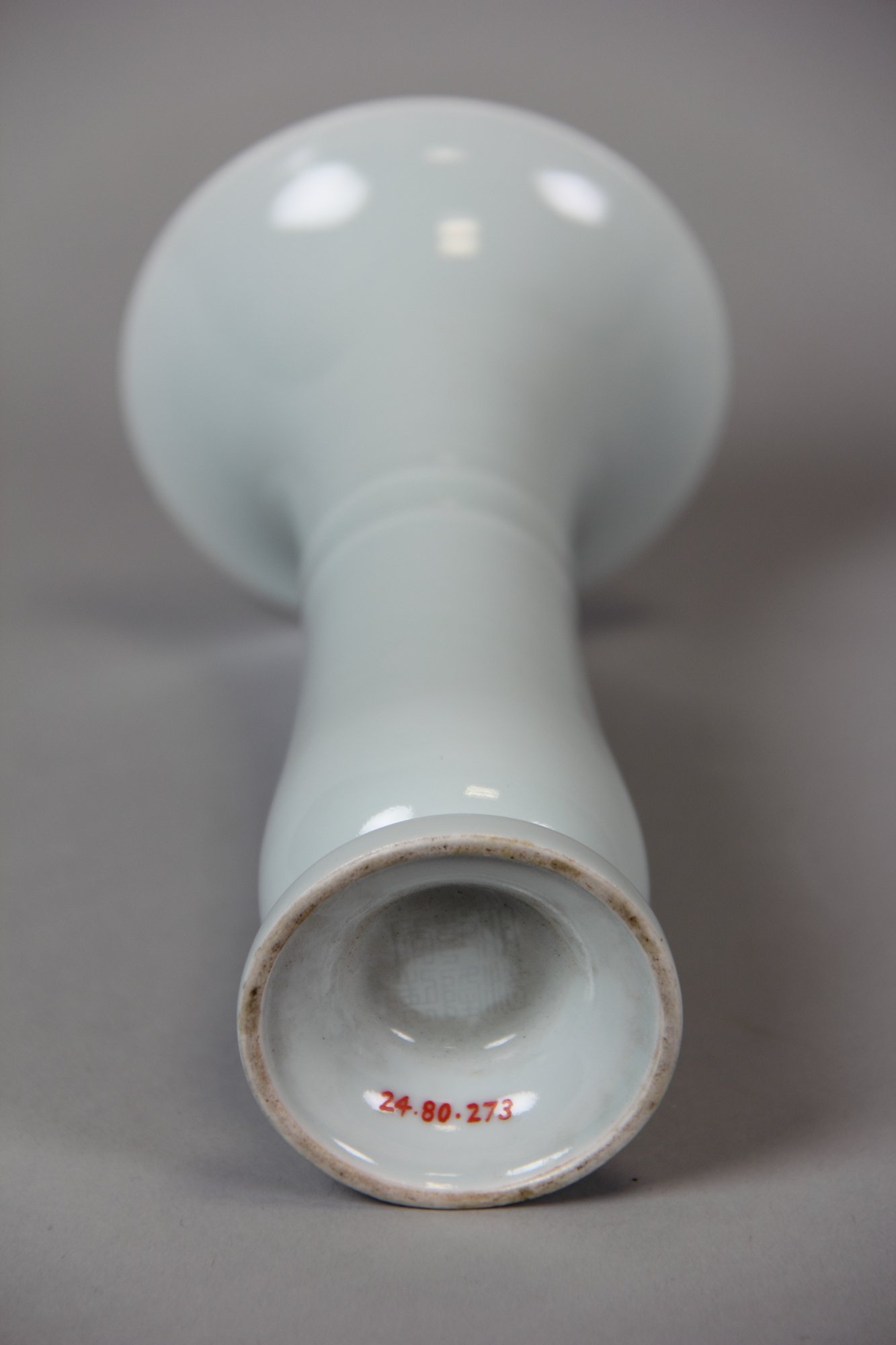
On Longquan the same logic runs the other way: the British Museum records glaze applied in up to four separate layers, and you can often see that accumulated thickness in section where it thins towards the foot.
4. Is the crackle intentional?
This is a condition question that costs people money in both directions.
On Guan ware the crackle is deliberate. The Met says so of one of its dishes in terms: the cracks were “made to resemble the accidental cracks that sometimes occurred during the firing of ceramics”. On Ge, the Palace Museum describes surface cracks of varying size and depth known as “gold thread and iron wire” — the ware’s defining feature, read by the trade as a two-tone network, and visible on the base above as much as the front. On Ru, fine “broken-ice” crackle is normal. Qing celadons are described by the British Museum as glossy with tiny bubbles.
None of that is damage. A hairline — a single crack running through the body, usually catching the light differently and often visible from both sides — is damage, and a different conversation. See what a hairline does to value, which has the cross-section.
5. What is written down there?
Read the base inscription last, not first. The full argument is in our guide to reign marks; here is what the marks actually look like on real bases.
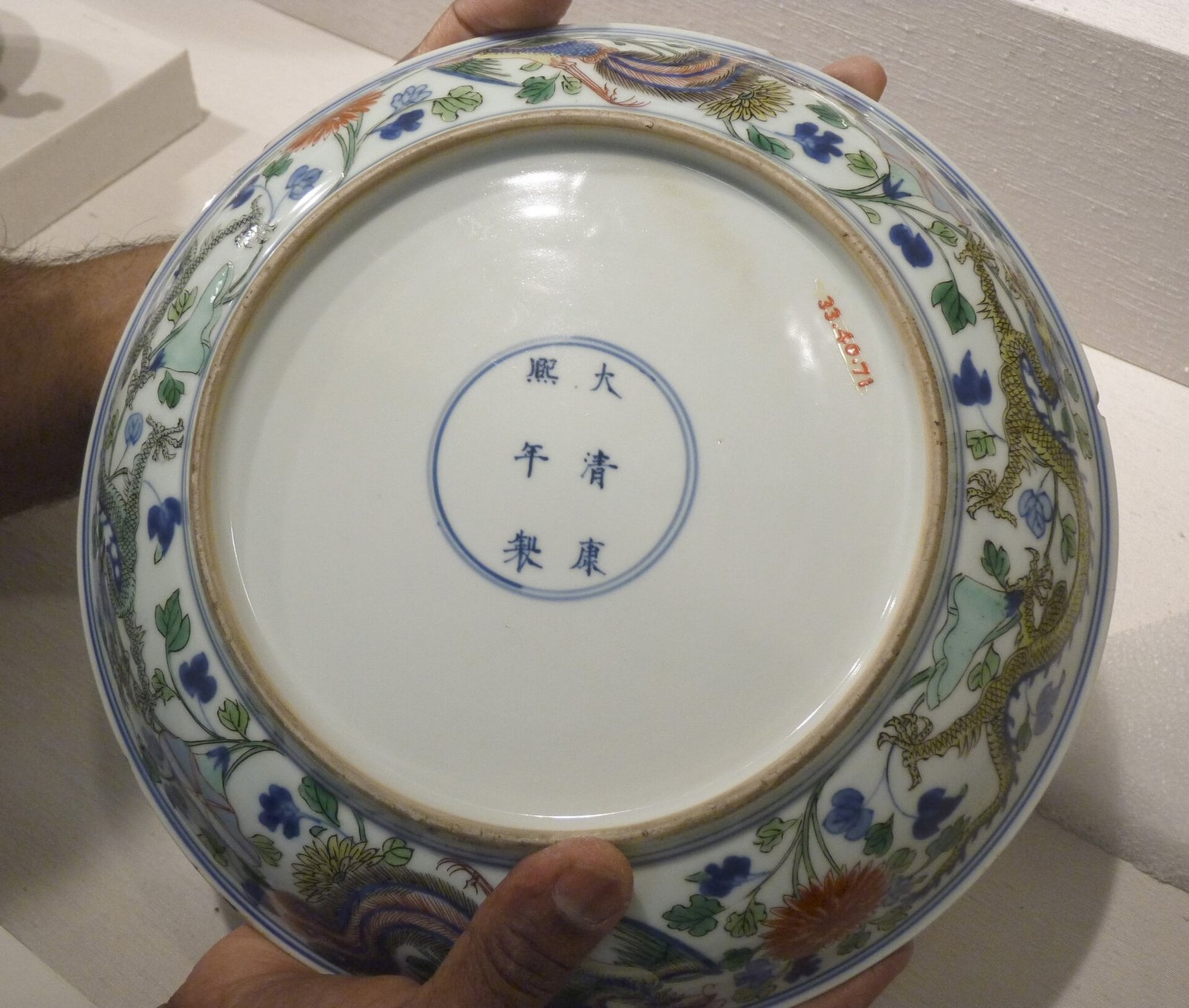
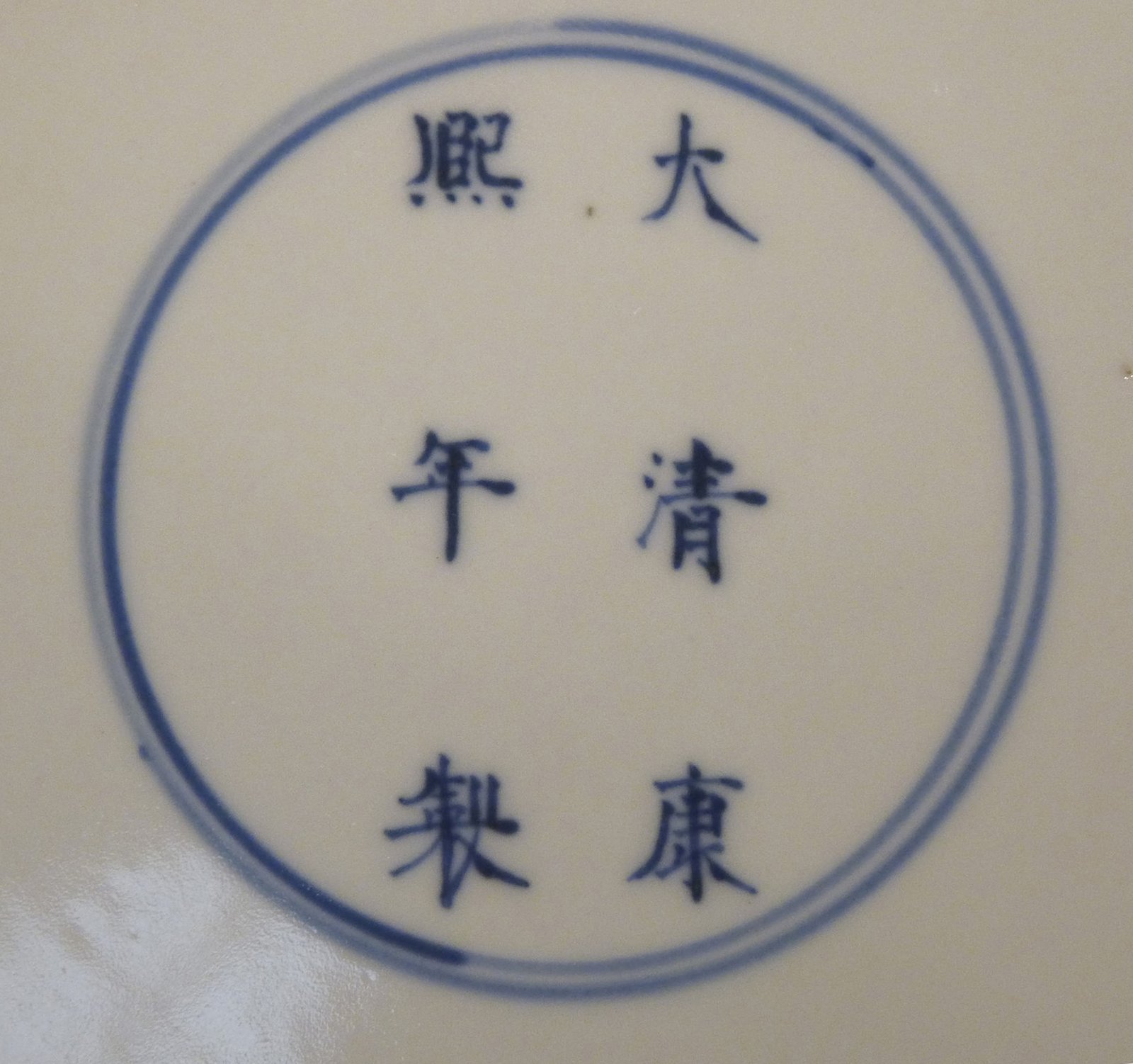
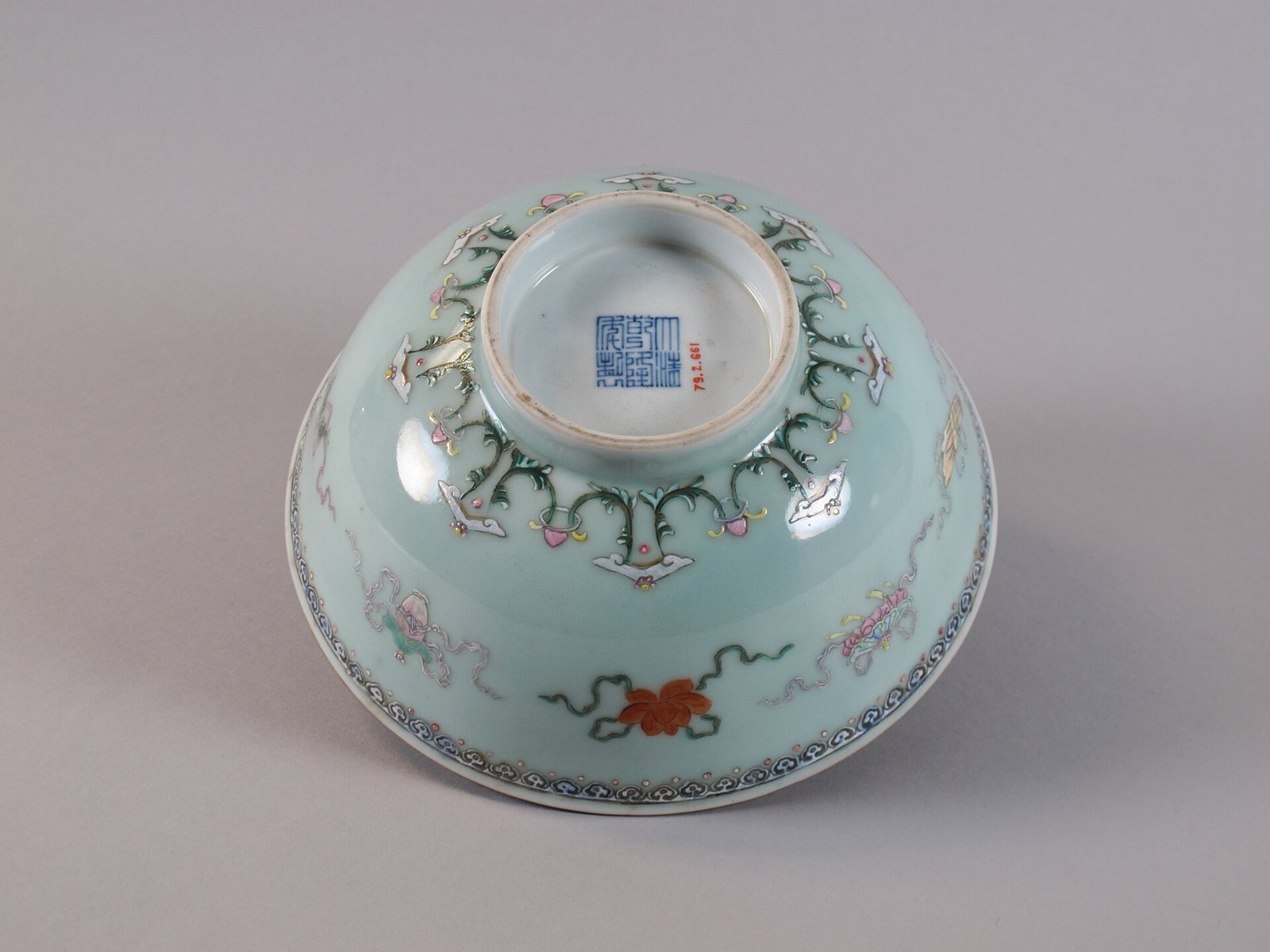
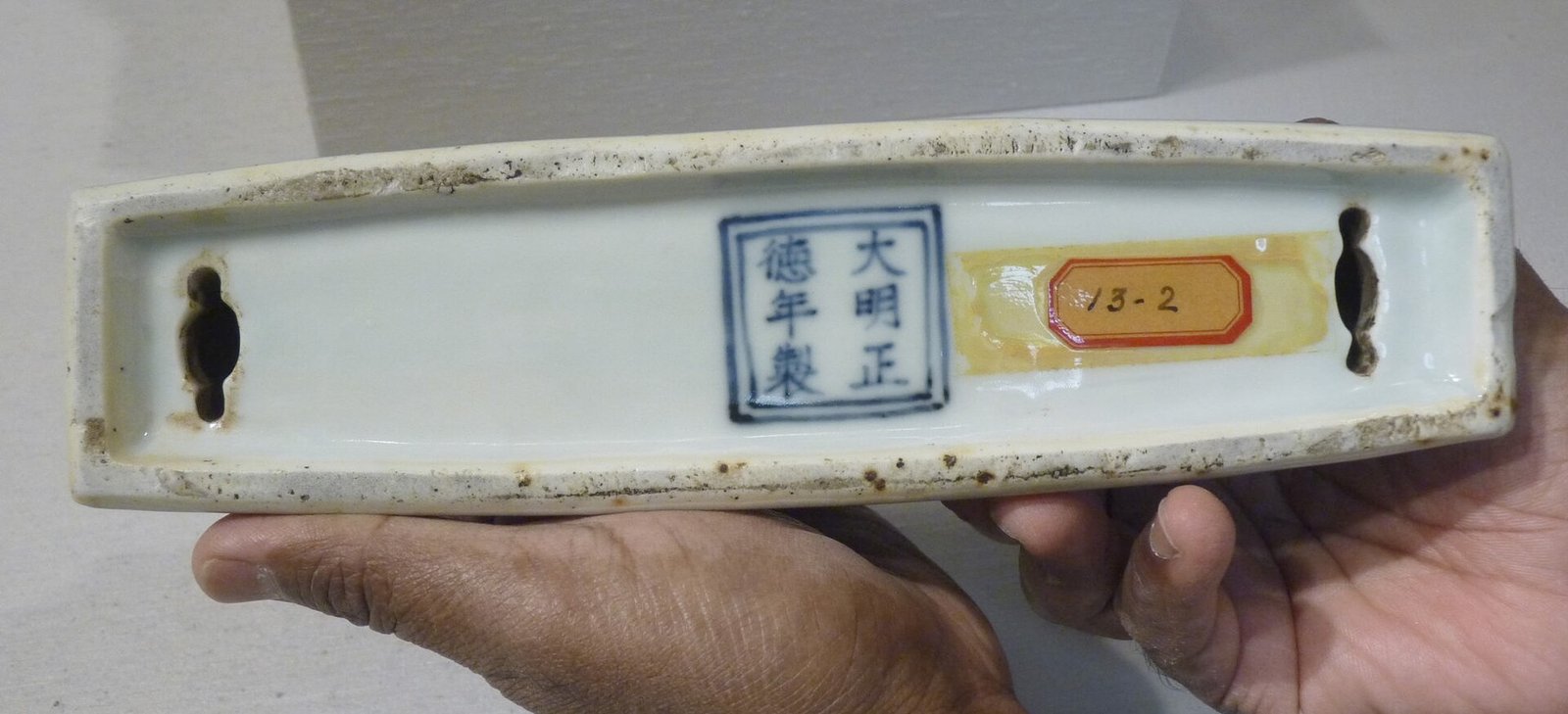
And one that is not a reign mark at all — which is the important lesson:
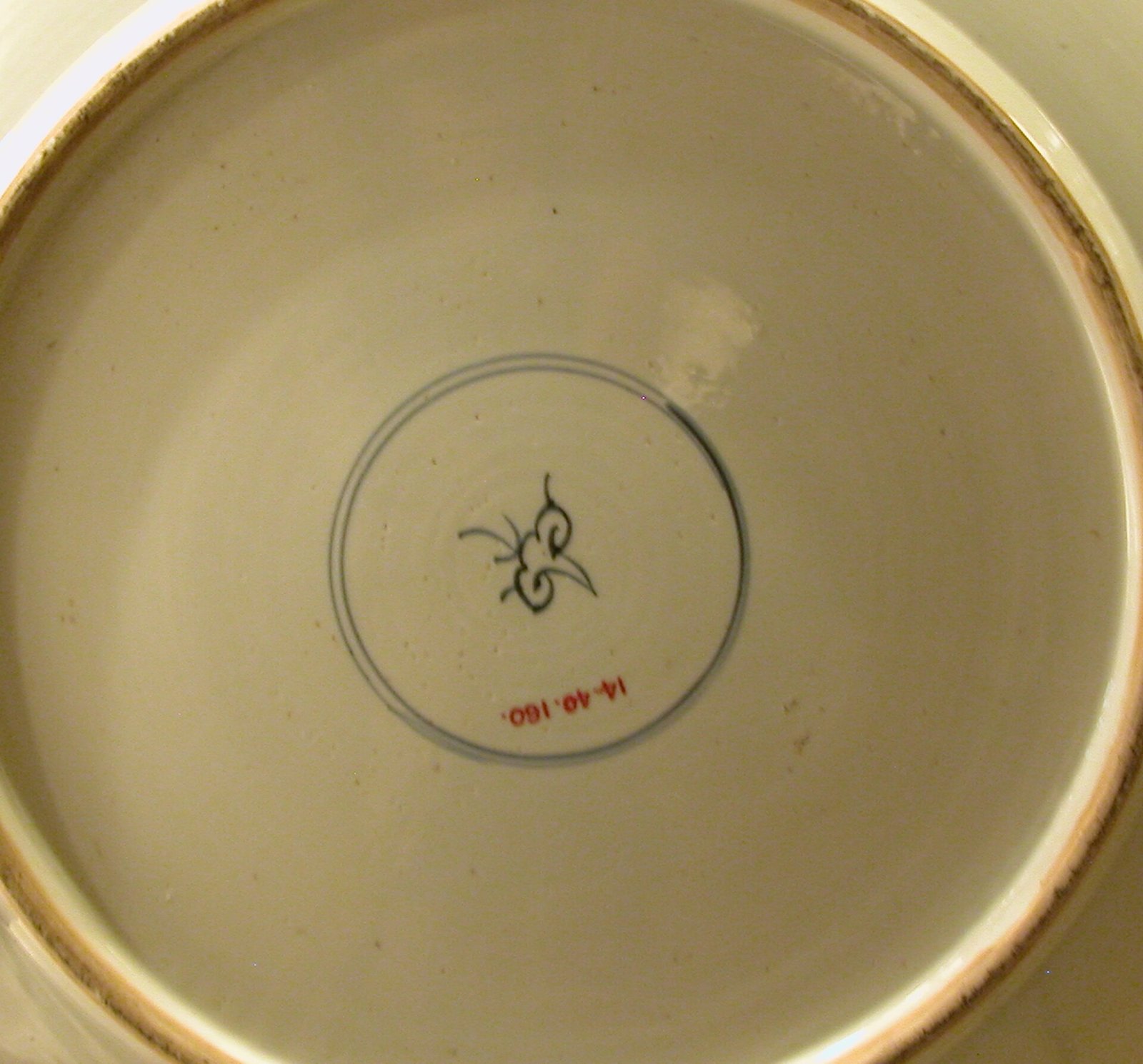
The Met’s period field for that plate reads “Kangxi mark and period”; the base carries a symbol mark, not a reign mark. That is not a contradiction — it is a museum using “mark” to mean any Kangxi-period mark — but it is exactly the kind of thing you will only learn by looking at the base rather than the catalogue line. Substitute marks of this kind, together with empty double rings, are characteristic of Kangxi porcelain; the guide to reign marks sets out the evidence and the myth that grew up around it.
Script is a date signal. Ming and early Qing marks are normally regular script within a double circle or square, as on the Kangxi dish; seal script is in use by Yongzheng and, in the British Museum’s phrasing, “predominated over” regular script through the Qianlong reign, as on the Qianlong bowl. Usefully, the museum also notes that most Yongzheng and Qianlong copies of Song celadons carry six-character underglaze blue seal marks — so a Song-looking celadon with a Qing seal mark is behaving exactly as expected.
The mark may not be on the base at all. The British Museum records a Xuande mark running horizontally around a vase neck. A Korean 祭 ritual mark can sit on the face of a dish (University of Michigan Museum of Art 2004/1.283), though the British Museum notes such inscriptions usually appear inside or beside the foot rim. A base-only habit will make you miss things.
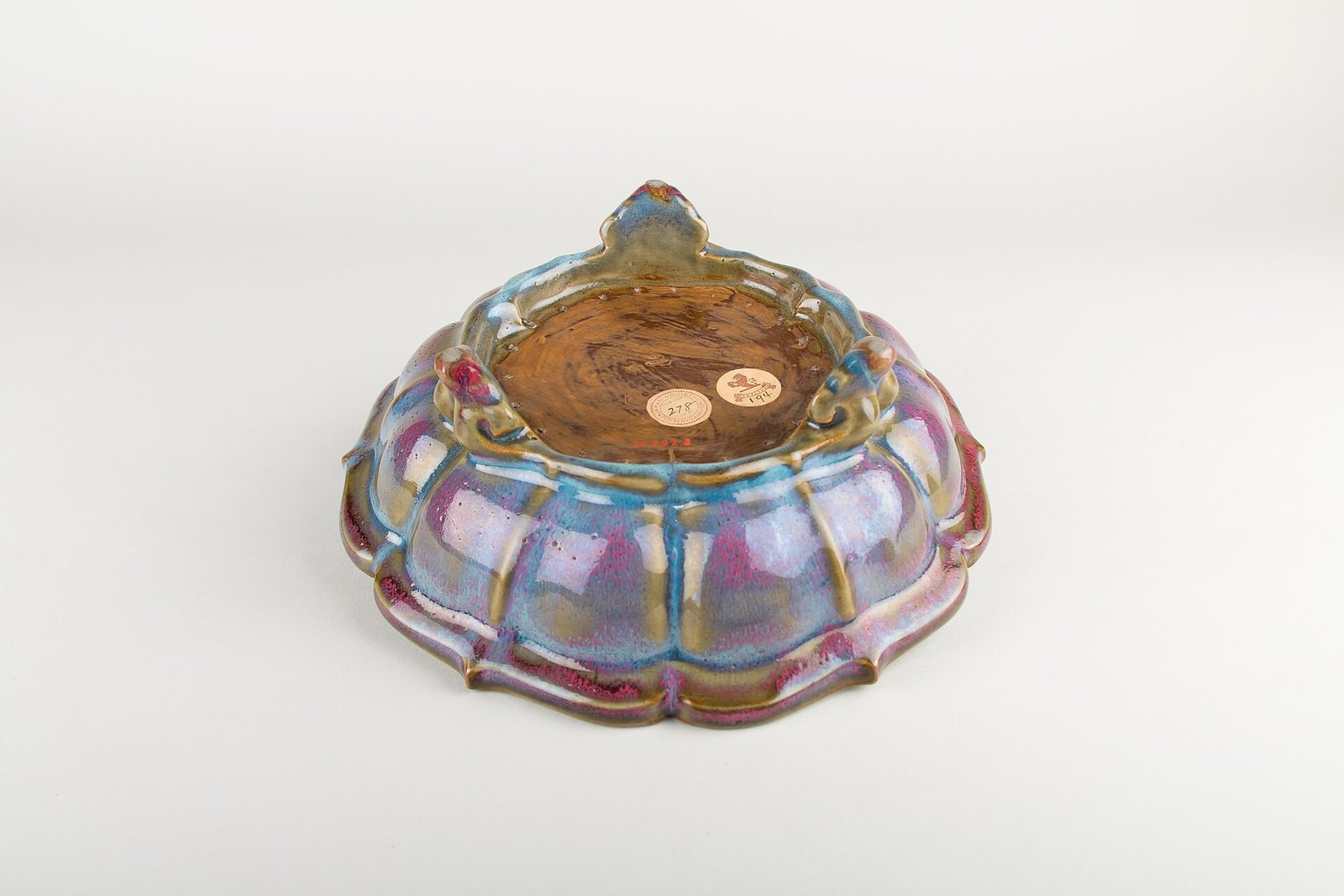
6. What else is down there: labels
Old collection labels, dealer stock numbers, exhibition stickers and loan tags are provenance, and they are worth more than most owners realise. Two Met bases above carry them; here is a third.
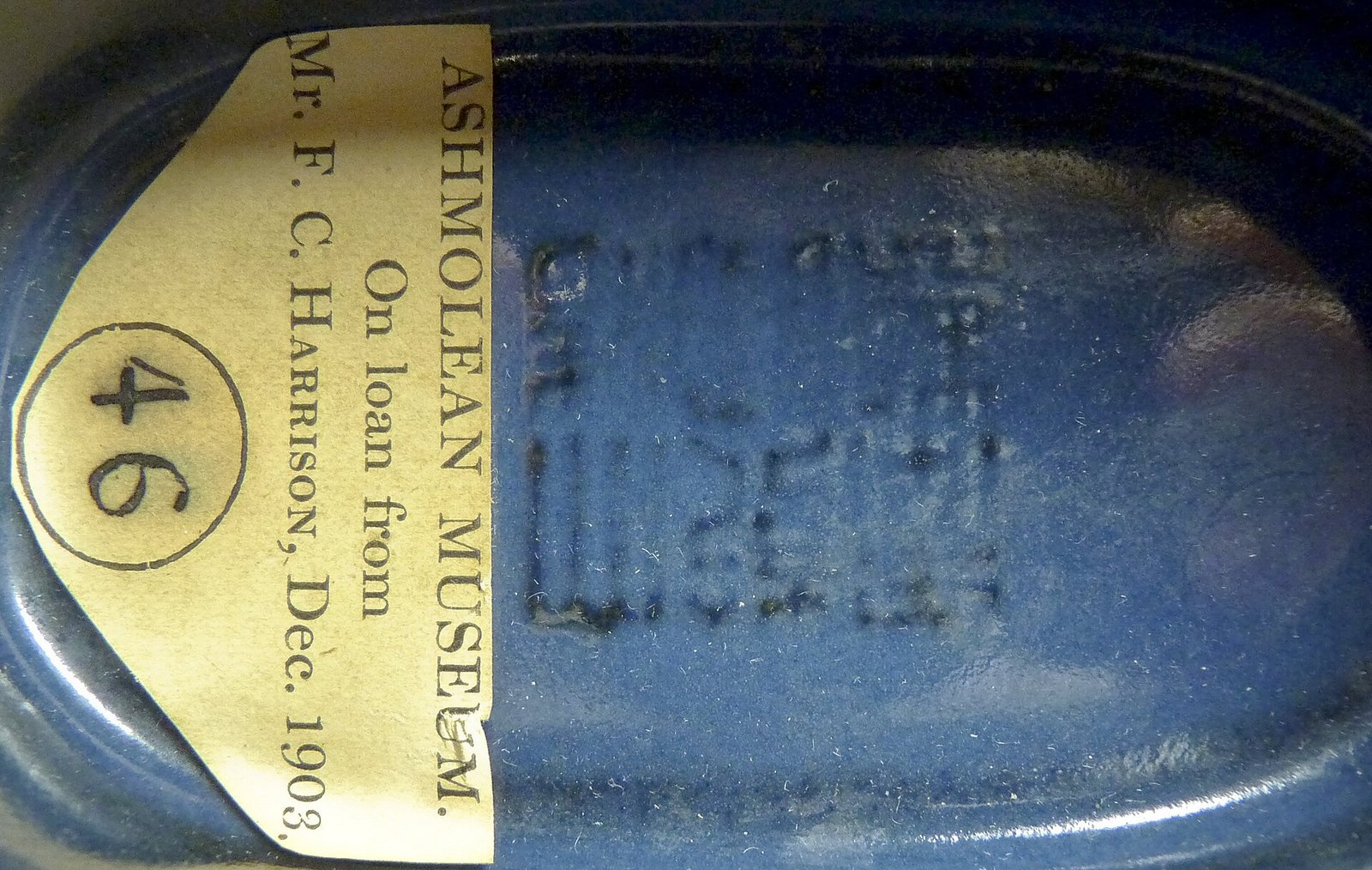
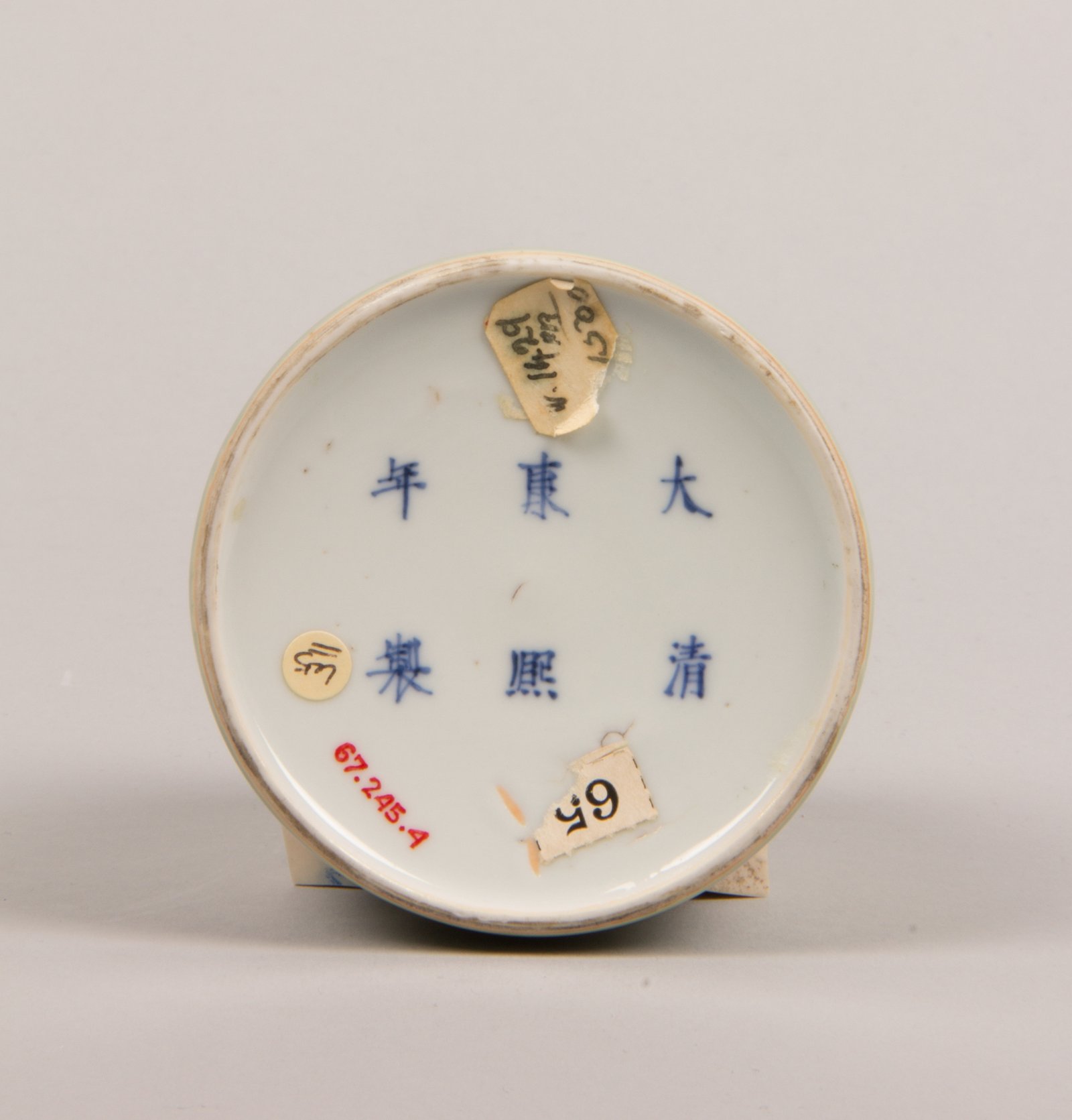
Do not clean them off. A label with a name and a date on it can be the single most valuable thing on the object. Photograph it, record it, and leave it where it is.
7. Does the wear make sense?
Here we have to be honest about the limits of what can be sourced. Museums document how objects were made; they do not publish wear-pattern checklists, and we are not going to invent one.
What is documented, and lets you reason properly, is that the material itself changed. The Met records a gradual shift to a high-kaolin porcelain body from the late Ming, universal at Jingdezhen by the Kangxi era, and then a further change in body composition “in the nineteenth/twentieth century”. So the body of a genuine eighteenth-century Jingdezhen piece is not the same material as a nineteenth-century one wearing an eighteenth-century mark.
The reasonable, honest test is coherence: does the wear sit where the object would actually have been handled and set down, and is it consistent with the glaze and body you are looking at? Uniform wear all over, or crisp wear in impossible places, is a question worth asking. That is judgement, and we present it as judgement.
What to ask a seller for
If a listing does not show these, ask. A dealer who will not photograph the base is telling you something.
- The full base, square on, in even light, with the mark legible if there is one.
- The foot ring in raking light, so the exposed body colour and any grit or spur marks read.
- A profile showing where the glaze stops above the foot.
- The mouth rim, close up — especially on anything described as Ding.
- Any fault, photographed as a fault rather than avoided.
- Any labels, legibly.
Every piece in our catalogue is described with its foot and base recorded as structured fields rather than buried in prose, and we photograph faults deliberately. If a base shot you want is missing from a listing, ask us and we will take it.
Sources
- British Museum, Room 95 Chinese ceramics gallery guide
- British Museum, Ru ware bowl PDF.3
- Suzanne G. Valenstein, A Handbook of Chinese Ceramics, The Metropolitan Museum of Art
- The Metropolitan Museum of Art, Guan ware dish 24.172.1
- The Metropolitan Museum of Art, dish 33.40.71
- The Metropolitan Museum of Art, plate 14.40.160
- The Palace Museum, Beijing, on Ge ware
- Smithsonian NMAA, Yaozhou bowl F1968.65
Written by James Treacher. Sections 1–6 are museum-documented and illustrated from museum base photographs; section 7 is explicitly presented as judgement, because no institution publishes a wear checklist. The diagrams are ours.