The Song dynasty (960–1279) is where Chinese ceramics stop being pottery and start being art with a literature. It is also where more nonsense is repeated than in any other period, starting with the phrase almost every guide opens on.
The “Five Great Kilns” is not a Song idea
Ru, Guan, Ge, Ding and Jun are routinely presented as the five imperial wares of the Song, as though a Song emperor had ranked them. He did not. The grouping is a later connoisseurs’ classification. Its earliest record is in a Ming imperial catalogue, the Xuande Dingyi Pu, and it was formalised by the Republican-period scholar Xu Zhiheng in Yinliuzhai’s Talks on Porcelain (1915).
The list was not even stable. The Xuande Dingyi Pu lists six kilns, including the Chai kiln alongside Jun; Xu Zhiheng’s five kept Chai and dropped Jun; modern lists drop Chai and keep Jun because no Chai kiln site and no authenticated Chai object has ever been found. And one of the surviving five is in scarcely better shape: the Palace Museum in Beijing states that “the site of the kiln that produced the existing Ge wares has as yet not been discovered”.
None of this makes the five wares less remarkable. It means the grouping is Ming and Qing taste looking back, not Song practice looking around — which is worth knowing before you pay a premium for a category.
Porcelain or stoneware? Museums genuinely disagree
You will see Longquan called porcelain in one catalogue and stoneware in the next. That is not sloppiness. The Chinese high-fired body sits across a boundary that Western definitions drew later, and major institutions land differently: the Met catalogues Longquan as porcelain, the British Museum and the Smithsonian as stoneware.
The Met’s own hedge is the useful one — “porcelaneous stoneware”. Our house position, and we state it as a position rather than a fact: Ding is porcelain; Ru, Jun and Cizhou are stoneware; Guan, Ge, Longquan and Yaozhou are porcelaneous stoneware. Anyone who tells you this is settled has not read two catalogues.
The wares, and the one feature that separates each
Museums describe objects; they rarely publish identification tests. The “look for” line under each ware below is therefore our own guidance, built from the sourced facts above it — not a museum instruction.
Ru 汝 — Qingliangsi, Henan, c. 1086–1125
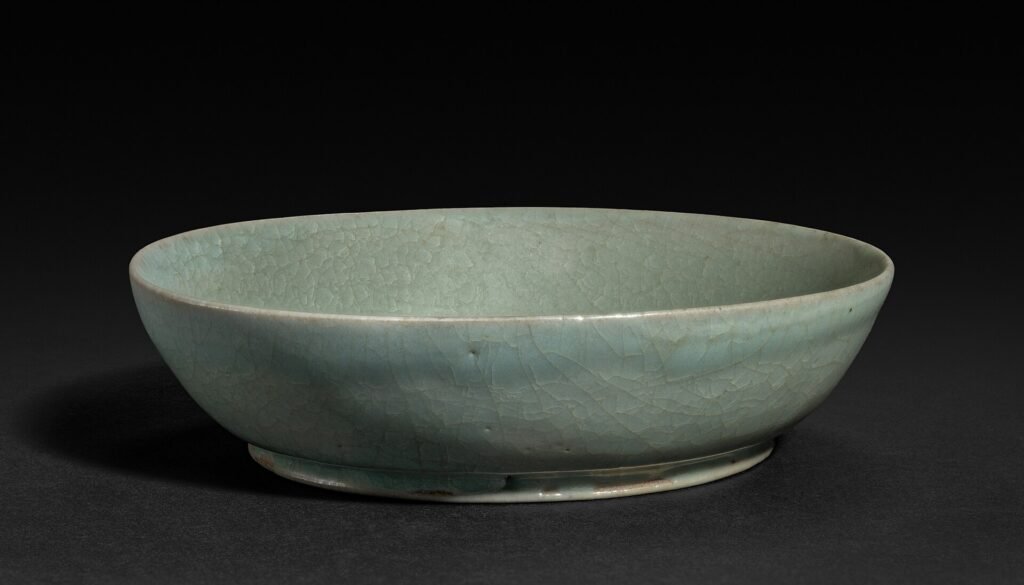
The rarest of them. The British Museum dates production to a window of some twenty to forty years (from 1086 to 1106 or 1125) and its 2021 announcement with Cranfield University states there are “under 100 surviving known examples”; the Palace Museum independently gives “less than 100 pieces” intact. Publish that as “fewer than 100” and no more — every precise figure you will see quoted (87, 79, 92) comes from a dealer site, not a museum.
Thin pale-grey body; thick opaque lavender to sky-blue glaze; fine “broken-ice” crackle. Song writers claimed the glaze contained powdered agate mined near the kiln — and the British Museum states flatly that they were incorrect. It is a genuine Song-period claim that modern analysis does not support, which is a far better story than either “it’s a myth” or “it’s agate”.
Look for: the base. Ru was glazed all over and fired on spurs, leaving tiny unglazed sesame-seed marks — usually three or five according to size: the British Museum’s brush washer has three, its bowl five, and a British Museum dish also has three. Treat the count as a range, not a rule that identifies the form. No other ware in this group glazes over its own foot.
Guan 官 — Hangzhou, Zhejiang, Southern Song
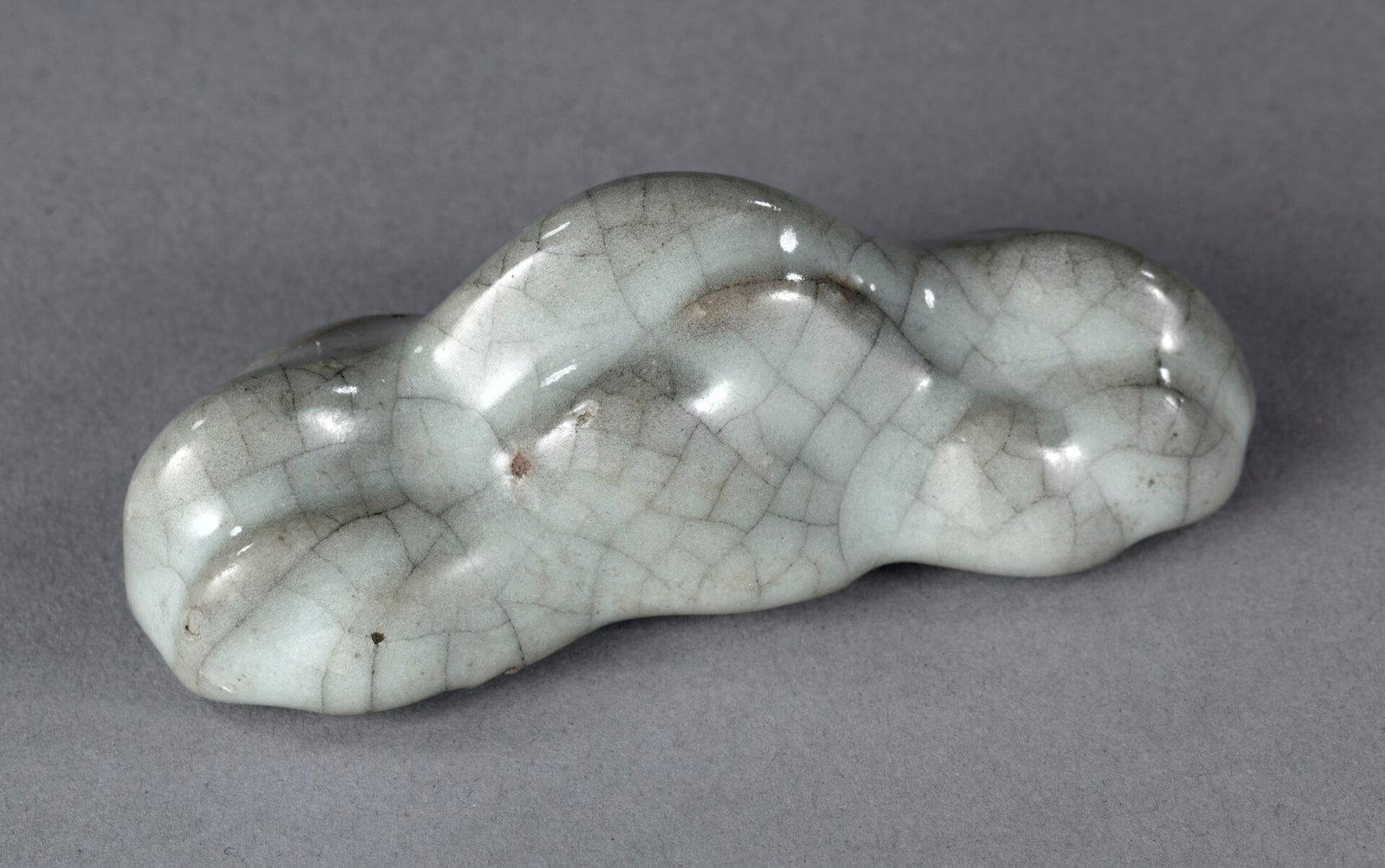
Celadon glaze full of tiny bubbles, under a wide crackle. Crucially, the Met records of a Guan dish that the cracks were “made to resemble the accidental cracks that sometimes occurred during the firing of ceramics” and are deliberate. Crazing on Guan is a design decision, not a fault, and should never be discounted as damage.
Look for: 紫口鐵足 zikou tiezu, “purple mouth and iron foot” — the British Museum’s own phrase. The dark body shows through where the glaze runs thin at the rim, and the unglazed foot fires ferrous brown. Glazed foot with spur marks means Ru; dark unglazed foot means Guan.
Ge 哥 — kiln site unknown
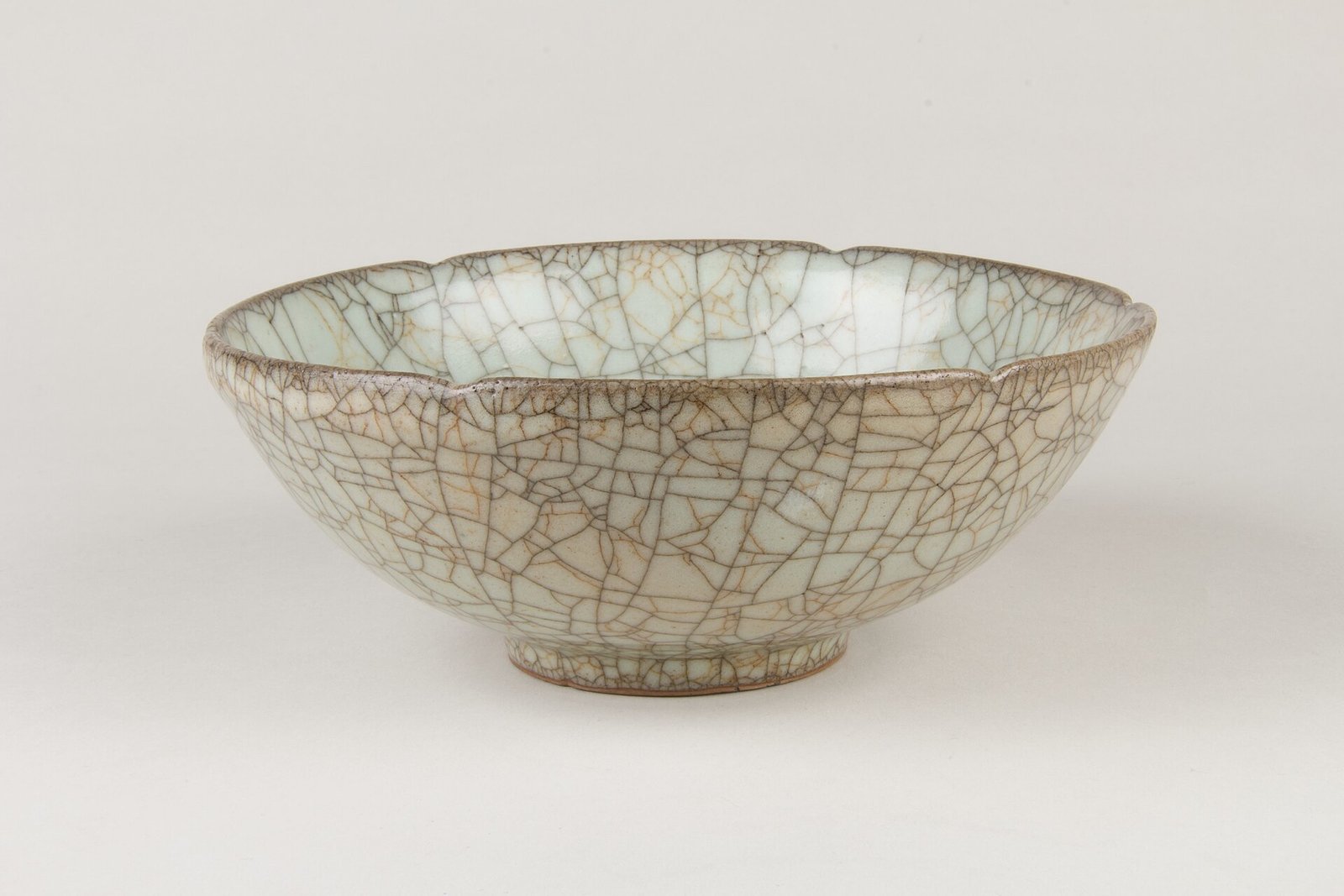
The weakest link in the whole scheme, and worth approaching with care. No kiln site. Contested dating — the British Museum dates a Ge ware piece to the Yuan, the Met dates its Ge bowl to the fourteenth century, Yuan to early Ming. A great deal of what is sold as Ge is later imitation, and much of it was made as imitation quite openly.
Look for: the Palace Museum’s “gold thread and iron wire” (金絲鐵線) — a two-scale crackle, a coarse dark network with finer golden-brown lines inside it. Guan’s crackle reads as one network; Ge’s reads as two. In practice, separating Guan from Ge is genuinely difficult even for specialists.
Ding 定 — Quyang, Hebei, 8th–14th century
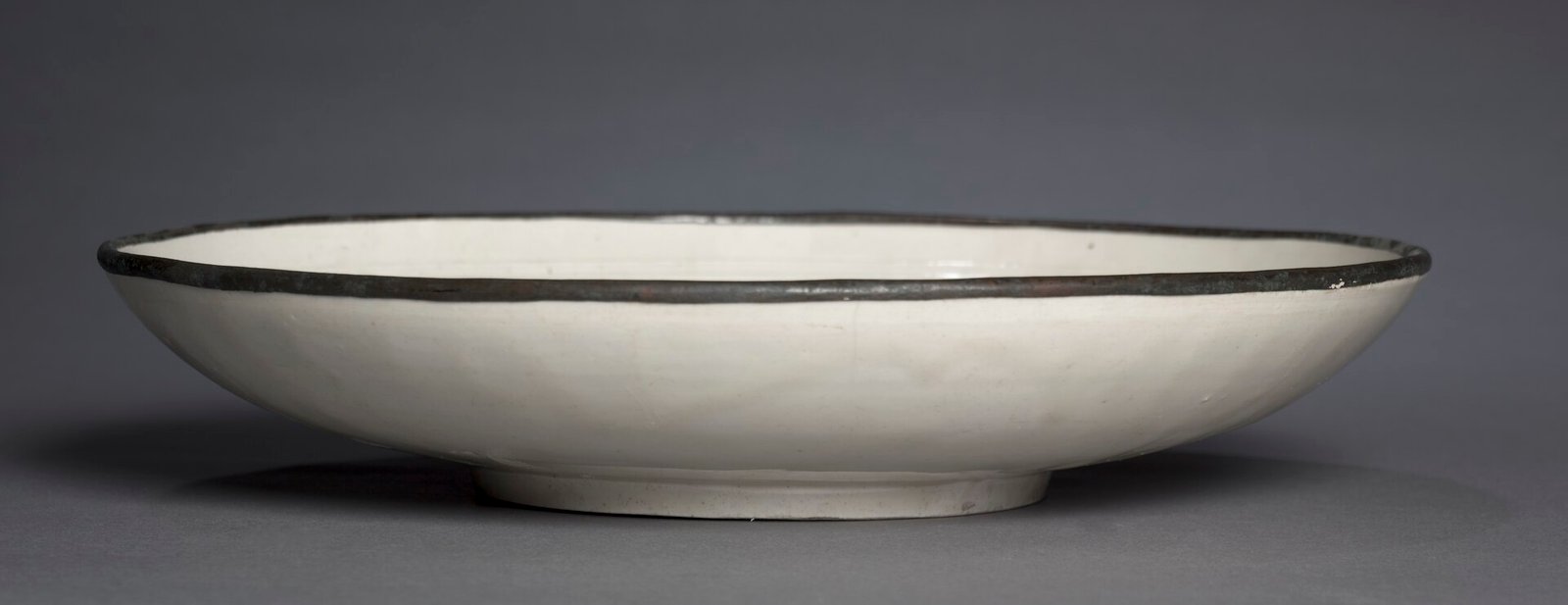
The one everyone agrees is porcelain. Ivory-white, warm rather than blue-white, with a mellow transparent glaze. Favoured at the Northern Song court. Decoration is incised or combed early, and moulded from the Jin period onward using carved intaglio moulds.
Look for: run a fingertip round the mouth rim. Ding was fired upside down on its rim, so the rim is unglazed and gritty — and was very often bound in a fitted copper or brass band to cover it. Nothing else in this list does that. It is the single most reliable identification in Song ceramics.
Jun 鈞 — Yuzhou, Henan
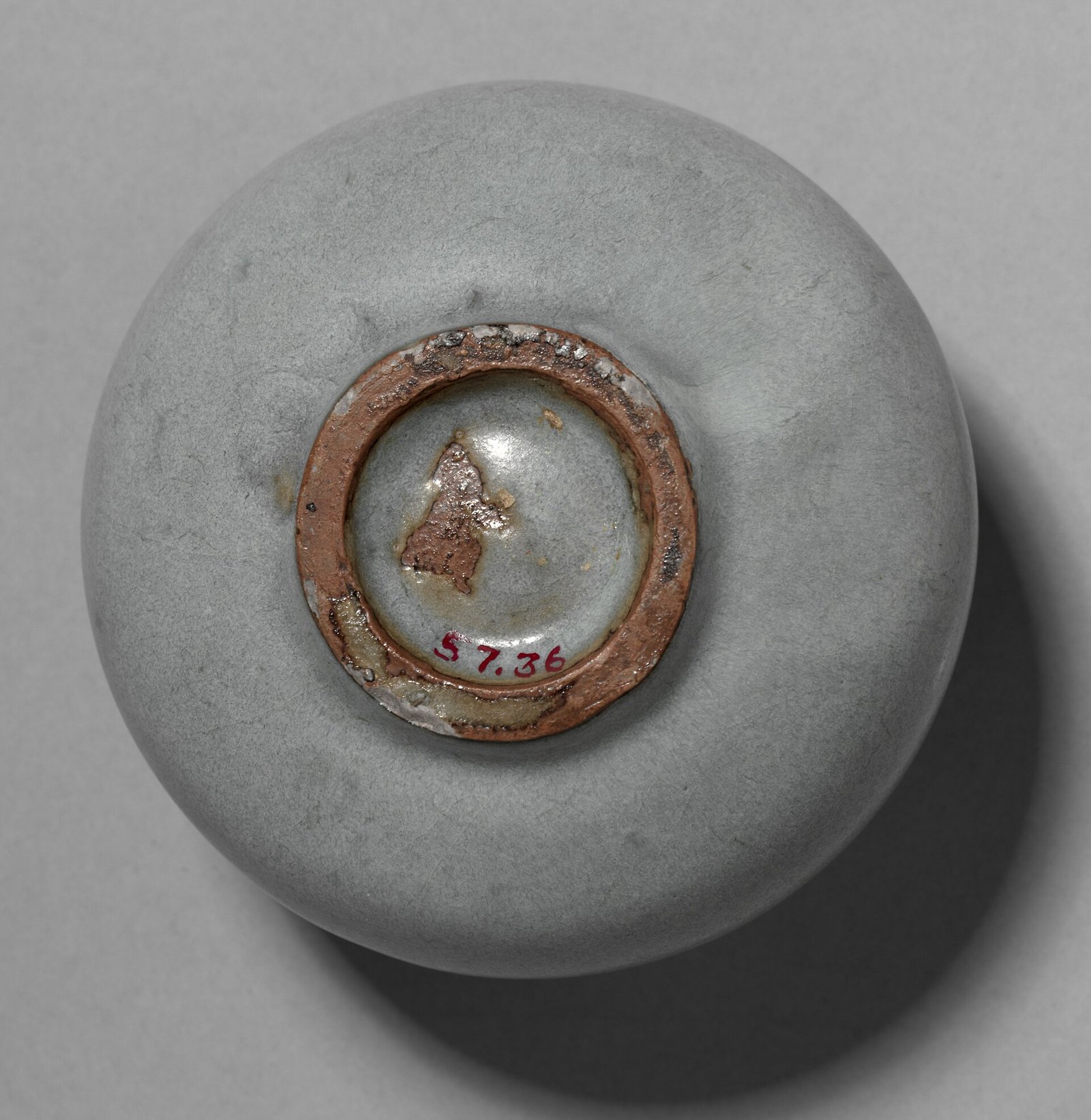
Thick opalescent blue, sometimes splashed purple from copper applied to the glaze before firing (the British Museum describes copper added to the wet glaze; the V&A describes copper brushwork applied to the dry glaze, merging with it at full heat — we note the disagreement rather than pick one), over a visibly coarse grey body. The blue is optical — light scattering in the glaze, not a pigment — which is why it looks lit from inside rather than coloured.
Look for: the glaze thinning to olive-brown over rims and raised edges, against that milky blue. If the blue is flat and even, it is probably not Jun.
Two cautions. First, the institutions hedge on whether Jun was court ware: the British Museum says it was made “for the domestic market, rather than the imperial court” and was “rarely exported”; the Met lists the Jun kilns among those making wares for the court. Do not assert either. Second, dating:
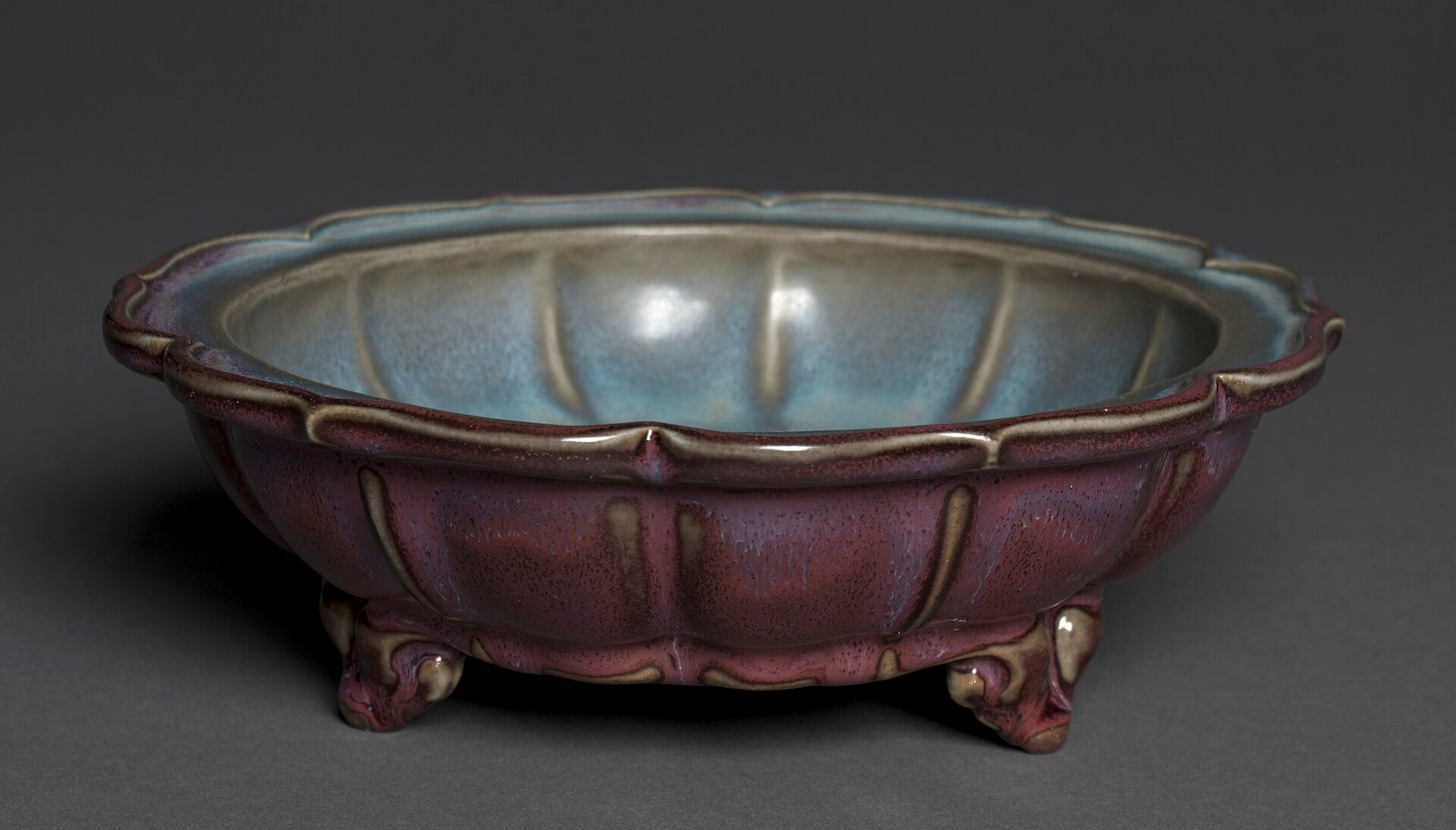
The famous “numbered” Jun flowerpots and narcissus bowls, incised 1 to 10 on the base, have been widely redated from Northern Song to early Ming. Cleveland dates the bowl above to the early 1400s. Given the sums involved in Jun attribution, treat any “Northern Song” numbered Jun with real caution.
Longquan 龍泉 — Zhejiang
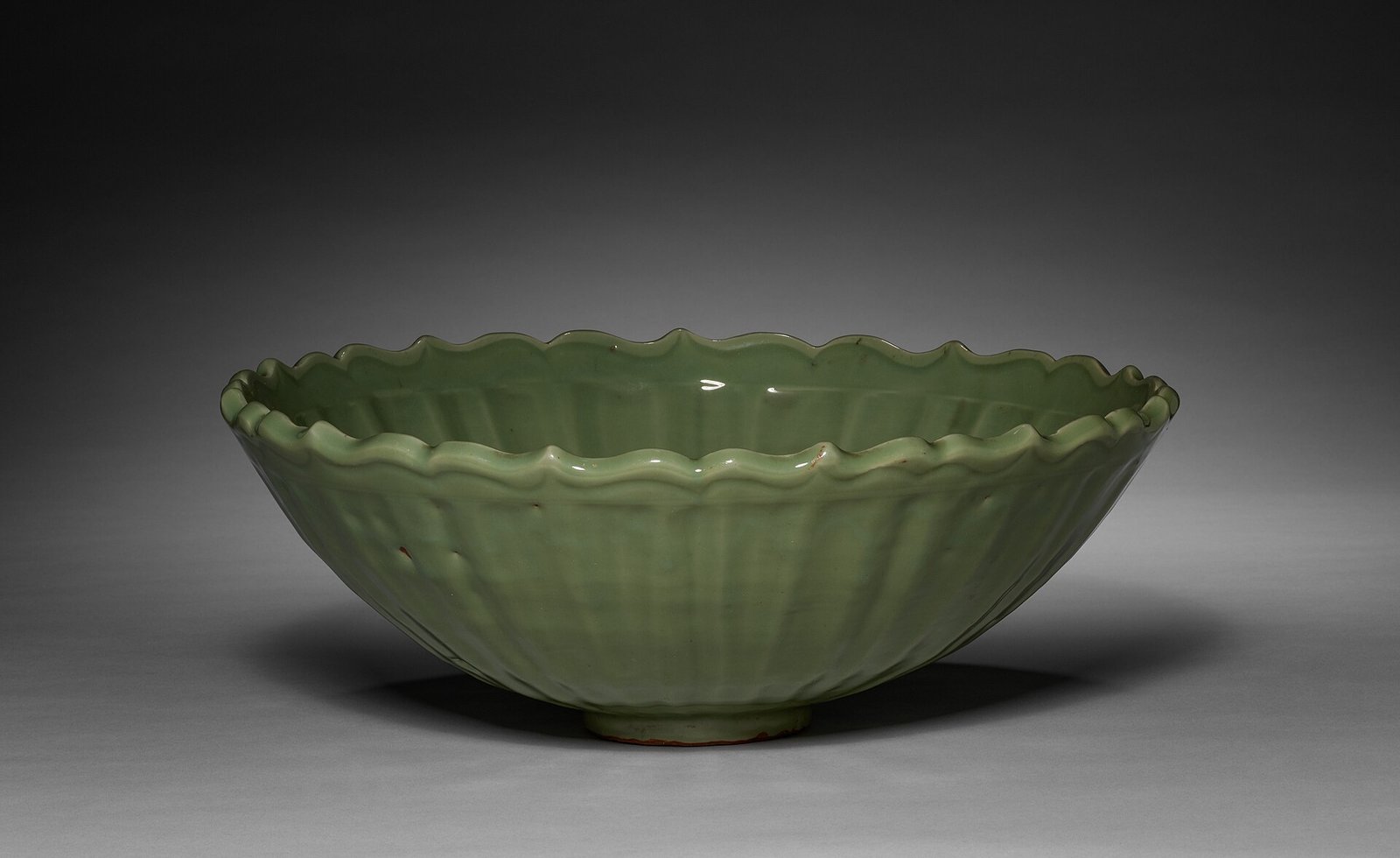
The great export celadon. The British Museum records that potters applied up to four separate layers of glaze to build depth and lustre, and identifies the finest as the blue-tinged wares of the late twelfth and early thirteenth centuries. By the late thirteenth century some Longquan “dragon kilns” exceeded 100 metres, firing tens of thousands of pieces at a time.
Look for: a thick, opaque, untranslucent blue-green glaze with a soft wet-jade surface, over a grey body that fires orange-brown wherever it is exposed at the foot.
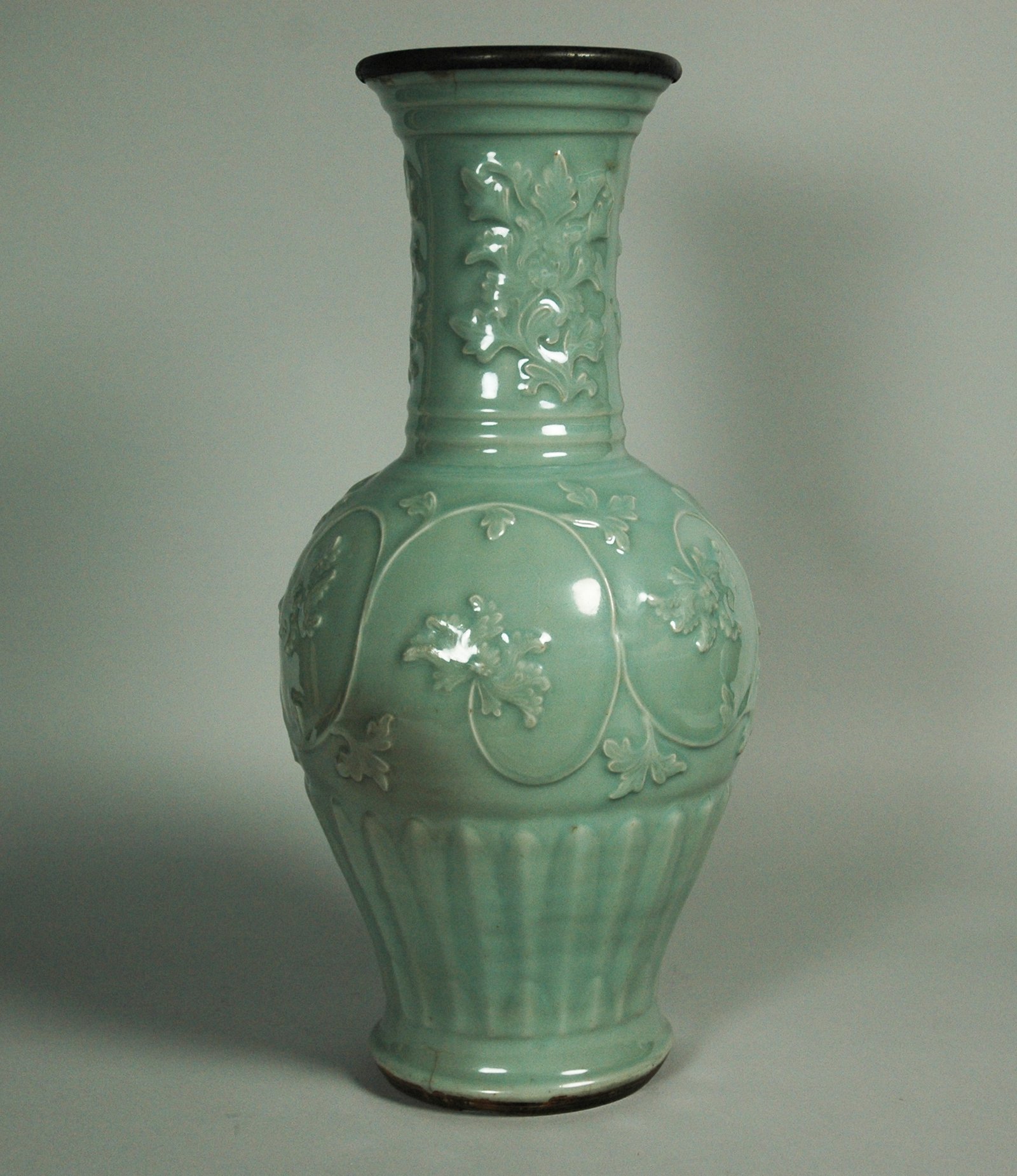
Dating Longquan honestly. The trade will give you a confident list — Yuan pieces heavier, the unglazed biscuit ring firing orange, the glaze going yellower. We could not source any of that institutionally. Two things we can source: decoration arrives (the Met identifies moulded peony relief as an innovation of the Longquan kilns, frequent there in the thirteenth and fourteenth centuries and continuing into the Ming), and scale arrives (the dragon kilns and mass export). A plain, thickly glazed, undecorated Longquan is more likely to be Southern Song; a moulded and decorated one more likely Yuan or later.
Yaozhou 耀州 — Shaanxi
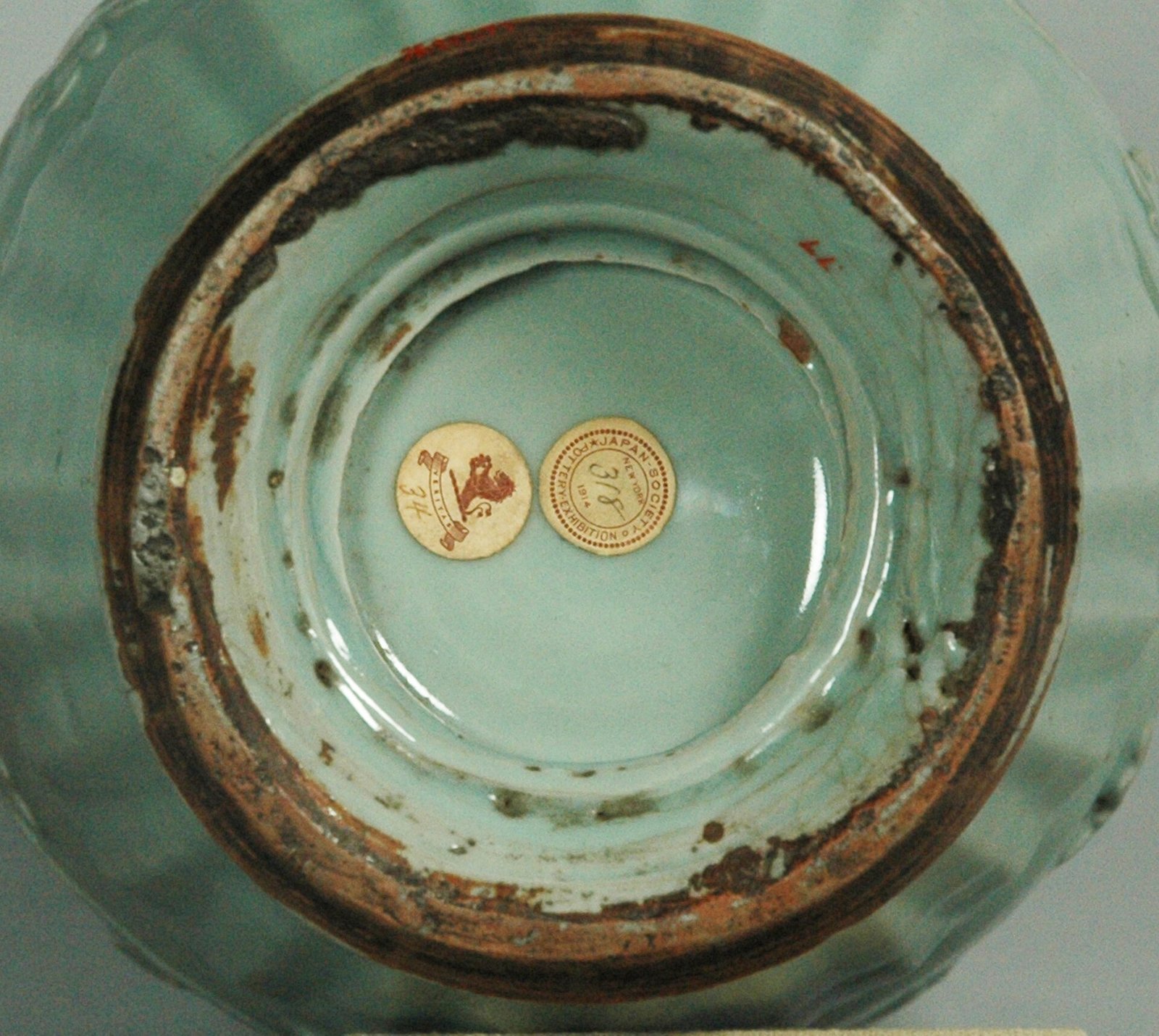
Buff-grey porcellaneous body under a thin, transparent olive-green crazed glaze, with deeply carved and combed decoration underneath. The Smithsonian says of one bowl that “the tool used was probably a piece of sharpened bamboo”.
Look for: carving that the glaze pools darkly inside. This is the cleanest separator from Longquan: Longquan’s thick glaze hides carving; Yaozhou’s thin glaze dramatises it.
Cizhou 磁州 — a family, not a kiln
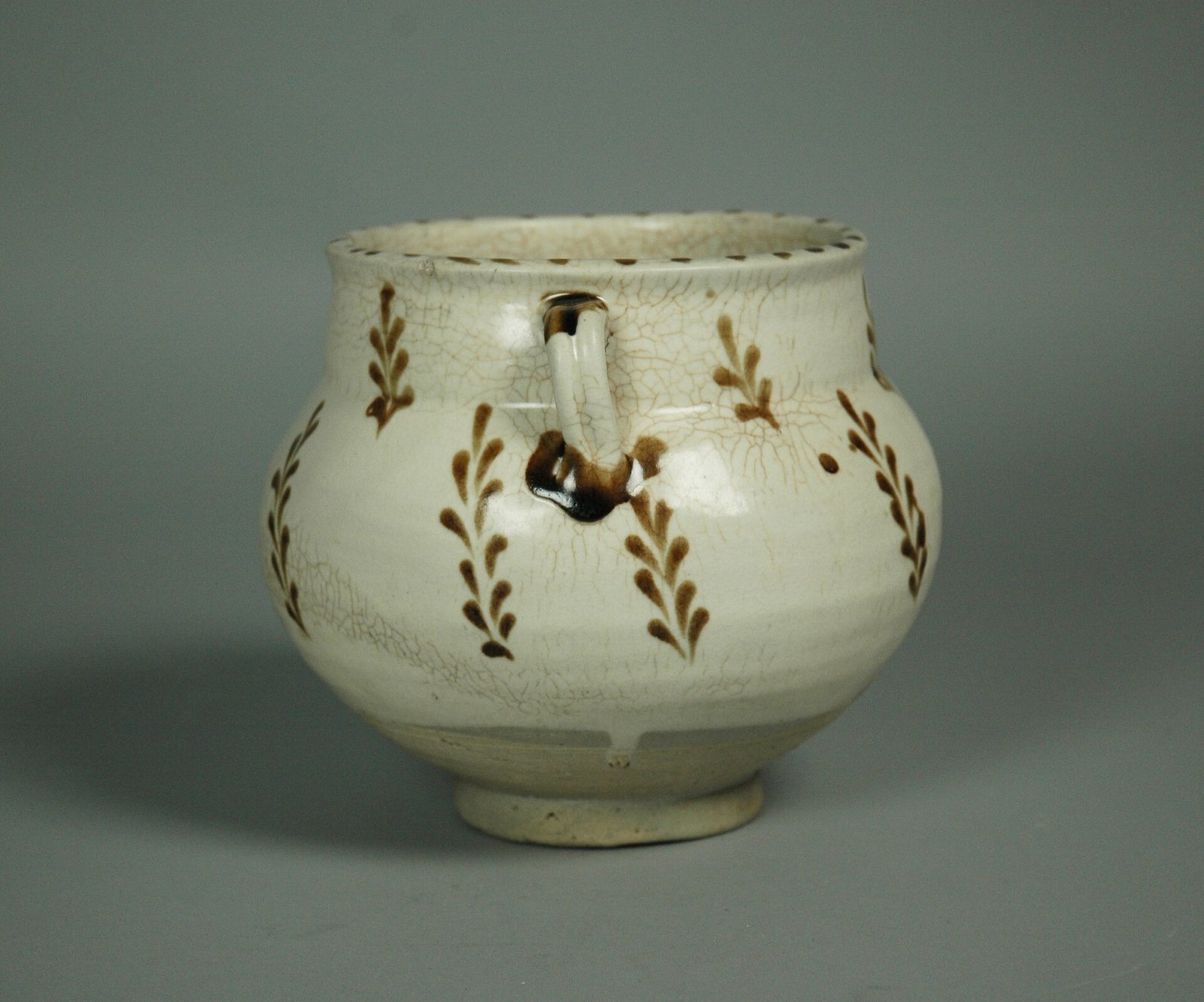
Not one kiln but a group across Hebei, Henan and neighbouring provinces. Coarse grey stoneware under white slip, then painted in brown or black, or carved through to reveal the contrasting slip beneath. The Met calls it “ceramics for popular use”, made in quantity for everyday use — the counterweight to the imperial monochromes.
Look for: a picture. If you can see brushwork or calligraphy on it, it is Cizhou-family, not one of the five.
What “celadon” actually means
It is not a Chinese word and it does not name a kiln. The Smithsonian defines celadon as “a large family of high-fired ceramics” whose glazes are coloured by small percentages of iron oxide — so the defining criterion is technical, not visual, and the results run “from sky blue to sea green”. The colour deepens when fired in a reducing, oxygen-starved atmosphere.
The word itself is commonly derived from Céladon, a shepherd in the seventeenth-century French drama L’Astrée, who wore grey-green. Note that even the Smithsonian hedges with “commonly believed”, and so should you.
Yue and Longquan are two wares inside that family, both from Zhejiang, several centuries apart. They are not synonyms for each other and neither is a synonym for celadon.
One term to handle carefully: kinuta. It is Japanese, it originally meant “mallet” — after the mallet-shaped vases exported to Japan — and it migrated from a shape word to a colour word in Japan. It is auction-room and Japanese-collector vocabulary; few museum catalogues use it, though the Met’s 1989 handbook does.
How Song ceramics actually travelled — not the Silk Road
Chinese ceramics did not reach the Islamic world along the Silk Road, and the reason is almost comically practical. The Smithsonian puts it in one line: “As ships could carry a much greater load than camels could, the maritime route from East Asia through Southeast Asia to South and West Asia became more important” — and the sea trade “made mass export of heavy, fragile Chinese ceramics possible for the first time”.
The scale settles it. A single ninth-century wreck off Belitung carried roughly 70,000 ceramic pieces, some 25 tons, nearly the entire surviving cargo. No caravan approaches that. For the Song period specifically, peer-reviewed work on wrecks including Nanhai No. 1 identifies Guangzhou as a loading port and the cargoes as the products of several kiln groups — Jingdezhen, Longquan, Dehua, Cizao, Minqing and Jian among them — bound for South-East Asia.
Europe is a different and much later story — the Portuguese and Dutch carrying trade of the sixteenth and seventeenth centuries. Any guide that has Song celadon crossing Central Asia by camel to Venice has invented it.
Buying Song
Three things we would say to anyone starting here. Condition conventions differ. Crackle on Guan and Ge is intended; a hairline is not. Know which you are looking at before you discount a price. The foot is the evidence. Every identification above turns on the base or the rim, which is exactly what most online listings do not photograph. Attributions move. The British Museum notes that Chinese ceramics “are constantly being redated and reattributed” — and its own Ru brush washer spent about fifty years catalogued as Korean before analysis in 2021 put it right.
You can see what we currently hold in Song ceramics, and the wider group of green wares under celadon and Longquan.
Sources
- British Museum, Room 95 Chinese ceramics gallery guide
- The Palace Museum, Beijing, on Ge ware
- The Palace Museum, Beijing, on Ru ware
- British Museum, Ru ware bowl PDF.3
- Smithsonian National Museum of Asian Art, on green and celadon
- Smithsonian NMAA, Shipwrecked: Tang Treasures and Monsoon Winds
- Peining Li, “The trade patterns of the South China Sea during the Song period”, Asian Archaeology 3 (2020)
- The Metropolitan Museum of Art, Longquan vase 26.292.77
Written by James Treacher. Where museums disagree — on Longquan’s body, on Jun’s status, on Ge’s date — this page says so rather than picking the tidier answer.