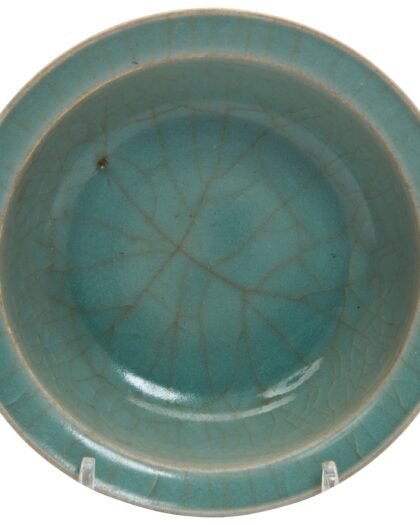
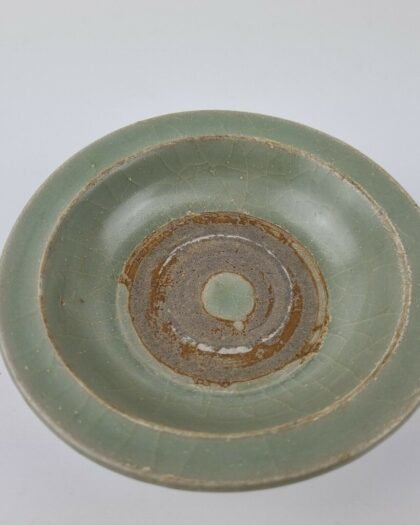
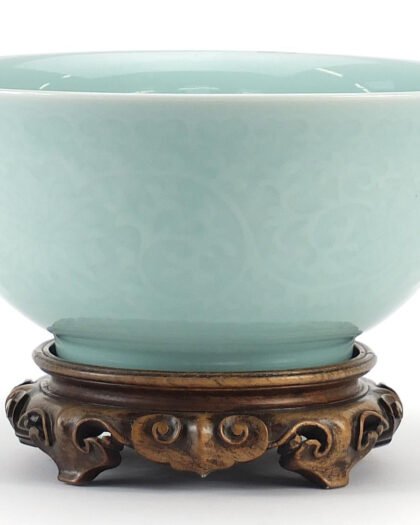
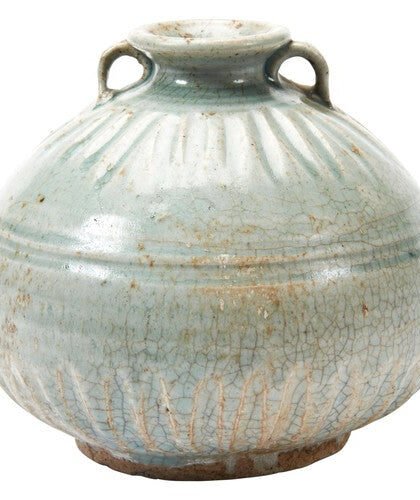
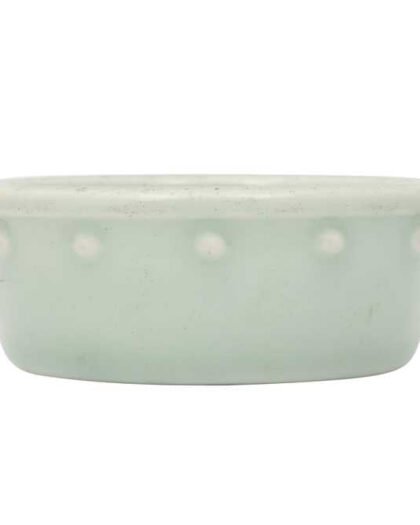
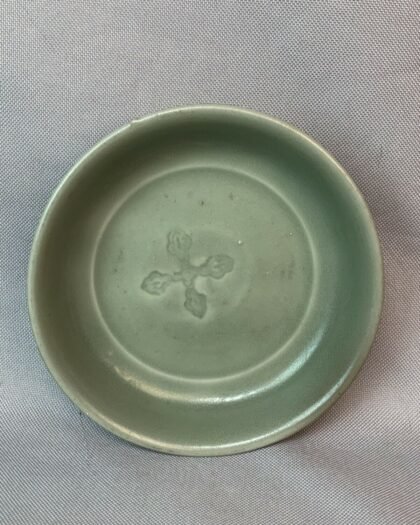
Celadon is a Western word for a family of high-fired stoneware and porcelain glazes coloured green by a small amount of iron fired in a reducing kiln. Longquan, in Zhejiang province, is the kiln complex that made the celadon most people have in mind: a thick, soft, jade-like glaze in tones from olive to blue-green, over a grey body that burns orange where it is exposed. The terms overlap and are often confused — the journal untangles celadon, Longquan and Yue — but the pots themselves are among the most satisfying objects in Chinese ceramics.
A short history
Green-glazed stoneware was made in China for many centuries before Longquan, notably the Yue wares of the Zhejiang coast. Longquan rose in the Northern Song and reached its peak in the Southern Song, after the court moved to Hangzhou in 1127; the British Museum records that connoisseurs regard the finest celadons as those with blue-tinged glazes made in the late twelfth and early thirteenth centuries. Yuan and Ming Longquan was made in great quantity and larger sizes for export — big dishes for the Middle East, incense burners, vases and jars for Southeast Asia — with a thicker, greener glaze and bolder carved and moulded decoration. Jingdezhen made its own celadon-glazed porcelain from the Ming on, and under Yongzheng and Qianlong produced refined imitations of the Song glaze that are collected in their own right. Korea’s Goryeo celadon is a separate tradition, covered on the Korean page.
How to read a piece
The glaze. Southern Song Longquan glaze is thick, opaque and layered, with a soft surface that does not glitter; it pools blue-green in recesses and thins to a pale line over carved edges. Later export glaze is thinner, glassier and greener. Jingdezhen celadon on porcelain is thin, even and transparent over a white body. Crackle is not usual in Longquan and its presence is worth noting.
The foot. Longquan was fired standing on its unglazed foot ring, and the iron in the body oxidised where it was exposed to a characteristic orange or brick red — the “burnt foot” that copyists rarely get right. Some Ming dishes have an unglazed ring inside the base where a stacking support sat. The guide to reading the base shows both on museum examples.
The body. Song Longquan is grey and fine; export ware is coarser and heavier. Tap a foot rim gently: a dull note usually means a hairline.
Condition
Glaze crawls, kiln grit and small firing cracks are common on Longquan and are recorded as firing faults, not damage. Chips on a thick celadon glaze show the grey body underneath and are easy to see; hairlines are harder and we photograph them. See what a hairline does to value.
Read more
The Song ceramics guide sets Longquan among the other Song kilns, and the Song, Yuan and Ming collection pages carry the period context. For crackled celadons see Ge and Guan crackle.