Song
The Song dynasty (960–1279) is where serious collecting of Chinese ceramics usually begins, and for a reason that has nothing to do with age. Song potters made stoneware and early porcelain whose whole effect lies in the glaze — its colour, its depth, the way it thins over an edge and pools in a recess — with decoration either absent or carved and moulded under the glaze so that it reads as light and shadow. The court and the scholar class prized restraint, and the pots show it.
The kilns
The Northern Song (960–1127) is the period of Ding, the fine white porcelain of Hebei with its characteristic unglazed rim, often bound in metal, because the bowls were fired upside down; of Ru, the rarest of all Chinese glazes, made for the court for only a few decades around 1100; of Jun, with its thick opalescent blue glaze and copper-purple splashes; of Yaozhou‘s carved olive-green celadons; and of Cizhou’s robust black-on-white slip-painted stonewares. After the court fled south in 1127, the Southern Song (1127–1279) produced Guan, the official ware of Hangzhou, with its dark body and thick, widely crackled celadon glaze (British Museum, Room 95), and brought Longquan in Zhejiang to its peak. The British Museum’s guide records that connoisseurs regard the finest Longquan celadons as those with blue-tinged glazes made in the late twelfth and early thirteenth centuries — the glaze most people have in mind when they say “Song celadon”.
One caution on terminology. The “Five Great Kilns of the Song” — Ru, Guan, Ge, Ding and Jun — is a ranking made by Ming and Qing connoisseurs looking back, not a category the Song themselves used, and Ge in particular is a ware whose dating is still argued over. We use the kiln names, not the league table.
How to look at a Song pot
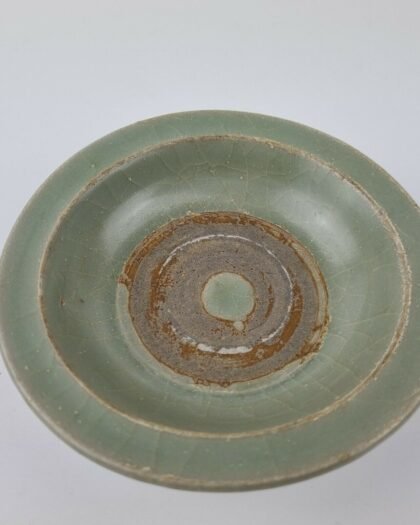
Song wares were fired in saggars on a variety of supports, and the support leaves its signature. Longquan and most Southern Song celadons stood on an unglazed foot ring that fired orange-red where the iron in the body oxidised — the “burnt foot” that a later copy rarely gets right. Ding was fired on its rim. Jun and Ru sat on tiny spurs. The foot therefore does most of the work of attribution, and our guide to reading the base shows these supports on museum examples. Marks are almost absent from Song ceramics; a pot with a reign mark and a Song attribution is telling you something is wrong.
Condition matters differently here. Glaze crackle in Guan and Ge wares is intended and is not damage; a hairline through the body is. Kiln grit, glaze skips and firing cracks are common and are recorded, not hidden. Our note on what a hairline does to value explains how we grade them.
Further reading
The full guide to Song ceramics covers each kiln in turn with museum examples, and the journal explains the muddle of celadon, Longquan and Yue as terms.
In the collection
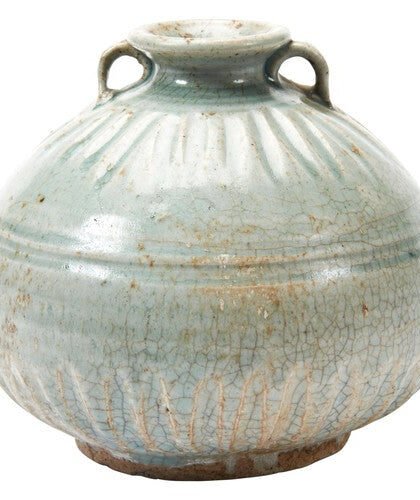
The Song group here is small and considered: a celadon glazed jar formerly in the collection of G. R. A. Murray and exhibited at the National Gallery of South Africa, Cape Town, in the 1953 Chinese Exhibition (no. 115), and a small Longquan celadon dish. Where a base photograph is still to be taken, the listing says so.
Showing all 2 results