Yuan
The Yuan dynasty (1279–1368) is short, Mongol, and decisive for the history of porcelain. It is the period in which Jingdezhen in Jiangxi became, in the British Museum’s phrase, the most important porcelain manufacturing centre in the world — a position it has held since about 1300 — and in which cobalt oxide imported from the Middle East and Central Asia was first used there on a large scale to paint under the glaze. Blue and white, the ware that would define Chinese ceramics for the next six centuries, is a Yuan invention in its mature form.
What was made
Jingdezhen’s white porcelain body, refined by the addition of kaolin, took a range of glazes: the bluish-white qingbai that continued from the Song; shufu, an opaque white glaze associated with official orders; and the new underglaze blue and underglaze copper red. Yuan blue and white is typically large — dishes, jars, meiping vases — densely painted in registers of lotus, peony, dragons, fish and figures, often for export to the Islamic world where the big dishes suited communal eating. The Met attaches the “heaped and piled” effect of cobalt darkening where it collected thickly to Yuan painting, and notes it disappearing in the early fifteenth century (Met, 1987.10).
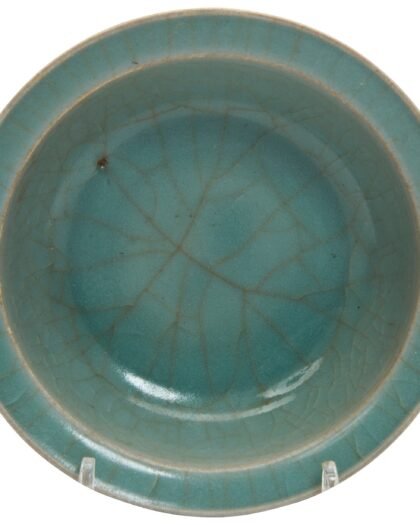
Away from Jingdezhen the Song kilns carried on. Longquan celadon was made in enormous quantity for export, with a thicker, greener glaze than the Southern Song ideal; Jun continued in the north; Cizhou’s painted stonewares served the domestic market. Ge-type crackle wares are now often placed by museums in the Yuan or later rather than the Song, which is one reason we describe crackled celadons cautiously.
Reading a Yuan piece
Yuan porcelain bodies are heavier than Ming, the feet often broad and flat with a slightly convex, unglazed base showing kiln grit and iron spots. Glazes tend to a bluish or greenish tinge over the white. Reign marks do not exist on Yuan porcelain; an inscribed date is a rarity to be treated with great care. The foot, the glaze colour and the painting style do the work, and the guide to reading the base shows the type of unglazed foot to expect.
Yuan is also the period most abused by later copyists, because the big blue and white pieces command such prices. A confident attribution needs the object in hand, and where we are not certain we say so in the listing.
In the collection
At present the Yuan group is a single small celadon-glazed crackle bowl. It is listed with its faults itemised, and the crackle — which is the glaze, not damage — is described as such. For the wider context see the guides to Song ceramics and Ming porcelain, which cover the periods either side.
Showing the single result