Vietnamese
Vietnamese ceramics have two stories, and the piece a British collector is most likely to meet belongs to the second. The first is a native tradition: Vietnamese blue and white made at Chu Dau in the Red River delta in the fifteenth and sixteenth centuries, exported across Southeast Asia and known to the world largely through the wreck found off the Cham Islands near Hoi An, whose cargo of a quarter of a million pieces or more was excavated in the late 1990s (Smithsonian National Museum of Asian Art). The second is Bleu de Hué — Chinese porcelain, made at Jingdezhen to Vietnamese order for the Nguyen court and Vietnamese market in the eighteenth and nineteenth centuries, and so, strictly, Chinese porcelain with a Vietnamese history.
Chu Dau and the Hoi An cargo
Chu Dau blue and white has a greyish body, a cobalt that fires to a soft grey-blue, and painting that is freer and more calligraphic than Jingdezhen work of the same date; dishes, jars, bottles and small kendi and cups were made in quantity. The Hoi An wreck, dated to the late fifteenth or early sixteenth century, put thousands of intact examples onto the market at the turn of the century and is the reason genuine Vietnamese blue and white is affordable. Pieces from it usually have sea-wear, shell adhesion or glaze loss, and that condition is a form of provenance.
Bleu de Hué
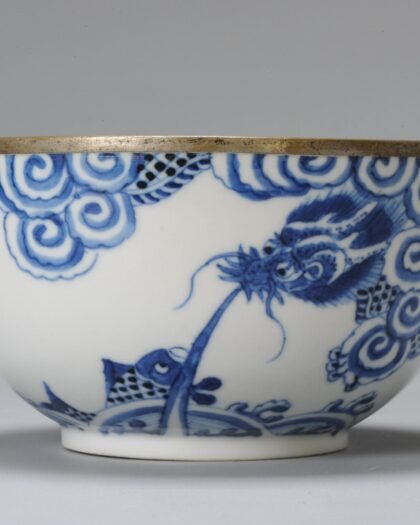
From the eighteenth century the Vietnamese court and gentry ordered porcelain from Jingdezhen painted to Vietnamese designs — landscapes, poems, dragons, the motifs of Nguyen court taste — and the French term Bleu de Hué, after the Nguyen capital, covers these wares. They are Chinese in body, glaze and cobalt and Vietnamese in design and ownership, which is why museums and this site catalogue them as Chinese porcelain made for Vietnam. Some carry Vietnamese reign or hall marks in Chinese characters; the reading of a given mark should be checked against a documented example, and where we cannot do that we say so. The guide Bleu de Hué is Chinese porcelain goes into the history and the marks.
Telling the two apart
The body settles it. Chu Dau ware is a stoneware-like body that fires grey or buff, with a glaze that often crazes and a foot that is roughly finished and sometimes chocolate-washed; Bleu de Hué is Jingdezhen porcelain, white, fine and translucent, with a clean foot and a sapphire or steely cobalt. Design and mark then tell you the market it was made for. We show the base in our listings for exactly this reason.
In the collection
One piece at present: a nineteenth-century Bleu de Hué bowl with a marked base, catalogued as Chinese porcelain made for Vietnam. See also the Qing collection for the Jingdezhen context.
Showing the single result