If you have come here from a Chinese porcelain marks guide, the most useful thing we can tell you is that almost none of it transfers.
Korean ceramics do not use reign marks. There is no Korean equivalent of 大清康熙年製 — no formula naming a dynasty, a monarch and “made in the years of”. What Korea has instead is a tradition of administrative and ritual inscriptions: marks added for accounting, ownership or ritual function, rather than to declare a date or a maker. Turning a Joseon jar over and finding nothing is the normal result, not a bad sign.
We should be straight about the evidence. No museum publishes the sentence “Korean ceramics are overwhelmingly unmarked”. What we can show is the positive body of inscription types below, every one of which is administrative or ritual, and the complete absence of a reign-mark category in any Korean record we examined. Take the headline as our judgement, and the detail below as sourced.
The marks that do exist
1. Government office stamps on buncheong — and they date things
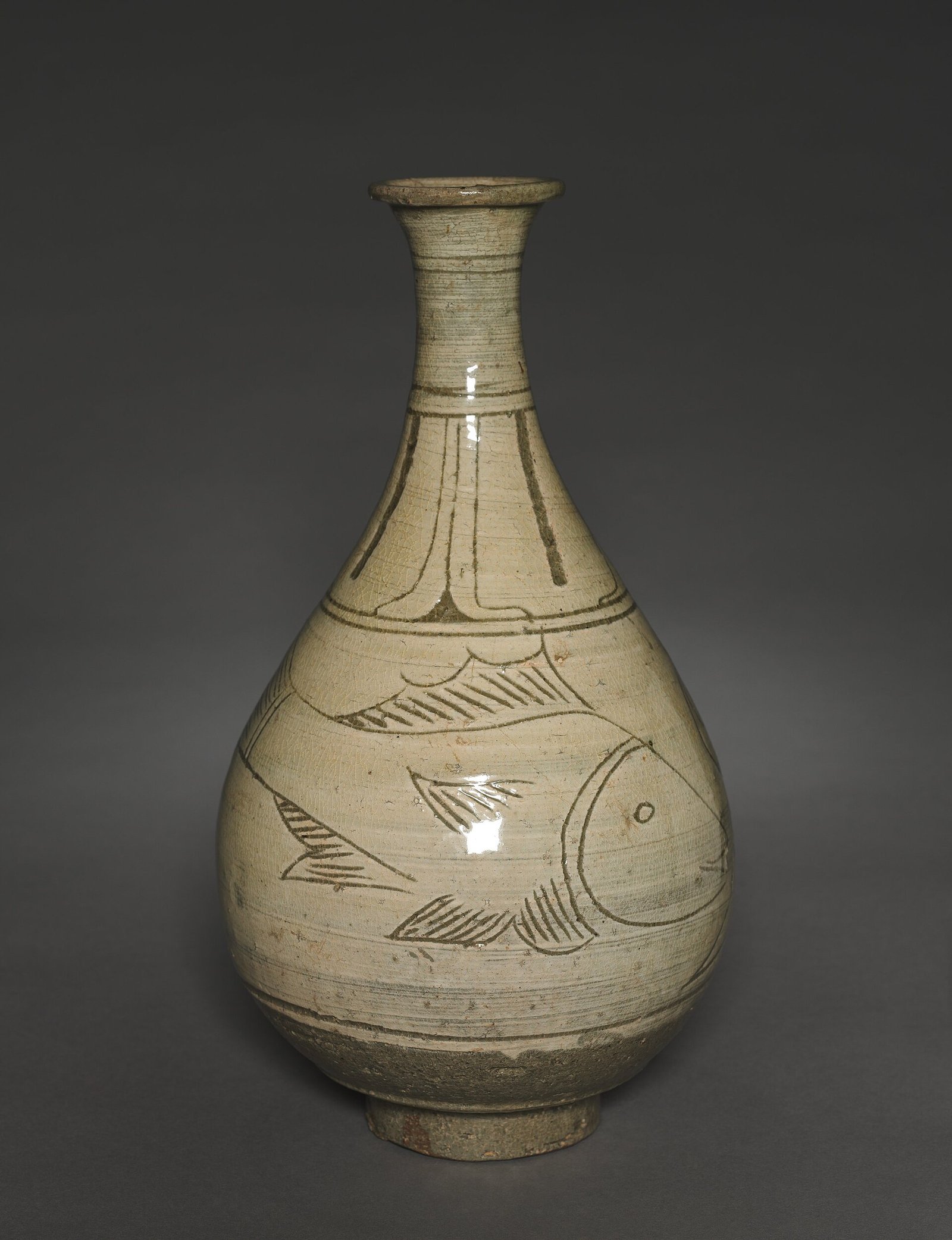
This is the single most practically useful marks fact in Korean ceramics, and hardly any trade guide carries it. Fifteenth-century buncheong wares were stamped with the names of the court bureaux they were made for. The Met holds a mid-fifteenth-century bowl whose “stamped inscription indicates that this bowl was made for Naeseom-si, a court bureau” supervising tributary products sent to the palace.
The purpose was anti-theft accounting: only about a fifth of the vessels used at official banquets were finding their way back to the bureaux, so pieces were marked to identify them.
And because those bureaux existed for known periods, the stamp is a dating bracket:
| Bureau inscribed | Operative dates |
|---|---|
| Gonganbu 恭安府 | 1400–1420 |
| Innyeongbu 仁寧府 | 1400–1421 |
| Gyeongseungbu 敬承府 | 1402–1418 |
| Deoknyeongbu 德寧府 | 1455–1457 |
| Jangheunggo 長興庫 | the most frequently inscribed |
| Naeseom-si, Naejasi, Insubu, Yebinisi | various |
A Gyeongseungbu mark means 1402–18. That is a tighter date than most Chinese reign marks will honestly give you. One caveat we would rather state than hide: these bureau date ranges come from a single scholarly catalogue — the joint Met–Leeum catalogue (2011) — and we have not been able to corroborate them against a second institution. Treat them as that catalogue’s figures, not as settled fact, and check before relying on them for a valuation. The same applies to the 1421 decree below. Source: the Met’s Korean Buncheong Ceramics from Leeum, Samsung Museum of Art.
2. Potters’ names — by decree, in 1421
The same catalogue records a government order of 1421 requiring that the names of potters be inscribed on the bases of vessels, so that craftsmen’s work could be assessed and poor makers replaced. Note what this is: quality control, not a signature tradition. It does not mean Korean potters signed their work as artists.
3. Place names
Production locations were inscribed, chiefly in Gyeongsang province — Gimhae, Gyeongsan, Gyeongju and others — marking where a ware was made and sent as tributary tax.
4. Royal household inscriptions, including hangeul
The National Museum of Korea’s own journal publishes the best account of these (Yunjeong Kim, Journal of Korean Art and Archaeology vol. 11, 2017). The findings matter for anyone examining a piece:
- They were typically added after manufacture — stippled hangeul on finer pieces, often accompanied by Chinese characters such as 天 or 地; inked on lesser ones. So the inscription can postdate the pot.
- They name royal kitchens — utsyo, daesyo, keunsyo, dongsyo — serving the queen dowager, the king and the crown prince.
- Placement moved over time: sixteenth-century examples on the base, later examples on the body near the foot.
- The purpose was to mark vessels as private royal property and reduce loss.
- Concentrated production of marked pieces begins under King Jungjong in the sixteenth century, with cyclical year names added in later centuries.
Read that last point carefully. Korean cyclical dates are a later addition to an ownership-inscription tradition — not a dating convention comparable to the Chinese reign mark.
5. Single characters — and they are not always on the base
- 重 (jung), in cobalt on the underside of a nineteenth-century Met jar, which “may refer to the location for which the jar was commissioned” — Junghui-dang, a lost hall in Changdeokgung.
- 祭 (je), “ancestral rite”, painted in a circle on a nineteenth-century blue-and-white ritual dish (University of Michigan Museum of Art, 2004/1.283). Simple white wares were preferred for Confucian ancestor veneration, and round dishes held fruit and vegetable offerings.
The 祭 mark sits on the face of the dish, not the base. If you only ever turn things over, you will miss it.
6. Goryeo celadon inscriptions — rare, and ritual
Inscribed Goryeo celadons excavated from the Goryeo palace site carry marks such as 燒錢 (Sojeon) and 成 (Seong), plus symbols, connected with Taoist rituals for state protection — not with administration or commerce.
Two things we are leaving out on purpose. The 官 (gwan) mark on Goryeo celadon, and the numeral and 천지현황 character sequences said to appear on Bunwon foot rims, are both widely cited in the trade. We could not source either from any museum or peer-reviewed publication, so we will not illustrate them from guesswork. They may well be real; we simply cannot vouch for them.
The kilns behind the marks
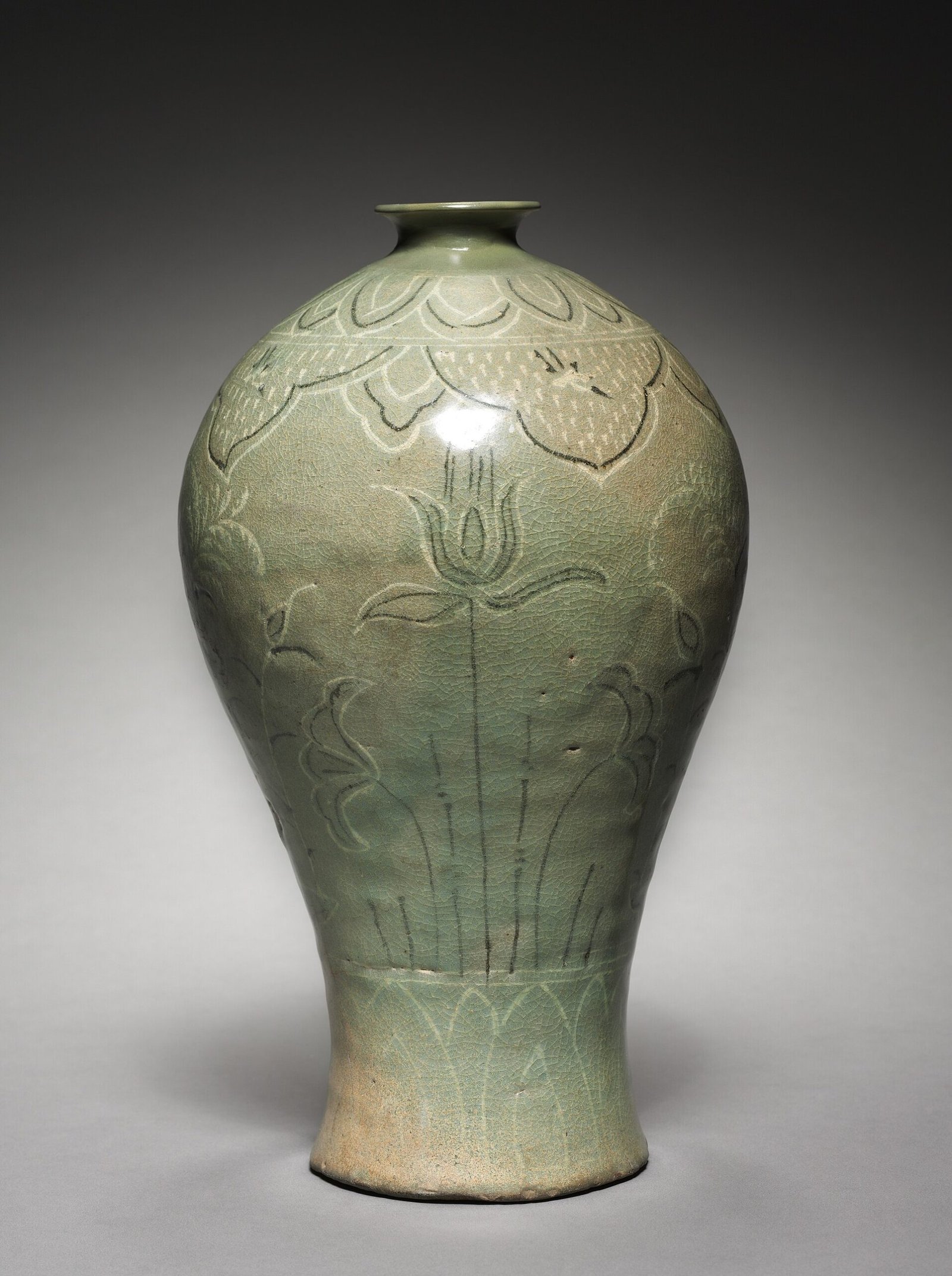
Goryeo (918–1392) is the celadon dynasty: the Met records that celadon “constituted the main type of ceramics produced on the Korean peninsula” for nearly five centuries, from kilns chiefly at Gangjin and Buan in Jeolla province. Its distinctive achievement is sanggam inlay — motifs etched into the dry body, filled with black and white slip, then glazed and fired. The technique is essentially Korean; it is rare in Chinese production.
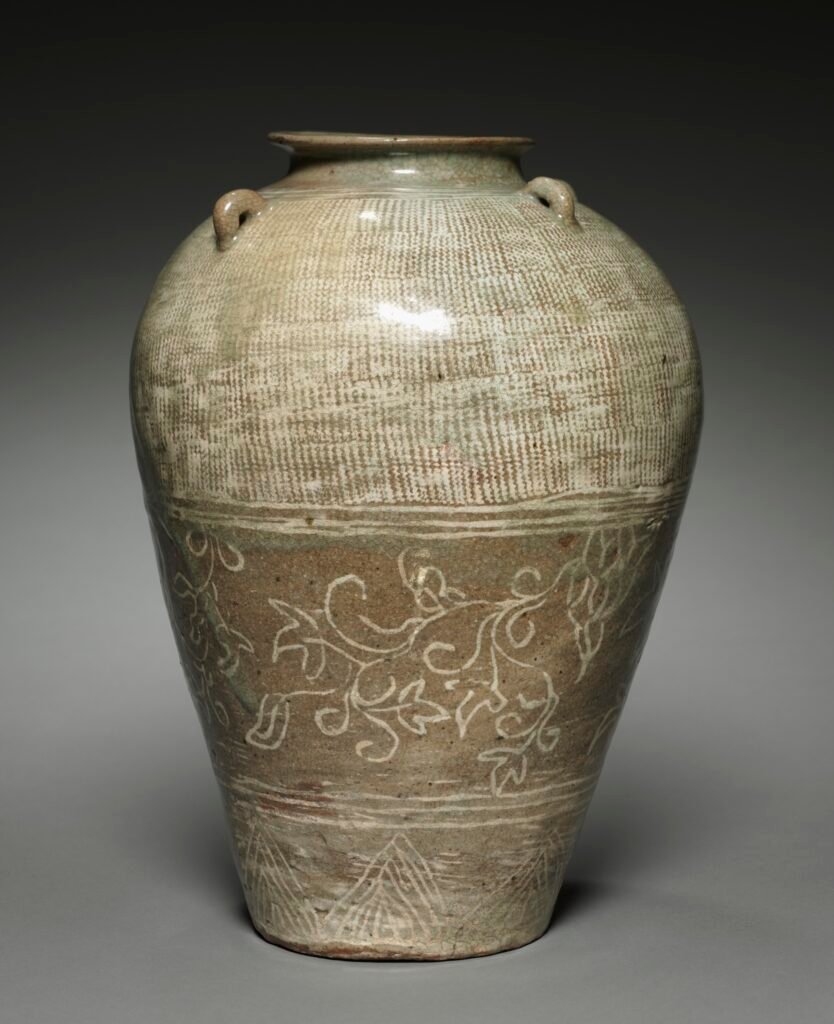
Buncheong spans roughly the first two centuries of the Joseon: a coarser grey body decorated with white slip under a green-tinged glaze, in regional modes — stamped and inlaid in Gyeongsang, incised and sgraffito in Jeolla, iron-painted in Chungcheong, and later slip-brushed (guiyal) and slip-dipped (dumbeong). The Met is precise about how it ends: “Gradually replaced by porcelain by the end of the sixteenth century, the buncheong tradition was brought to an end with the Japanese invasions of Korea between 1592 and 1598.”
Those invasions matter to Japanese ceramics too. Korean potters were taken to Hizen on Kyūshū, and it was they who found porcelain clay at Arita in the early 1600s — the beginning of Japanese porcelain. See our guide to Japanese ceramic marks.
The Bunwon. The official court kilns were initiated by the royal court in the 1460s at Gwangju, outside present-day Seoul, and — the detail that surprises people — continued as the official court kilns until their privatisation in the 1880s. Four hundred and twenty years.
A correction: white porcelain was not restricted to the court
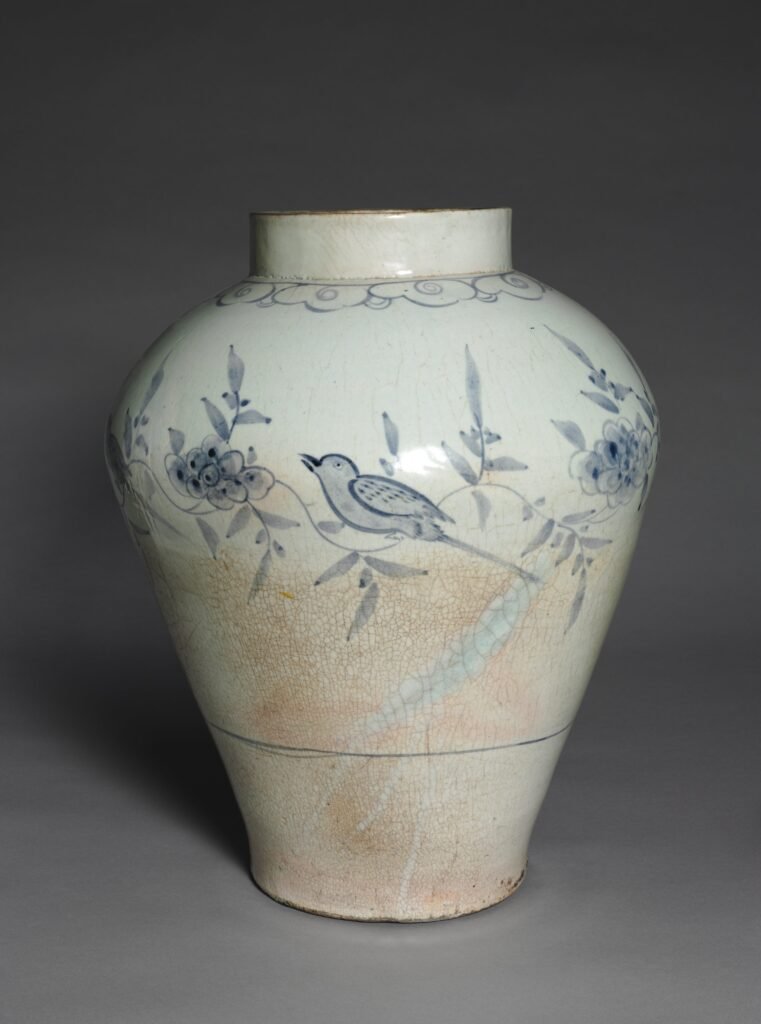
You will read that Joseon white porcelain was reserved for royal use. The Met states the opposite in terms: “By the sixteenth century, white ware was no longer the sole domain of the court or even the privileged few living in the capital.”
It began as court ware, adopted in the fifteenth century. It did not stay that way. The one genuine restriction we can source is narrower: Cleveland records that dragon jars were “reserved only for the king”, while moon jars and decorated porcelains were commissioned by upper and middle classes for household rituals.
And we could not find any dated Joseon sumptuary edict — the 1466 regulation sometimes quoted did not survive checking. We do not print a date for a law we cannot produce.
The moon jar
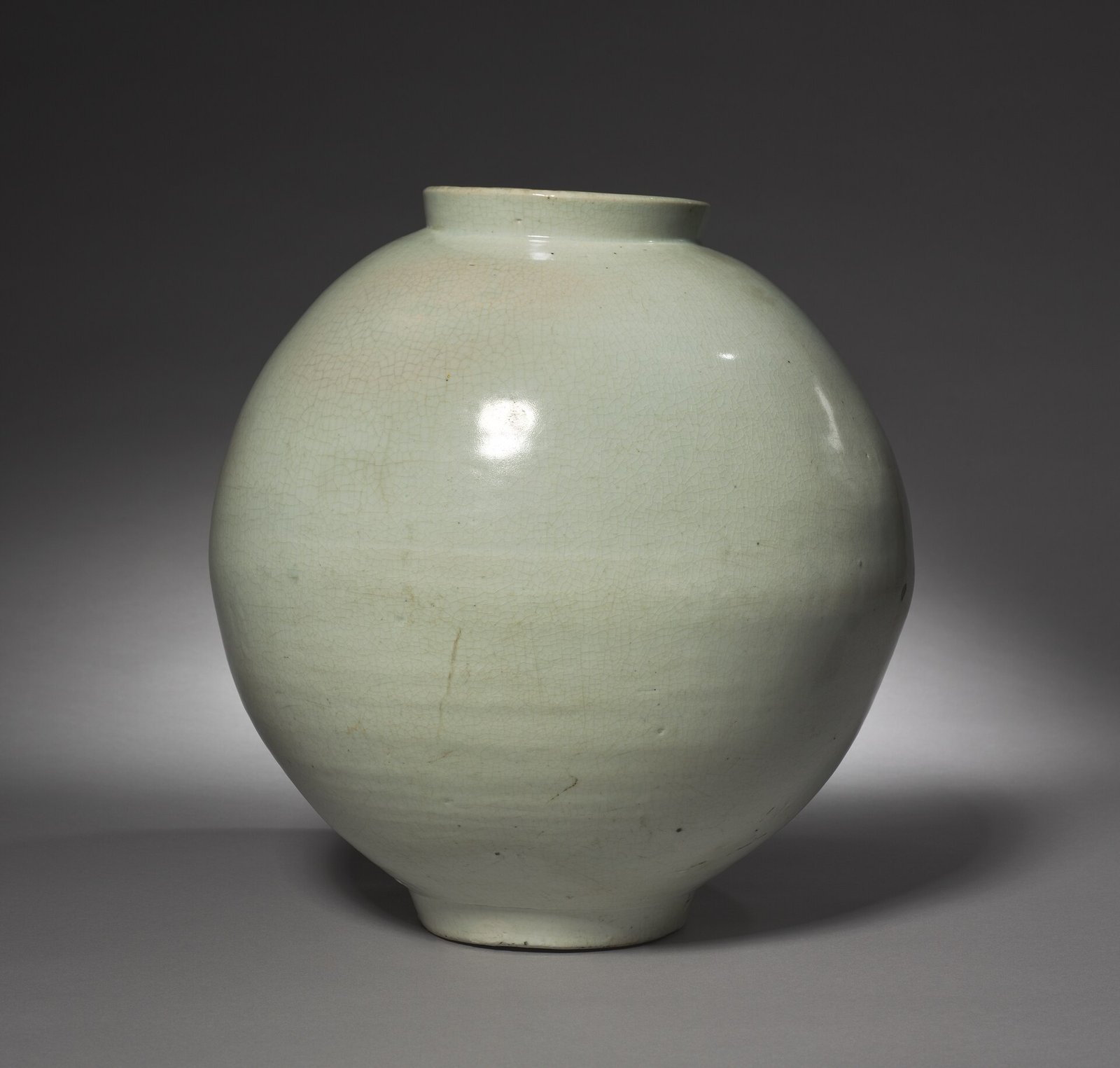
Because it is the object most people come to Korean ceramics for, and because its most misunderstood feature is a mark of a different kind — the join.
A jar of this size cannot be thrown in one piece. The National Museum of Korea is blunt about the physics: a jar above about 40 cm made in one piece would break in the kiln, so the upper and lower halves are thrown separately and joined at the widest point. The British Museum notes that the two bowl-shaped halves then “shrink and sag in the firing”, producing the characteristic asymmetry.
Every institution treats the asymmetry as the point, not a defect. The National Museum of Korea speaks of a charm arising from “natural beauty, which does not conform to an exact set pattern”; the Met records that collectors prize “unintentional features acquired during firing, such as asymmetry or the final hue”. Most moon jars, to our eye, are a waning moon rather than a full one.
Dating is genuinely unsettled and you should know the spread before you buy: the British Museum dates its jar to the eighteenth century, the Met to the second half of the eighteenth, Cleveland to the 1700s, and the V&A dates its own example 1800–1900. Heights across those records run about 34–47 cm.
They began as utilitarian storage jars — daeho, “big jar” — fell into neglect by the 1800s, and were rediscovered in the twentieth century. The best-known of all, the British Museum’s 47 cm jar, was bought by Bernard Leach in Korea in 1935, given to Lucie Rie in 1943, and stood in her studio until her death.
More on this in our journal: the Joseon moon jar and its join.
One more caution, from the British Museum’s own shelves
In 1928 Sir Percival David bought a small green-glazed brush washer in New York, believing it to be Chinese Ru ware. By about the 1970s scholars had reclassified it as Korean, “and the attribution stuck for 50 years”. In 2021 it was re-identified as Ru after all — by Regina Krahl, confirmed with handheld XRF analysis developed with Cranfield University’s Forensic Institute. It is one of fewer than a hundred surviving Ru pieces.
Korean and Chinese green wares have been confused at the highest level, in both directions, for a century. If a piece is being sold to you on the strength of a confident attribution and nothing else, that is the story to remember.
Sources
- The Metropolitan Museum of Art, Goryeo Celadon
- The Metropolitan Museum of Art, Joseon Buncheong Ware
- The Metropolitan Museum of Art, In Pursuit of White
- Korean Buncheong Ceramics from Leeum, Samsung Museum of Art, The Metropolitan Museum of Art
- Yunjeong Kim, “Sixteenth-century Joseon White Porcelain with Hangeul Inscriptions”, Journal of Korean Art and Archaeology 11 (2017), National Museum of Korea
- National Museum of Korea, on the moon jar
- British Museum, moon jar 1999,0302.1
- British Museum, Ru ware re-identification, 2021
- Cleveland Museum of Art, moon jar 1983.28
Written by James Treacher. Two commonly published Korean marks — the gwan mark and the Bunwon foot-rim numerals — are deliberately absent because we could not source them.