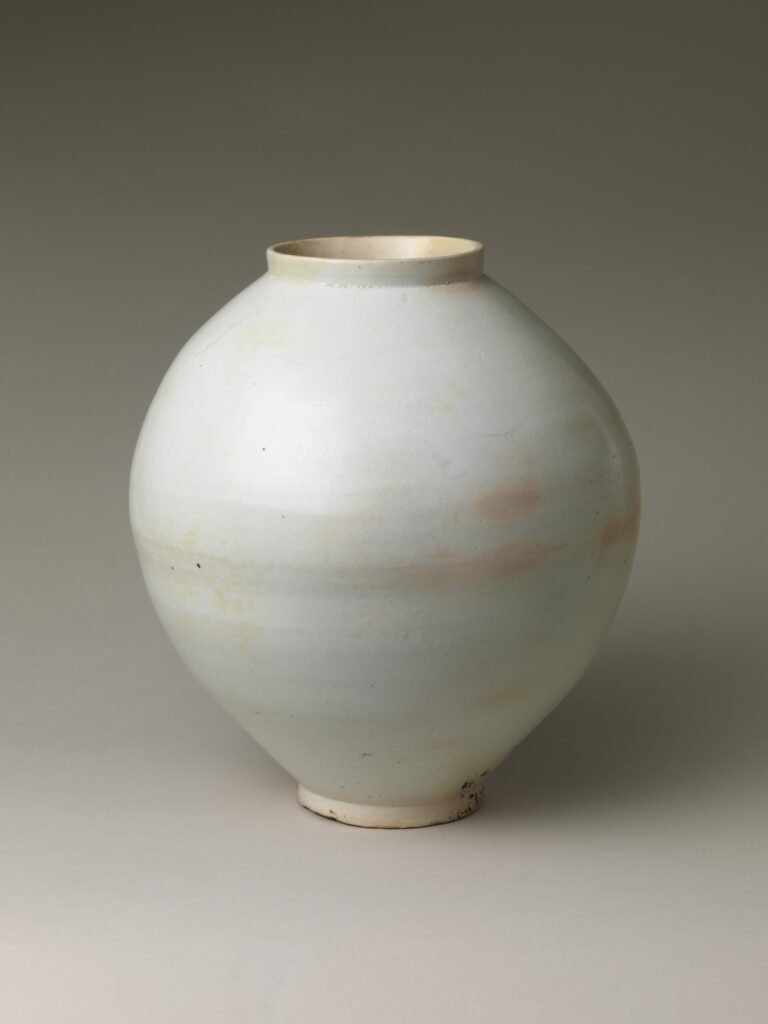
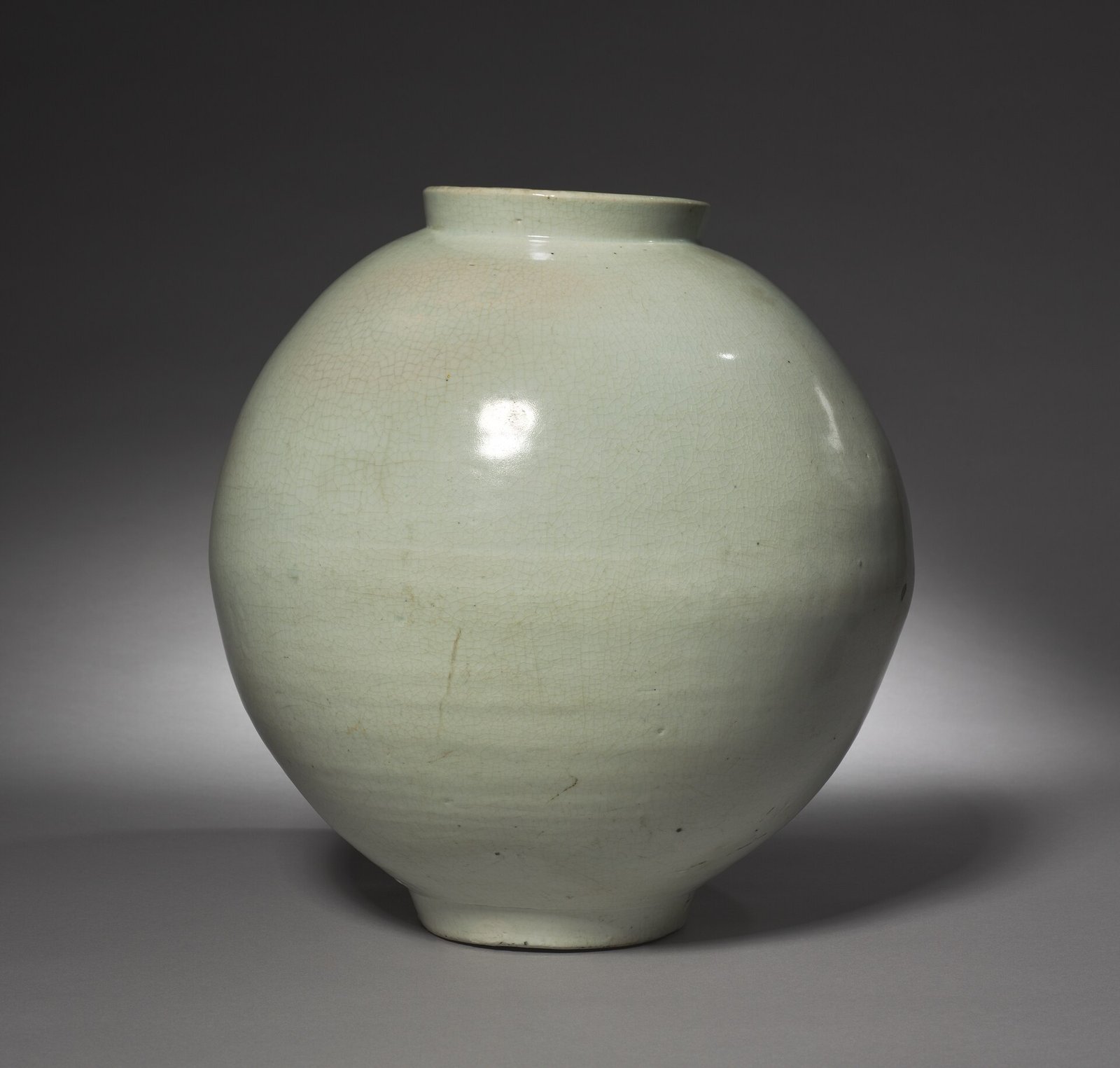
Run a finger round the widest point of a Joseon moon jar and you will usually find a slight ridge, sometimes a visible line, occasionally a small step where the two halves did not quite meet. New collectors ask whether it is a fault. It is the opposite: it is the reason the object exists in that form at all.
Why it is made in two pieces
Physics. The National Museum of Korea is blunt about it: creating a jar of this size “is impossible with a single spin of a spinning wheel”. The museum adds that a jar over about 40 cm made in one piece would break in the kiln.
So the potter throws two large bowl shapes, leaves them to firm, inverts one onto the other, and joins them at the equator. What you are looking at is not one pot but two hemispheres persuaded into a sphere.
Then the kiln does the rest. The British Museum notes that the two halves “shrink and sag in the firing”, which is why almost no moon jar is truly round. Most, to our eye, resemble a waning moon rather than a full one — the symmetry of asymmetry.
Every museum treats the asymmetry as the point
This is not a dealer’s defence of a flaw. It is the settled institutional reading, and it is unusually unanimous:
- National Museum of Korea: the jar’s charm “arises from its natural beauty, which does not conform to an exact set pattern” — “the beauty of nature made with bare hands”.
- Metropolitan Museum: collectors prize the “unintentional features acquired during firing, such as asymmetry or the final hue”.
- British Museum: places the intentional and accidental irregularity within a Joseon aesthetic valuing “naturalism and spontaneity over rigid perfection”.
- V&A: records “several apparent faults (irregular oval profile, visible central seam and pooling of the greenish tinged glaze on one side)” and says the jar nonetheless “conveys an impression of restful ease”.
Four major institutions, one reading. A moon jar corrected into a perfect sphere would be a lesser object, and a moon jar with no visible join would raise more questions than it answered.
They were not made to be admired
The name is modern and the romance is retrospective. The Met calls them utilitarian storage jars — daeho, simply “big jar” — though the V&A says they were generally used for display, so the museums do not agree; the Met records that they fell out of vogue in the 1800s and were rediscovered only in the twentieth century. “Moon jar” describes what the form evokes, not what its makers called it.
Cleveland offers a reading of the plainness that is worth sitting with: the absence of underglaze cobalt decoration “could be the artist’s response to the socioeconomic crisis caused by famines in the late 1600s”, with government restraint on luxury to preserve finances. Austerity as circumstance, later read as taste.
Dating: know the spread before you buy
This is the practical point. Museums do not agree, and the range is wide enough to matter commercially:
- British Museum — 18th century (its jar is 47 cm)
- Metropolitan Museum — second half of the 18th century (38.7 cm)
- Cleveland — 1700s (34.3 cm)
- V&A — 1800–1900 (36 cm)
Late seventeenth to eighteenth century is the mainstream position; the V&A gives its own example a date range of 1800–1900 while describing it as eighteenth to nineteenth century. Heights across those records run about 34–47 cm. Anyone offering you a moon jar with a confident single-decade date is going well beyond what the museums will say.
The Leach and Rie jar
The most famous of all has a British story. Per the British Museum’s record for museum number 1999,0302.1: Bernard Leach acquired it in Korea in 1935 and gave it to Lucie Rie in 1943. It stood in her studio until her death. The British Museum bought it at Bonhams in September 1998 and accessioned it in 1999.
Two of the most important potters in twentieth-century Britain owned an eighteenth-century Korean storage jar, and one of them kept it in her studio until she died. That is as good an argument for the object as any curator could write.
Moon jars in the tea room
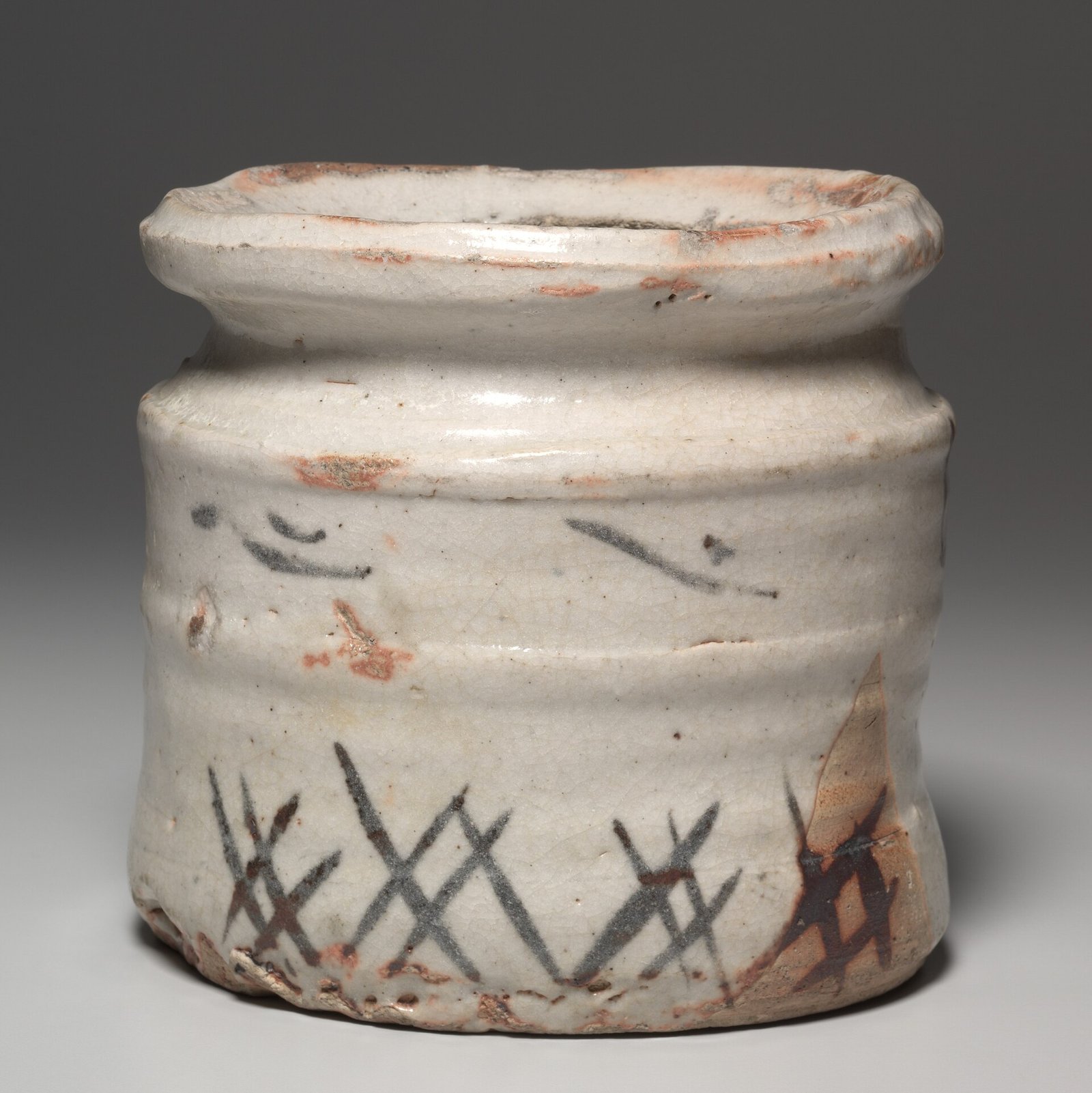
A moon jar described as “used as a mizusashi” is not a sales flourish. Cleveland defines a mizusashi as a jar “used to hold water for the preparation of tea at tea gatherings”, supplying the kama, the iron kettle. It is one of the display utensils a host selects for a particular gathering.
And the practice of adopting Korean vessels into chanoyu is well documented: Sen no Rikyū’s wabi aesthetic “celebrates austerity, spontaneity, and apparent artlessness”, and tea masters, the Met says, began to incorporate rustic Korean vessels and found beauty in unrefined, natural or imperfect forms. A Joseon jar with a Japanese tea provenance is recording real history.
Bunwon, the glaze and the foot
Where were these jars made? The Met’s essay on Joseon white ware puts the court kilns on the map. In the 1460s the royal court “helped initiate and manage a group of kilns called bunwon” at Gwangju, just outside Seoul. They stayed the official kilns until privatisation in the 1880s. Not everything came from there. The Met notes that jars of the shape of its copper-red grapevine jar were made in the eighteenth century “at kilns not linked to the court porcelain manufacturing center”.
The white itself is never quite white. The British Museum’s catalogue entry for the Leach jar describes a “clear, pale white glaze” with crackle and scratches. The V&A’s jar has a “greenish tinged glaze” that pooled on one side. Expect a soft, faintly blue or green cast, and expect it to vary round the pot.
Turn the jar over. The same British Museum record says the foot “was roughly and deeply carved” and that the foot ring and base were “wiped clear of the glaze”. It also notes traces of kiln ash stuck to the shoulder. A coarse, unglazed foot and a little kiln debris are what we want to see. A neat, fully glazed foot is a question.
The jars most of us can actually own
A moon jar over 40 cm is a museum object. The same kilns made smaller globular jars, and these are where most collecting happens. The Met’s cobalt-painted jar with flowers and insects, mid-eighteenth century, is 34.3 cm. Its label says the “minimalism of the painted design and the abundance of white space” set Korean blue-and-white apart from China, Japan and Europe.
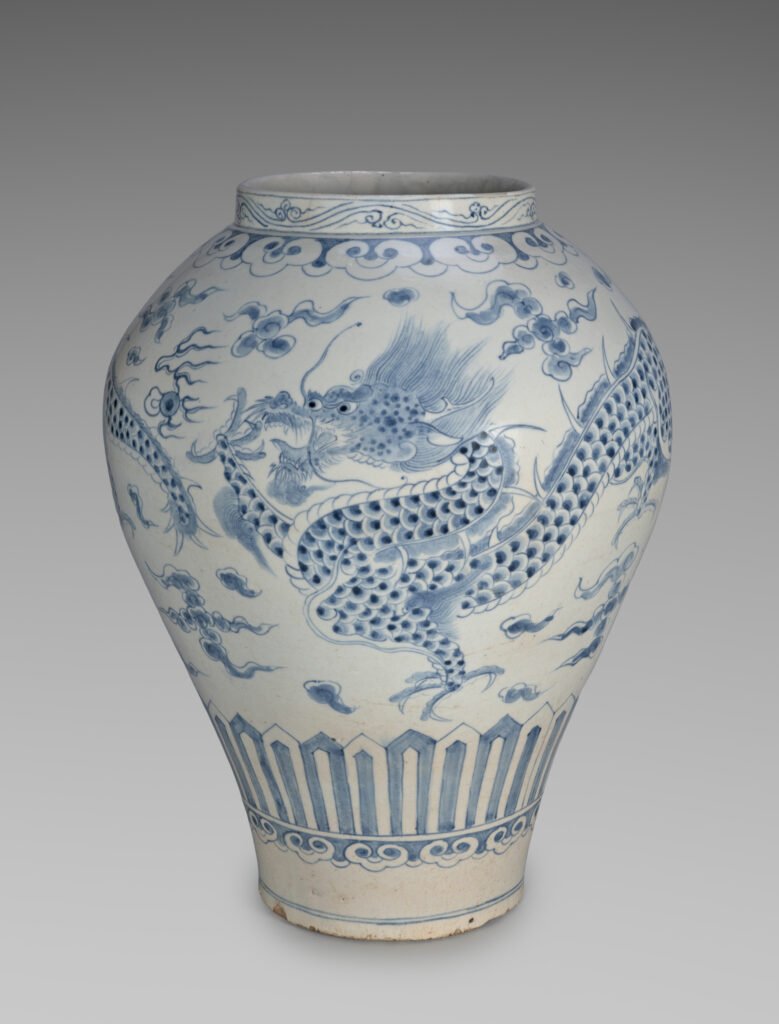
Iron brown was the cheaper pigment. The Met’s essay records that from the seventeenth century iron-brown decoration became popular “especially during periods when the cost of cobalt was exorbitant”. Its seventeenth-century dragon jar in iron brown is 26 cm, the dragons “abbreviated, almost to abstraction”. The copper-red grapevine jar is 25.6 cm. The V&A’s cobalt jar with tortoise and crane roundels, dated 1800–1850, is 28 cm and has “a short foot”.
These are the moon jar’s relations: the same body, the same soft glaze, the same rounded profile at half the height. Most are thrown in one piece, so a horizontal seam is not expected at this size. Everything else in the checklist above still applies.
A moon jar may have been made last year
Korean potters have revived the form, and museums buy their work. The British Museum holds a moon jar by Park Young-sook dated 2005, 58.7 cm high, with a “pale blue glaze” and a painted signature and impressed monogram. It was bought at Bonhams in 2006. The V&A has another Park jar, about 2008, 62 cm, formed from “two thrown parts that are joined at the belly” in the eighteenth-century manner.
Both are bigger than any Joseon jar in the museum records we cited earlier. The V&A also lists a 2019 moon jar by Kim Syyoung, catalogued as a black moon jar, at 42 cm, and a 2023 “Moon Jar” by Ryu Jongdae that is not porcelain at all but 3D-printed recycled plastic.
So the word on a label tells you the shape, not the century. Two practical tests. A signature or monogram means a modern studio piece; Joseon jars are almost always unmarked. And a jar well over 50 cm with a clean, even glaze is far more likely to be contemporary than to be a Bunwon survivor. Contemporary moon jars are serious objects, and we admire them. They are simply a different purchase.
What to look at
- The join. Present, slightly irregular, integral. Not a repair line — learn the difference, because they can look similar in a photograph.
- The lean. Most genuine examples are off-round. Perfect symmetry is a question, not a reassurance.
- The glaze colour. Joseon white runs from bluish to warm cream, and the Met notes the final hue is one of the unintended firing features collectors value.
- The foot and the mouth rim, as always — see reading the base.
- Marks: expect none. Korean ceramics carry no reign marks; an unmarked moon jar is entirely normal. See Korean porcelain marks.
More in collecting Korean ceramics, and see what we hold under Joseon.