The Four Treasures of the Study — 文房四寶, wenfang sibao — are brush, ink, paper and inkstone. Four, and those four.
We are being emphatic because the version of this page we inherited listed “brush, desk screen, brush pot, objects for admiration, brush washer”, which is five things, none of them ink, paper or inkstone. Those are all scholar’s-desk furnishings and several are wonderful to collect — but they are not the Four Treasures, and a dealer who gets the canonical list wrong has no business advising on the rest.
| Chinese | Pinyin | English | |
|---|---|---|---|
| 1 | 毛筆 | máo bǐ | writing brush |
| 2 | 墨 | mò | inkstick — solid ink |
| 3 | 紙 | zhǐ | paper |
| 4 | 硯 | yàn | inkstone |
Source: the Smithsonian’s National Museum of Asian Art, Four Treasures of a Scholar’s Studio.
Why a brush pot could be art
To understand why these objects carry the value they do, you have to understand who owned them. The Metropolitan Museum describes the scholar-officials as an intellectual elite selected “by merit rather than heredity” — from the early Northern Song (the late tenth century) the entire government bureaucracy was staffed through the civil examination system, with the highest degree, the jinshi, awarded to only two or three hundred candidates a year.
They were not an economic class. Their power “resided in their Confucian ideals and their moral and ethical values”, and they took up calligraphy, painting, poetry, weiqi and the qin because “the study of which was considered a path to the cultivation of the moral self”.
That is the whole answer. The desk was not a workplace; it was the apparatus of self-cultivation. Which is why a bamboo brush pot could be carved by a named artist, inscribed with a poem, and collected as seriously as a painting.
The four, and what to look for
The brush 毛筆
Three components: the hair, the holder, and a sheath to cover the tip when not in use. The Smithsonian notes the hair “may come from a deer, goat, sable, rabbit, or other animal, depending on the desired resilience and size”.
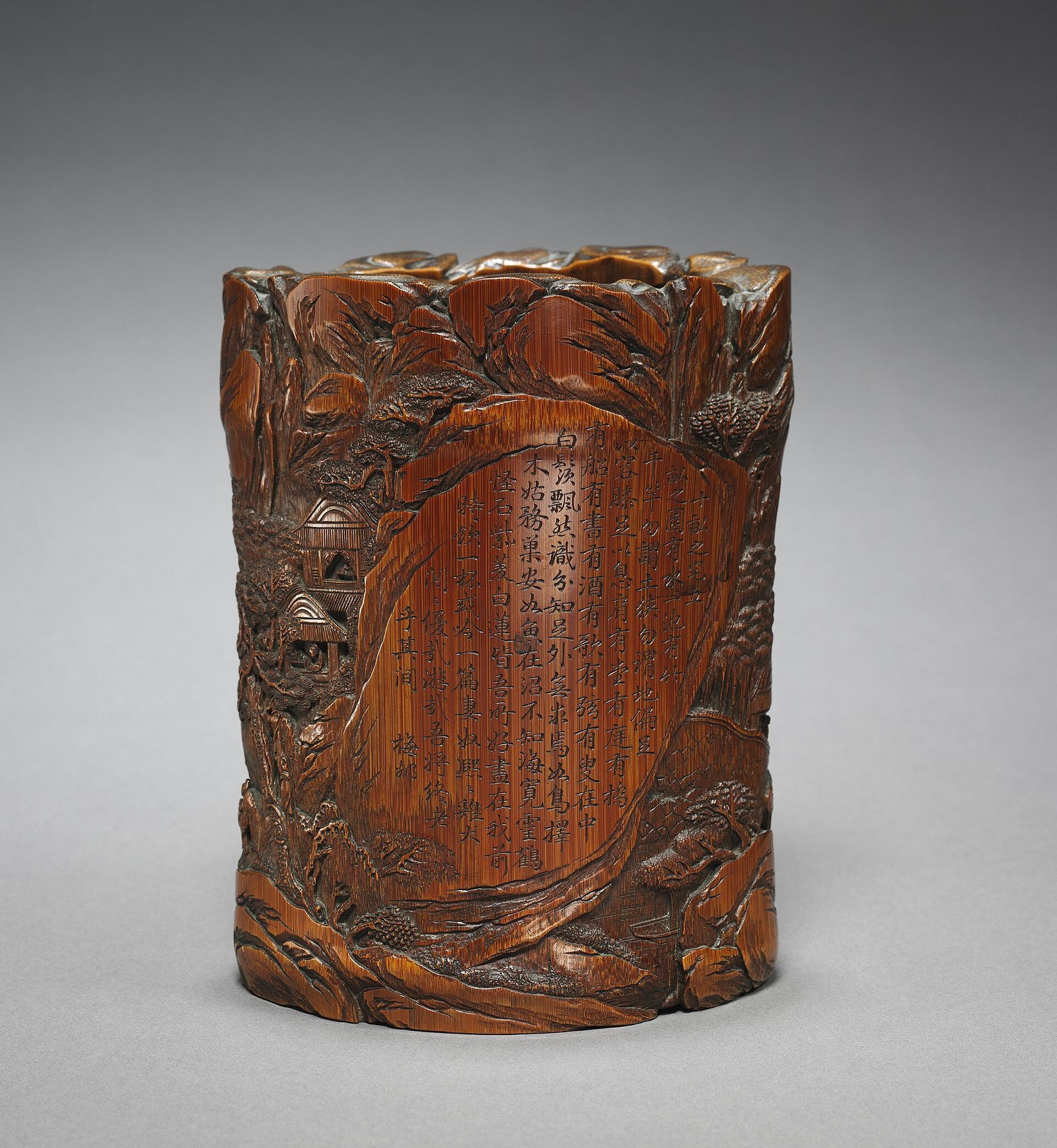
What a collector looks at: hair type governs resilience and therefore the quality of line — it is a functional choice, not decoration. Value, though, mostly sits in the holder: bamboo, lacquer, porcelain, jade or ivory, often carved and sometimes inscribed. The Smithsonian’s own collection includes ivory holders inscribed with dedications to Charles Lang Freer from the collector Pang Yuanji (1864–1945).
A warning on ivory holders. Ivory brush holders are caught by the UK Ivory Act 2018, which came into force for elephant ivory on 6 June 2022. Dealing includes buying, selling, hiring and advertising, with penalties up to £250,000 or five years’ imprisonment. Exemptions exist — pre-1918 items of outstandingly high artistic value by certificate, and pre-3 March 1947 items with under 10% ivory by volume by registration — but they must be applied for. See our journal piece on import duty, CITES and shipping.
The inkstick 墨
Chinese ink is solid. It is made of pine soot or lampblack mixed with glue and pressed in moulds, then ground with water on the inkstone when needed.
What a collector looks at: the moulded decoration and the box. Inksticks were made as presentation objects, “often decorated with moulded designs or texts and painted with gold or other colours” and presented in brocade-covered boxes. A great many, in our experience, were never ground at all — which is why fine examples survive with their decoration crisp. An inkstick with worn edges has been used; that is a condition question, not necessarily a fault.
Paper 紙
Standard ingredients are bamboo, hemp fibre and the bark of mulberry trees. Stationery was often lightly printed with texts or designs.
And a term to drop: the Smithsonian states directly that Chinese paper “is popularly known in the West as ‘rice paper’, the term is a misnomer”. There is no rice in it.
The inkstone 硯
Both a grinding surface and a reservoir. The Smithsonian gives the connoisseurship test in one sentence, and it is worth memorising: the surface “should be fine and smooth, yet abrasive enough for grinding the ink quickly”.
What a collector looks at: the stone. The two classic materials are Duan and She — Cleveland holds a Qing inkstone in She stone carved as a roof tile with seal-script characters. Then carving, inscription, and the fitted box, which is often part of the object rather than packaging. A well-used inkstone with a polished grinding well and a crisp carved border is a better object than an unused one with a dull stone.
The rest of the desk — not the Four Treasures, and often the better buy
These are the objects that actually come through a dealer’s hands, because ink and paper rarely survive and brushes seldom do.
Brush washer 筆洗 bixi
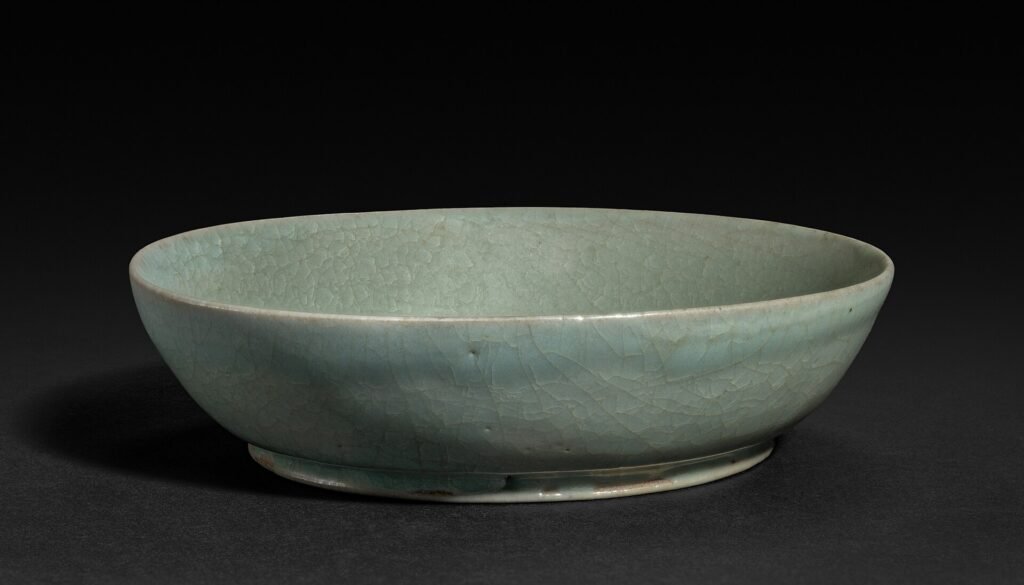
Worth pausing on. The Ru brush washer above is Northern Song, from the Qingliangsi kiln in Henan, and belongs to a group of fewer than a hundred surviving pieces worldwide. The single rarest category in Chinese ceramics is a scholar’s desk accessory. That tells you how seriously this furniture was taken.
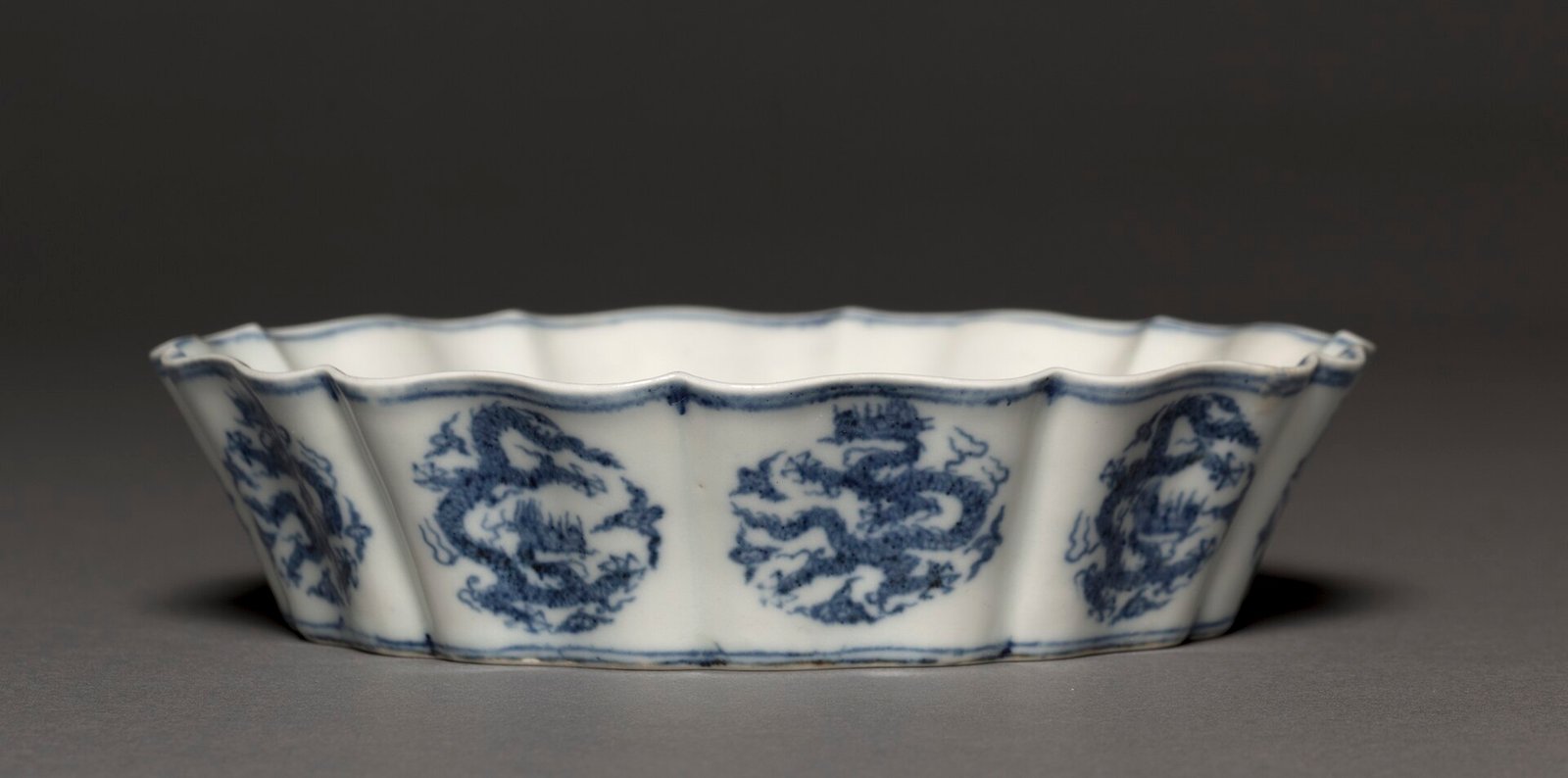
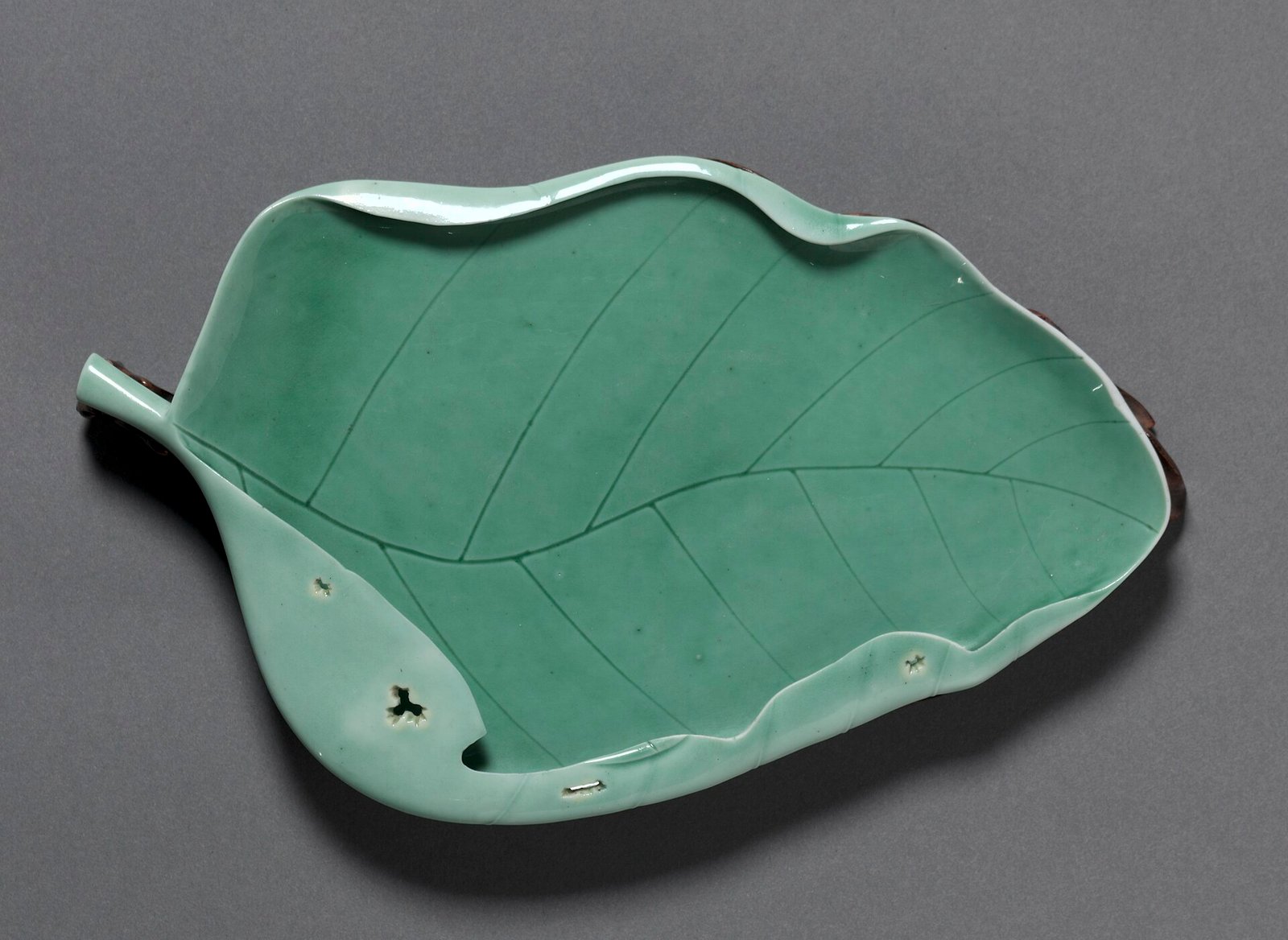
Brush washers run from Song monochromes through imperial Ming blue and white to the naturalistic Qing forms above — leaves, lotus pads, gourds. The Kangxi peachbloom group is the most sought after of all: the Metropolitan Museum’s 1989 handbook notes that the finest peachbloom wares form “an elite series — in all likelihood consisting of no more than eight specific shapes — of small and elegant vessels that were intended to be used at the scholar’s writing table”.
Brush pot 筆筒 bitong
The workhorse of the desk and the most collected single form. In porcelain, bamboo, wood, jade or bronze. Carved bamboo brush pots by named Jiading school carvers are a collecting field of their own — the Cleveland example above carries a poetic inscription by Wang Meilin.
Brush rest 筆架 bijia
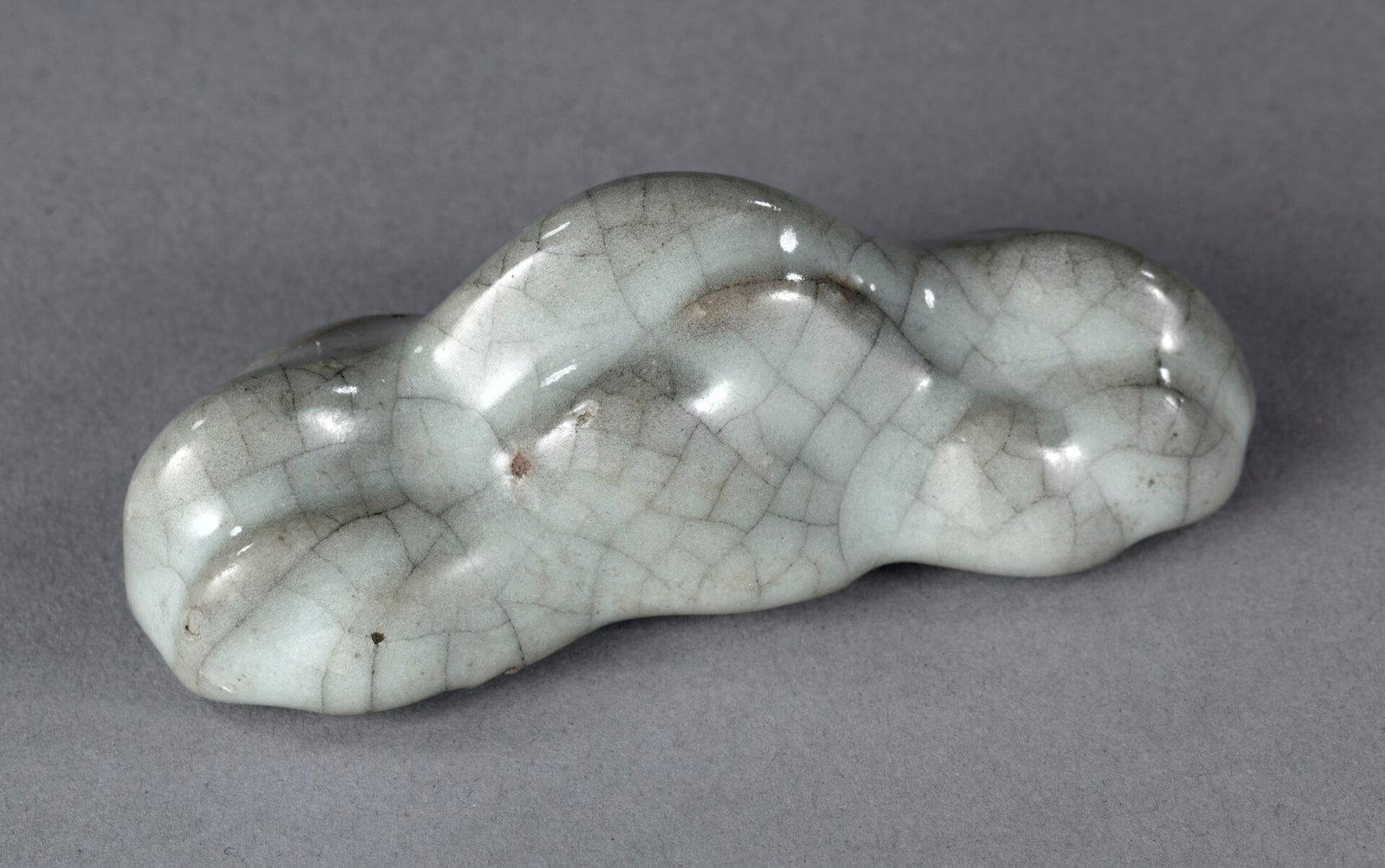
A small stand to lay a loaded brush on without letting the tip touch the desk. Modelled as mountain ranges, as animals, as clouds. The Met holds a Zhengde-period example inscribed in Persian, reading “pen” and “holder”.
Water dropper 水滴 shuidi
Delivers a controlled few drops of water onto the inkstone. Almost always figural — a rhinoceros, a coiled dragon, a lion — and small enough that they survive in numbers. The V&A holds Chinese examples from the Northern Song and Korean ones in openwork and animal forms.
Wrist rest 臂擱 bige
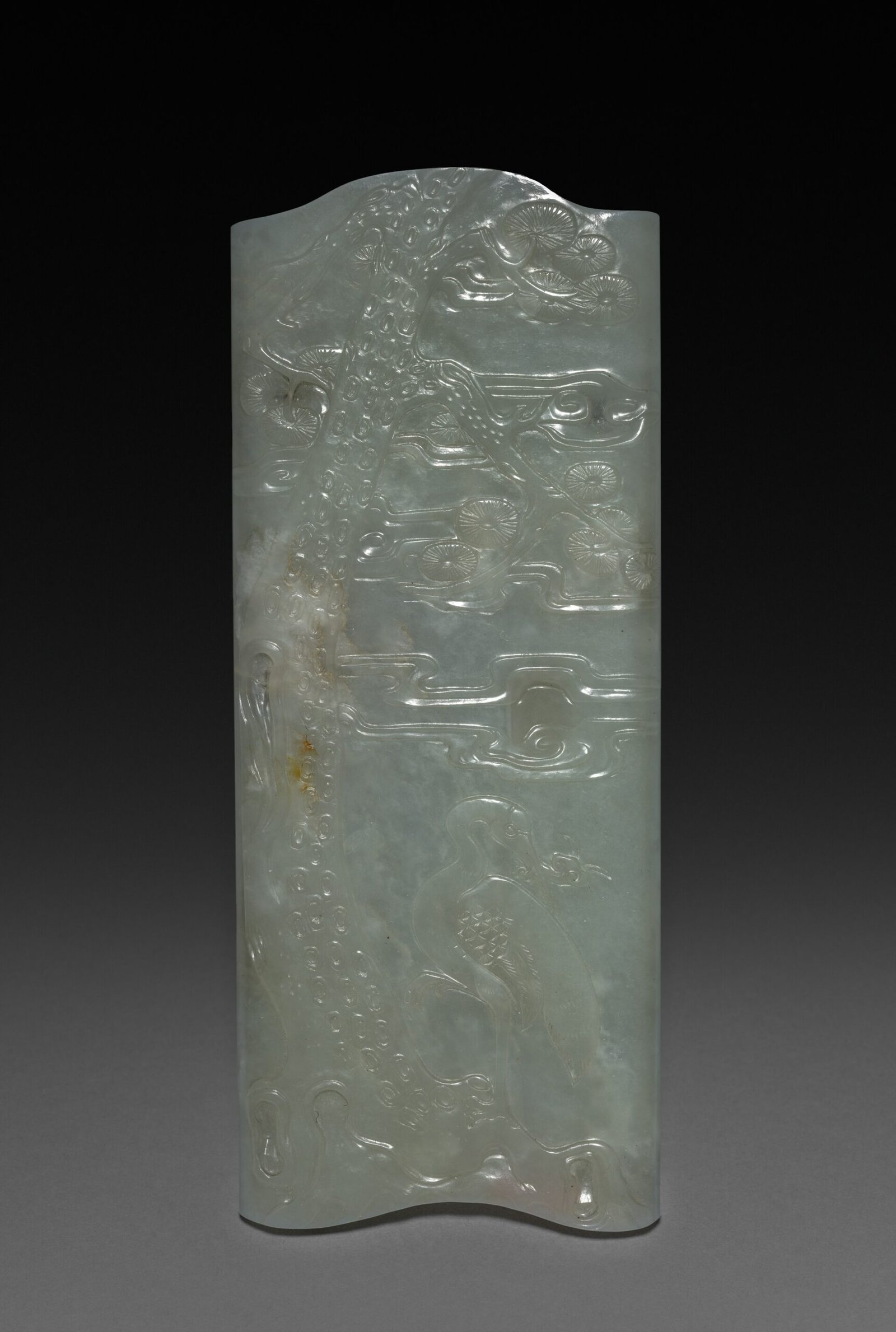
A curved slat, usually bamboo or ivory, supporting the wrist above wet ink. Bamboo examples carry some of the finest small-scale carving in Chinese art.
And the ones we will not overclaim
Seal paste boxes are well attested in museum collections. Table screens and scholar’s rocks (供石 gongshi) we handle more carefully: table screens are catalogued (Cleveland holds several, e.g. 1941.595, Qianlong period), but we found no museum text setting out the classical criteria for rocks — thinness, wrinkling, perforation, openness. Those criteria are real and they are in the printed literature, but we are not going to source them to a museum that has not published them.
Buying for the studio
Three practical points. The desk is where the rarest things are, because these objects were made in small numbers for a small class, in the best materials available. Boxes matter — a fitted box for an inkstone or a brocade case for an inksticks set is frequently original and part of the object. And function is legible: a genuine brush washer has a shape you can actually rinse a brush in, a genuine wrist rest has a curve that fits an arm. A great deal of decorative material is sold under scholar’s-object names without ever having been usable.
You can see what we currently hold in the collection; scholar’s objects also appear under celadon and monochromes.
Sources
- Smithsonian National Museum of Asian Art, Four Treasures of a Scholar’s Studio
- The Metropolitan Museum of Art, Scholar-Officials of China
- Cleveland Museum of Art, Ru ware brush washer 1957.40
- Cleveland Museum of Art, carved bamboo brush holder 1988.75
- The Metropolitan Museum of Art, brush rest with Persian inscription 18.56.14
- Suzanne G. Valenstein, A Handbook of Chinese Ceramics, The Metropolitan Museum of Art
- Ivory Act 2018
Written by James Treacher.