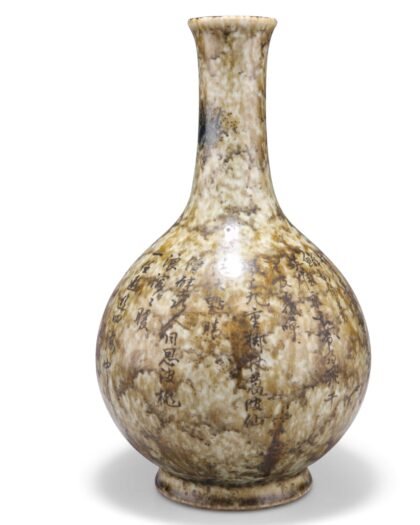
Republic
The Republic period (1912–1949) is the last chapter of the Jingdezhen story before the state factories, and it is treated unfairly by the market. Much Republic porcelain is thin, white, beautifully potted and painted with real skill; much of it also carries a Qianlong, Yongzheng or Kangxi mark, or a Hongxian mark for Yuan Shikai’s brief imperial restoration of 1916, and so is sold — and bought — as something it is not. Read honestly, it is one of the better-value areas of Chinese ceramics.
What was made
Three strands run through the period. The first is continuation: the same workshops that had supplied the Guangxu court went on making famille rose and blue and white in the late-Qing manner, often to a higher technical standard as materials and kilns improved. The second is the studio movement: the painters known collectively as the Eight Friends of Zhushan brought literati painting onto porcelain, signing plaques and vases with their own names and dates in the manner of a scroll rather than hiding behind a reign mark. The third is the export and revival trade: eggshell-thin bowls, copies of eighteenth-century monochromes and enamels, and the reproduction of imperial wares that is the origin of so many misattributed pieces today.
Reading a Republic piece
The body is the give-away. Republic porcelain is characteristically very white and very even, often thinner than the eighteenth-century piece it imitates, with a glassy glaze and a foot rim that is clean, white and sometimes slightly sharp. Enamels are bright and can be thin; gilding is often bright and unworn. Marks are frequently in iron red rather than underglaze blue, and the “Qianlong” seal marks written in this period tend to be neat and a little mechanical. None of this is proof by itself — a superb Republic piece is a superb piece — but together they are usually decisive. The guide to Republic-period porcelain shows the comparison in detail, and reign marks explains why the mark is the least reliable thing on the pot.
Why it is worth collecting
Because it is honest work at a fair price. A Republic famille rose vase painted with skill is a good object; it becomes a bad object only when it is sold as Qianlong. We date Republic pieces as Republic, describe the mark for what it is, and price accordingly.
In the collection
One piece at present: a dragon vase catalogued as late Qing to Republic, because the evidence of the body and enamels does not allow a narrower date and we would rather say so.
Showing the single result