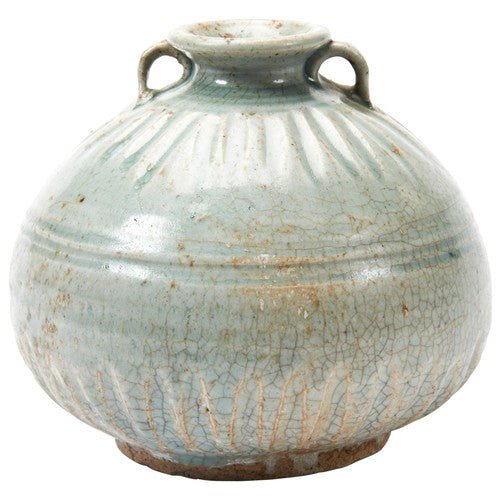
A squat baluster jar, the sides carved with a band of vertical lines at the shoulder and foot divided by concentric bands, the short flared neck with a pair of loop handles, under a pale green crackle-suffused glaze. Song dynasty.
This is the best-documented piece in the collection. It was formerly in the collection of G. R. A. Murray, and was exhibited at the National Gallery of South Africa, Cape Town, in the Chinese Exhibition of 1953 as number 115. A named former owner and a dated exhibition record is exactly the kind of history that moves price in this market, and it is the reason this jar is worth more than a visually similar piece without it.
Condition is commensurate with age and disclosed in full: several old chips to the foot rim, and oxidisation and staining to the glaze throughout. On a Song jar with this history, that is a record of nine centuries rather than a problem.
Song celadon, and this jar’s history
The Song dynasty (960–1279) is where Chinese ceramics acquire a literature, and its green wares are the reason. Celadon — a Western term for high-fired wares whose glaze is coloured by a small percentage of iron oxide — was made at many southern kilns, of which Longquan in Zhejiang became the greatest, building its glaze in several layers over a grey body that fires orange-brown at the foot. A plain Song jar in this taste depends entirely on its glaze and its proportion; decoration came later.
This jar has a documented history, which is rare in this catalogue and valuable in this market: it was formerly in the collection of G. R. A. Murray and was exhibited at the National Gallery of South Africa, Cape Town, in the Chinese Exhibition of 1953, as no. 115. An exhibition record fixes the object in time and in a named collection, and it is one of only a handful of pieces here to carry one.
Read more: Song ceramics and published and exhibited pieces.
The object, up close
The finer
details.
Reference XA-0025
A question about this piece? Ask for measurements, close-up photographs or a condition report.
Discuss this piece- Dimensions
- Ask for measurements
- Period
- Song dynasty (960–1279)
- Mark
- Unmarked
- Condition
- Commensurate with age, faults disclosed below
- Faults
- • Several old chips to the foot rim.
• Oxidisation and staining to the glaze throughout. - Provenance
- Formerly in the collection of G. R. A. Murray
- Exhibited
- National Gallery of South Africa, Cape Town, Chinese Exhibition, 1953, no. 115