Korean ceramics are the largest genuine gap in the English-language collecting literature. The museums own the scholarship — the Met, the National Museum of Korea and Cleveland all publish seriously on it — and almost nobody has written the practical guide. That gap is the opportunity.
There are three things to know, and they map onto three periods.
Goryeo (918–1392): celadon, and the technique nobody else had
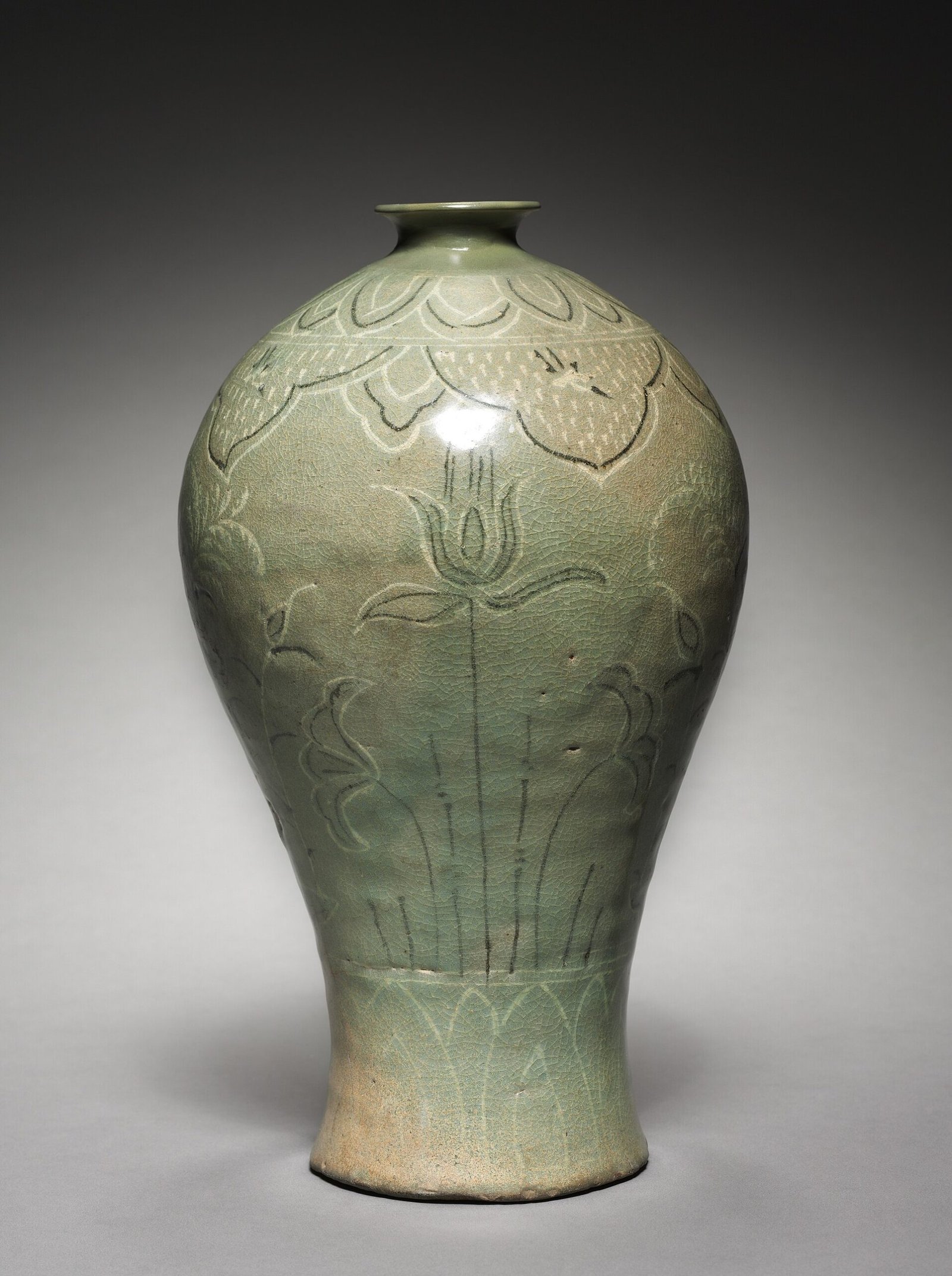
For nearly five centuries, the Met records, celadon “constituted the main type of ceramics produced on the Korean peninsula”. The kilns that matter are Gangjin and Buan, in Jeolla province on the south-west coast, and the peak is the twelfth and thirteenth centuries.
Korean celadon began under Chinese influence — Cleveland notes the kiln structure resembles Chinese Yue kilns and that the spur-support firing technique was adopted from the Ru kilns. Production was under way by the 900s; a celadon jar inscribed with a record of its use at the royal ancestral shrine is dated 993.
Then, from around the mid-twelfth century, it goes its own way, and the mechanism is sanggam inlay. The Met defines it precisely: “etching the desired motifs on the dry clay body and filling in the carved space with black and/or white slip, after which the translucent glaze is applied and the vessel fired”.
The black and white are slips, not different clays; the black fires from an iron-rich slip. And the technique is essentially Korean — rare in Chinese production. If you want one thing that makes Korean ceramics collectable in their own right rather than as a Chinese footnote, it is this.
What to look at: the crispness of the inlay, whether the slip has stayed within its incised lines, and the foot — spur-fired Goryeo carries the same small support scars as Ru.
Buncheong (15th–16th century): the most under-priced material in Asian ceramics
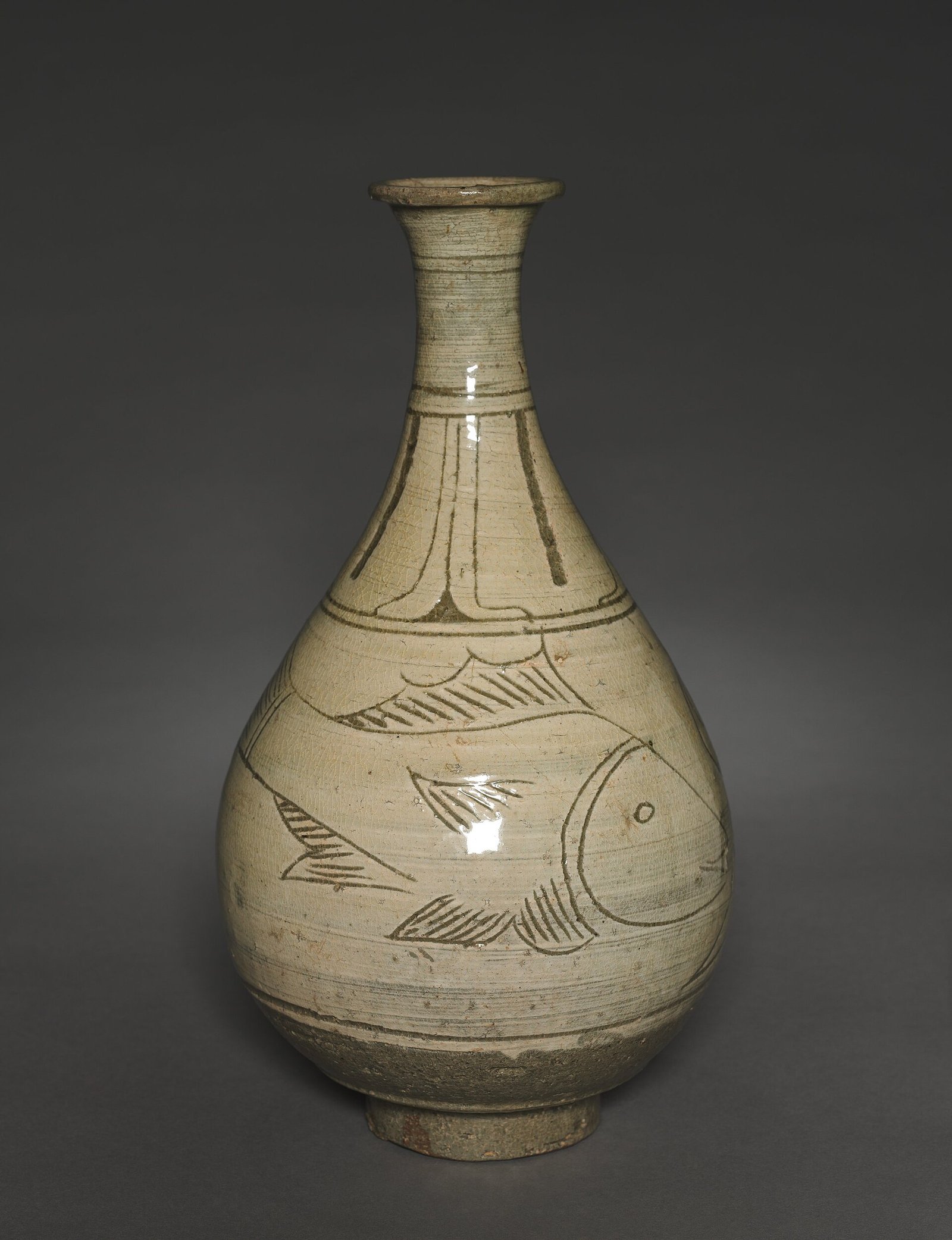
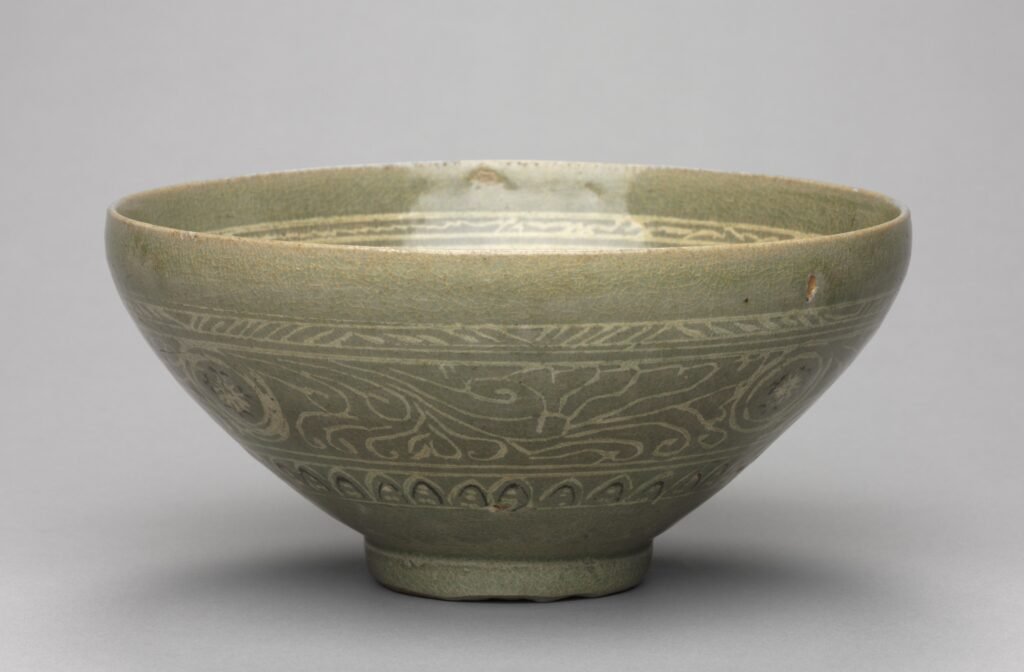
“Gray-green ceramics decorated with powder” is the Met’s gloss. A relatively coarse grey body under white slip and a green-tinged semi-translucent glaze — descended from Goryeo celadon, using similar clay and glaze but “less processed and refined”, and adapting the inlay technique the Goryeo potters had perfected.
It comes in regional modes, which is the useful framework for a buyer:
- Inlaid and stamped — Gyeongsang province
- Incised and sgraffito — Jeolla province, the fish and floral designs
- Iron-painted — Chungcheong province
- Slip-brushed (guiyal) and slip-dipped (dumbeong) — later, and the freest
It has a hard end date, and the Met states it plainly: “Gradually replaced by porcelain by the end of the sixteenth century, the buncheong tradition was brought to an end with the Japanese invasions of Korea between 1592 and 1598.” A two-hundred-year tradition, closed by a war.
And it is stamped buncheong that carries the court bureau marks that date a piece to within twenty years — the single most useful dating tool in Korean ceramics, set out in our guide to Korean marks.
Why we like it commercially: buncheong is spontaneous, confident, wildly varied, museum-collected, and priced far below Chinese material of comparable age and quality. Its influence on Japanese tea taste is well documented at the level of the invasions and the potters taken to Hizen — though we would note that the specific claim that buncheong bowls are the Ido bowls of chanoyu is repeated more confidently in the trade than the sources support.
Joseon white porcelain (1392–1910): restraint as a programme
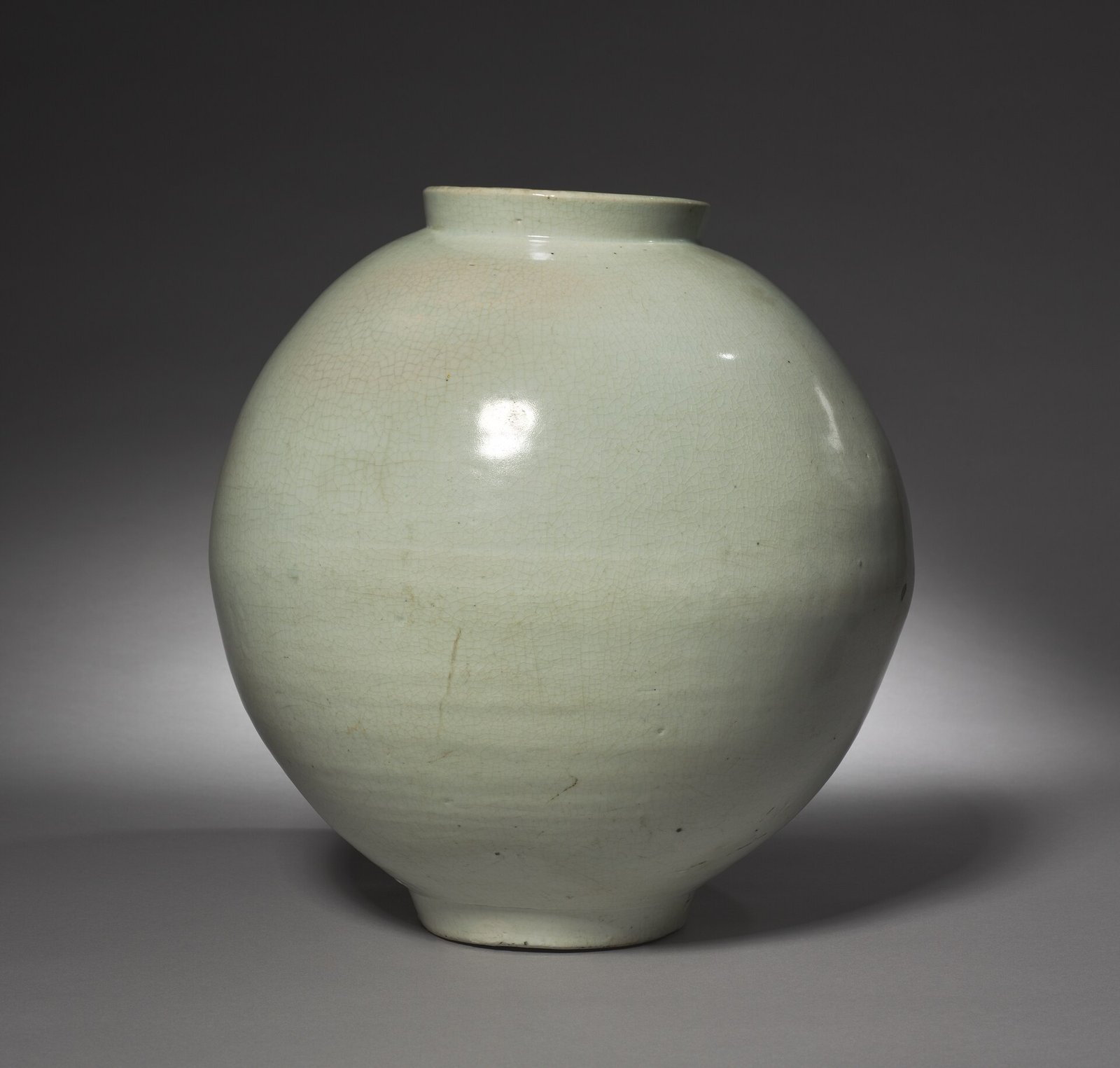
White porcelain was adopted as imperial ware in the fifteenth century. The Bunwon — official court kilns initiated in the 1460s at Gwangju, outside present-day Seoul — ran for about 420 years, until privatisation in the 1880s.
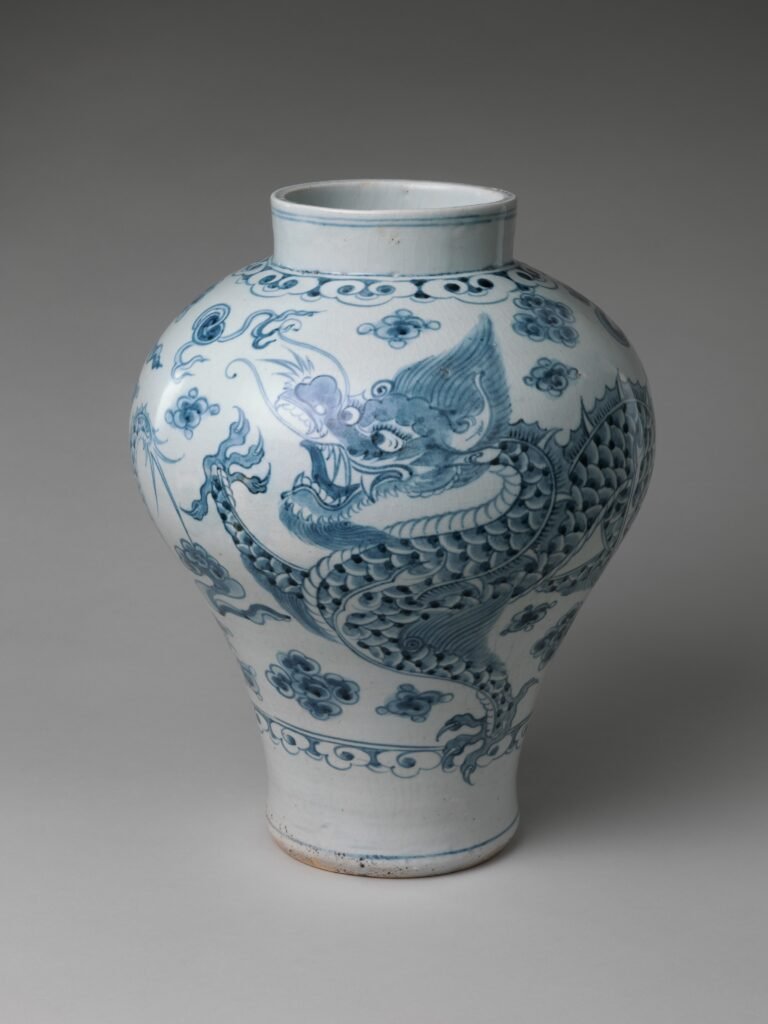
But it was not restricted to the court, and this is worth correcting because you will read otherwise. The Met: “By the sixteenth century, white ware was no longer the sole domain of the court or even the privileged few living in the capital.” The one restriction we can source is narrower — Cleveland records that dragon jars were “reserved only for the king”, while Cleveland also records upper- and middle-class commissions for ritual vessels, including blue-and-white dragon jars.
The decorative sequence is driven partly by economics:
- Blue and white (cheonghwa baekja) — prized from as early as the fifteenth century, perhaps above plain white.
- Iron-brown (cheolhwa) — popular from the seventeenth century, the Met notes, “especially during periods when the cost of cobalt was exorbitant”. Iron-painted Joseon is not a lesser choice; it is a cobalt-price choice.
- Copper red — successful pieces date primarily to the eighteenth century. Copper is difficult in the kiln, which is why good examples are scarce.
And the moon jar, the object most people arrive for: thrown in two halves and joined at the widest point because, as the National Museum of Korea puts it, a jar over 40 cm made in one piece would break in the kiln, with the resulting asymmetry treated by every institution as the point rather than a defect. Full account in our Korean marks guide and in the journal on the moon jar and its join.
Note the dating spread before you buy one: the British Museum says eighteenth century, the Met second half of the eighteenth, Cleveland the 1700s, and the V&A dates its own moon jar 1800–1900. Heights run about 34–47 cm.
Three practical points for a buyer
1. Expect no marks. Korean ceramics carry no reign marks. An unmarked Joseon jar is normal, not suspect.
2. Attribution between Korea and China is genuinely hard. In 1928 Sir Percival David bought a green-glazed brush washer as Chinese Ru ware. In the 1970s, the British Museum says, scholars reclassified it as Korean, and the attribution held for fifty years — until 2021, when hand-held XRF analysis in collaboration with Cranfield University’s Forensic Institute confirmed it as Ru after all. If the Percival David Foundation, now at the British Museum, could carry the wrong country for half a century, a confident label on a dealer’s listing is not evidence.
3. The Japanese connection runs both ways. Korean potters taken to Hizen after the 1590s invasions found porcelain clay at Arita and founded Japanese porcelain; the Satsuma kilns were established, per the British Museum, “by immigrant potters from Yi dynasty Korea”. And Korean vessels were adopted into the Japanese tea ceremony, where Sen no Rikyū’s wabi aesthetic raised them to parity with ancient Chinese treasures. A Korean jar with a Japanese tea provenance is documenting a real historical practice.
What we hold
We keep a small Korean group — Joseon white porcelain, iron-painted wares and a published moon jar. See Korean ceramics and Joseon.
Sources
- The Metropolitan Museum of Art, Goryeo Celadon
- The Metropolitan Museum of Art, Joseon Buncheong Ware
- The Metropolitan Museum of Art, In Pursuit of White
- Cleveland Museum of Art, Goryeo celadons in relation to Chinese ceramics
- Cleveland Museum of Art, moon jar 1983.28
- National Museum of Korea, on the moon jar
- British Museum, Ru ware re-identification, 2021
- The Metropolitan Museum of Art, The Japanese Tea Ceremony
Written by James Treacher.