Joseon
The Joseon dynasty ruled Korea from 1392 to 1910, and for almost all of that time its finest ceramic was white porcelain. The court’s Neo-Confucian ideals of purity and restraint gave baekja a status that decorated wares held in China, and the plain white jar or bottle, thrown with a slight, deliberate asymmetry, remains the most Korean of all ceramic forms.
A chronology in three parts
Early Joseon (15th–16th century). Buncheong — grey stoneware under white slip, stamped, incised, painted or simply dipped — grew out of Goryeo inlaid celadon and served both court and country in the first two centuries of the dynasty. In the 1460s the court established the bunwon, official kilns near the capital, to make the best white and cobalt-decorated porcelain for its own use (Met). Cobalt was imported and expensive, and early blue and white is correspondingly rare and restrained.
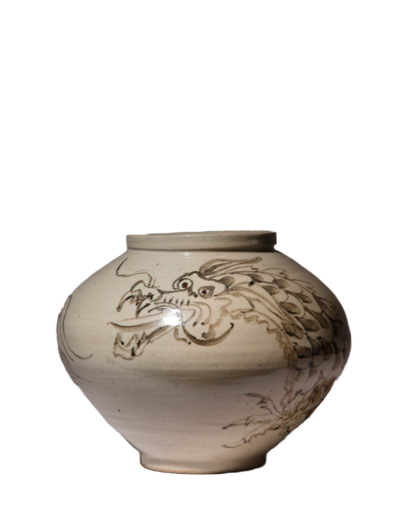
Middle Joseon (17th century). The Japanese invasions of 1592–98 devastated the kilns and carried potters to Japan, where they founded the porcelain industry of Arita. In Korea, white ware painted in iron brown became popular from the seventeenth century, partly because iron was available when cobalt was not; the painting is quick, bold and often of dragons, grapes or bamboo.
Late Joseon (18th–19th century). Blue and white returned in quantity, copper-red decoration appeared, and the large moon jars became fashionable in the eighteenth century (Met). The bunwon remained the court kilns until their privatisation in the 1880s, after which production continued commercially, and Joseon gave way to the short-lived Korean Empire in 1897 and annexation in 1910.
What the base tells you
Joseon porcelain is rarely marked, and we do not publish claims about the few marks that exist without a museum example to show. Attribution rests on the body and foot: a dense, heavy porcelain; a glaze that is bluish or greyish white and often finely crazed; a foot rim that was wiped of glaze and stood on sand or grit in the kiln, leaving fused grains that are a good sign of age; and, on the largest jars, the visible join where two thrown halves were luted together. Wear on the foot and the interior is usually honest. The guides to collecting Korean ceramics and Korean marks set out the method, and the journal explains the moon jar and its join.
Condition and value
Kiln grit, glaze skips and firing cracks are common on Joseon porcelain and are recorded rather than treated as faults. Later hairlines and chips are itemised in the usual way. Because the market is thinner than for Chinese porcelain, a well-provenanced piece — one that came through a Japanese tea collection with its box — carries a premium that is worth paying.
In the collection
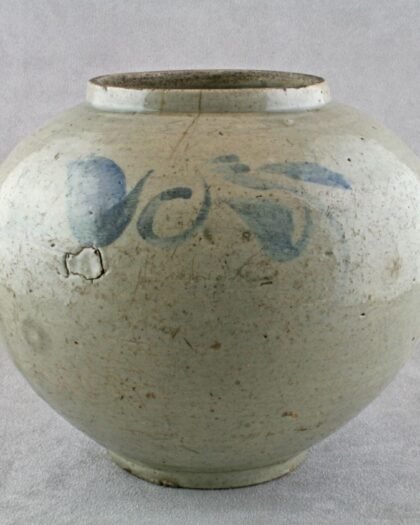
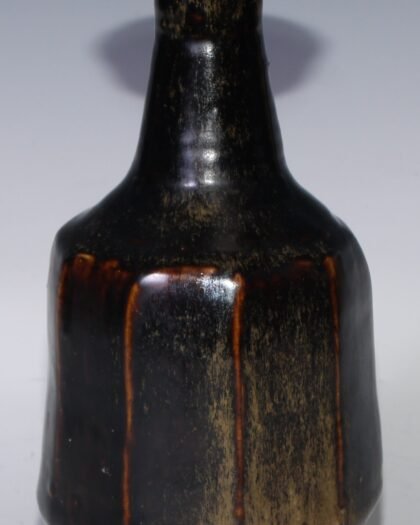
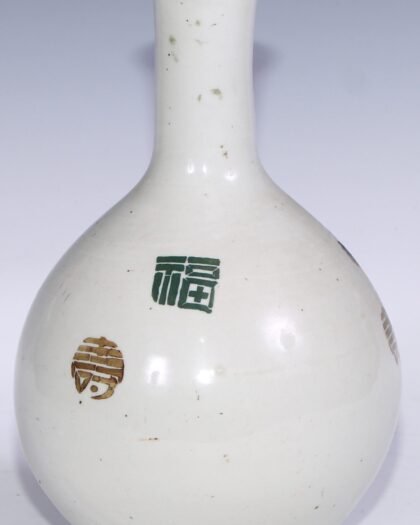
All four of our Korean pieces are Joseon: a moon jar with a published tea-ceremony history, a guglet painted with shou characters and seals, a panelled bottle in mottled brown, and an iron-painted dragon moon jar with an inscribed tomobako.
Showing all 4 results