Korean
Korean ceramics are the least written-about serious ceramic tradition in English and, in our view, the most consistently undervalued. Two traditions matter to a collector: the inlaid and carved celadons of Goryeo (918–1392), and the white porcelain of Joseon (1392–1910) that followed, together with the stonewares and painted wares made alongside it. This page is about what those pots are, how to look at one, and why their survival so often runs through Japan.
Goryeo celadon
Goryeo potters, working from Chinese Yue and Longquan models, developed a celadon of their own with a distinctive grey-green glaze and, from the twelfth century, sanggam inlay — designs incised into the body and filled with white and black slip before glazing, so that cranes, clouds and chrysanthemums sit crisply under the green. Goryeo celadon is rare on the market in good condition and much copied; it is included here for context rather than as something we regularly stock.
Joseon porcelain
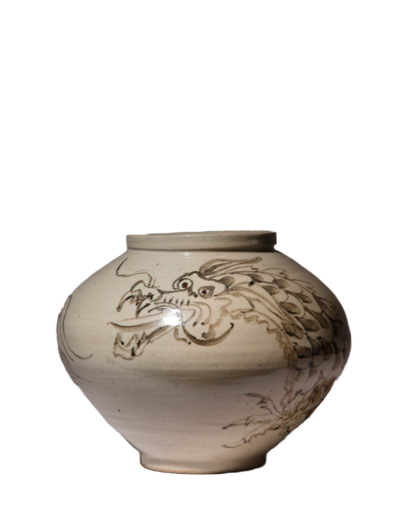
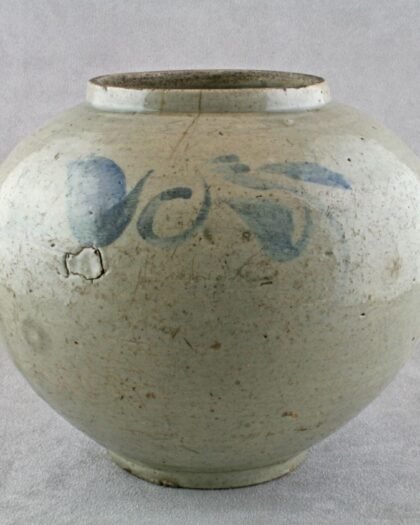
The Joseon court’s Neo-Confucian taste for restraint made white porcelain, baekja, the dominant ceramic of the dynasty. The Met records that in the 1460s the court helped establish and manage a group of kilns near the capital, the bunwon, which functioned as the official court kilns until their privatisation in the 1880s. Alongside plain white came white ware painted in cobalt blue, prized from the fifteenth century though cobalt was scarce and imported; white ware decorated in iron brown, popular from the seventeenth century; and copper-red decoration, mainly of the eighteenth century (Met, In Pursuit of White). Buncheong, a grey stoneware coated with white slip, evolved from the inlaid celadon of the fourteenth century and was produced only in the first two centuries of the dynasty. In the eighteenth century the large, softly bulbous jars now called moon jars became fashionable; the biggest were thrown in two halves and joined at the waist, and the slight asymmetry of the join is part of what collectors value. The journal has a note on the moon jar and its join.
How to look at a Joseon pot
Joseon porcelain is rarely marked, so the base carries the attribution. Look for a slightly bluish or greyish white glaze rather than the Chinese dead white, a foot rim that was often wiped and set on sand so that sand grains remain fused to it, and a body that is denser and heavier than Jingdezhen ware of the same size. Painting in cobalt tends to be sparse and placed with a calligrapher’s economy; iron-brown painting is bolder and faster. The guides to collecting Korean ceramics and Korean marks go further, including what can and cannot be said about the few marks that do occur.
The Japanese connection
Much of the Joseon porcelain in Western collections came out of Japan, where it had been valued for the tea ceremony since the sixteenth century. A Korean jar reused as a mizusashi (cold-water container) and kept in a fitted wooden box, or tomobako, with an inscription, often has a better documented history than one that stayed in Korea. Boxes and their inscriptions are part of the provenance and are photographed with the piece.
In the collection
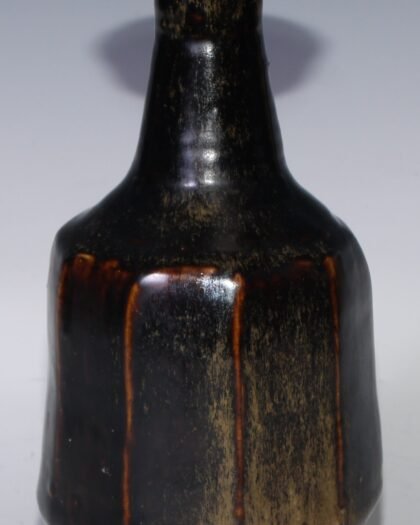
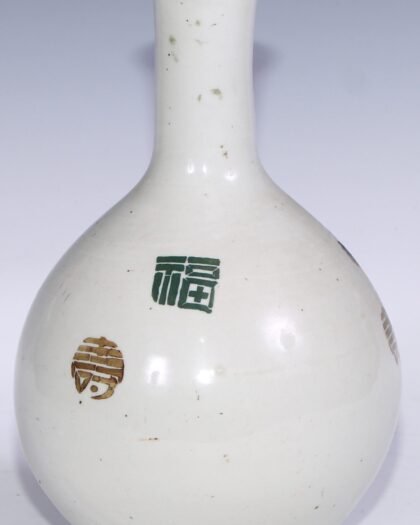
Four Joseon pieces: a moon jar used as a mizusashi and illustrated in Chadogu — The Art of Tea (plate 51); a porcelain guglet painted with shou characters and seals; a mallet-shaped panelled bottle in a mottled brown glaze; and an iron-painted dragon moon jar of the nineteenth century or later, with an inscribed tomobako whose text we have not yet had translated.
Showing all 4 results