Two things to clear up before anything else, because both appear in a great many published guides to Ming porcelain and both are wrong.
The Ming was not China’s last imperial dynasty. It ran 1368–1644 and was followed by the Qing, which lasted a further 267 years to 1911 (the last emperor abdicated in February 1912) (Metropolitan Museum, List of Rulers of China). And Ming porcelain did not reach Europe along the Silk Road. It came by sea, in Portuguese and then Dutch ships, from the sixteenth century — a route so specific that the word for the porcelain is named after the boat.
Jingdezhen, and what “imperial” actually meant
Imperial ware was not a quality grade. It was an administrative system, and the British Museum describes its mechanism in a sentence that explains almost everything about surviving Ming imperial porcelain:
Court officials supervised the production of vessels in specified sizes with particular designs in pre-ordered quantities. Any with mistakes, inferior painting, and any surplus to the order were deliberately broken and buried.
British Museum, Room 95 gallery guide
That is why the imperial kiln site at Zhushan yielded tons of sherds, from which the Palace Museum has restored over a thousand objects. It is also why genuine imperial pieces are so consistent within an order — the inconsistent ones were destroyed on purpose.
Two proportions worth holding on to. Government kilns “had access to the finest raw materials, including imported cobalt”. But after 1530, despite individual court orders of more than 100,000 items, the imperial quota accounted for just one per cent of Jingdezhen’s total output. The overwhelming majority of Ming porcelain — including most of what you will ever be offered — was never imperial and was never meant to be.
A note on dates: the imperial kiln’s foundation is traditionally given as 1369. We have found only one museum stating that year, and none of the major institutions gives a founding date at all. Treat “traditionally dated to 1369” as the honest phrasing.
Cobalt — the most useful dating tool, stated carefully
Ming blue came from two sources: domestic cobalt, chiefly from Yunnan, and cobalt imported from West Asia. The V&A confirms both; the Smithsonian notes that in the fourteenth and fifteenth centuries most cobalt was imported; the British Museum records that early-fifteenth-century Jingdezhen “used cobalt oxide imported from the Middle East or Central Asia”.
The supply was interrupted, and you can see it. The British Museum attributes the Hongwu period’s turn towards monochrome and underglaze copper red directly to “the lack of imported cobalt during the Hongwu period” — and notes Hongwu blue is paler than later Ming.
Where we part company with the trade
You will be told that “heaping and piling” — darker concentrations where the cobalt pooled — is diagnostic of Yongle and Xuande. We could not stand that up. The only institutional definition we could find is on a Met object record, and it attaches the effect to the Yuan dynasty — though the Met’s own 1989 handbook also applies the phrase to Yongle and Xuande wares, so the museum is not consistent with itself and states that it “disappeared in the early fifteenth century, when potters further mastered the use of this pigment” — which is precisely when the trade says it becomes diagnostic.
What is defensible, and still genuinely useful:
- Imported West Asian cobalt gives an uneven blue with darker concentrations. This unevenness characterises Yuan and early Ming blue and white.
- The unevenness diminishes through the fifteenth century as pigment control improved. The British Museum still describes a Xuande vase as having “uneven underglaze cobalt”.
- By the second half of the sixteenth century imperial cobalt is, in the British Museum’s words, “a distinctive strong, dark and even tone”. Jiajing blue is the opposite visual character to early-fifteenth-century blue.
So the direction of travel — uneven and blotchy early, strong and even late — is real and sourced. The confident rule is not. We also found no institutional use of the terms “sumali qing” or “Muhammadan blue” outside a general encyclopedia, so we do not use them as though they were technical vocabulary.
The reigns, and what changes
| Reign | Dates | What to look at |
|---|---|---|
| Hongwu | 1368–98 | Underglaze copper red rather than blue; where blue occurs, paler and greyer. A cobalt-supply story, not a taste story. |
| Yongle | 1403–24 | The British Museum’s superlative: blue and white with “a lustrous quality never before accomplished and never successfully imitated”. Characteristically unmarked. |
| Xuande | 1426–35 | Ten years, an extraordinary range of forms. The reign where marking begins — see below. |
| Chenghua | 1465–87 | Doucai at its height. The mark within a double square is an innovation of c. 1482–87, which narrows dating to the last five years of the reign. |
| Zhengde | 1506–21 | The Palace Museum’s Hongzhi–Zhengde exhibition calls it the turning point: heavier bodies, more shapes, elaborate decoration. Also the Arabic and Persian inscribed wares. |
| Jiajing | 1522–66 | Strong, dark, even cobalt with a violet cast. |
| Wanli | 1573–1620 | Mass export. Kraak. And a great many pieces bearing earlier reign marks. |
| Transitional | c. 1620–1683 | Defined by the Met’s 1989 handbook as the death of Wanli (1620) to the arrival of the imperial supervisor Zang Yingxuan (1683). Treat the bracket as convention, not fact. |
Xuande and the invention of the reign mark
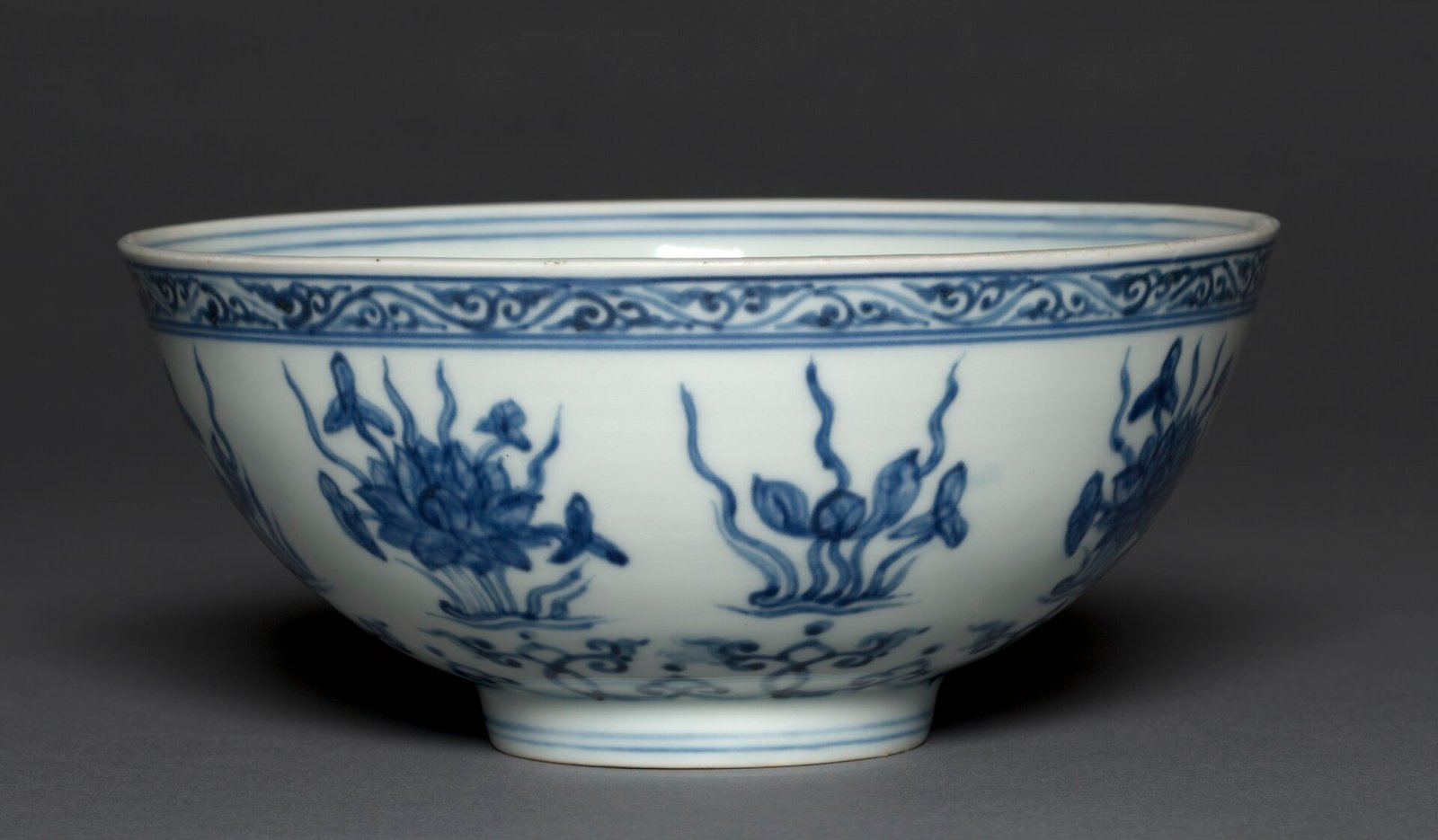
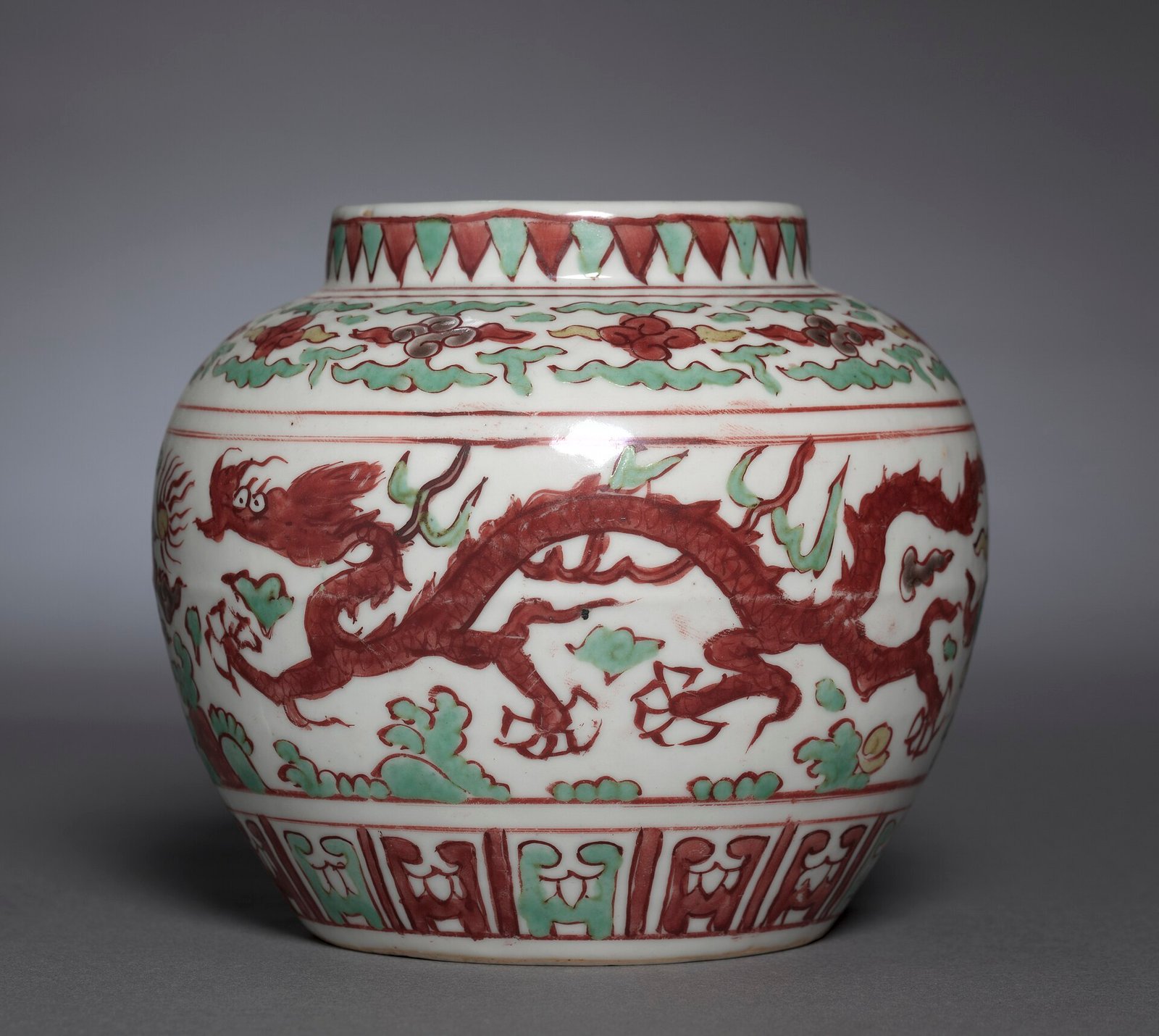
This is the fact to lead with, because it explains a whole category of confusion. Reign marking becomes systematic practice from the Xuande reign — the Metropolitan Museum attributes to the Xuande emperor the establishment of “the system of marking ceramics with reign dates to indicate their period of production”.
Before Xuande, systematic reign marking essentially does not exist — which is why Yongle imperial wares are characteristically unmarked, and why an unmarked early Ming piece is not thereby suspect. After Xuande, marks are the norm, and everything in our guide to reign marks applies.
One practical warning: Xuande marks turn up in varied positions. The British Museum records one running horizontally around a vase neck, read right to left, not on the base at all. A base-only expectation will make you reject good pieces.
Chenghua doucai, and the chicken cups
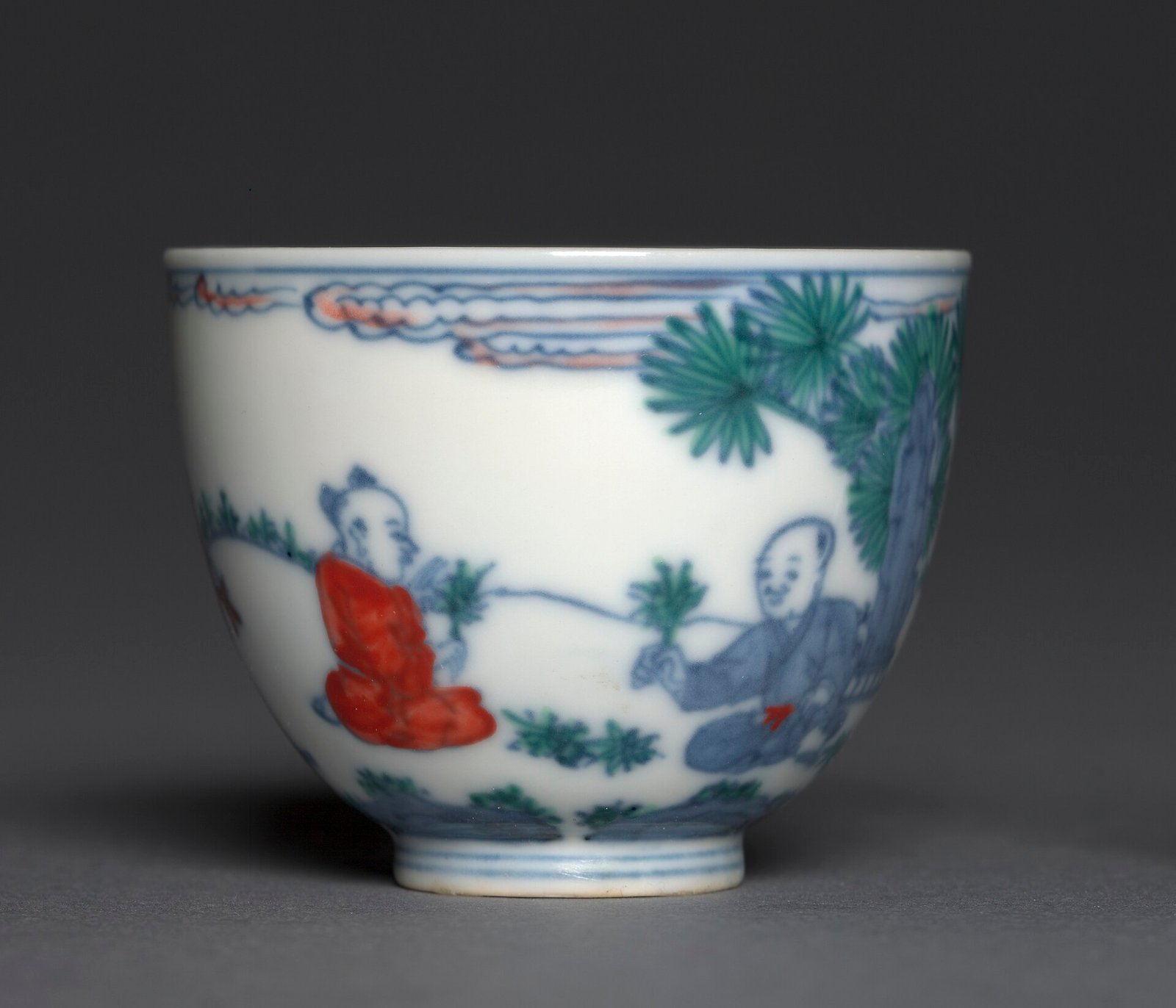
Doucai (鬥彩) means “joined colours”, and the name describes the method: the design is outlined in cobalt blue under the glaze and fired at high temperature, then filled in with coloured enamels over the glaze and fired again, lower. Two firings, two layers, joined.
Which disposes of two claims we have seen in print. The chicken cups are not “glazed in a beautiful shade of blue”: the British Museum records the palette as underglaze blue outlines and washes plus overglaze green, red, yellow and brown enamels. And the technique is not called “ding”. Ding is a grey-white porcelain from Hebei of the Song and Jin periods, centuries earlier (the British Museum dates Ding from the early eighth to the mid-fourteenth century) and unrelated — see our Song ceramics guide.
The British Museum records that Chenghua doucai was so admired that Jingdezhen potters “imitated them for 500 years”. That is the real reason Chenghua is the most-copied mark in Chinese ceramics. For scale: the Meiyintang doucai chicken cup, Chenghua mark and period, sold at Sotheby’s Hong Kong on 8 April 2014, reported in the press at HK$281.24 million, about US$36 million, to the collector Liu Yiqian. The cup is 8.2 cm across.
Kraak, and how porcelain really got to Europe
By 1517 (the Met’s chronology; other accounts put the first landing at 1513) Portuguese ships had reached the Pearl River estuary — the first Europeans to arrive in China by sea. By the early sixteenth century, the Met records, Chinese potters “began to produce objects specifically for export to the West”.
The word settles the route. Blue-and-white export dishes “became known as kraak porcelain, the term deriving from the Dutch name for caracca, the Portuguese merchant ship”. The porcelain was stowed low in the hull as ballast, being impervious to water, with the more valuable tea kept above it — a practice the Met describes for the later Company trade rather than the Portuguese period.
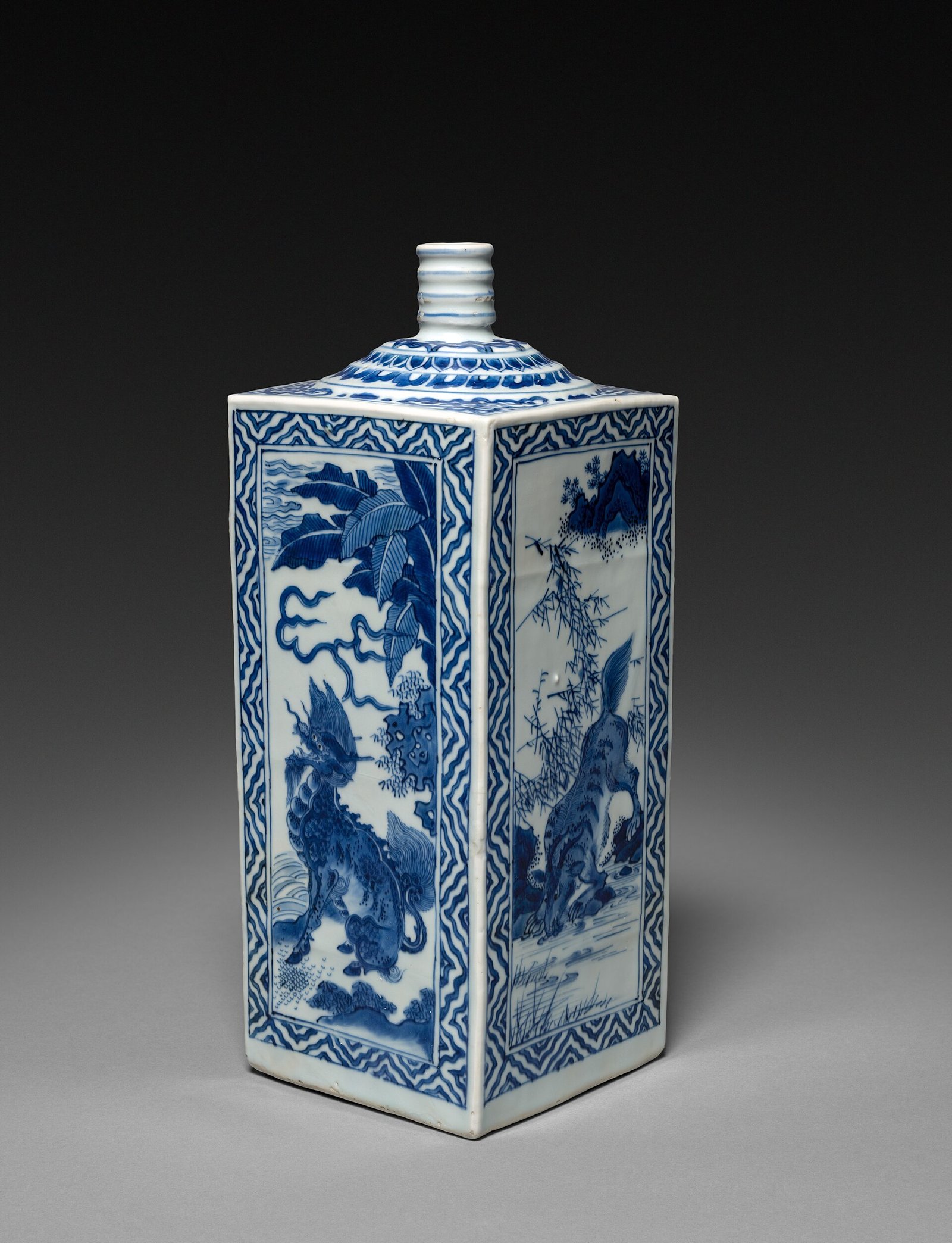
The Dutch phase follows: the VOC was founded in 1602, Chinese blue and white became fashionable in seventeenth-century Holland, and Delft potters set about copying it. Kraak itself is recognisable — a central panel with alternating wide and narrow border compartments carrying floral motifs and auspicious symbols. Institutional object records support a date range of roughly 1590–1644; the wider c. 1550–1650 bracket you will see quoted has endpoints we could not source.
The hardest dating anchor of all is a shipwreck. The VOC ship Witte Leeuw sank off Saint Helena in 1613, and the Rijksmuseum holds and publishes its kraak cargo — porcelain that cannot be later than that year. See our journal piece on shipwreck cargo porcelain for what that means for buyers.
Marks on Ming porcelain are not evidence of date
Two documented cases make the point better than any warning. A Wanli-period dish in the V&A carries an apocryphal Chenghua mark, and the museum notes that “both Chenghua and Xuande marks were commonly used on Wanli period porcelains”. And a Qianlong-period chicken cup in the British Museum carries an apocryphal Chenghua mark in a double rectangle.
Earlier marks on later pots, in both directions, for centuries. Judge the object; read the mark afterwards.
Buying Ming
Most Ming on the open market is export or popular ware, not imperial, and that is not a criticism — it is 99% of what was made, and the good pieces are very good. What you are paying for is potting, the quality of the cobalt and the confidence of the brushwork, not the presence of a mark.
See what we currently hold in Ming ceramics and blue and white.
Sources
- British Museum, Room 95 Chinese ceramics gallery guide
- British Museum, Chenghua chicken cup PDF,A.748
- British Museum, Xuande vase 1968,0422.34
- V&A, Chinese blue-and-white ceramics
- V&A, Wanli dish with apocryphal Chenghua mark, C.230-1926
- The Metropolitan Museum of Art, East and West: Chinese Export Porcelain
- The Metropolitan Museum of Art, China 1400–1600 A.D.
- The Metropolitan Museum of Art, List of Rulers of China
- The Palace Museum, Beijing, porcelain from the Ming imperial kilns
- Rijksmuseum, kraak plate from the Witte Leeuw
Written by James Treacher. Where the trade’s standard account did not survive checking against museum sources — heaping and piling above all — this page says so.