Shipwreck porcelain is the easiest way into genuinely old Chinese ceramics. The cargoes are datable to the year, sometimes to the night; they were sold openly through the major auction houses; and the pieces are inexpensive relative to their age because they exist in tens of thousands rather than in ones.
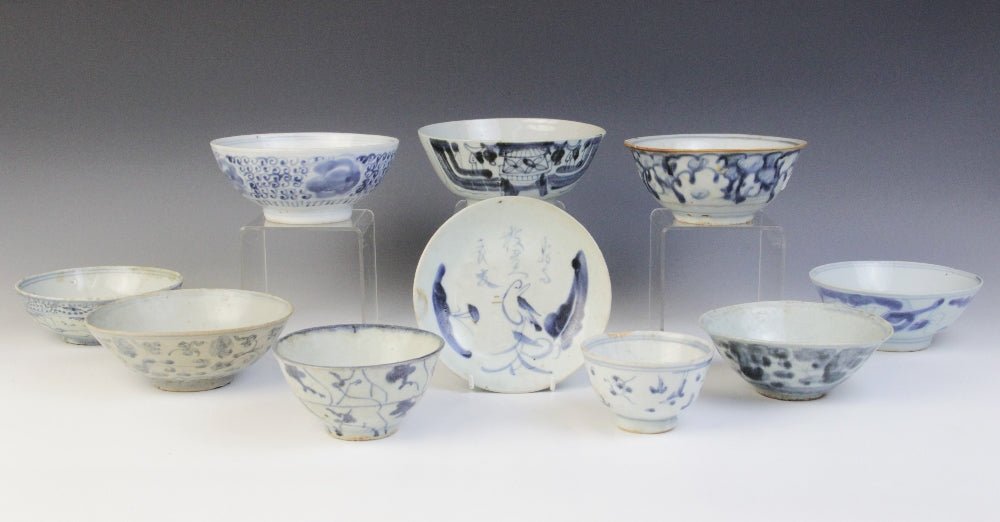
They also come with an ethical and legal history that a responsible dealer should set out rather than skip. We will do both.
The cargoes a British buyer actually meets
| Cargo | Sank | Recovered | What it carried | Sold |
|---|---|---|---|---|
| Binh Thuan | c. 1608 | Maritime Explorations with Visal | Zhangzhou porcelain and cast-iron pans; probably the junk of the merchant I Sin Ho | Christie’s Australia, Melbourne, 1–2 March 2004. All lots sold, A$2m |
| Vung Tau | c. 1690 | Archaeological direction by Dr Michael Flecker (1991) under the Hallstrom salvage licence | Over 48,000 ceramics, predominantly Kangxi blue and white from Jingdezhen. The hull was a lorcha — the only one ever found | Christie’s Amsterdam, 1992. 28,000 pieces, US$7.3m |
| Ca Mau | c. 1725 | Found off southern Vietnam, 1998; 51,500 pieces by 1999 | Jingdezhen export porcelain for South Asia and Europe | Sotheby’s Amsterdam, 29–31 January 2007. The V&A bought 182 pieces |
| Geldermalsen — the “Nanking Cargo” | Night of 3/4 January 1752 | Located 1985 by Michael Hatcher and Max de Rham | Over 150,000 porcelain pieces, plus tea, gold and silk | Christie’s Amsterdam, 1986. Over £10 million |
| Desaru | c. 1830 | Nanhai Marine Archaeology Sdn Bhd, Malaysia | Utilitarian Chinese wares | — |
| Tek Sing | 6 February 1822 | Michael Hatcher, 12 May 1999 | c. 350,000 porcelain pieces, mostly Fujian; the ship carried about 1,600 passengers | Nagel Auktionen, Stuttgart, November 2000 |
Sources for the table: Museum of New Zealand Te Papa Tongarewa and the V&A for the Geldermalsen; the British Museum for Tek Sing; the V&A and Sotheby’s for Ca Mau; Dr Michael Flecker, who directed the excavations, for Vung Tau and Binh Thuan. Where a figure comes from press reporting rather than an institution we have said so.
Two corrections to things commonly stated. Ca Mau was Sotheby’s, not Christie’s. And Tek Sing was Nagel in Stuttgart, not a London house — the British Museum bought its Tek Sing figure from that sale, lot TS147.
One more, from the V&A’s own record for the Ca Mau material: the museum summary says c. 1725 “corresponds to the reign of the Kangxi emperor” while the object-history field on the same record says Yongzheng. Yongzheng is the arithmetically correct one — Kangxi died in 1722.
What sea burial does to a pot
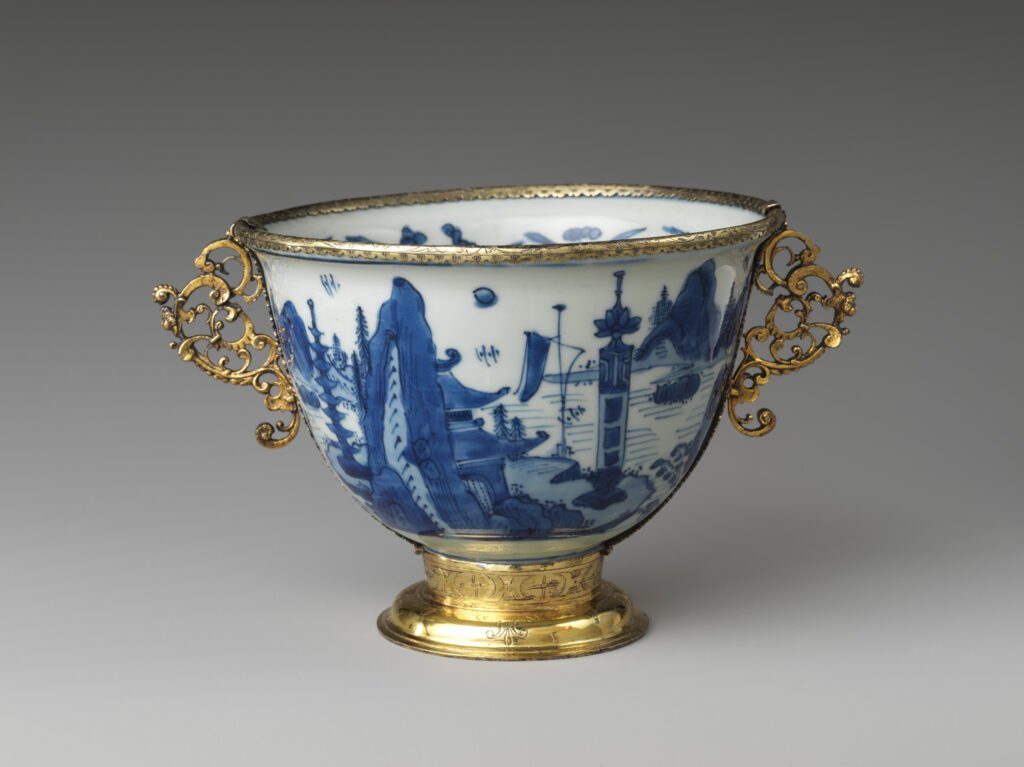
The V&A describes the two visible effects in its own catalogue, which is as good a source as you will find.
- Overglaze enamel is lost. Of a Geldermalsen figure group: “Originally polychrome, the group has lost all coloured decoration, and is now white/grey, with patches of encrustation.” Underglaze cobalt survives; overglaze enamel does not. This is why almost all shipwreck porcelain on the market is blue and white — not because that is what was shipped, but because that is what survived legibly.
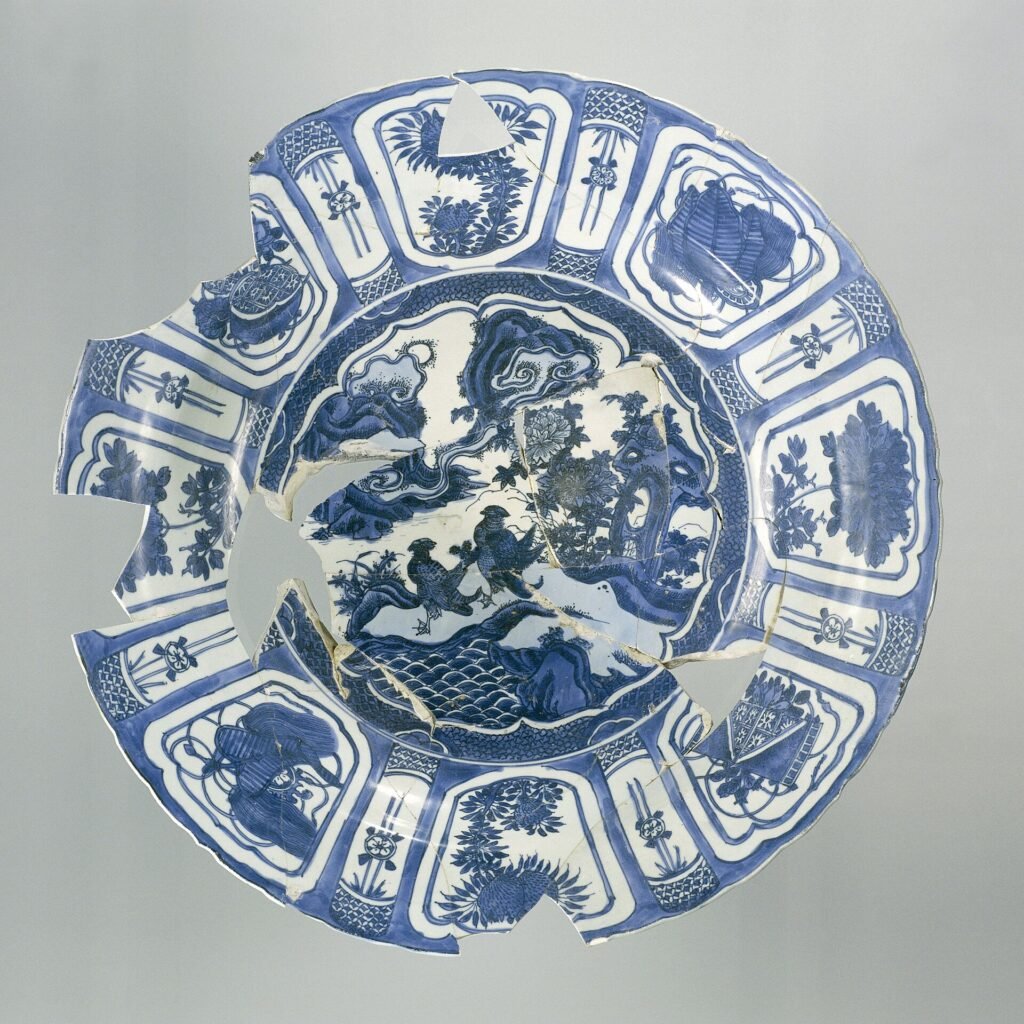
- Marine encrustation. Of a Desaru jar: “Large pieces of white encrustations now adhered to the body.”
The underlying chemistry has been studied on the Southern Song Nanhai I cargo and published open access (npj Heritage Science, 2023): seawater burial produces a porous, silica-rich corrosion layer over the pristine glaze, formed by dissolution and re-precipitation rather than simple ion exchange. One finding is directly useful to buyers — pyrite in the deposits oxidises to iron oxides once a piece is out of the water, which implies — our inference from the study, which examined lead-glazed pottery rather than porcelain — that some staining on shipwreck pieces developed after recovery, in storage, not on the seabed.
We should be straight that there is no institutional buyer’s guide to identifying sea-wear. No museum publishes a “how to spot shipwreck porcelain” page. What is documented is the above; the rest is trade experience and should be labelled as such by anyone offering it.
The part most dealers skip
Commercial salvage of historic wrecks is contentious, and the objections are not fringe.
UNESCO. The 2001 Convention on the Protection of the Underwater Cultural Heritage states at Article 2(7): “Underwater cultural heritage shall not be commercially exploited.” The UK has not ratified it — UNESCO lists it among the UK’s non-ratified conventions — so it does not bind British buyers or sellers. But it is the international standard, and it is why museums are cautious.
ICOMOS is blunter still. Its 1996 charter: “Underwater cultural heritage is not to be traded as items of commercial value”, and in-situ preservation “should be considered as a first option”.
And museums say so about specific cargoes. Te Papa, New Zealand’s national museum, holds a Nanking Cargo teabowl and records alongside it that Hatcher “prioritis[ed] his commercial interests over the heritage value”, focusing on removing ceramics rather than archaeological investigation, and that that “the Geldermalsen was destroyed during the salvage”. That is a national museum, about an object in its own collection.
Not all these cargoes are alike. The Binh Thuan and Vung Tau excavations were archaeologically directed, worked in partnership with the Vietnamese authorities, and are published. The Geldermalsen salvage was not. It is reasonable to weigh that difference when you buy.
The legal points, as published
Sourced summary, not advice — checked 1 September 2026.
1. The Receiver of Wreck. This is the one that catches importers, and almost nobody in the trade mentions it. GOV.UK states you must report to the Receiver of Wreck “all wreck material recovered from UK territorial waters and any wreck material brought into the UK from outside UK territorial waters” — regardless of age, size or value, within 28 days of recovery. Under the Merchant Shipping Act 1995, failing to declare without reasonable excuse carries a £2,500 fine on summary conviction, payment of twice the value of the find, and loss of salvage rights. How this applies to previously auctioned cargo material is not spelled out on that page, so if you are importing wreck-recovered goods, ask the Maritime and Coastguard Agency rather than assume.
2. The Dealing in Cultural Objects (Offences) Act 2003. It is an offence to dishonestly deal in a “tainted” cultural object knowing or believing it to be tainted — up to seven years on indictment. An object becomes tainted where it was removed or excavated unlawfully after the Act commenced, and section 2(3) provides that it is “immaterial whether—(a) the removal or excavation was done in the United Kingdom or elsewhere, (b) the offence is committed under the law of a part of the United Kingdom or under the law of any other country or territory”. The Act’s definition of a monument encompasses sites containing the remains of vessels, above or below water. So a shipwreck can be a monument for these purposes, and unlawful recovery abroad after December 2003 can taint an object in British hands.
3. China’s claim. Article 5 of China’s Law on Cultural Relics Protection, in force from 1 March 2025, vests state ownership in cultural relics of Chinese origin remaining in seas under Chinese jurisdiction. Relevant to any cargo recovered in or near those waters. See our note on import duty, CITES and shipping.
None of this makes buying a Nanking Cargo teabowl unlawful in the UK. It does mean the paperwork matters, and that a seller who cannot tell you which cargo a piece came from and how it was sold is not giving you enough.
What to buy, and what to ask
Shipwreck material is a genuinely good entry point: a Vung Tau bowl is Kangxi-period Jingdezhen porcelain with a date you can defend, at a fraction of the price of a comparable unrecovered piece. The trade-off is that it is not rare, and it will not become rare.
- Ask which cargo, and for the sale reference. Lot numbers and sale dates exist for all the major cargoes. A piece that cannot be tied to a named recovery is worth materially less.
- Expect blue and white. If an enamelled piece is offered as shipwreck-recovered with its overglaze colours intact, ask how.
- Distinguish seabed staining from post-recovery staining. Iron-oxide crusts can form after excavation.
- Weigh the recovery. Archaeologically excavated and published cargoes are a different proposition from stripped wrecks.
We hold shipwreck cargo wares in the collection; see also Ming porcelain for kraak and the Witte Leeuw cargo of 1613, and Qing porcelain for the Kangxi and Yongzheng export wares that make up most of these cargoes.