Ming
The Ming dynasty (1368–1644) is the age in which Chinese porcelain became an imperial project and a world commodity at the same time. The imperial kilns at Jingdezhen were producing to court order by the early fifteenth century; by the late sixteenth, Portuguese and then Dutch ships were carrying Jingdezhen blue and white to Europe by the tens of thousands. Both stories are visible on the pots.
The reigns that matter
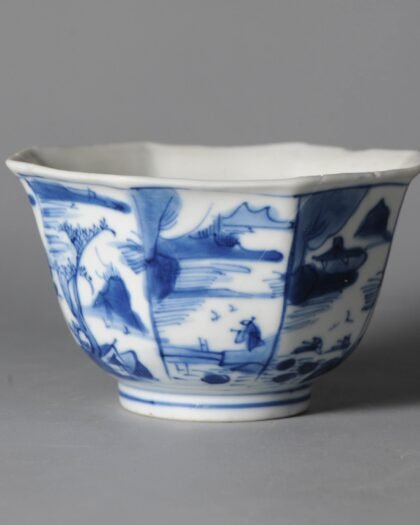
Early Ming is the classic period: Yongle (1403–1424) and Xuande (1426–1435) blue and white painted in a rich, sometimes blackish cobalt, and the first regular use of reign marks. Chenghua (1465–1487) is famous for doucai — underglaze blue outlines filled with overglaze enamels — of which the “chicken cups” are the celebrated example. Under Jiajing (1522–1566) and Wanli (1573–1620) the palette broadened to wucai five-colour enamels, and the volume of production rose sharply. The Wanli reign was the first great age of export: the V&A records that from the sixteenth century large quantities of blue and white reached Europe, first through Portuguese merchants and then the Dutch East India Company, and that kraak porcelain — a central scene inside alternating panelled borders — was the characteristic product. The “Transitional” decades between the end of imperial patronage around 1620 and the Kangxi reign produced some of the freest painting in Chinese porcelain: landscapes, figures and narrative scenes on tall sleeve vases and brush pots, often unmarked.
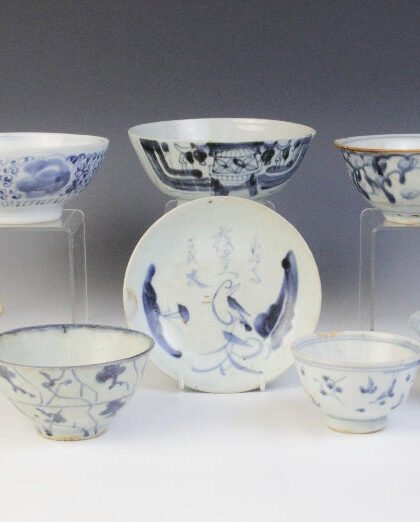
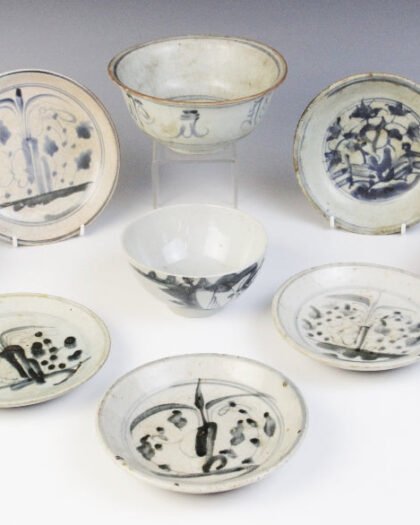
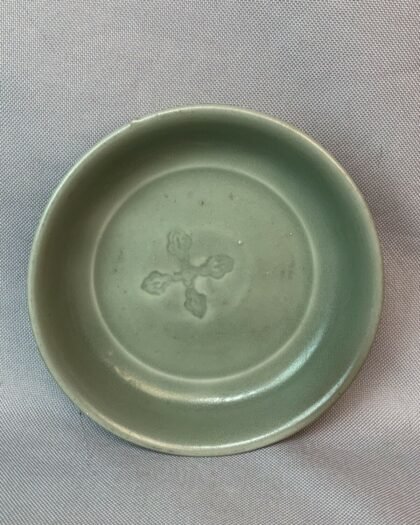
Outside Jingdezhen, Longquan continued to produce celadon through the Ming, including the large dishes and incense burners that turn up in Middle Eastern and Southeast Asian collections; Dehua in Fujian made the white porcelain Europeans called blanc de Chine; and the cargo of ships lost on the China–Southeast Asia routes has given the market whole categories of “shipwreck porcelain” — see the journal on shipwreck cargo.
Reading a Ming piece
Ming feet are usually neatly cut, the unglazed rim fired to a pale buff or orange where iron in the body oxidised, and the glaze often stops short of the rim in a tidy line. Cobalt varies with the reign: the early-Ming blue is saturated and can break through the glaze; Wanli cobalt is greyer and more diffuse than the sapphire blue Kangxi would achieve a century later, and that difference is one of the more reliable dating tools in blue and white. A six-character reign mark in a double circle is normal from Xuande on, but it is also the most copied thing in Chinese ceramics: Kangxi, Yongzheng and nineteenth-century potters all wrote Chenghua and Xuande marks as homage. The guide to reign marks deals with how to weigh one.
Further reading
The full guide to Ming porcelain goes reign by reign with museum examples. For the glazes, see blue and white and celadon and Longquan.
In the collection
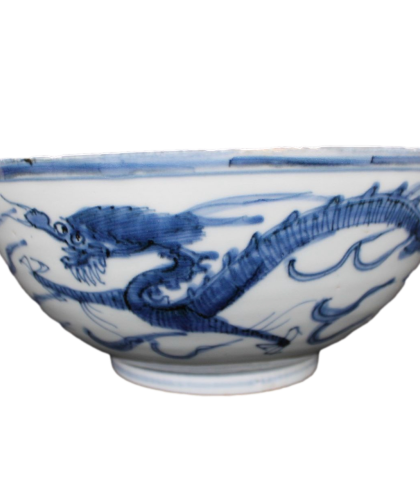
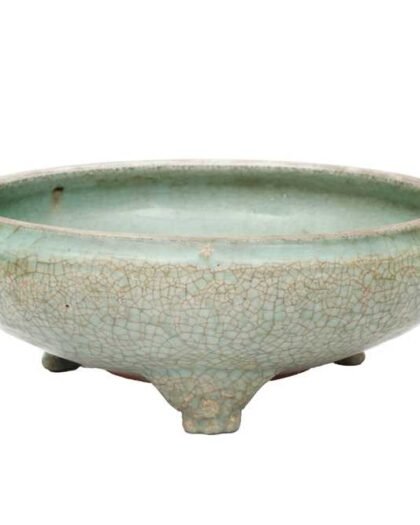
The Ming group here includes a Wanli blue and white bowl painted with a dragon and phoenix, its base marked with a double circle rather than a reign mark; a seventeenth-century Transitional bowl with landscape compartments; a Longquan brushwash; a celadon crackle tripod incense burner; and two groups of blue and white shipwreck cargo whose wreck has not been identified — a point we state plainly, because identifying it would change what they are worth.
Showing all 6 results