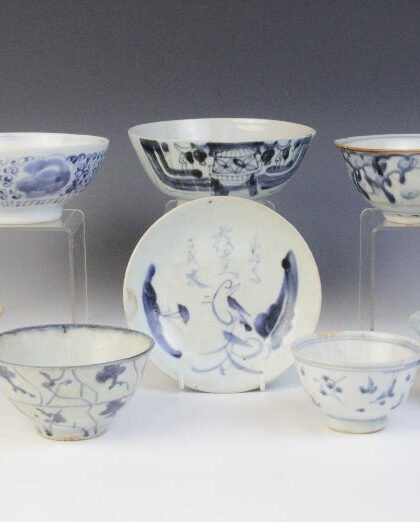
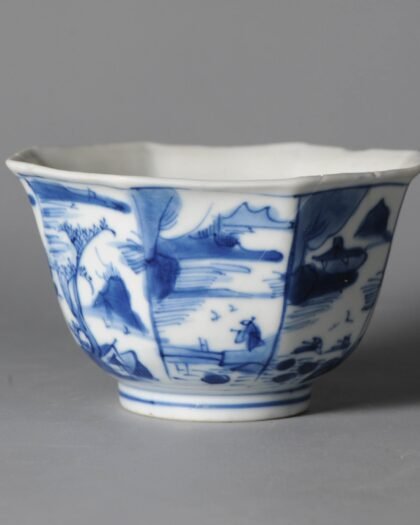
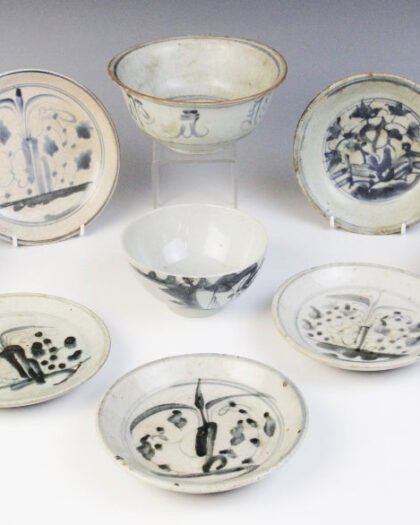
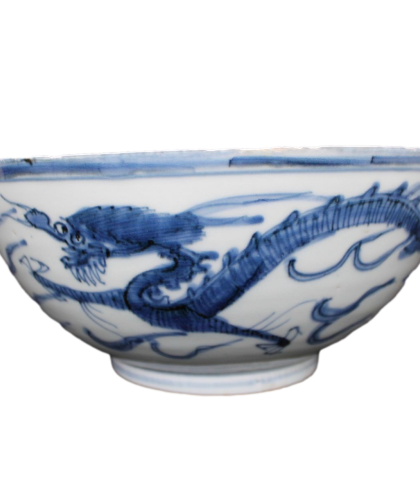
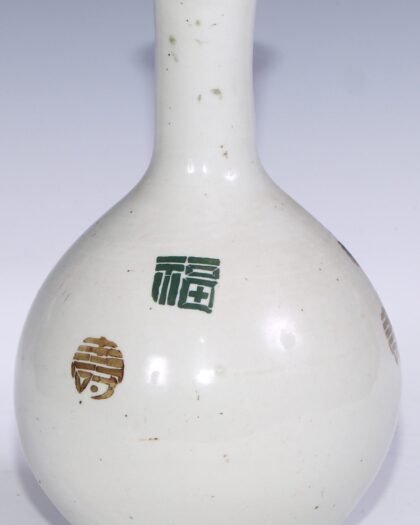
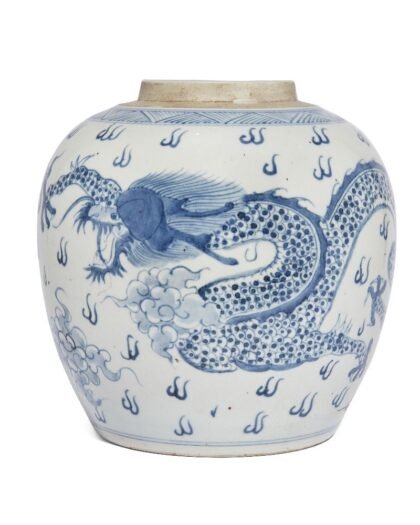
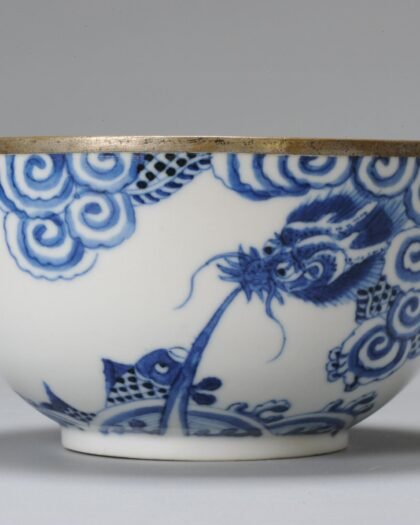
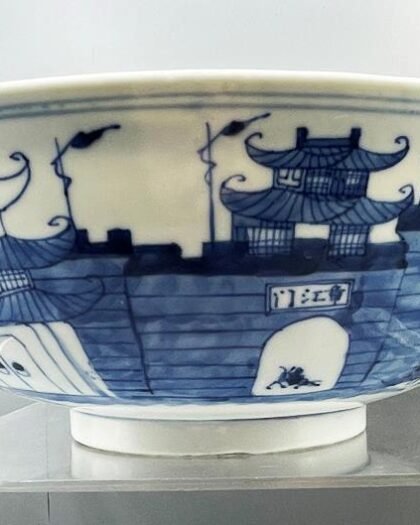
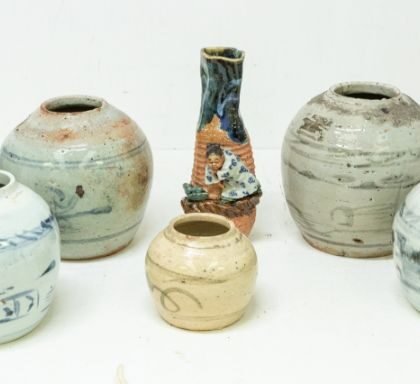
Blue and white is cobalt oxide painted onto the unfired porcelain body, covered with a clear glaze and fired once at high temperature, so that the blue sits under the glaze and cannot wear. It is the most durable of all ceramic decorations and, since the fourteenth century, the most widely made, copied and traded. That history is what makes it both the easiest ware to start collecting and the hardest to attribute with confidence.
Where it comes from
The V&A traces the earliest Chinese blue and white to the Tang dynasty, on a coarse greyish body, but the ware as we know it belongs to Jingdezhen in the Yuan dynasty, when potters refined the clay with kaolin, mastered high firing, and painted in cobalt oxide imported from the Middle East or Central Asia, with domestic ores from Jiangxi coming into use later (British Museum, Room 95; V&A). The Ming court took the ware over: the imperial blue and white of Yongle and Xuande is the standard against which everything later is measured, and from the sixteenth century the export trade — Portuguese first, then the Dutch East India Company — carried Wanli kraak porcelain to Europe in quantity. Under Kangxi the cobalt reached a clear sapphire and painters worked in graded washes, the technique the V&A calls fenshui, producing the blue and white European collectors have prized above all others. It never stopped: nineteenth-century Jingdezhen, the Republic kilns and today’s workshops all make blue and white, much of it with earlier reign marks.
How to read a piece
The blue. Cobalt varies with its source and the firing. Yuan and early-Ming blue is deep, sometimes blackish where it pooled thickly; Wanli blue is greyer and more diffuse; Kangxi blue is bright and clean; nineteenth-century blue can be a dull or purplish tone. Held beside each other the differences are obvious, which is why we photograph in daylight and give the reign of comparison pieces where we can.
The painting. Outline-and-wash is the Ming and Qing norm; the freedom or stiffness of the line, the way waves, rocks and foliage are drawn, and the treatment of borders are period habits that are hard to fake convincingly across a whole pot.
The foot. Ming feet are cut cleanly with the glaze stopping short of an unglazed rim that fired buff or orange; Kangxi feet are neat and white; export ware is often heavier and rougher underneath. The guide to reading the base covers this with museum examples.
The mark. A six-character mark in a double circle is the most copied thing in Chinese ceramics. It tells you what the pot claims; the guide to reign marks explains how to weigh it, and why a Chenghua mark on a Kangxi bowl was an act of homage rather than fraud.
Condition
Because the decoration is under the glaze it does not wear, so condition is about the body: rim chips and frits, hairlines, star cracks from a knock to the base, and restoration, which fluoresces differently under ultraviolet light. Firing faults — a glaze skip, kiln grit on the foot, a slight warp — are not damage and are recorded as such. See what a hairline does to value.
Read more
The Ming and Qing guides follow blue and white reign by reign; the journal covers shipwreck cargo porcelain, which is mostly blue and white, and the Bleu de Hué guide explains the blue and white made at Jingdezhen for Vietnam.