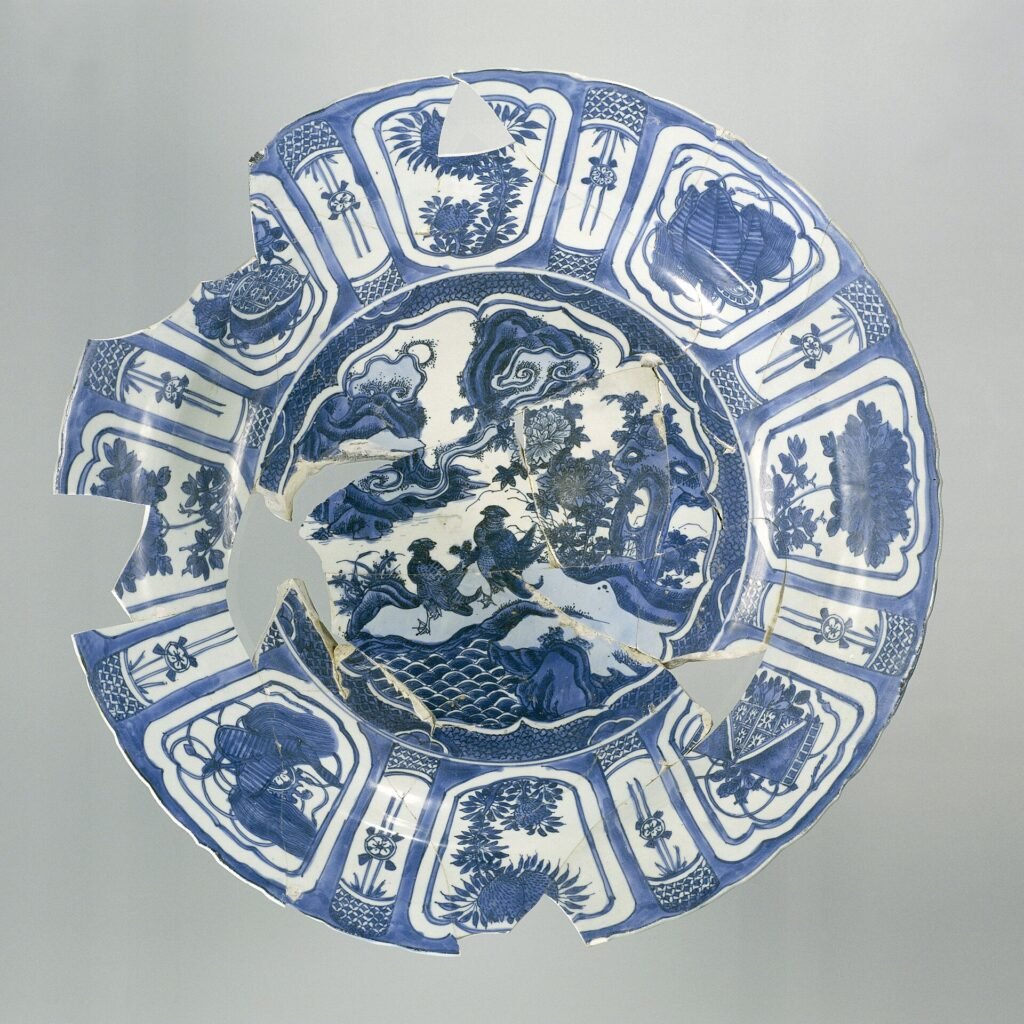
One thing matters more than any other with late Ming export porcelain. It was made in enormous quantity, for a hundred years, by private kilns working to a formula. That fact drives everything else. It is why kraak dishes survive in their thousands, why “Wanli” means little without a look at the foot, and why one well-painted Transitional jar is worth many plain kraak dishes. Quantity is the context. Quality within it is what you are buying.
This guide covers the century from about 1570 to 1683. We keep to what museums have put in writing; where the trade repeats something we cannot source, we say so. For the wider dynasty, start with our Ming porcelain guide.
What “kraak” means
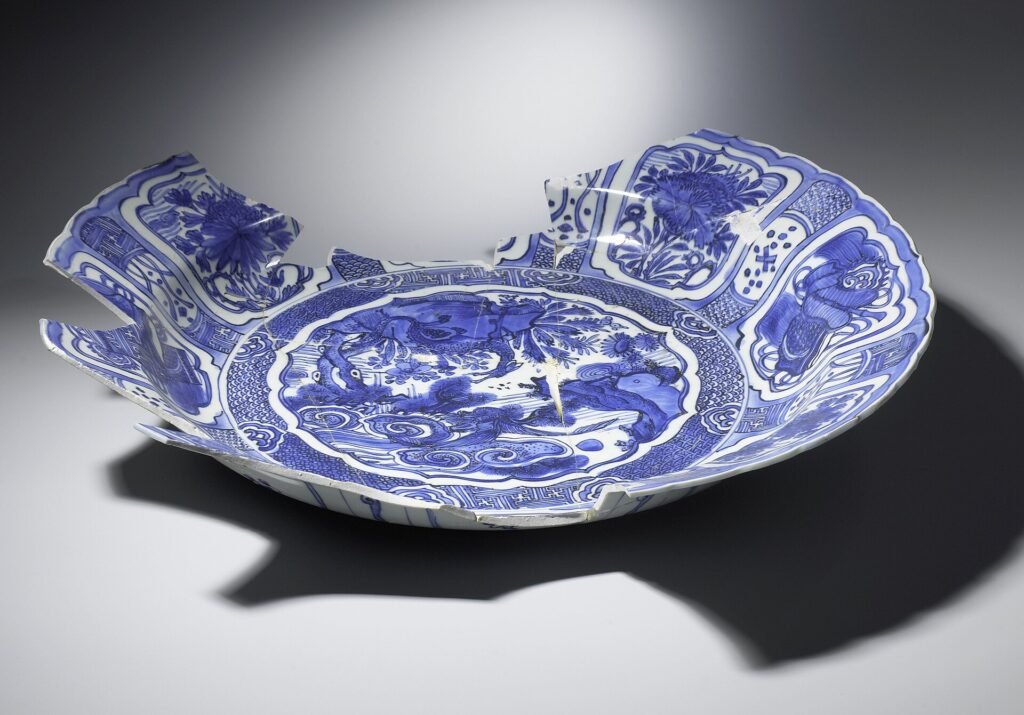
Kraak is a Western name, not a Chinese one. The Metropolitan Museum explains that the term derives “from the Dutch name for caracca, the Portuguese merchant ship”. The Portuguese reached the China coast first; the Dutch East India Company (VOC) followed, and the Dutch gave the type its name. By the early sixteenth century Chinese potters were already making pieces specifically for Europe. The Met’s own label for a Wanli dish calls it porcelain “popularly known as kraak ware”, made in large numbers for trade. See also our glossary entry.
You recognise kraak by its layout. The British Museum describes it as export ware “characterized by a fairly thin body and panelled decoration”. The V&A puts it as “radiating decorative panels, placed around a large central design”. The panels alternate wide and narrow. Wide panels carry flowers, fruit and emblems; narrow ones dots, lozenges, ribbons and tassels. The centre is a bird on a rock, deer, a landscape or a vase of flowers. Rims are often lobed, sides shallowly moulded. The Rijksmuseum notes that on dishes and bowls of this period “the borders … are often divided into panels”. Bowls, kendi, bottles, boxes and “kraaikop” bowls exist too, but the dish is the type piece.
Wanli and the private kilns at Jingdezhen
The Wanli emperor reigned from 1573 to 1620. Imperial kilns at Jingdezhen supplied the court. Private kilns in the same town supplied everyone else, and the export trade was theirs. The British Museum records that kraak porcelain “was produced on a vast scale throughout the late sixteenth and seventeenth centuries”. It also notes that kraak-style dishes “are seldom found in Chinese domestic contexts”. This was product for ships.
Quality was uneven and the museums say so. The V&A describes a Wanli kraak dish as made of “poor quality, brittle porcelain clay” with an apocryphal Chenghua mark, and calls this typical of bulk export ware. At the top of the range the British Museum notes an egret mark that appears almost only on the better small and medium dishes. Our own Ming collection includes a Wanli blue and white dragon bowl, unmarked and domestic in feel rather than kraak in layout; the private kilns made both.
The Transitional period, c. 1620–1683
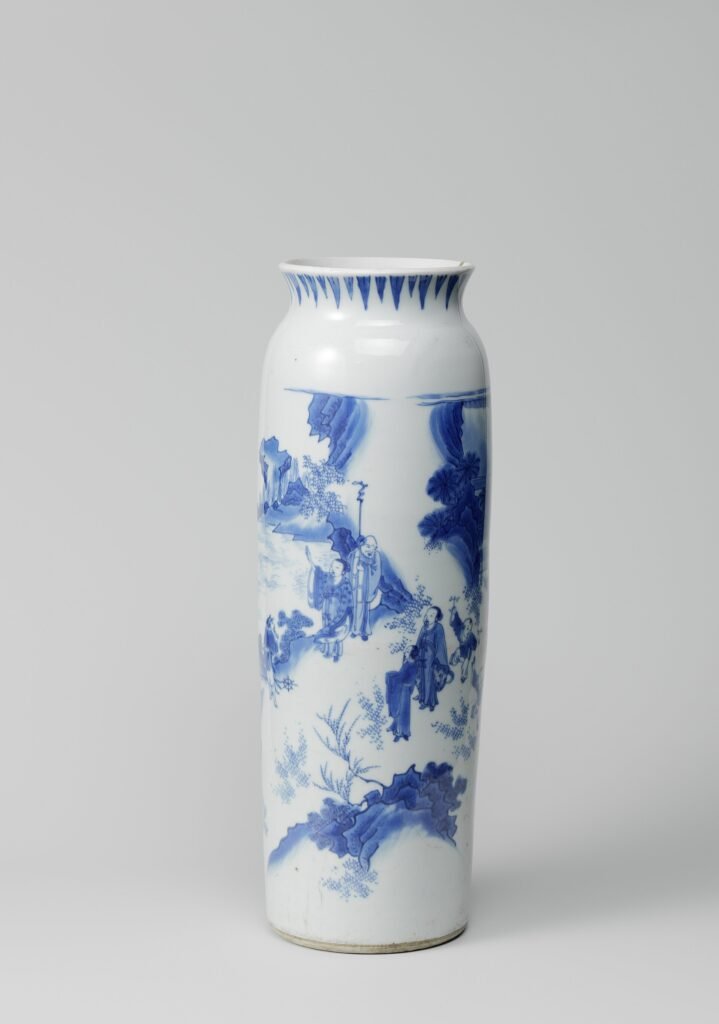
The Cleveland Museum of Art defines the Transitional period as roughly 1620 to 1683, “when official kilns in Jingdezhen were no longer under imperial supervision”. Wanli died in 1620. Tianqi reigned 1621 to 1627, Chongzhen 1628 to 1644, and the Ming fell in 1644. Shunzhi, the first Qing emperor in Beijing, reigned 1644 to 1661 and Kangxi from 1662. The imperial kilns did not resume proper operation until well into the Kangxi reign; 1683 is the conventional close of the period. Reign dates here follow the Met’s list of rulers. See also our glossary entry.
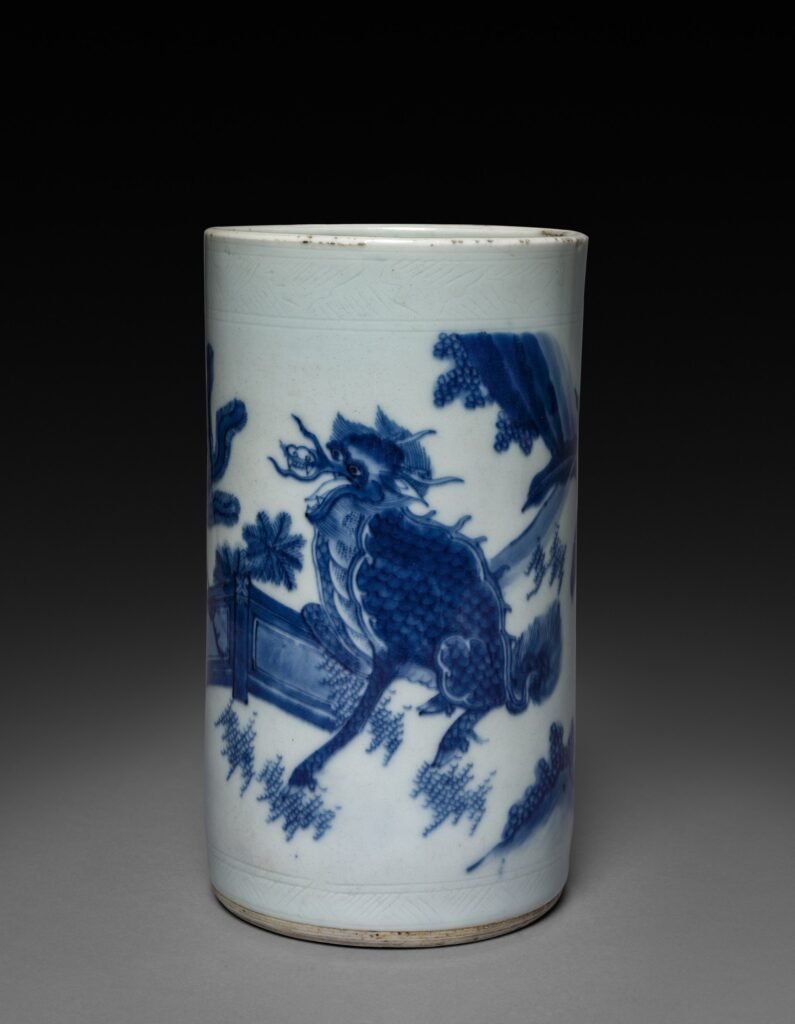
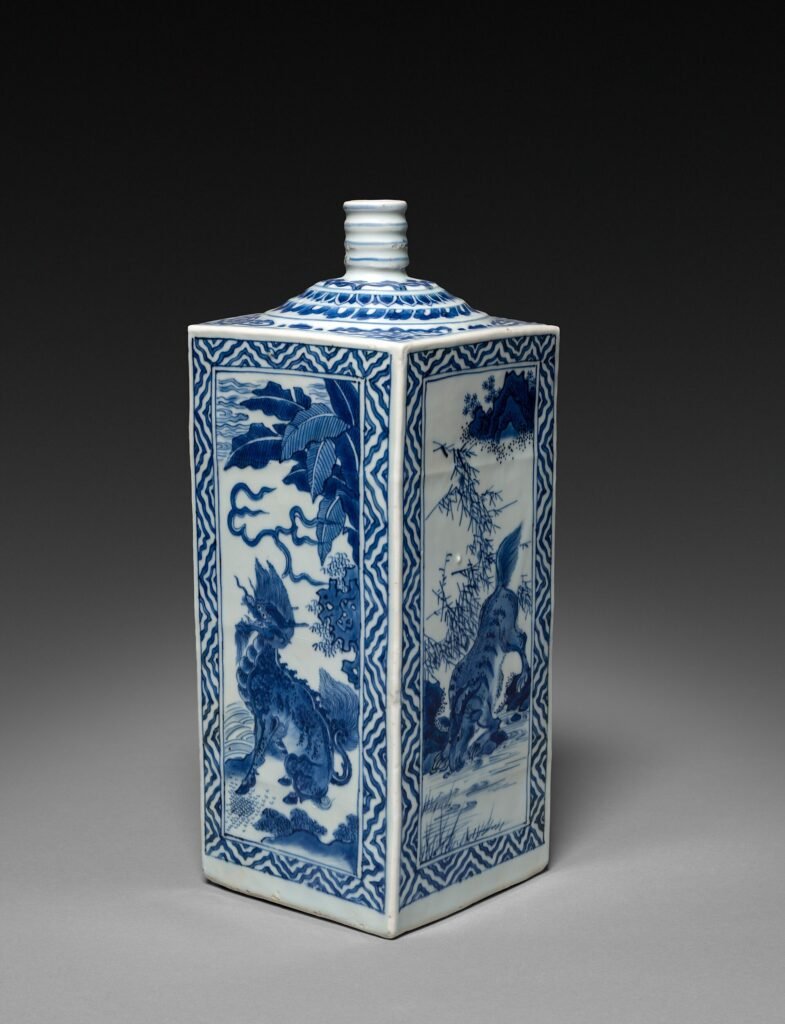
Why it matters: with the court gone as a client, the best painters and potters had to find other work. Cleveland says the potters “lost imperial patronage and experimented to find new clients in China and abroad”. The new clients were the Chinese scholar class and the Dutch. For the scholars the kilns made brush pots, sleeve vases (rolwagen), bottles and jars painted with landscapes, narrative scenes from plays and histories, and literary subjects. Cleveland’s Chongzhen brush holder is a good example. The Rijksmuseum’s sleeve vase of about 1635–50 shows a dignitary meeting a fisherman in a river landscape, very likely King Wen and Jiang Taigong, with an incised band at the shoulder and pendant leaves at the rim.
The Dutch wanted it too. The Rijksmuseum records that the VOC sought vases with “clear blue tints” and scenes of “trees and rocks alternating with Chinese figures”. European motifs crept in. A Rijksmuseum bottle vase of about 1635–45 has, in the museum’s translated description, twice a tulip motif with two precious objects (pearl, lozenge) between on the neck, a Dutch flower on a Chinese pot. Some pieces went east instead; the Met suggests a Chongzhen lobed bottle was made for the Japanese market. The trade often speaks of a “violet-blue” cobalt and of “V-shaped grass” tufts as Transitional markers. We see both on good pieces, but no museum page we found uses those terms, so treat them as dealer shorthand.
Delft is the other half of the story. The V&A notes that Delft potters took up the kraak layout of “compartilised borders containing floral motifs and Chinese symbols” and worked to compete with the imports. By the 1670s Delft was producing octagonal jars with Chinese figures drawn from Olfert Dapper’s 1670 book on the VOC in China.
How to read a piece
Turn it over first. Our general method is in Reading the base; here is what applies to this century.
| Period | Typical forms and borders | What to check |
|---|---|---|
| Wanli, c. 1573–1620 | Kraak dishes, bowls, kendi, klapmuts; radiating wide and narrow panels; lobed rims; bird-on-rock or deer centres | Low tapering foot with grit; thin brittle body; rim frits; apocryphal Chenghua mark or egret |
| Tianqi–Chongzhen, 1621–1644 | Late kraak alongside new Transitional forms: sleeve vases, brush pots, bottles, jars; landscape and narrative scenes; incised bands; pendant leaves | Quality of the painting; incised decoration under the glaze; tulips or other Dutch motifs; Hatcher-cargo parallels |
| Shunzhi–early Kangxi, 1644–1683 | Continued Transitional wares, some enamelled; Japanese Arita kraak-style dishes and VOC-marked plates filling the gap | Weight and size (Arita is heavier, larger); purple-tinged blue; ring foot with kiln spur marks on Japanese pieces |
| Later Kangxi and after | Kraak layout revived on late 17th-century dishes; later Chinese and European copies | Crisper potting, whiter body, brighter blue; a kraak layout is not proof of a Wanli date |
What is copied or misdescribed
Japanese Arita. When Chinese supply faltered in the late 1650s, the V&A records that Dutch merchants in western Japan “began commissioning copies of Chinese porcelain from Japanese kilns”. The Met’s essay on Edo porcelain says the same: the Dutch “encouraged the fledgling Japanese porcelain industry to fill the gap left by China”. Arita kraak-style dishes of 1660–80 are common. The V&A gives the tells: Japanese pieces were “considerably heavier and often much larger than their Chinese counterparts”, with a blue “tinged with purple or blue”. The British Museum has an Arita dish of 1690–1710 in “a loose Kraak style pattern based on Chinese prototypes”. These are good objects in their own right. They are not Ming.
Later Chinese kraak. The layout outlived the Ming. The Met dates a kraak dish with a panelled border and ducks on a pond to the late seventeenth century. Panels alone do not make a piece Wanli.
“Ming” as a catch-all. Kraak was made for at least a hundred years and the style ran on into the Qing. A dish described only as “Ming” with no reign, no foot description and no comparison is under-described. Ask which reign, and why.
Shipwreck evidence
Wrecks give this century its fixed points. The Rijksmuseum holds the porcelain and pepper from the VOC ship Witte Leeuw, which sank in 1613 and was salvaged in 1976. Its kraak plates, with flat scalloped rims and alternating wide and narrow panels, are a dated benchmark, and the museum’s “kraaikop” bowl from the same wreck is the type piece for that form. The British Museum cites it as the comparison for its large Franks dish.
For the Transitional period the key wreck is the so-called Hatcher junk. The British Museum records a pair of kendi “recovered from among some 25,000 vessels” on an unidentified Asian ship in the South China Sea, found in 1983 and dated to 1643 by cyclical dates on two jar covers. The cargo held two things at once: “late variations of ‘kraak’ ware” and a Transitional style of landscapes, plants and birds. Kraak and Transitional wares were made side by side; kraak did not stop in 1620. Our journal piece on shipwreck cargo porcelain covers how wreck material is documented. We hold two groups of shipwreck cargo ourselves; the wreck is not identified in the records that came with them, and we say so.
Condition and value
Expect wear. Kraak dishes were used, stacked and shipped, and their thin rims chip. Rim frits are near universal. Grit on the foot, a warped rim, a firing crack in the base or a glaze skip in a panel are kiln faults, not damage, and we grade them as such. A hairline crack, a restored chip or a re-glued section are damage and should be declared. Sea-recovered pieces may have lost glaze or gained encrustation; that should be stated too.
Value in this field follows painting first, form second, and condition third. A plain kraak dish is abundant. A large one, an unusual subject, a rare form such as a klapmuts or kendi, or a documented wreck provenance lifts it. Transitional pieces are scarcer; a sleeve vase or brush pot with a coherent narrative scene, an incised band and a strong blue is the kind of object museums show. Our blue and white holdings include a Transitional bowl with landscape compartments, honestly graded with minor faults, which shows the compartment habit of kraak carried into the new landscape painting.