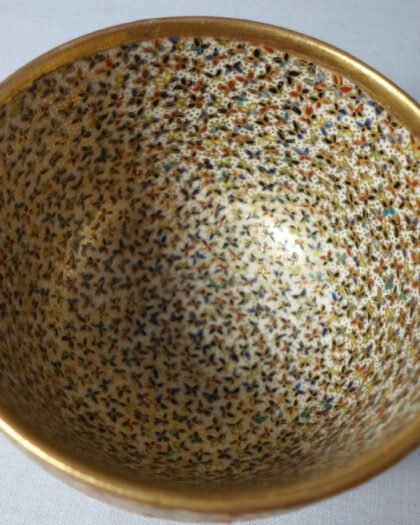
Japanese
Japanese ceramics cover two very different things that are often confused in the trade: the porcelain of Arita and its successors, and the low-fired, gilded pottery sold under the name Satsuma. Most of what we handle is Meiji (1868–1912), the period in which Japan produced enormous quantities of finely decorated ware for Europe and America, and this page is a short orientation before the Meiji page and the guide to Japanese marks.
Porcelain: Arita and after
Japan had no porcelain until the early seventeenth century. Korean potters brought to Kyushu after Hideyoshi’s invasions of the 1590s revived stoneware production and then, when suitable clay was found at Arita in Hizen, began to make porcelain painted in underglaze cobalt blue (Met). Overglaze enamels followed in the 1630s in the Kakiemon manner, with its spare designs in red, yellow, green, blue and black on a milky white body. When Chinese exports faltered in the mid-seventeenth century the Dutch, trading from Deshima, encouraged Japanese production to fill the gap, and the export wares shipped through the port of Imari — blue and white and the red, blue and gold “Imari” palette — became the Japanese porcelain Europe knew. Nabeshima, the refined ware made for the ruling house, and Kutani, the bold enamelled ware of Kaga, complete the early repertoire. Meiji porcelain continued all of these lines for export, at every level from factory to studio.
Satsuma
Satsuma is not porcelain. It is a low-fired, opaque, glazed pottery body — catalogued variously as earthenware or stoneware — with a cream-coloured crackled glaze, painted over the glaze in enamels and gold. The tradition began in the Satsuma domain of southern Kyushu with Korean potters in the 1590s; what most people mean by Satsuma is the export ware that followed its success at the 1867 Paris exposition, decorated not only in Satsuma but in workshops in Kyoto, Osaka and Tokyo, the best-known being Kinkozan of Kyoto and Yabu Meizan of Osaka (Bowers Museum). The journal sets out why Satsuma is earthenware and why that matters for price and for care.
How to look at a Japanese piece
Japanese marks are more informative than Chinese ones, because workshops and decorators often signed their own names, but they are also freely borrowed. The guide to Japanese marks explains what a mark can settle. Quality on a Meiji piece is judged with a lens: the fineness of the line, the number of colours, the control of the gilding, and how many figures or flowers the painter fitted into a square inch. On Satsuma the crackle should be fine and even and the glaze warm, not chalky; heavy, coarse crackle and thick gilding usually mean a later or lesser piece. We do not publish the tariff-marking chronology (“Nippon”, “Made in Japan”) that circulates online, because we have not found a primary source for it.
In the collection
At present one Japanese piece, a Meiji Satsuma bowl. Japanese pieces pass through the collection quickly; the archive shows what has sold.
Showing the single result