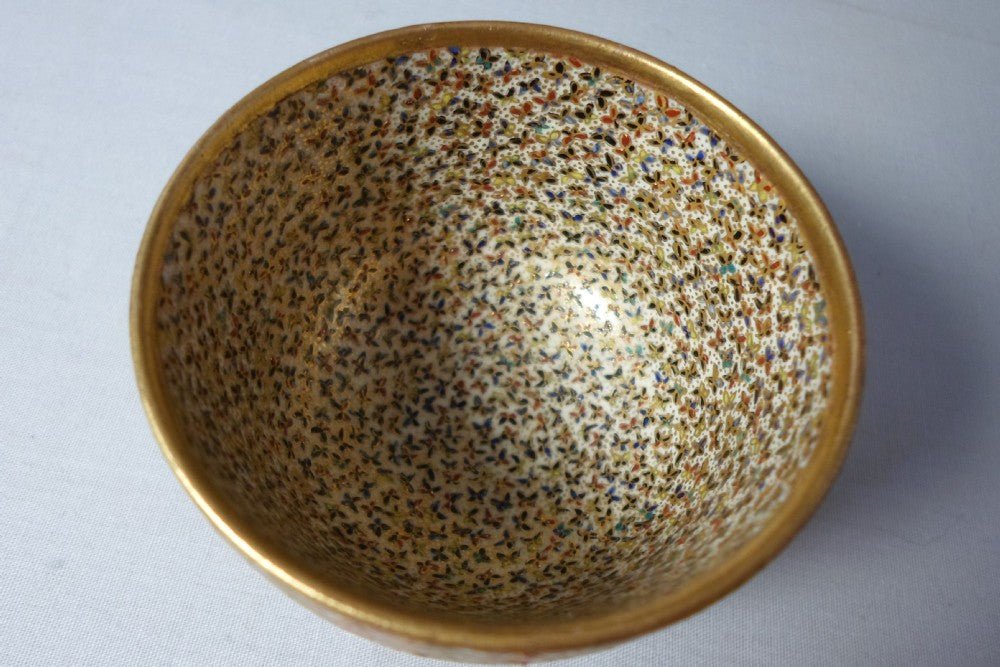
A Satsuma bowl decorated with butterflies, Meiji period.
One correction worth making at the outset, because it is got wrong almost everywhere: Satsuma is earthenware, not porcelain. The body is a soft, cream-coloured clay under a finely crazed glaze, decorated in overglaze enamels and gilding — which is why Satsuma pieces feel lighter and warmer in the hand than a porcelain of the same size, and why the crazing is original rather than damage.
Meiji (1868–1912) Satsuma was made in enormous quantity for export to Europe and America, and quality varies from the exceptional to the frankly commercial. Marks in roman letters generally indicate twentieth-century export production.
Satsuma in context
Satsuma is not porcelain. The Metropolitan Museum catalogues its Satsuma ware as earthenware, the V&A as earthenware or buff stoneware — a low-fired, opaque clay body under a crackled cream glaze, decorated over the glaze in enamels and gilding. That crackle is intrinsic to the glaze and is not damage, and the body is why Satsuma chips and wears differently from porcelain.
The kilns were founded in Kagoshima, in the old Satsuma province, by potters brought from Korea after the invasions of the 1590s — the British Museum records the Korean origin directly. The Western taste for the ware has a precise trigger: the Chin Jukan workshop’s success at the 1873 Vienna International Exhibition, which the V&A credits with starting “the western craze for Satsuma wares”. Kyoto answered with Kyō-Satsuma, and the style spread to Osaka, Yokohama and Tokyo, so much Meiji Satsuma was decorated far from Satsuma itself. This bowl belongs to that Meiji period (1868–1912) of export production.
Read more: Japanese ceramic marks and why Satsuma is earthenware, not porcelain.
The object, up close
The finer
details.
Reference XA-0034
A question about this piece? Ask for measurements, close-up photographs or a condition report.
Discuss this piece- Dimensions
- Ask for measurements
- Period
- Meiji period (1868–1912)
- Condition
- Very good