It is the correction we make most often, and it is not pedantry — it changes how you judge condition and what you should pay.
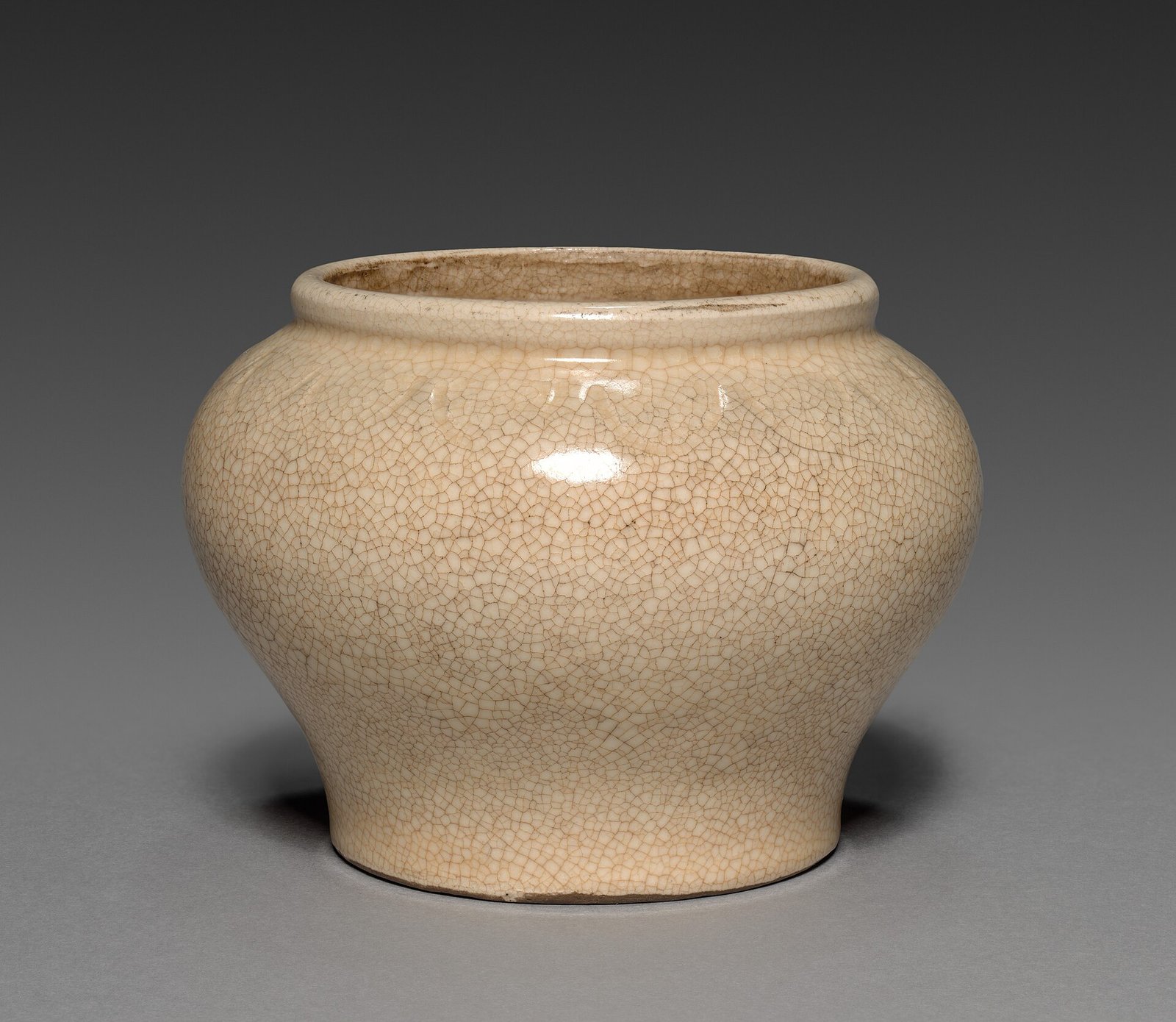
Satsuma is not porcelain. The Metropolitan Museum records the medium of its eighteenth-century Satsuma incense burner in its own catalogue as “Satsuma ware, earthenware with clear glaze”. The V&A catalogues its Satsuma jar as earthenware with a crackled cream glaze. Cleveland records its examples simply as “pottery”.
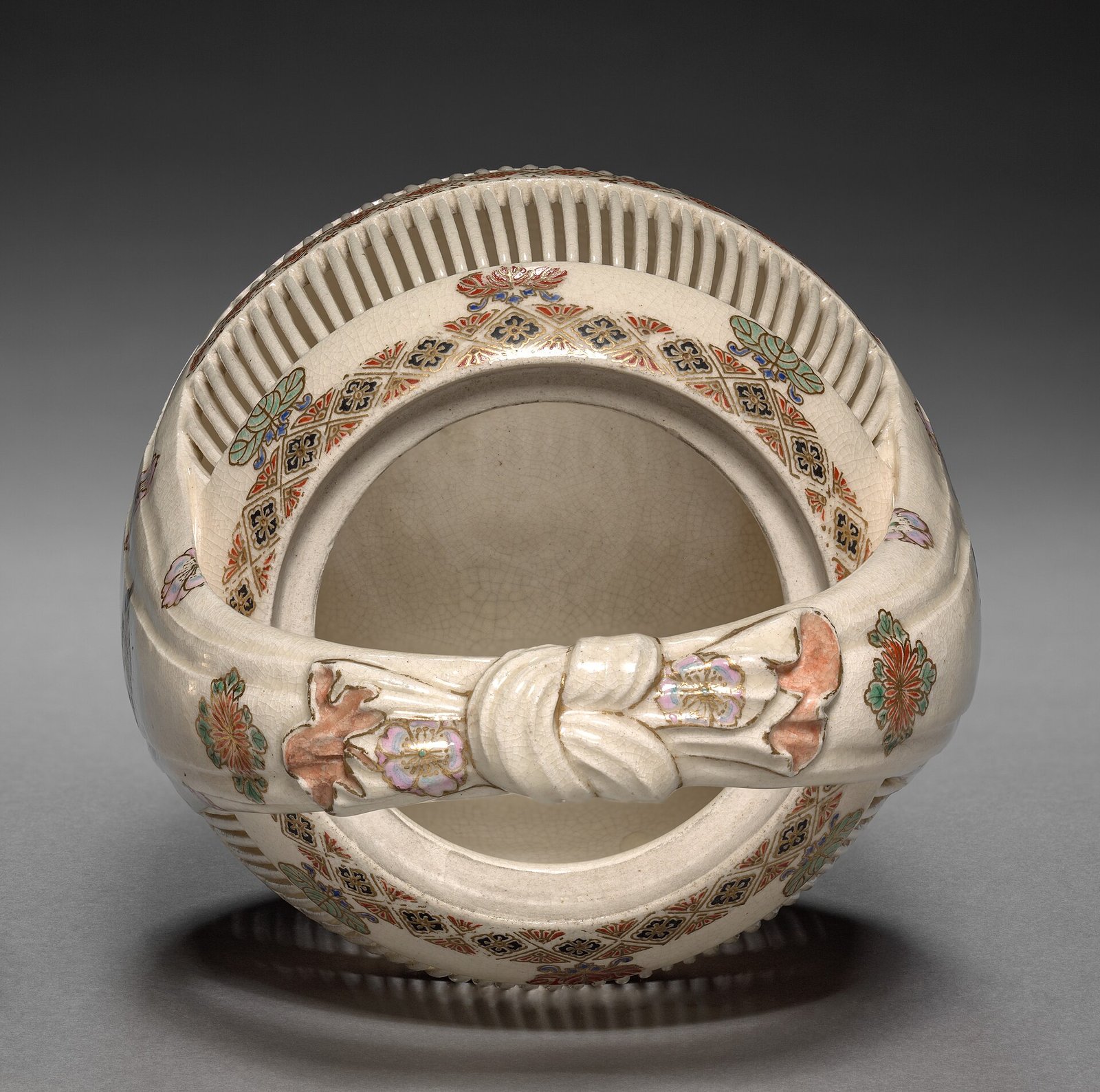
One honest qualification, because we would rather you heard it from us than from someone correcting us. Museum cataloguing of Satsuma is not uniform — and that includes within a single museum. The V&A describes one Chin Jukan piece as “pale buff stoneware with a clear crackled glaze”, and two older Met records for Satsuma wares use the word porcelain, almost certainly legacy cataloguing. So the claim we stand behind is the material one: Satsuma is a low-fired, opaque, glazed pottery body — catalogued variously as earthenware or stoneware — and it is never true porcelain.
Why it matters commercially
The crazing is intrinsic. That fine network across the cream ground is the glaze doing what it was always going to do on this body. It is not damage, it is not a sign of age or fakery, and discounting a Satsuma bowl for crazing is discounting it for existing. Compare a hairline — a crack through the body — which is structural and genuinely matters.
Earthenware behaves differently. Lower fired, more porous, chips rather than flakes at the rim, and less forgiving of thermal shock. Never put a Satsuma piece in water and never wash it as you would porcelain.
And it is not translucent. If you can hold a thin section to the light and see through it, it is not Satsuma.
The bigger surprise: most Satsuma is not from Satsuma
The kilns were established in Kagoshima, in the old Satsuma province — and the British Museum records they were founded “by immigrant potters from Yi dynasty Korea”, the same Korean diaspora that founded Japanese porcelain at Arita after the invasions of the 1590s.
But the Western craze has a date. The Chin Jukan workshop won acclaim at the 1873 Vienna International Exhibition and, in the V&A’s words, “their work started the western craze for ‘Satsuma wares’”. Kyoto answered commercially: the Kinkozan workshop became one of the leading producers of Kyō-Satsuma — Kyoto Satsuma — and the trend spread to Osaka, Yokohama and Tokyo.
So most of the densely gilded, minutely figured Satsuma on the British market is Meiji export ware decorated in Kyoto, Yokohama or Tokyo. That is not a criticism — the best of it is superb and increasingly sought after — but it is not a Kagoshima product, and it should not be priced as one.
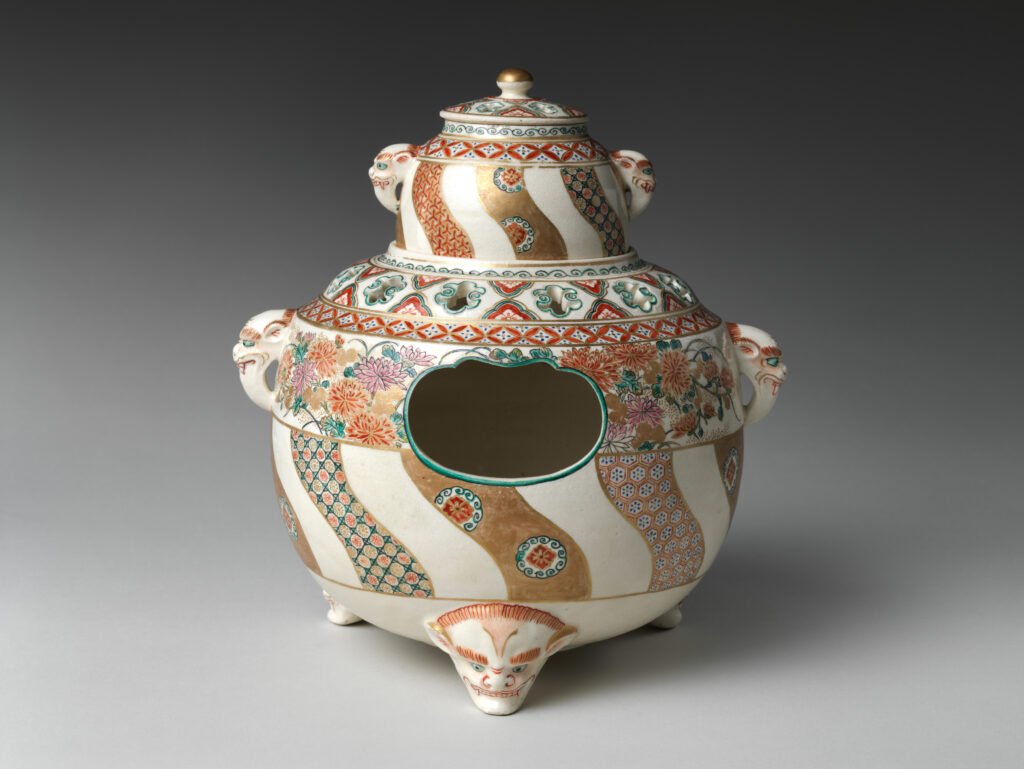
The contrast is easiest to see between two museum objects: the Met’s eighteenth-century burner, plain, moulded, no enamels, no gilding; and Kinkozan pieces of 1905–10, dark grounds, gold chrysanthemums, painted panels. Same name, different centuries, different cities.
Two Satsumas: black ware and white ware
The Korean-founded kilns at Nawashirogawa began, around 1607, with utilitarian pots in mottled glazes, and from that grew two lines: a black-glazed ware (kuromono) and a white-glazed ware (shiromono). The JAANUS dictionary at Columbia records both, and dates the arrival of Kyoto-style brocade enamelling (nishikide) to the Keian era, 1648–52. The Kyushu National Museum is blunter about the early output: “everyday items like black-glazed tea containers”.
The white ware is the one the West knows. The Freer Gallery describes a seventeenth-century white Satsuma tea bowl as “dense, sonorous, grayish” clay under a “luminous, gray, and bluish-gray, crackled” glaze (Freer, F1904.323), and a tea jar of 1650–1750 as “hard, grayish” clay with a cream glaze “closely crackled in dark brown” (Freer, F1896.85a-b). The Freer files these as stoneware, the same catalogue disagreement we noted above. The practical point stands: a pale, hard-fired clay under a clear glaze that crazes.
The gilded, enamelled version came late. The Kyushu National Museum puts the appearance of Satsuma kinrande, “white glazed pottery elaborately decorated with gilded polychromatic enamels”, at the end of the Edo period, and describes how the trade then split: white-glazed blanks made in Satsuma, painted in Tokyo, Yokohama, Nagoya and the Kansai region.
Paris 1867 and the named workshops
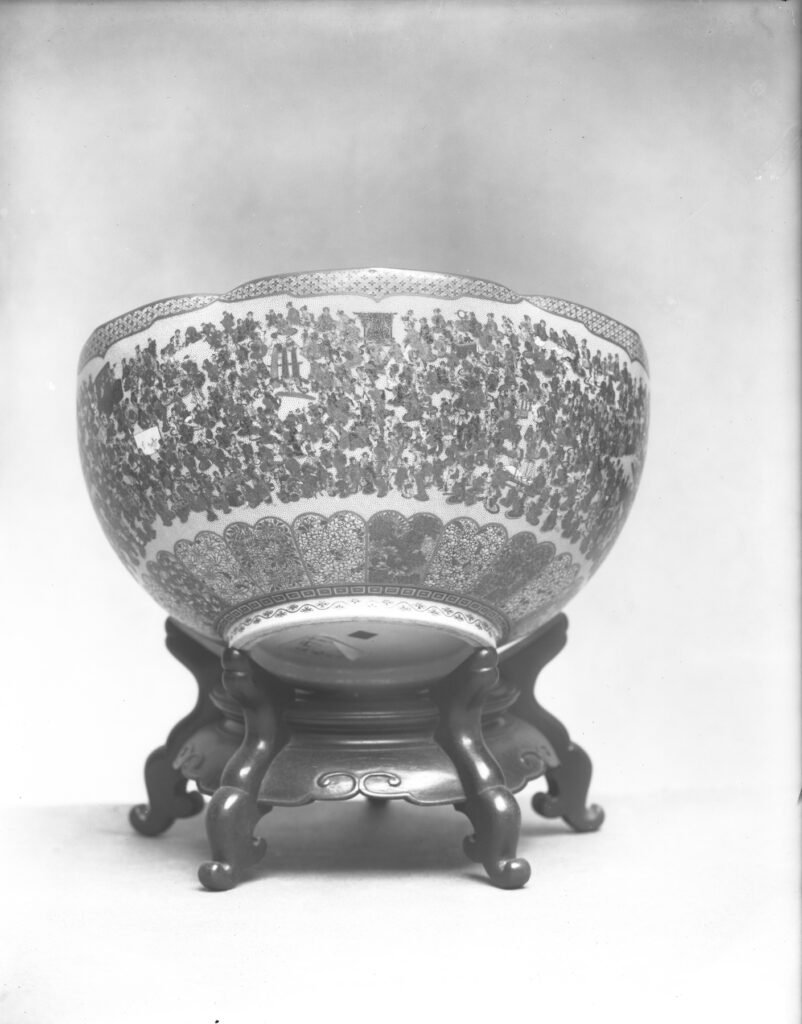
Vienna in 1873 was not the first showing. The V&A holds a small bowl painted with carp, marked by the decorator Gensaiken, whose record reads “Purchased from the Paris Exhibition, 1867 (Satsuma Government)” (V&A), and a pair of earthenware vases from the same source (V&A, 814-1869). The vendor was the domain itself, trading under its own name. The Kyushu National Museum pairs the two fairs: “Exhibited at the Paris (1867) and Vienna (1873) Expositions, they won worldwide acclaim.”
Two names dominate the Meiji trade outside Kagoshima. The Bowers Museum calls Kinkozan of Kyoto and Yabu Meizan of Osaka “the two most famous Satsuma ware companies outside of Satsuma”. Yabu Meizan (1853–1934) founded his Osaka workshop in 1880 and was, in the V&A’s words, “a regular participant in international exhibitions”; one of his vases, bought at the Japan-British Exhibition in London in 1910, was given to the museum by Lt-Col Kenneth Dingwall (V&A). The Bowers credits workshops like his with “a more controlled and refined aesthetic” as the industry matured. Meizan’s work is tight and small-scale, not loud.
Kinkozan was an industry. Ritsumeikan University’s Art Research Center names Kinkozan Sobei VI (1824–1884) as the man who invented the painting technique and his son Sobei VII (1868–1927) as the one who developed it further, and puts Kyoto’s Satsuma production at its peak at “over 700 workers” in a complex of more than 4,000 square metres. The V&A’s Kinkozan stand of about 1875 was bought from the Japanese Commissioners for the Philadelphia exhibition of 1876 (V&A, 266-1877). One caution: the same workshop also made porcelain. A Kinkozan vase of 1910 in the V&A is catalogued as porcelain, not earthenware (V&A, C.289-1910). A Kinkozan mark is not proof of Satsuma body. Check the foot.
Judging a Meiji piece in the hand
Start with the crackle, before the painting. The Art Museum Riga Bourse states the rule plainly: “The finer the product’s craquelure, the higher the quality” (Riga Bourse). The same museum notes that Meiji signatures “were painted by hand, rather than by using stamps”.
Then the painting. The best work is dense but legible: every face, every fold of a robe, every petal drawn with a controlled line, and the gold laid on as part of the drawing rather than poured over it. As the trade chased Western taste, the Bowers says, wares “became overladen with gold embellishments and distorted tales from Japanese folklore”. That is the honest distinction between the restrained Meiji work we buy and the later export work we usually pass on. It is less about date than about whether the brush controlled the gold, or the gold the brush.
The body sets the condition points. Because the glaze is crazed and the clay beneath is porous, the crackle takes up whatever the pot has held. The Freer’s early pieces are catalogued with glaze “stained by ink” on the tea bowl above and “stained by sake” on a bottle of 1660–1700 (Freer, F1903.78). On a tea bowl that is history. On an export vase it is dirt, and it will not come out. The other two things we check are the gilding, which sits on the surface and rubs through on rims, handles and high points, and the enamels, which can lift from the glaze. We check all three in raking light before we look at the mark.
And a warning about the marks
The V&A holds a Satsuma jar it dates to about 1850 whose base carries a gilded mark reading “made in Satsuma in the fifth year of Kansei” — that is, 1793. Sixty years out, in a museum collection, and nobody is calling it a fake. Japanese date marks are claims about lineage, not evidence of date.
We also decline to repeat the standard “Nippon 1891–1921, Made in Japan from 1921, Occupied Japan 1947–52” dating chain, because we could not find the statute behind any part of it. More in our guide to Japanese ceramic marks.
Browse what we hold in Satsuma and Japanese art.