Meiji
The Meiji era (1868–1912) opened with the restoration of imperial rule and the deliberate remaking of Japan as an industrial and exporting nation, and Japanese ceramics were part of that policy. Craft goods were sent to the international exhibitions — Japan exhibited at Vienna in 1873 (Tokyo National Museum) and the enthusiasm that followed Satsuma’s showing at Paris in 1867 turned into an export industry (Bowers Museum) — and workshops in Kyoto, Osaka, Tokyo, Arita and Kaga reorganised themselves to supply Europe and America. Quality across the period runs from superb to trivial, sometimes from the same workshop, and a Meiji piece has to be judged on its own merits rather than its label.
What was made
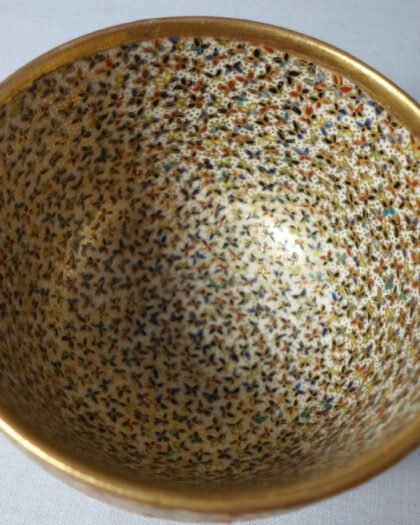
Satsuma. The cream, crackle-glazed pottery painted over the glaze in enamels and gold is the Meiji ware most people know. The finest was decorated in Kyoto and Osaka — Kinkozan and Yabu Meizan are the names that carry a premium — with figures, processions, birds and flowers painted so finely that the detail needs a lens. At the other end, thickly gilded, coarsely crackled pieces were made in quantity for the tourist and department-store trade, and much of what is called Satsuma today is of that kind or later still.
Porcelain. Arita continued to make blue and white and the red, blue and gold Imari palette for export; Fukagawa in Arita became one of the best-known makers; Kutani porcelain was decorated in rich reds and gold; and studio potters such as Makuzu Kozan in Yokohama produced work of a technical brilliance that museums collect in its own right. Cloisonné, bronze and lacquer travelled with the ceramics but are outside our field.
How to judge a Meiji piece
Look first at the painting under magnification: the steadiness of the line, the shading in the faces, the number of separately mixed colours, the control of the gold. Look at the gilding wear — honest wear on the rim and handles, not on the protected inside of a foot. On Satsuma, look at the glaze: it should be warm, fine and evenly crackled; chalky white glaze with a coarse net of crackle is a warning. Then look at the mark. Meiji marks include workshop names, decorators’ names, crests, and sometimes the word Dai Nippon (Great Japan); they are informative but were freely copied and applied, and the guide to Japanese marks explains what each kind can and cannot establish. We have deliberately not published the common “Nippon / Made in Japan / Occupied Japan” dating chain, because we cannot trace it to a primary source.
Care
Satsuma’s low-fired body is porous and its enamels sit on the surface. It should not be soaked, put through a dishwasher or scrubbed; gilding lifts. Porcelain is more forgiving but enamelled and gilt rims wear in the same way. The journal note on why Satsuma is earthenware covers the practicalities.
In the collection
One Meiji piece at present, a Satsuma bowl. Meiji objects tend to sell quickly; the archive records what has passed through.
Showing the single result