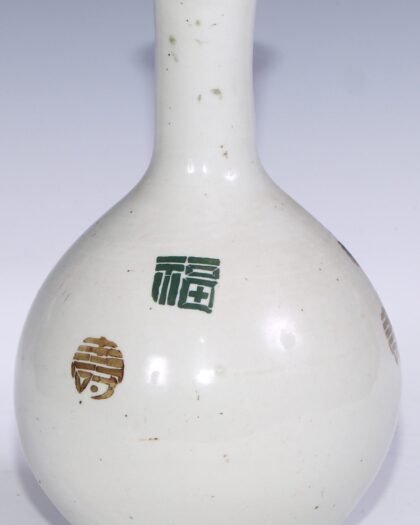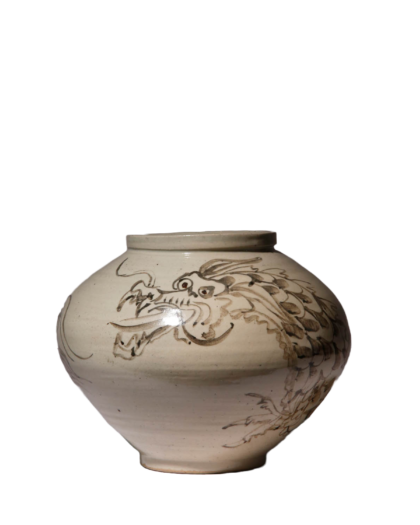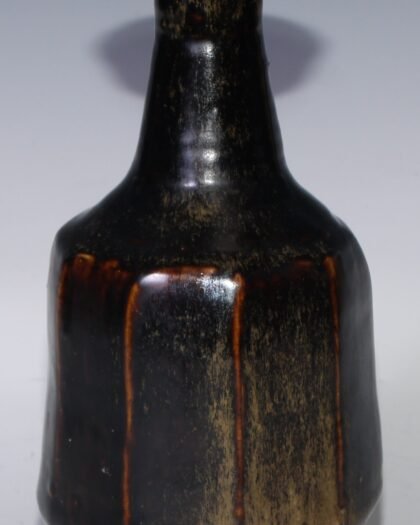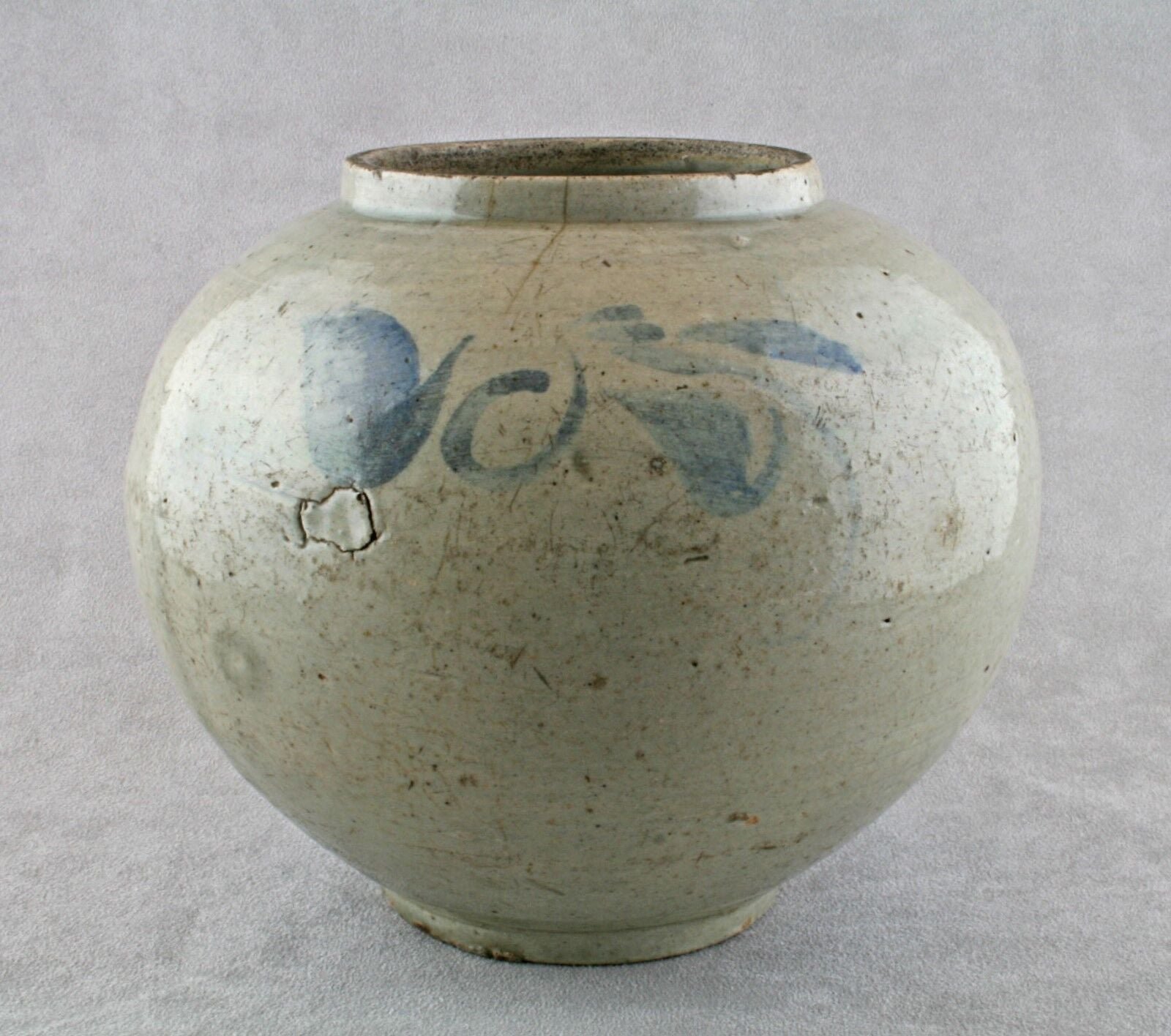
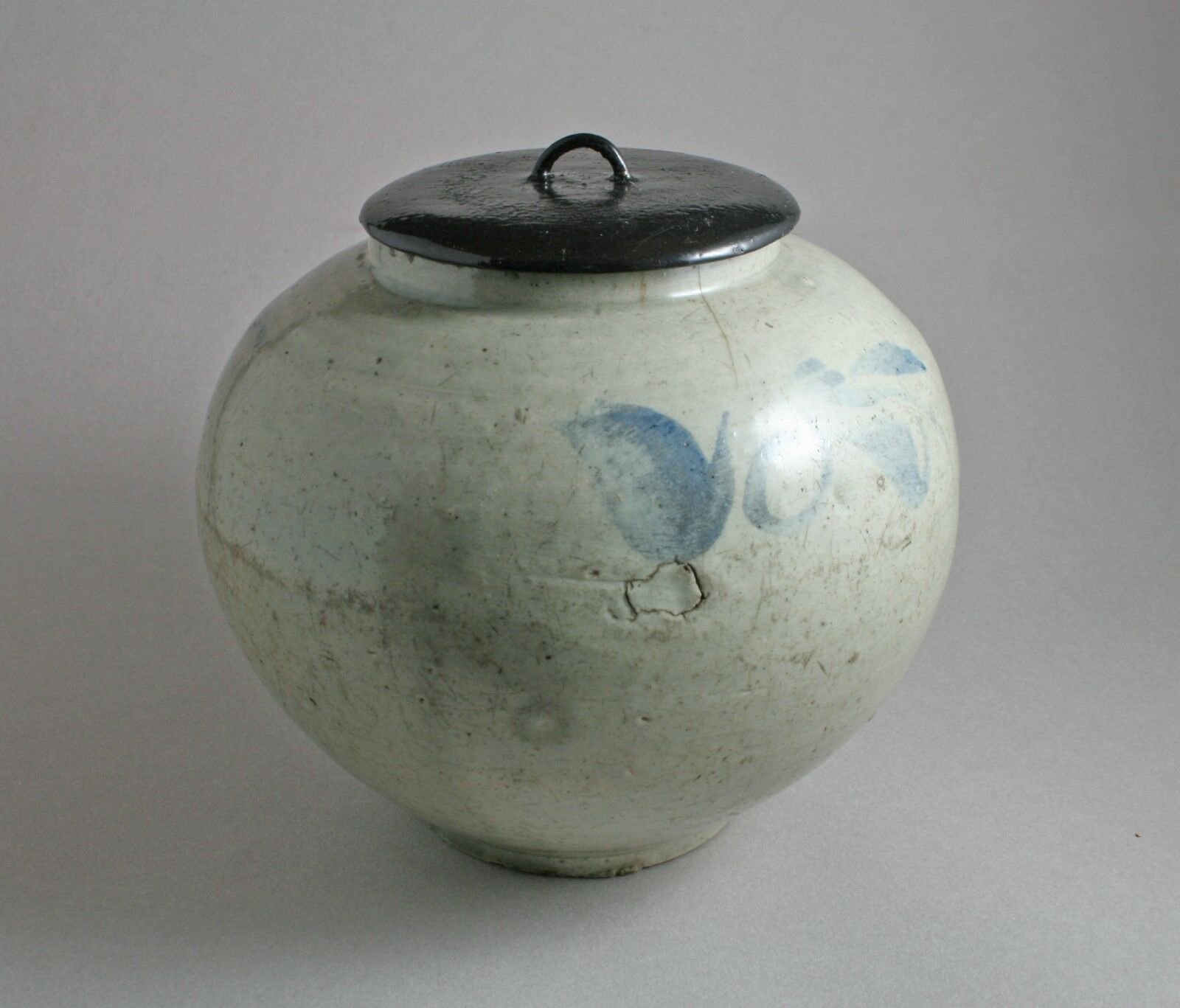
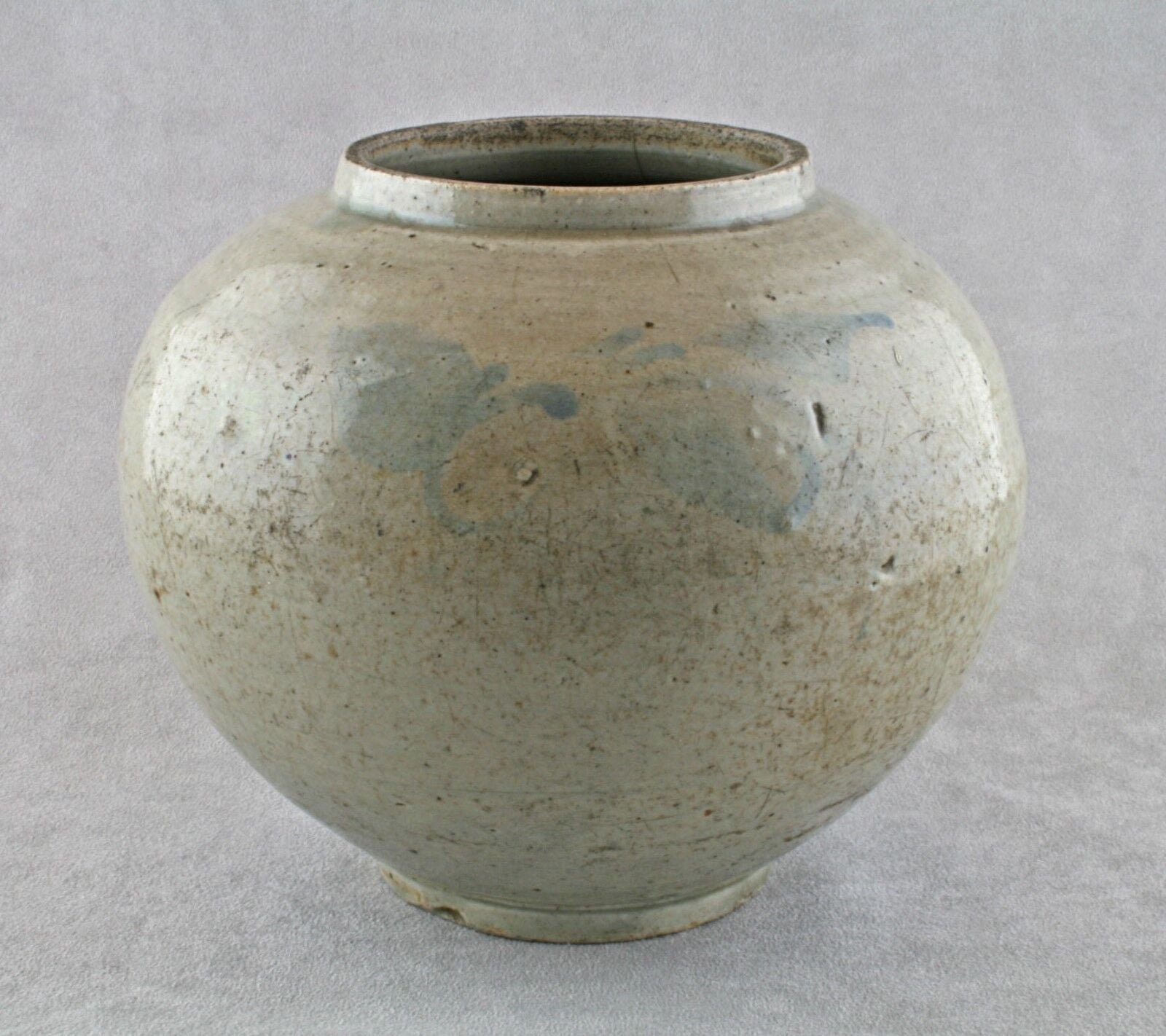
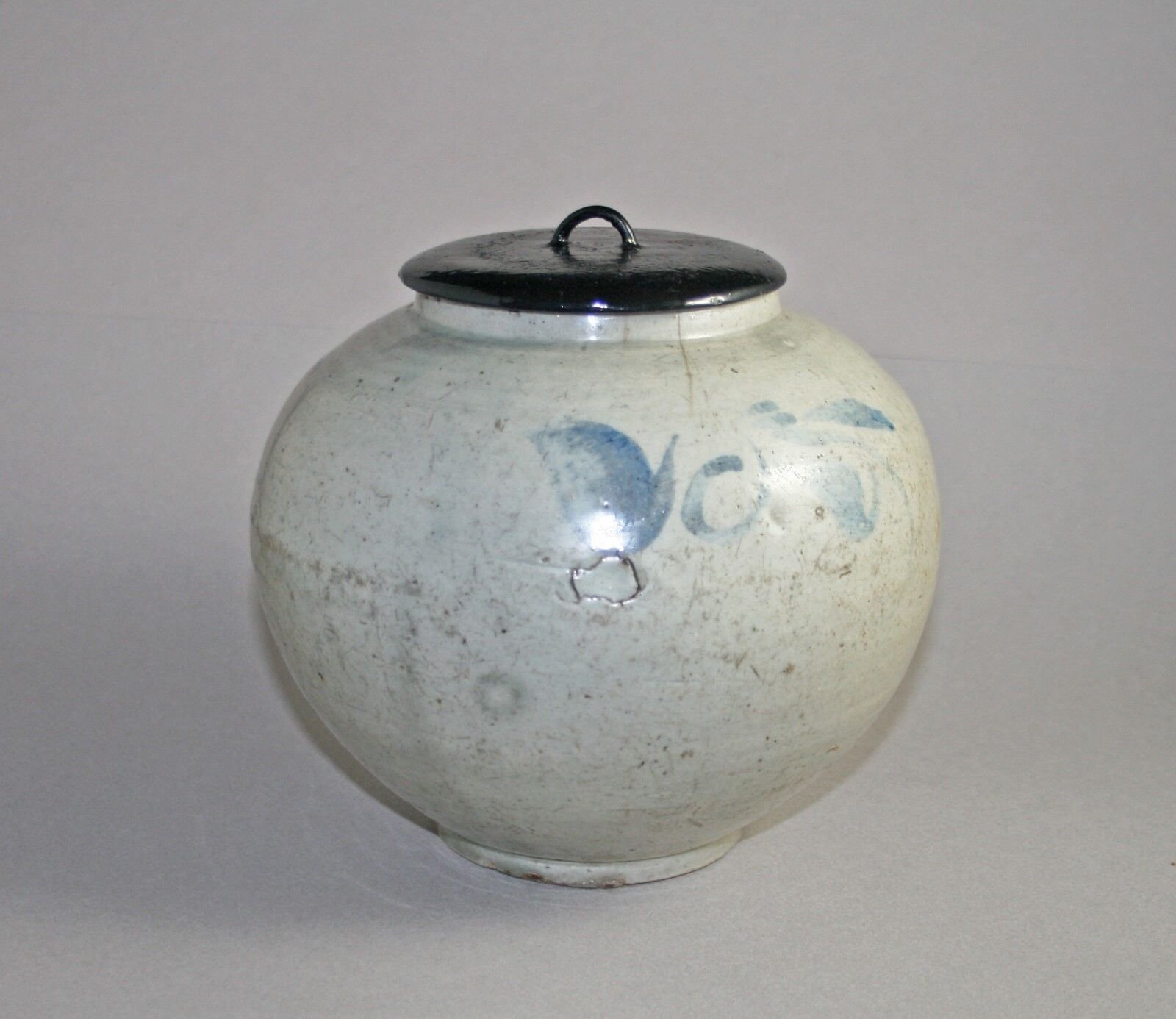
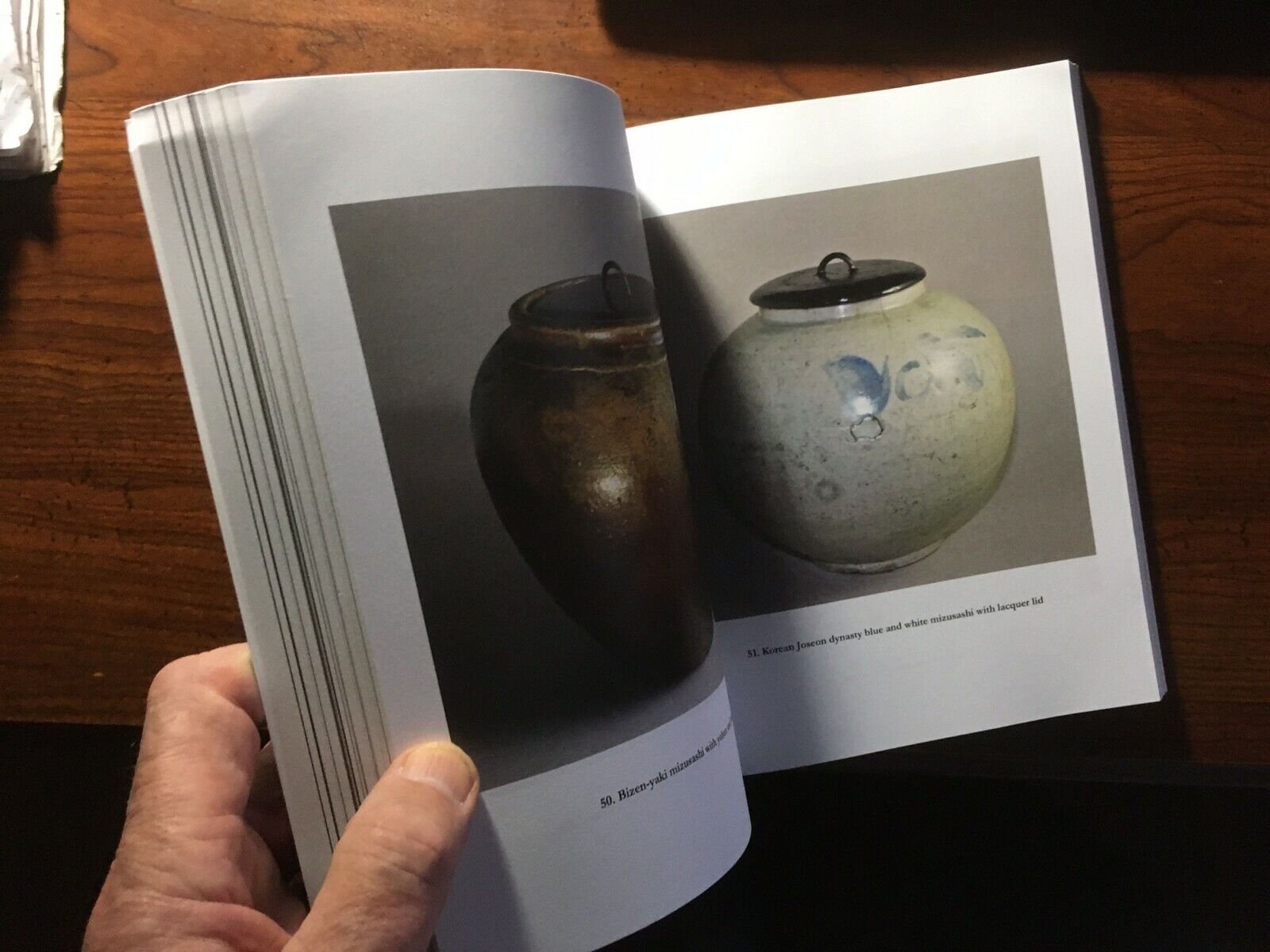
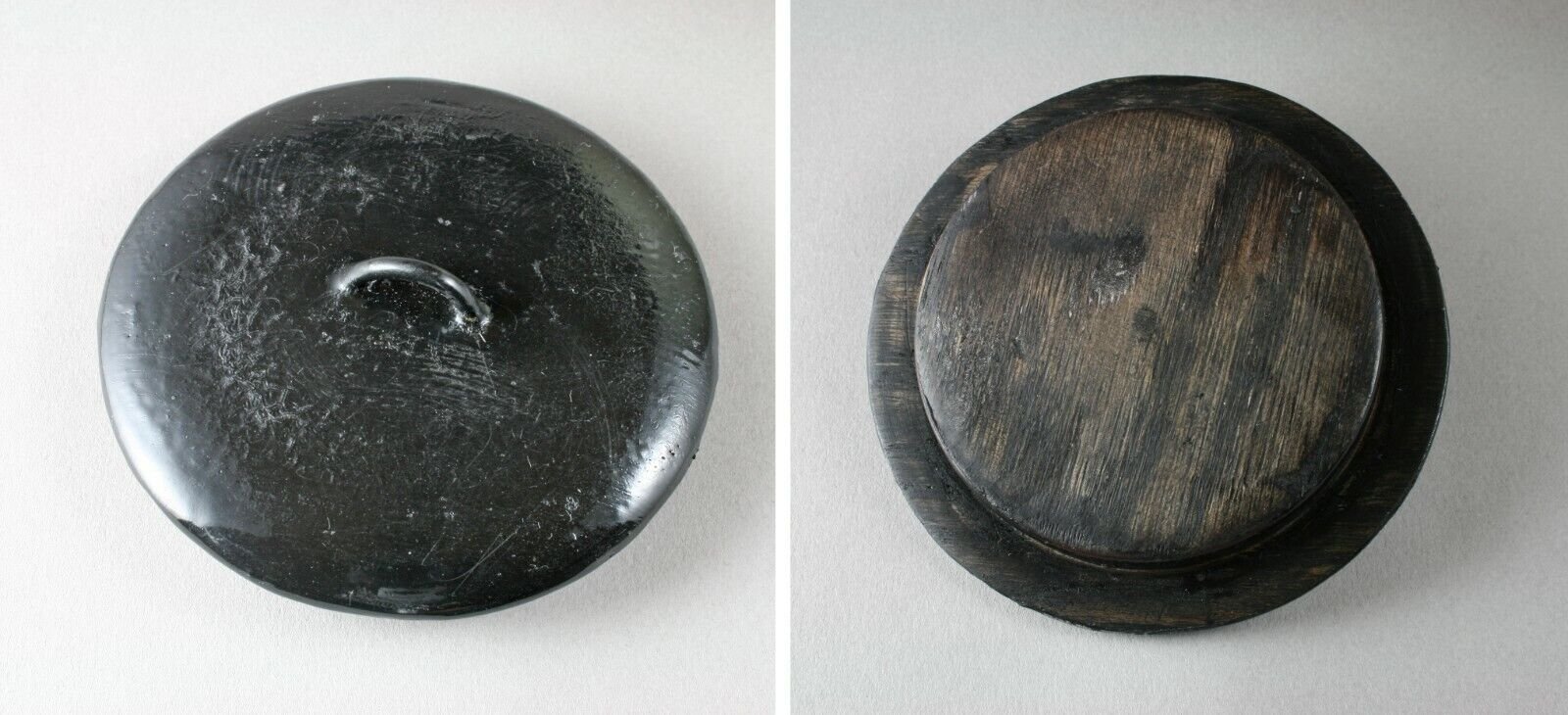
A Joseon moon jar, later fitted with a wooden lid and used in Japan as a mizusashi — the fresh-water jar of the tea ceremony. That second life is not a corruption of the object; it is a documented part of how Korean ceramics came to be valued at all. Japanese tea masters, and later the mingei scholars around Yanagi Sōetsu, saw in Joseon wares an unforced quality that Korean court taste had treated as ordinary.
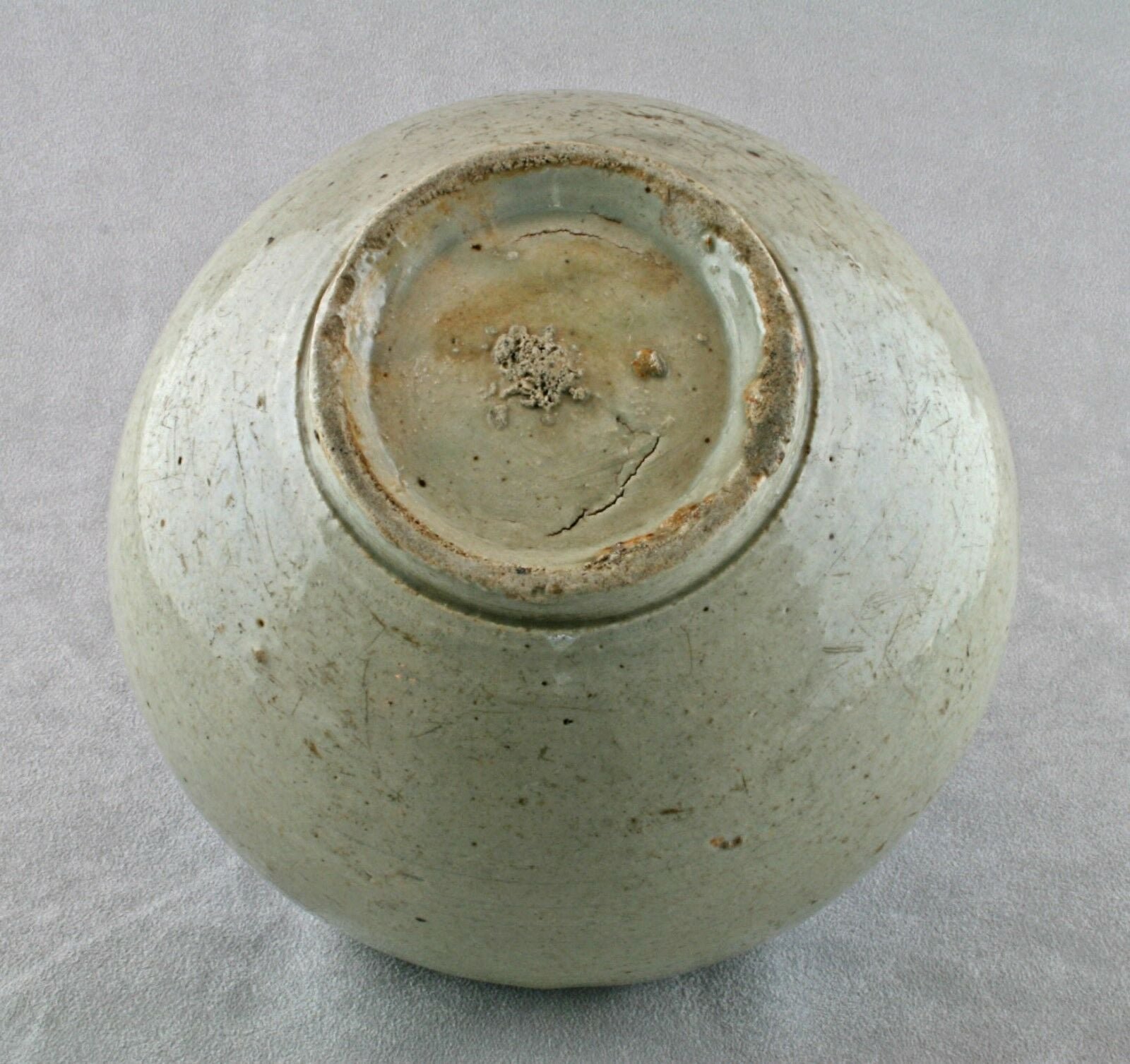
Moon jars were thrown in two halves and joined at the waist, which is why the profile is rarely perfectly symmetrical and why a faint horizontal seam can often be found inside. The asymmetry is a consequence of the making, not a defect.
The moon jar, and this one’s history
“Moon jar” names a form, not a size. The celebrated Joseon examples in the British Museum, the Met and the V&A stand 34–47 cm high and had to be thrown in two halves joined at the widest point, because a form that large collapses on the wheel; their asymmetry is treated by every major museum as the point rather than a defect. At 15.9 cm this jar is a small example of the same full-bellied white porcelain form — a scale that could be thrown in one piece, and one that sits naturally on a tea-room shelf. Dating of the type is genuinely unsettled: the British Museum dates its jar to the eighteenth century, Cleveland to the 1700s, and the V&A dates its own example 1800–1900. The large jars began as utilitarian storage vessels and were rediscovered by collectors in the twentieth century.
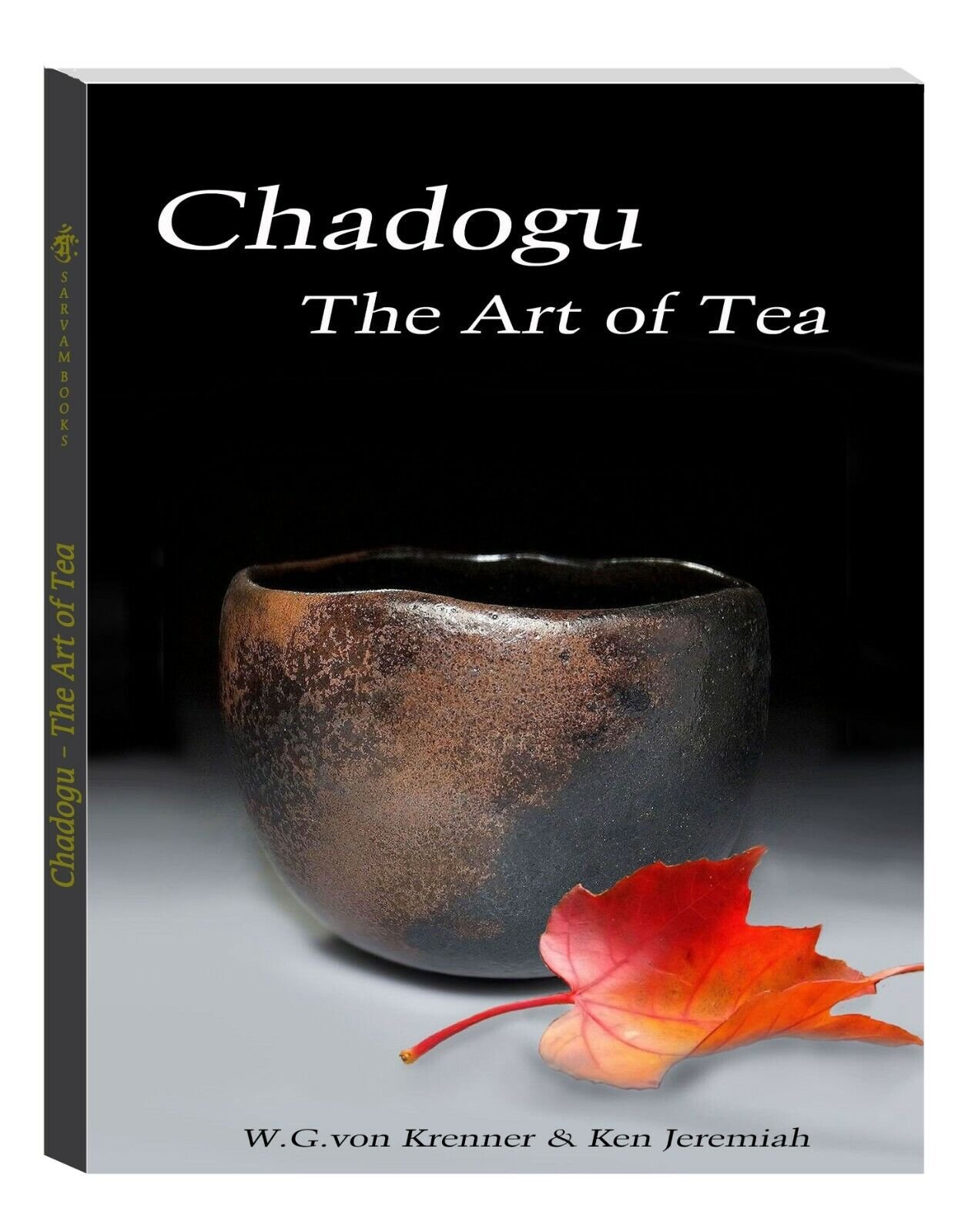
This jar has two things most do not. It is published — illustrated in Chadogu: The Art of Tea, plate 51 — and it was used in Japan as a mizusashi, the fresh-water jar of the tea ceremony that fills the iron kettle. That use is a documented practice, not a sales flourish: tea masters in the tradition of Sen no Rikyū raised Korean vessels to parity with ancient Chinese treasures. The most famous moon jar of all, at the British Museum, stood in Lucie Rie’s studio after Bernard Leach gave it to her in 1943.
Read more: the Joseon moon jar and its join and published and exhibited pieces.
The object, up close
The finer
details.
Reference XA-0003
A question about this piece? Ask for measurements, close-up photographs or a condition report.
Discuss this piece- Dimensions
- Height 15.9 cm (6¼ in)
- Period
- Joseon dynasty, most likely 1750–1897
- Mark
- Unmarked
- Condition
- Very good
- Published
- Illustrated in Chadogu — The Art of Tea, plate 51