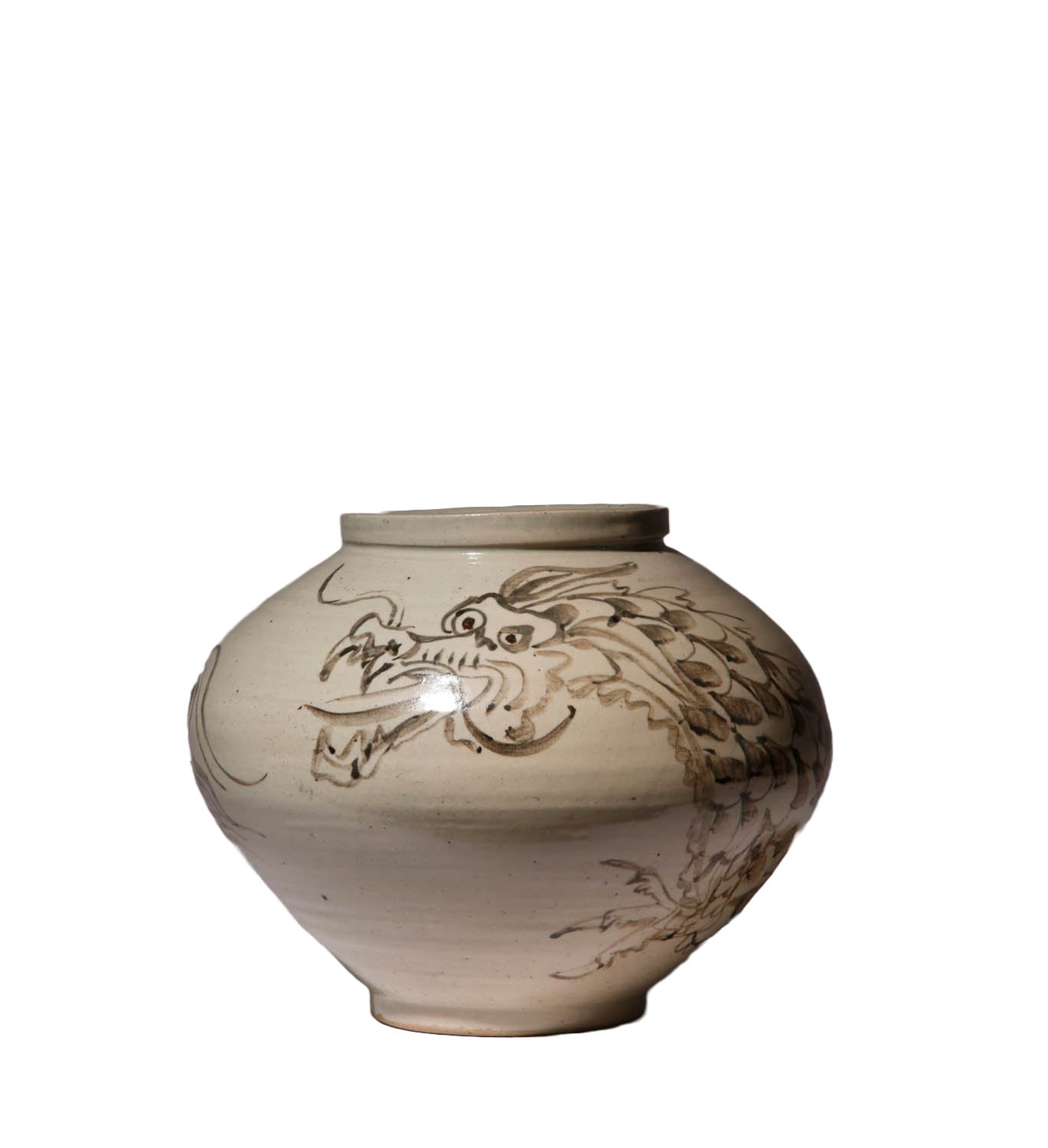
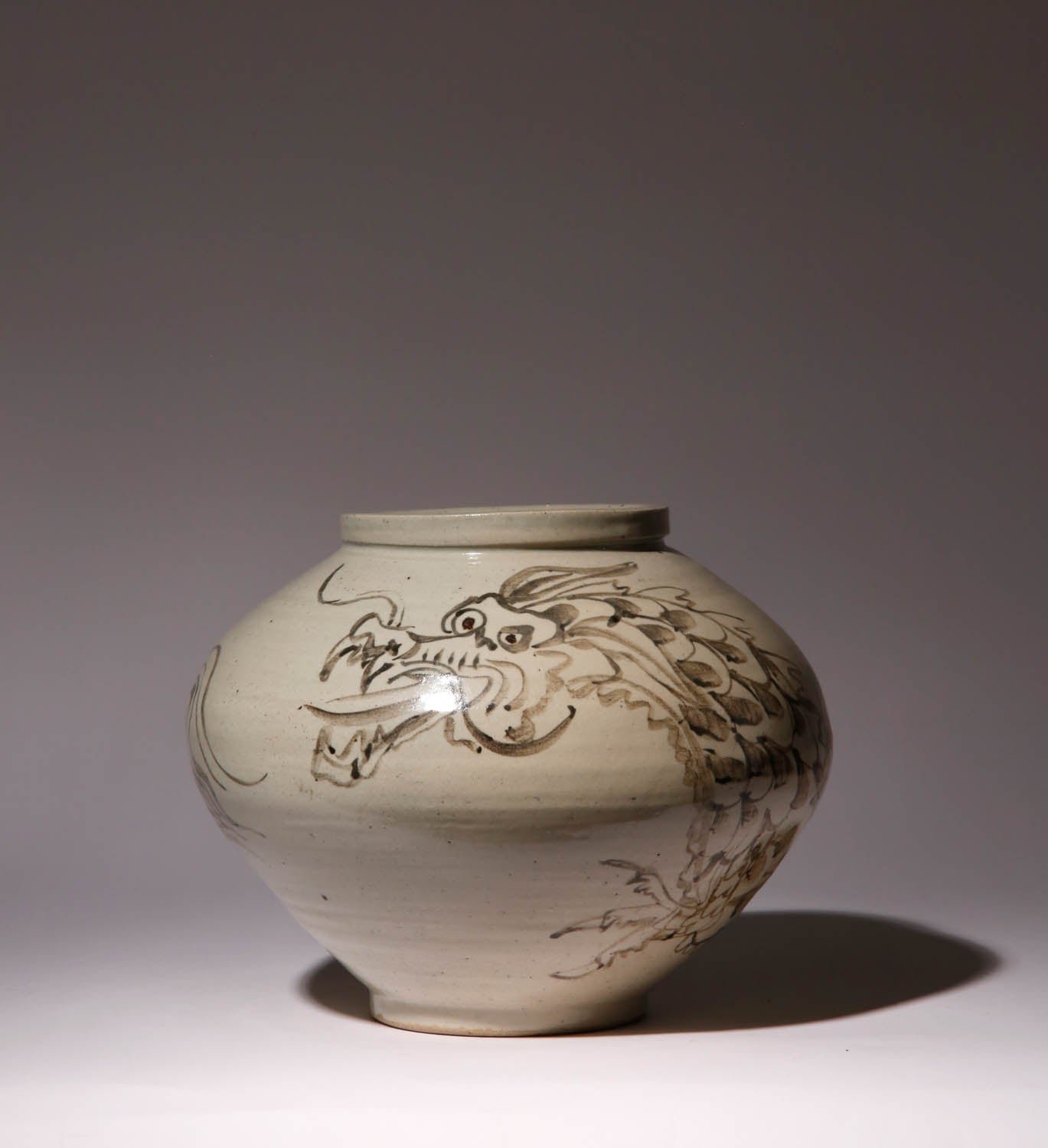
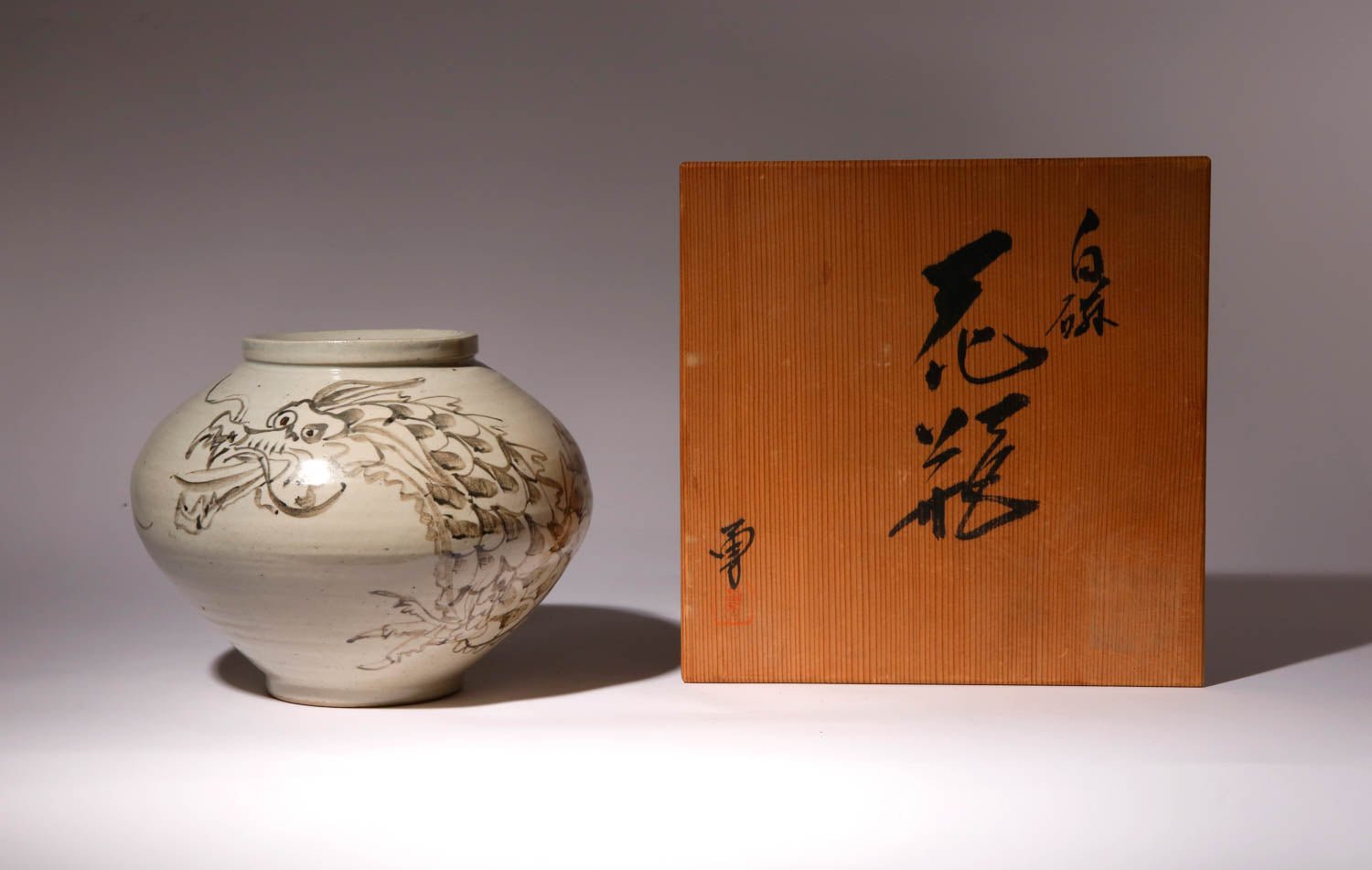
A moon jar of compressed ovoid form on a short foot, with a straight rim, painted in iron brown with a large writhing dragon across the body. The ground is a creamy grey flecked with minute brown specks — iron impurities in the clay coming through the glaze, and a characteristic of Joseon white wares rather than a flaw.
Iron-brown painting was the Korean alternative to cobalt: the pigment was local, cheap and forgiving, and Joseon painters used it with a freedom that the expense of imported cobalt discouraged. There is an incised character to the base.
The jar comes with an inscribed tomobako — a fitted wooden storage box. Tomobako inscriptions are provenance: they record who owned or authenticated the piece and when, and they should never be discarded.
The Korean moon jar in context
“Moon jar” names a full-bellied white porcelain form rather than a size. The great Joseon examples in the British Museum, the Met and the V&A stand 34–47 cm and had to be thrown in two halves joined at the widest point — the National Museum of Korea is direct that a form that large collapses on the wheel — and their asymmetry is treated by every major museum as the point rather than a defect. At 24 cm this jar is a mid-sized example of the form; whether it was thrown in one piece or two is a question for the object in hand, and the join, if there is one, is described in the catalogue below.
Iron-painted decoration, cheolhwa, became popular in Korea from the seventeenth century — the Metropolitan Museum notes especially “during periods when the cost of cobalt was exorbitant” — so iron brown is a cobalt-price choice, not a lesser one. The dragon is the most ambitious subject in the Joseon repertoire. Korean ceramics carry no reign marks, so an unmarked jar is normal; this one is accompanied instead by an inscribed tomobako, the fitted wooden box that Japanese owners made for objects they valued. Its inscription has not yet been translated.
Read more: the moon jar and its join and collecting Korean ceramics.
The object, up close
The finer
details.
Reference XA-0023
A question about this piece? Ask for measurements, close-up photographs or a condition report.
Discuss this piece- Dimensions
- 24 cm
- Period
- Joseon dynasty or later, 19th century
- Mark
- Incised character to the base
- Condition
- Very good
- Provenance
- Accompanied by an inscribed tomobako (fitted wooden box)