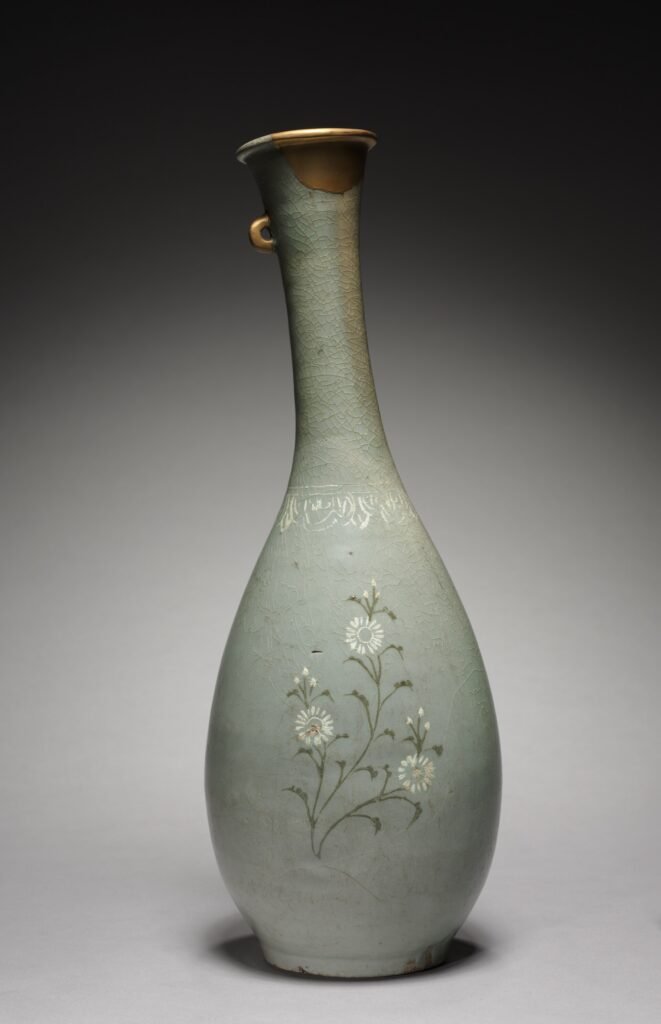
Most of the damage we see on old ceramics was done in a sink, or on the way to one. Pots that have survived three centuries are chipped on the tap, cracked in a dishwasher, or dropped between the cabinet and the table. So the one rule that matters more than all the others is this: do less. Handle less, wash less, move less. Conservators say the same thing in their own words. The Canadian Conservation Institute (CCI) puts it plainly: “Do not handle unless necessary.” The American Institute for Conservation’s (AIC) Caring for Ceramic and Glass Objects leaflet warns that “it is not a good idea to routinely wash these pieces.”
Everything below is a set of ways to do less, safely. It applies to the high-fired porcelain and stoneware we mostly deal in, and, with stricter limits, to the earthenware and enamelled wares that need more caution.
Handling
Before you touch a piece, prepare the place it is going. The AIC advises a “level space of adequate size” and a clear path before lifting. Take off rings and watches: the CCI asks for hands that are “clean, dry, and free of bulky jewellery”. Cotton gloves are not recommended for glazed wares, because they are slippery on glaze. Then:
- Use two hands. One under the base, the other supporting the side. Never lift by a handle, spout, knob, neck or rim. The National Trust’s reason is the right one: those parts “may be weak, previously damaged or poorly repaired”.
- Lids off first, and carried separately. One object, or one part of an object, at a time.
- Do not carry pieces in your hands between rooms or up stairs. Put them in a padded box or basket.
- Assume any piece with an old repair is weaker than it looks, and hold it as if the join were not there.
Cleaning
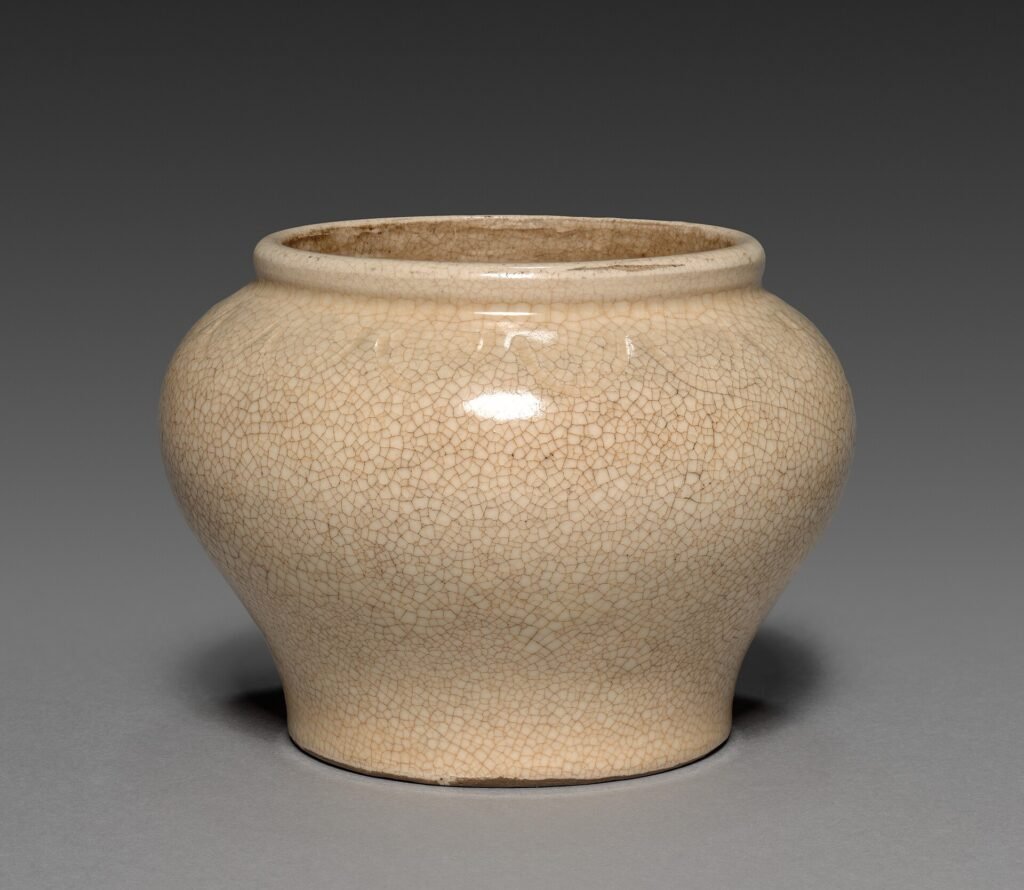
Dust is the only cleaning most pieces will ever need. Do it in place, without moving the object, with a soft artist’s brush. A cloth can catch on a chip or a flaking edge. The National Trust allows a lint-free duster only for “stable, glazed surfaces without enamel, gilding or repairs”. For anything with enamel, gilding or a repair, the brush is the tool.
If a high-fired porcelain or stoneware piece in sound condition is genuinely grubby, it can be washed by hand. Check first that the glaze is not flaking and that painted, gilded or printed decoration is not lifting and, in the CCI’s words, “not soluble in water”. Use distilled or deionised water, lukewarm or cooler, on a swab or soft brush. No detergent, as the CCI advises; two other museum guides allow a few drops of non-ionic detergent at most. Do not immerse: the Western Australian Museum’s manual says “Never fully immerse ceramics in water”, because water held in glaze cracks does further damage. Let it air-dry slowly, without heat.
What is not safe:
- Dishwashers. Never, for anything old or gilded. The National Trust notes the heat and chemicals “can bleach some glaze colours, remove gold” or damage the glaze.
- Bleach, acids and stain removers. The CCI warns against the “bleach or acid formulations often recommended” in how-to books. The US National Park Service warns that chlorine bleach leaves soluble salts in the body that go on crystallising.
- Water on earthenware. This includes Satsuma, which is earthenware, not porcelain. Low-fired bodies are porous. The AIC says they “should never be immersed in water”; the CCI adds that low-fired bodies “will turn to mud when exposed to water”. Dry brushing only.
- Gilding and overglaze enamels. These sit on top of the glaze and abrade. Do not rub them, do not tape them, and keep them out of water unless you have checked the decoration is sound, not lifting and not soluble. The National Park Service advises handling gilded ceramics and lustreware in nitrile gloves, because skin oils “will disrupt and eventually etch these delicate surfaces”.
- Unglazed, powdery or crackled surfaces. The US National Park Service’s rule before any wet cleaning is that “no surfaces are powdery, sticky, or crackled”. A crackle glaze that has stained over centuries is part of the object. Water will only drive the dirt deeper.
Stop when a stain does not lift with water. The CCI’s advice is short: “If cleaning an object is important, consult a conservator.” In the UK, the Institute of Conservation’s register is the place to find one.
Display and environment
Fired ceramic is one of the most stable materials there is. The National Park Service’s handbook says “Visible or UV light will not damage most ceramics, glass, and stone”. What does the harm is heat, sudden change, and being knocked. Keep pieces off windowsills and away from radiators and spotlights, which can warm one side of a pot faster than the other. The CCI’s rule is to avoid “temperature extremes, particularly rapid temperature changes”. A normal British room is fine. A conservatory in July is not.
Light does matter for two things that travel with ceramics: lacquer, including the lacquer under gold on a kintsugi repair, and paper labels or box inscriptions. The CCI notes that on natural-resin finishes, which include urushi lacquer, light causes a “slow and insidious degradation”. Keep those out of direct sun.
Stands and hangers are where good pieces get hurt. Spring-loaded wire plate hangers press on the rim; the AIC says they “often cause cracks and damage”, and recommends racks or padded prongs that do not exert pressure. A carved wood stand should hold a vase by the foot, not grip it. Small dots of soft museum wax stop a piece walking under vibration; think first about whether it can be removed cleanly. Keep pieces back from the edge of a shelf and out of the traffic of a room. The Museum of Royal Worcester advises displaying “where there is less traffic to avoid the risk of being knocked”. Earthquake mounts are an American preoccupation you can ignore here; a wobbly table, a slamming door and a cat are not.
Storage and transport
Wrap in acid-free, lignin-free tissue, never newspaper, which the AIC says “can cause discoloration and stains”. Tissue goes on first, so that nothing plastic sits directly on gilding or enamel; bubble wrap goes over the tissue, not under it. Do not stack bowls or plates: an unglazed foot rim “can abrade the overglaze on the object below”. For posting or moving house, use two boxes, the inner one padded on all sides and floating in the outer. The National Park Service is blunt: “Always use double boxing when packing and shipping”. That is how we pack; see our shipping page. Store on a shelf that does not get jarred, and not on the floor.
Old repairs, and what not to do
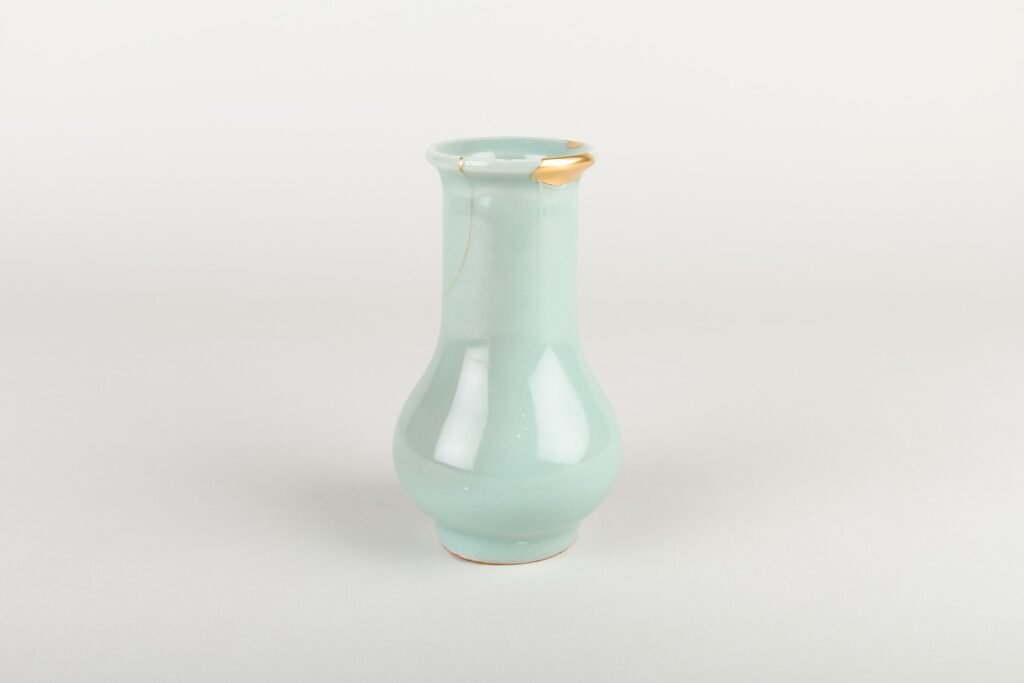
Most of the pieces we handle have some history of repair, and a good deal of it is honest. Riveted plates, lacquer-filled chips and gold-lacquer joins were all made so that a broken thing could go on being used. Kintsugi is a repair, not a decoration, and it is priced as one. A hairline changes value too; we have written about what a hairline does to value separately.
- Never re-glue a break yourself. Not with superglue, not with a five-minute epoxy, not with a kit. The CCI says such repairs “can irreparably damage ceramics”. A conservator’s adhesive is chosen to be reversible; household ones are not, and they yellow.
- Do not remove rivets. They are part of the object’s history. Iron or copper rivets may have stained the body, but the CCI’s rule is to leave them unless they “have come apart and are not holding the pieces firmly together, or are seriously disfiguring the object”.
- Never soak a riveted, glued or lacquered piece. Old adhesives soften, metal corrodes, and of natural-resin finishes such as lacquer the CCI says “Water usually produces rapid and obvious damage”.
- Treat yellowed glue as a warning. If a join shows brittle, discoloured adhesive, the CCI’s advice is to “assume that it is fragile and might fall apart”.
- Do not take an old repair apart. A conservator can remove and redo it with stable, reversible materials. That is what restoration should mean.
Finding repairs is a separate skill. Ultraviolet examination shows adhesives, fills and overpaint that daylight hides, and it is how every piece we sell is checked. Owning a UV torch is easy; reading one is not. The CCI’s view is that it “should be done by a conservator familiar with the procedure”. If you are buying, ask the seller what they found under UV and expect a straight answer.
Insurance and records
This part is ours, not the conservators’. Photograph every piece when it arrives: profile, interior, foot rim, base and mark, and any repair, in daylight against a plain background. Keep the receipt, the seller’s condition description and any old labels or box inscriptions with those photographs. If a piece is broken or stolen, that file is what the insurer will ask for. Check whether your household policy has a single-item limit; many do, and a good vase will exceed it. For anything above that limit you will need a written valuation, and it should be updated every few years, because the market for Chinese, Korean and Japanese ceramics does not stand still.
Then put the piece where you can see it, and leave it alone.
Sources
- Canadian Conservation Institute, CCI Notes 5/1: Care of Ceramics and Glass
- Canadian Conservation Institute, Caring for ceramic and glass objects
- Canadian Conservation Institute, CCI Notes 7/2: Care of Furniture Finishes (natural resin finishes, including urushi)
- American Institute for Conservation, Caring for Your Treasures: Caring for Ceramic and Glass Objects
- National Trust, How to care for your precious objects
- US National Park Service, Museum Handbook, Appendix P: Curatorial Care of Ceramic, Glass, and Stone Objects
- US National Park Service, Conserve O Gram 8/1: Removing Dust from Ceramic and Glass Objects
- US National Park Service, Conserve O Gram 8/3: Preservation of Low-Fired Ceramic Objects
- Museum of Royal Worcester, Care of ceramics
- Western Australian Museum, Collections Care Manual: Ceramics
- Institute of Conservation (Icon), Find a conservator