“Celadon” is not a Chinese word, does not name a kiln, and is not strictly a colour. It is a Western term, and understanding what it actually denotes clears up most of the confusion around green wares.
What celadon means
The Smithsonian’s National Museum of Asian Art defines it as “a large family of high-fired ceramics” whose glazes are coloured by small percentages of iron oxide.
So the defining criterion is technical, not visual: high-fired, iron-oxide colourant, fired in a reducing atmosphere. The Smithsonian describes the result as “variable shades of bluish green” — and the results run, in the Smithsonian’s words, “from sky blue to sea green”. A celadon glaze can be blue, olive, grey-green or almost yellow, and all of them are celadon.
This is why two pieces that look nothing alike can both be correctly catalogued as celadon, and why “celadon” on its own tells a buyer almost nothing about what they are looking at.
Where the word comes from
It is commonly derived from Céladon, a shepherd in the seventeenth-century French pastoral drama L’Astrée, who wore grey-green. Note that the Smithsonian itself hedges — “commonly believed to have been derived from” — and so should anyone repeating it.
It is also worth knowing how regional the term is. The Cleveland Museum of Art writes of “green ware (called celadon in the US)”, treating it as a naming habit rather than an object category.
Yue and Longquan are wares. Celadon is the family
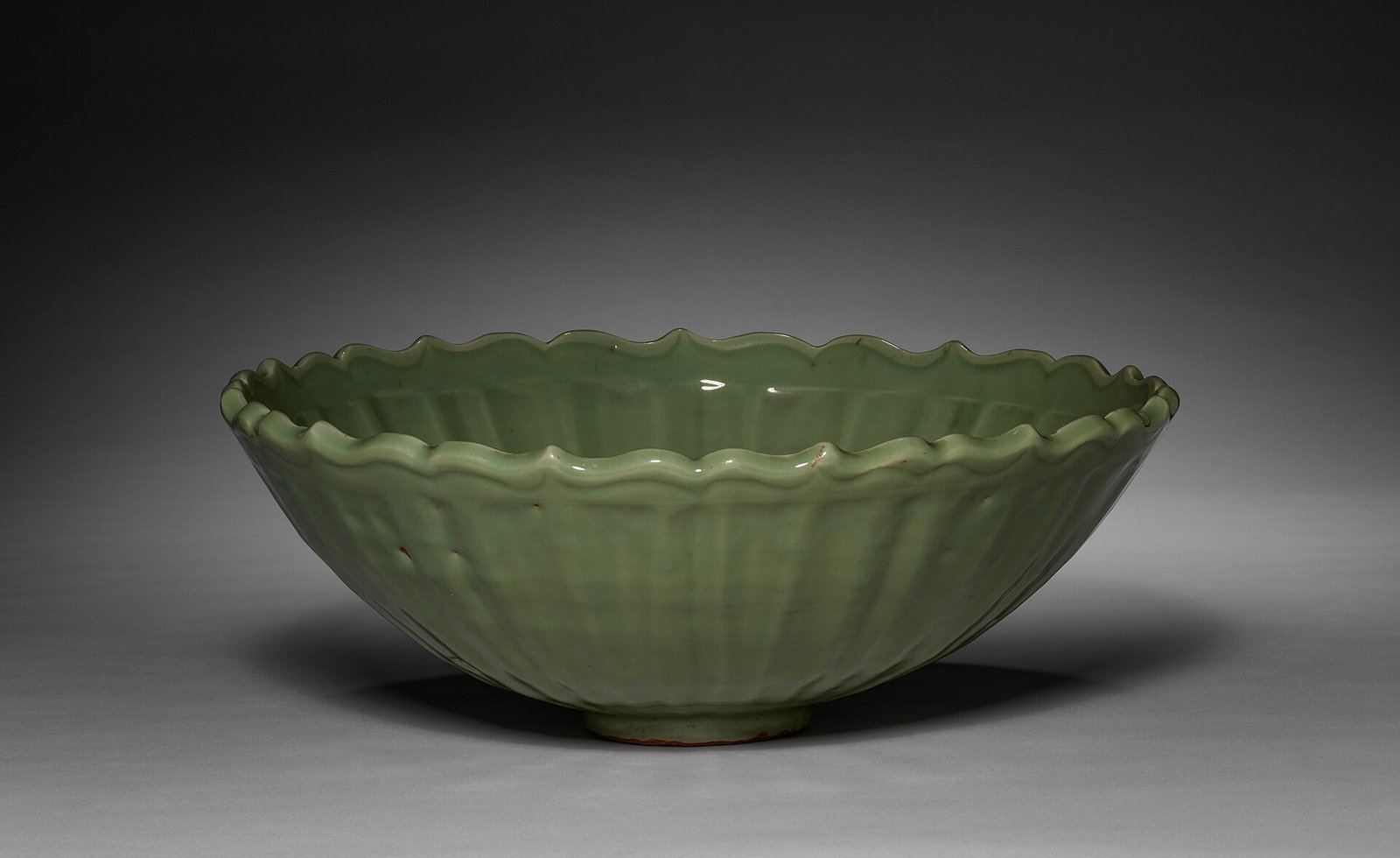
Yue is the earlier Zhejiang green ware — the British Museum’s gallery covers Shanglinhu, Zhejiang, around AD 800–907. Longquan is the later Zhejiang green ware that succeeded and eclipsed it. Both are from Zhejiang, both are celadon, and they abut rather than sit centuries apart: the Met catalogues Yue and Longquan wares of the tenth and eleventh centuries alike, and Longquan rose as Yue declined in the Northern Song.
They are not synonyms for each other and neither is a synonym for celadon. Yue also travelled north: the Smithsonian suggests Yaozhou’s carved decoration “may show the influence of south Chinese Yue ware on the northern kilns”.
Longquan itself is worth knowing in detail. The British Museum records that potters applied up to four separate layers of glaze to build depth and lustre, and notes that connoisseurs regard the finest as the blue-tinged wares of the late twelfth and early thirteenth centuries. By the late thirteenth century some Longquan “dragon kilns” exceeded 100 metres, firing tens of thousands of celadons at a time for export.
The glaze names, and which are Japanese
This is where catalogues get loose, so here is what we can and cannot stand behind.
- Kinuta is Japanese, and it is a collectors’ term rather than a kiln term — trade usage, which we could not find defined on any museum record. It is said to have originally meant “mallet”, after the mallet-shaped vases exported to Japan in the Southern Song and Yuan, and it migrated from a shape word to a colour word — a migration that happened in Japan, not China. No museum catalogue we checked uses it, and none translates it, so we do not print a translation.
- Meiziqing (“plum green”) and fenqing (“powder blue”) are Chinese, not Japanese — which is the reverse of what is often assumed. But we could not verify either term from an institutional source, so we will not publish definitions of them on our own authority.
Museums, for what it is worth, mostly use none of these. They catalogue simply “celadon glaze” and describe the colour in plain English.
Dating Longquan honestly
The trade will offer you a confident list: Yuan pieces heavier, an unglazed biscuit ring on the base firing orange, the glaze turning yellower over time. We could not source any of it institutionally, so we are not going to repeat it.
Two things we can source, and they are genuinely useful:
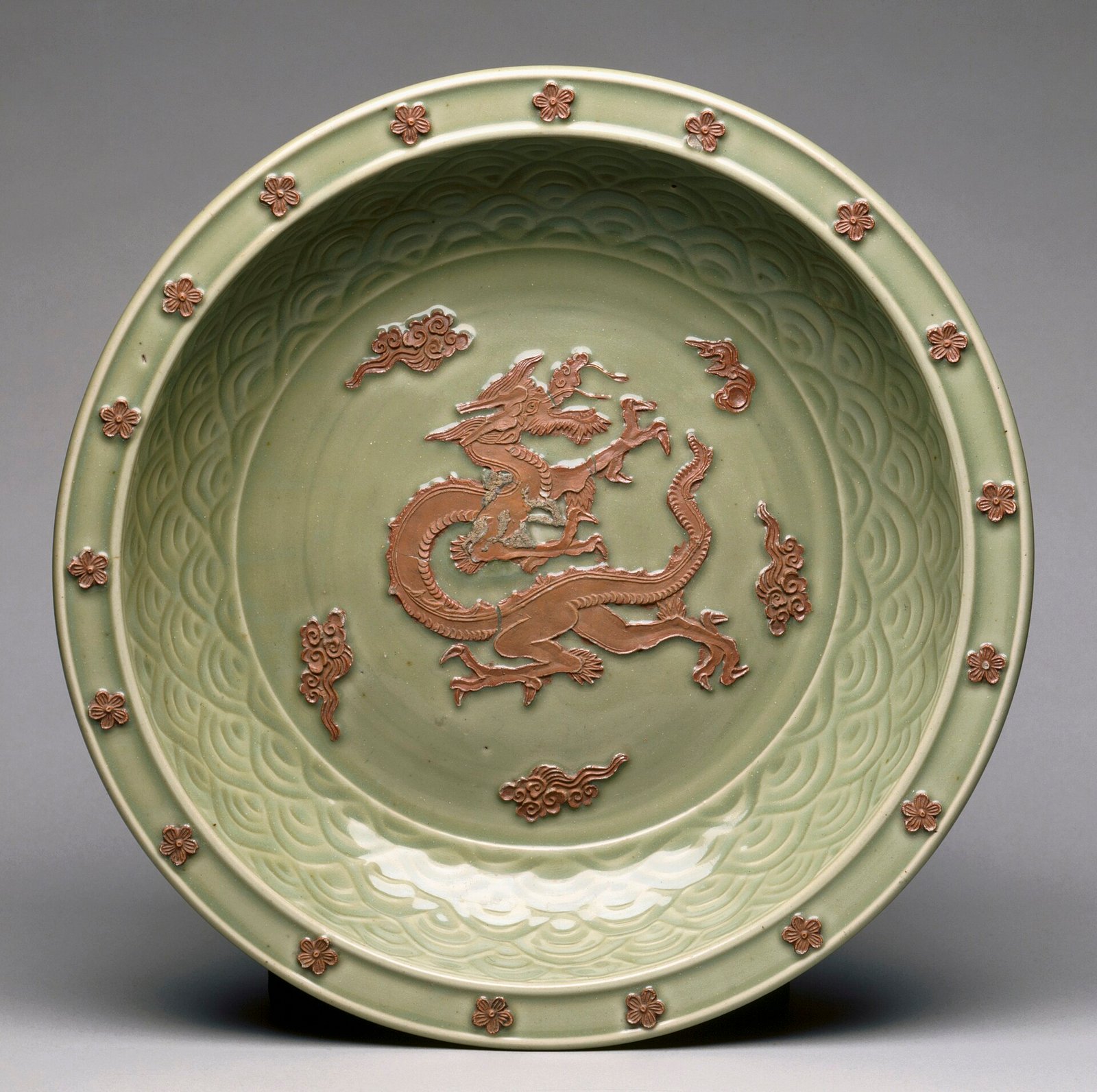
- Decoration arrives. The Metropolitan Museum identifies moulded relief decoration — peony scrolls and the like — as an innovation of the Longquan kilns in the thirteenth and fourteenth centuries, continuing into the Ming. A plain, thickly glazed, undecorated Longquan is more likely Southern Song; a moulded and decorated one more likely Yuan or later.
- Scale arrives. The dragon kilns and the mass export trade are a late-thirteenth-century development.
And one visual test that is documented: the grey Longquan body fires orange-brown wherever it is exposed at the foot, against a cool blue-green glaze. See reading the base.
Why one kiln made blue-green, olive and brown pieces
Buyers often assume a brown or yellow Longquan piece must be a different ware. It is not. Three variables set the colour, and the kiln controlled only two of them well.
The first is iron. The Smithsonian’s Southeast Asian ceramics survey gives a sense of scale: an early Sawankhalok (Thai) green glaze averages “2.5 percent iron (Fe2O3)”, while the later celadon glaze contains 1.2 percent. Small shifts in iron move the colour a long way.
The second is oxygen. Fired in a reducing atmosphere, iron gives “variable shades of bluish green”. Starve the kiln of oxygen and the green deepens; let air in and the same glaze goes warm. The Smithsonian holds a twelfth-century Longquan bowl catalogued with an “oxidized celadon glaze” whose colour is cream-yellow, crackled in brown. Same kiln, oxidising atmosphere. The Freer’s title records it as “used in Japan as a tea bowl”.
The third is time. Early Longquan is not blue at all. A late tenth-century Longquan funerary jar in the same collection has a “transparent olive-green” glaze with fine crackle, and the museum reads its incised decor and colour as Yaozhou influence. The thick, opaque blue-green we think of as Longquan came later.
Potters also used oxidation on purpose. The Met’s thirteenth-century bowl with two fish leaves the fish unglazed, so the iron-rich body “oxidized into a fresh orange-red color” against the green. That is the foot-rim effect turned into decoration.
None of this was easy. UNESCO’s listing of the Longquan firing tradition records temperatures “as high as 1310º C”, judged by the colour of the flame and a thermometer. Over- or under-firing spoils the result. So when we describe a piece as olive or straw-coloured, we are describing what happened in the kiln, not questioning where it was made.
The other celadon: Goryeo
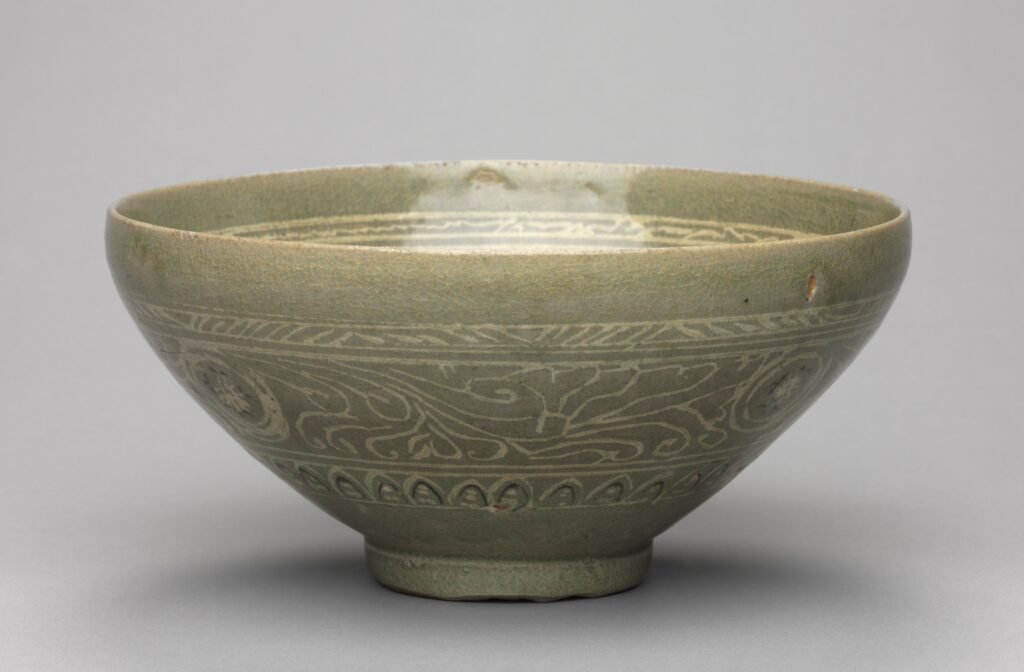
China did not have the family to itself. Korea’s Goryeo dynasty (918–1392) produced the other great celadon tradition, and the Met describes it plainly: it “typically appears gray-green in hue”. The chemistry is the same story. The Met credits iron in the clay, iron and manganese oxide in the glaze, and a kiln whose oxygen “was dramatically reduced at some stage of the firing”.
The connection to China is documented, and we will go only as far as the museums do. The Met notes that the Song envoy Xu Jing, visiting the Goryeo capital in 1123, “noted the resemblance of Goryeo ceramics to the celadons of China’s Yue and Ru kilns”. The National Museum of Korea adds that a Song writer listed the “luminous jade-green color of Goryeo celadon” among the best things under heaven. That is the praise. We have seen it inflated elsewhere; those two sentences are what the record supports.
What Goryeo made its own is sanggam, inlay. The Met calls it “a rarity in China”. The method: motifs are etched into the dry clay body and the cuts filled with black and/or white slip before the translucent glaze goes on. A thirteenth-century tile at the Met shows the result, “black-and-white imagery in a celadon blue-green ground”. The finest pieces came from kilns at Gangjin and Buan, which the National Museum of Korea says served mainly the palace and the nobility.
For a buyer, the practical point is this. Grey-green rather than blue-green, and inlaid black and white under the glaze, typically points to Korea rather than Zhejiang. Both are celadon. Neither is Longquan.
How to tell Longquan from Yaozhou
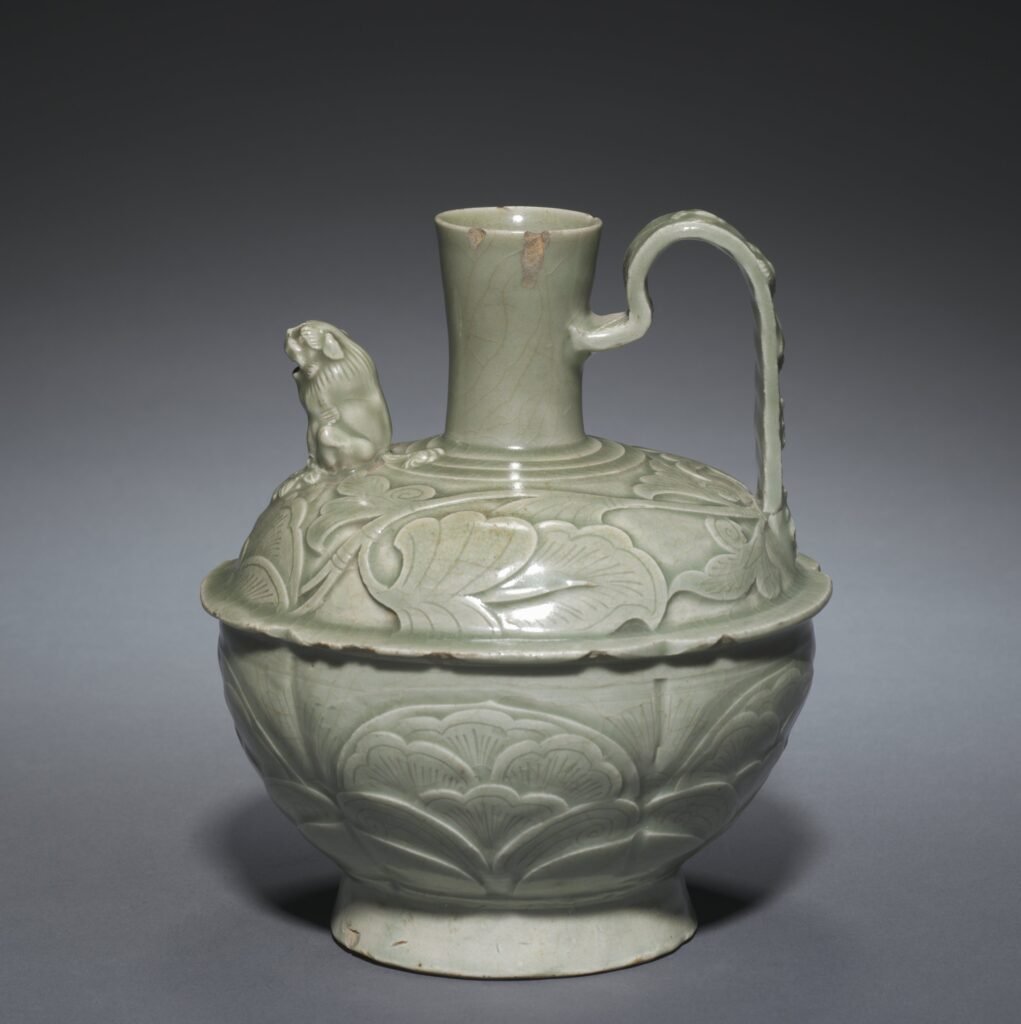
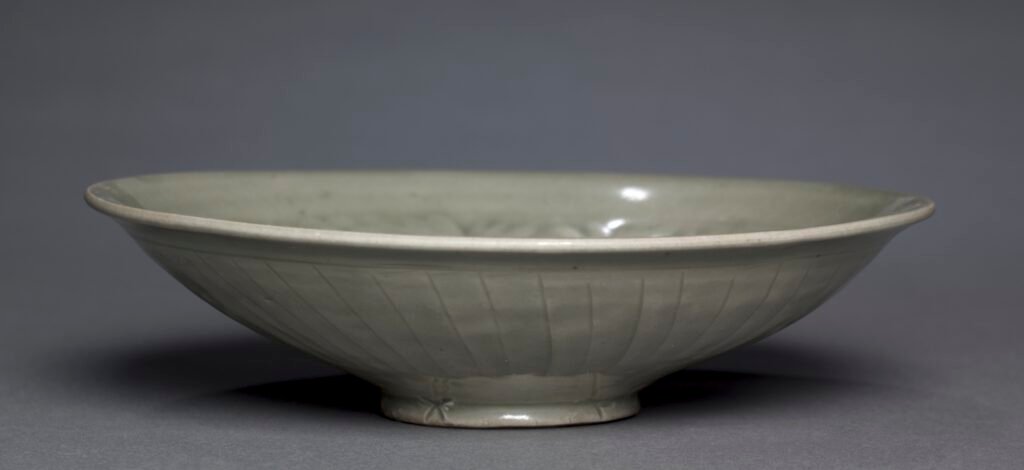
Both are green. The separator is what the glaze does to the carving. Longquan’s thick opaque glaze hides carving; Yaozhou’s thin transparent olive glaze dramatises it, pooling darkly in the incised lines and giving strong light-and-dark contrast. If the decoration leaps out at you, it is more likely Yaozhou — a rule of thumb from handling rather than a museum definition.
More in our Song ceramics guide. Browse what we hold under celadon and Longquan.