Two of the most valuable wares in Chinese ceramics are covered in cracks on purpose. If that sounds like a dealer’s excuse, here is the Metropolitan Museum on one of its own Guan dishes: the cracks were “made to resemble the accidental cracks that sometimes occurred during the firing of ceramics” and are deliberate.
That sentence is worth reading twice, because it describes something unusual in ceramics: a flaw so admired that potters learned to reproduce it, and then built an entire aesthetic on it.
Guan — one network
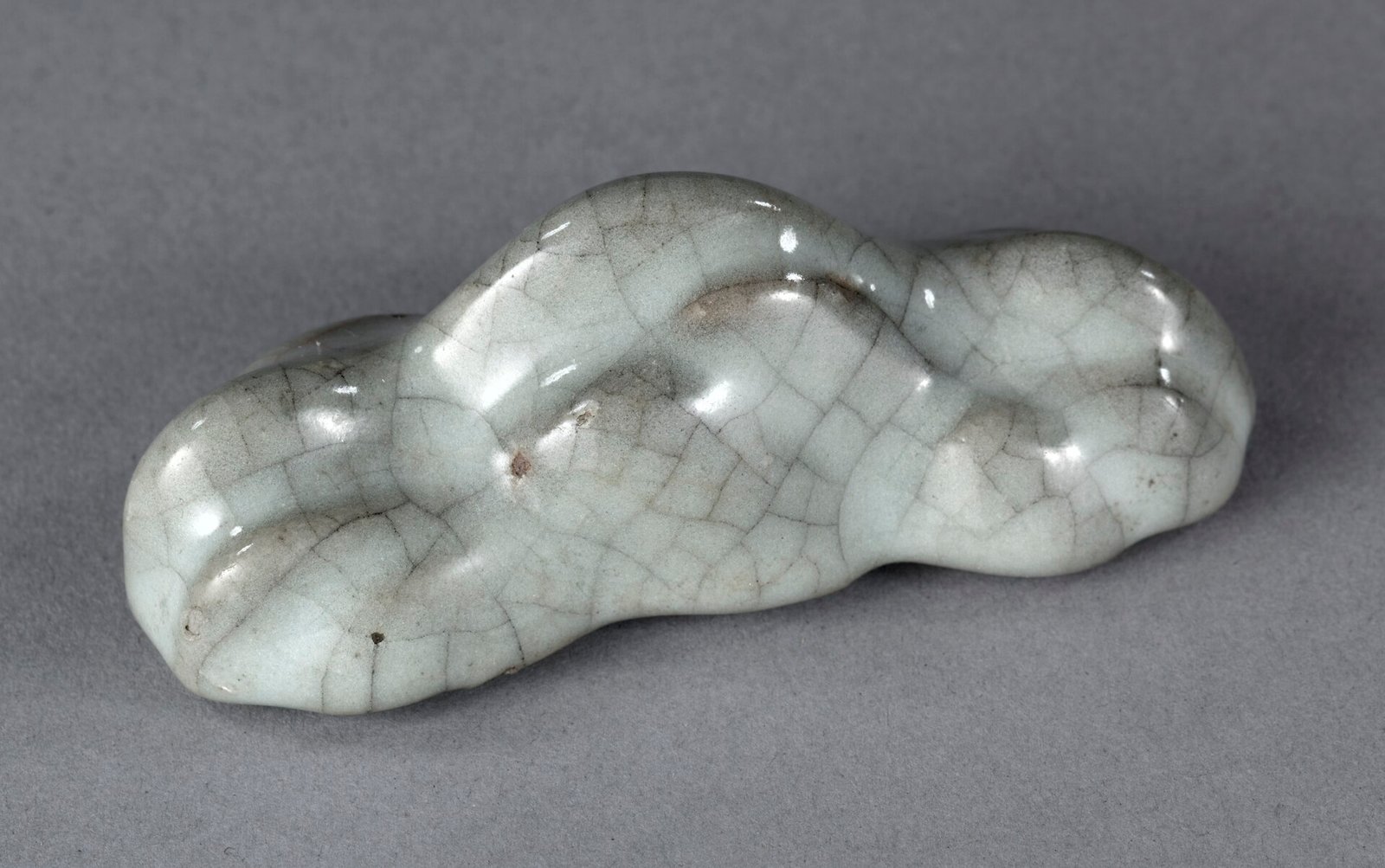
Guan (官, “official”) was made at Hangzhou in Zhejiang under the Southern Song. Celadon glaze full of tiny bubbles, under a wide, open crackle that the Met describes elsewhere as “frequently cobwebbed with a profuse crackle—generally brownish…or blackish”.
Its identifying feature is not the crackle, though, but the foot. The British Museum quotes the classical description: 紫口鐵足 zikou tiezu, “purple mouth and iron foot” — the purplish-grey body showing through where the glaze thins at the rim, and the unglazed foot firing ferrous brown.
Ge — two networks
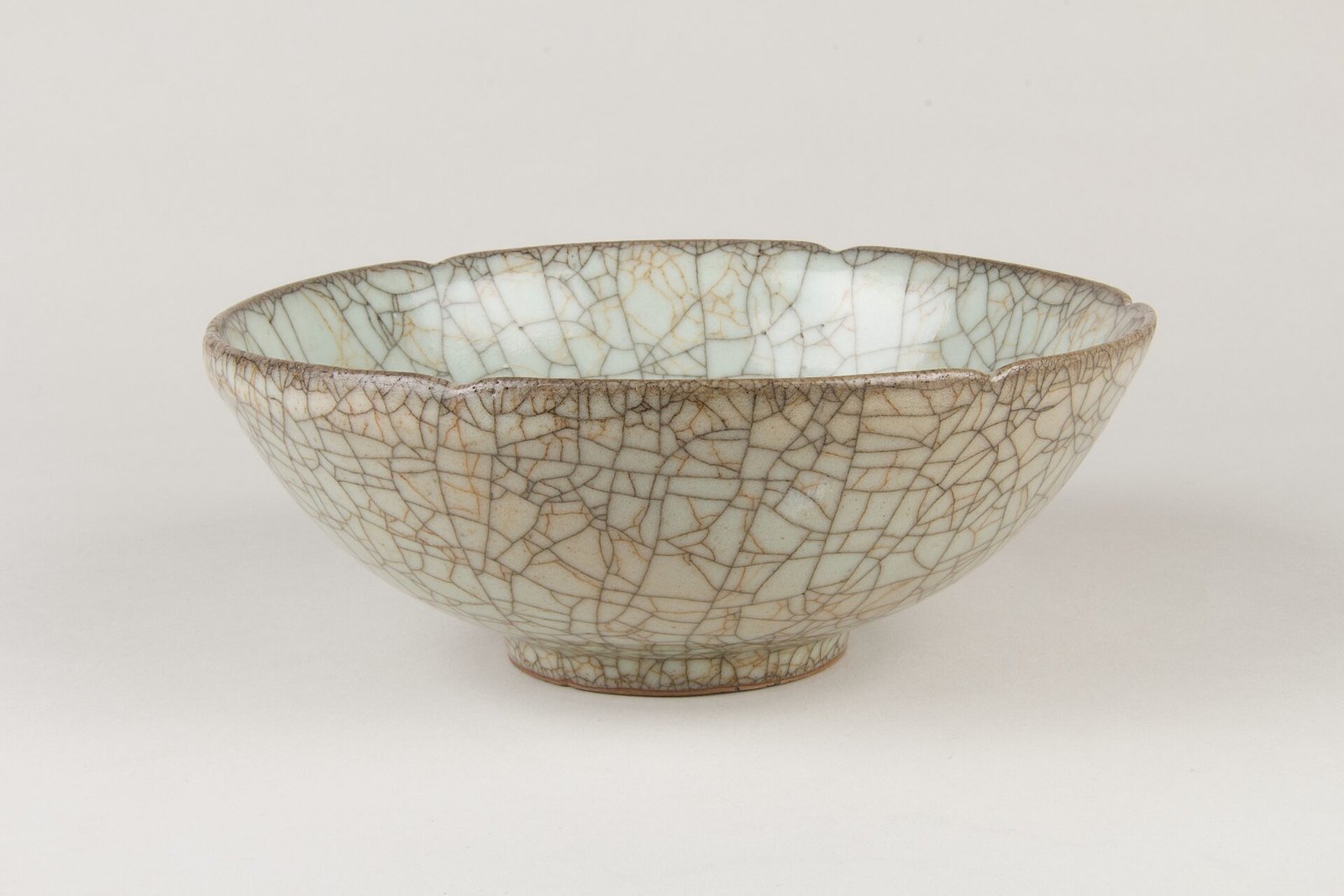
Ge (哥, “elder brother”) is the harder case, and the more interesting one. The Palace Museum in Beijing describes its glaze as “varying in color from bluish gray to light greenish blue to cream…thick and lustrous”, and its crackle by the phrase every collector should know: 金絲鐵線, “gold thread and iron wire”.
That names the diagnostic. Ge’s crazing reads as two superimposed networks — a coarser dark one, with finer golden-brown lines running inside it. Guan’s reads as one. In practice, separating the two is genuinely difficult even for specialists, and anyone who finds it easy has not looked at enough of them.
The awkward fact about Ge
Nobody knows where it was made. The Palace Museum states plainly that “the site of the kiln that produced the existing Ge wares has as yet not been discovered”. Nor is the date settled: the British Museum dates a “ge-type” piece to the Yuan; the Met catalogues its Ge bowl as Song.
This is relevant to the “Five Great Kilns” framing you will see everywhere. That grouping is not a Song category at all — it first appears in a Ming imperial catalogue and was formalised by Qing scholarship, and the fifth place originally belonged to the Chai kiln, which has never been found either. Ge is the weakest link in a list that is itself later connoisseurship. More in our Song ceramics guide.
How a crackle is made, and how it was controlled
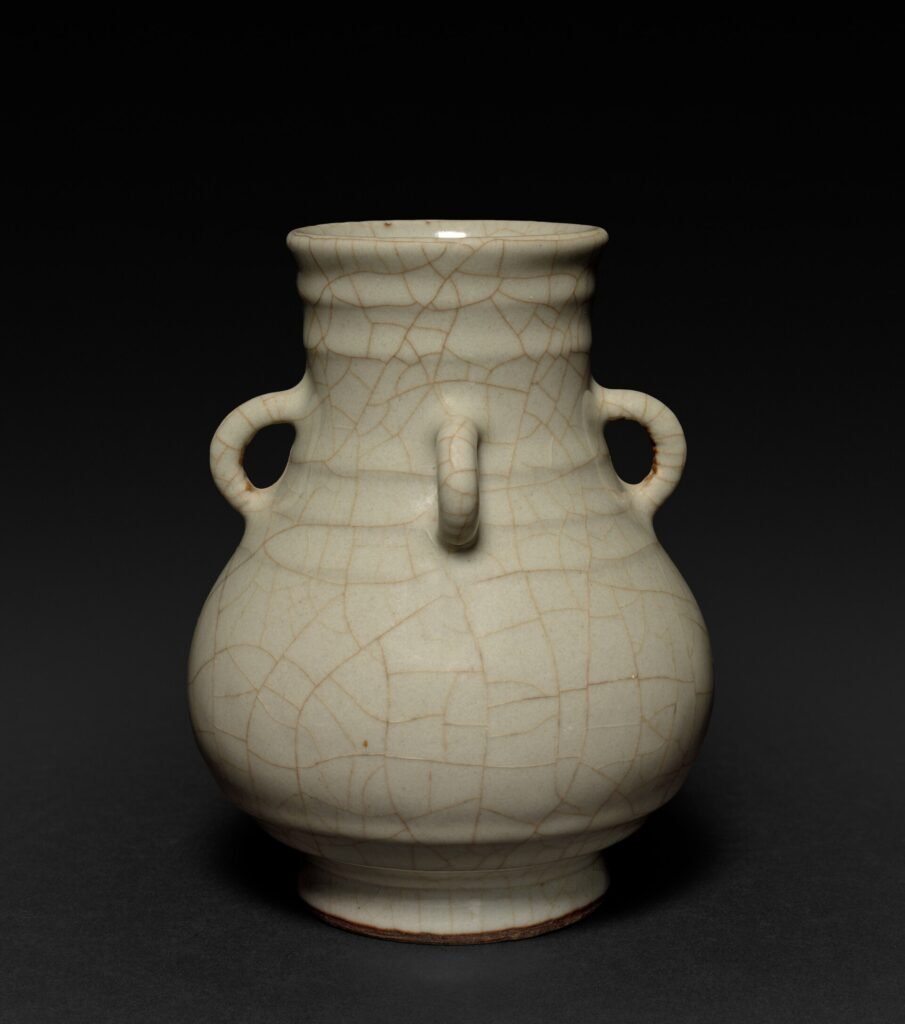
A crackle is a fault that has been tamed. Glaze and clay body shrink as the kiln cools. If they shrink at different rates, the glaze is put under tension and splits. The Cleveland Museum of Art puts it plainly: the crackle on its Guan basin “developed after firing, due to the different rates of expansion and contraction” of body and glaze (Cleveland Museum of Art). On most pots that is crazing, and unwanted. At Hangzhou it was the point. The Smithsonian’s National Museum of Asian Art notes that Guan crackle “was induced by formulating the glaze to shrink more than the clay body” (NMAA, Guan vase F1911.347).
The other half of the trick is thickness. Guan glaze was built up in several coats, and the Smithsonian describes it as “often thicker than the thin clay body” (NMAA). Its Guan bowl from the Jiaotanxia kiln is catalogued as carrying “two to four layers of glaze” (NMAA, Guan bowl F1932.58). The method was repeated glazing and firing at moderate heat, then one final high firing (NMAA, teaching resource).
The dark lines are not always natural. Some come from the dark body showing through the cracks. Cleveland records that the crackles on its basin were “stained at different stages during the cooling process”, giving a wide dark-brown net as well as finer golden-brown and colourless webs (Cleveland Museum of Art). The Smithsonian agrees: sometimes the crackle colour “was also artificially enhanced” (NMAA). A stained crackle is not by itself a sign of a later hand.
Six centuries of imitation
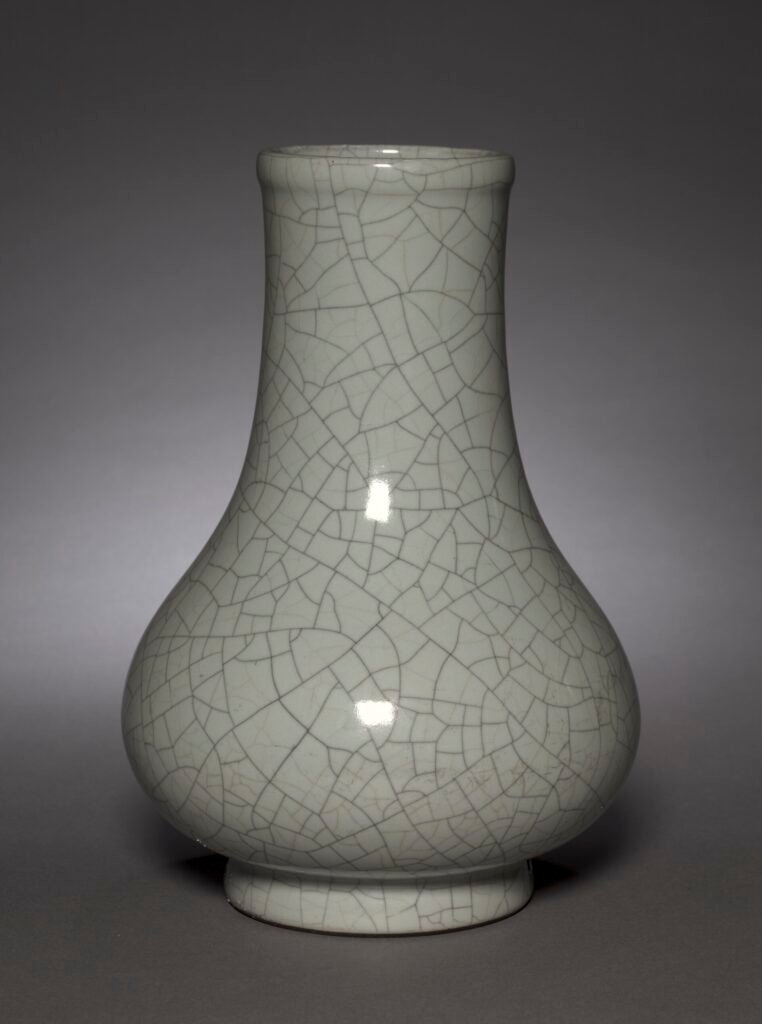
Copying began almost at once. The Longquan kilns, also in Zhejiang, made celadons in the Guan manner during the Southern Song. The Smithsonian catalogues a thirteenth-century Longquan vase as “Kuan type”, with a thick glossy glaze and irregular crackle (NMAA, Longquan vase F1950.22). The Ming court joined in. The British Museum shows a porcelain copy of Southern Song Guan made at Jingdezhen for the Chenghua emperor (British Museum, Room 95 guide).
The great revival came under the Qing. Harvard’s Qianlong-period cong vase has a “crackled, grayish blue, ‘guan’-type glaze” over a white porcelain body, with a bold charcoal-grey crackle and a finer rust-brown one beneath, and it carries the Qianlong six-character seal mark in underglaze blue (Harvard Art Museums). The British Museum shows three Qianlong vases that pair an archaic bronze shape with a copy of the Guan glaze on porcelain (British Museum). These are the pieces we see most often in the trade. A reign mark on a crackle-glazed vase is not a red flag. It is normal for an eighteenth-century Ge-type or Guan-type piece.
The Qianlong emperor did more than order copies. He wrote on the originals. A Ge-ware vase in the British Museum, dated Yuan, was “incised with verses inside the neck” that he composed on the beauty of its crackled glaze (British Museum, PDF 94). He also had his verses put on the copies. A Qianlong bottle in the same museum, made in imitation of Song Guan with the mouth and foot painted brown to fake the “purple mouth and iron foot”, carries on its base “a poem by the Qianlong emperor” praising Guan ware (British Museum 1936,1012.177). The National Palace Museum in Taipei records that he punned on the word for cracked to make crackle “a metaphor for the passion of a martyr” (National Palace Museum).
What the texts and the digs actually tell us
The written record for Ge is Ming, and it is thin. The National Palace Museum summarises it: a story of two potter brothers named Zhang in Chuzhou, the elder’s wares being called “Older Brother wares”, and the Ming scholar Gao Lian sorting crackle into three kinds, including “eel-blood ice cracks” and a plum-blossom pattern (National Palace Museum). None of this is Song testimony. It is what later collectors believed.
For Guan the archaeology is firmer. Two kiln sites have been excavated in Hangzhou, Jiaotanxia and Laohudong, both in the vicinity of Phoenix Mountain. The National Palace Museum reads one as the Jiaotanxia official kiln of the records and the other as possibly the Xiuneisi kiln, with overlapping periods of production (National Palace Museum). The British Museum agrees, placing potters at Laohudong first and describing Jiaotanxia as set up “to supplement production” (British Museum). Taipei adds a caution we share: some Guan pieces in the old Qing court collection are finer than anything found at either site, which suggests a kiln still undiscovered.
Where does that leave Ge? The Longquan county and Xiaomei kilns have yielded crackled celadon, and Yuan-period Guan-type sherds from Laohudong resemble Ge pieces in the old court collection (National Palace Museum). That is evidence of crackle made in more than one place, and of resemblance. It is not proof that either was the Ge kiln, and we do not sell on that basis.
What this means when you are buying
- Do not discount crackle as damage on these wares. It is the point. A Guan or Ge piece without crazing would be the anomaly.
- Do learn the difference between crackle and a hairline. Crazing sits in the glaze; a hairline runs through the body and is usually visible from both surfaces. See what a hairline does to value.
- Treat confident Ge attributions with care. With no kiln site and contested dating, a great deal sold as Ge is later imitation — and much of it was made openly as imitation, which is a different thing from a fake.
- Look at the foot. On Guan, purple mouth and iron foot. It is a harder feature to fabricate than a crackle.
Ge and Guan crackle wares appear in our catalogue under Ge and Guan crackle.