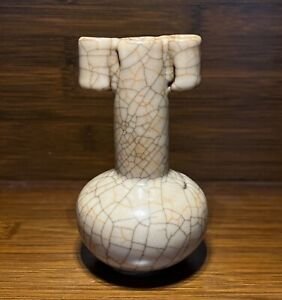
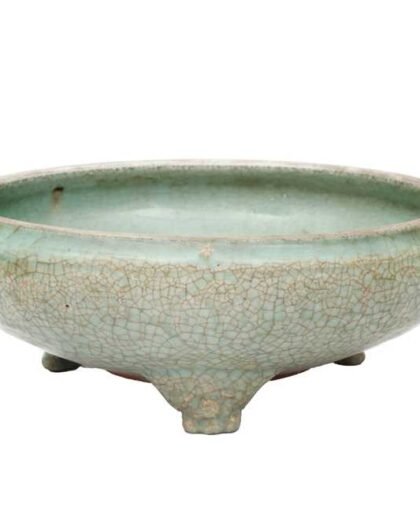
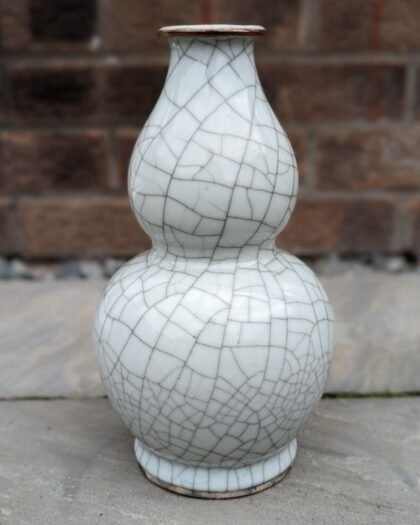
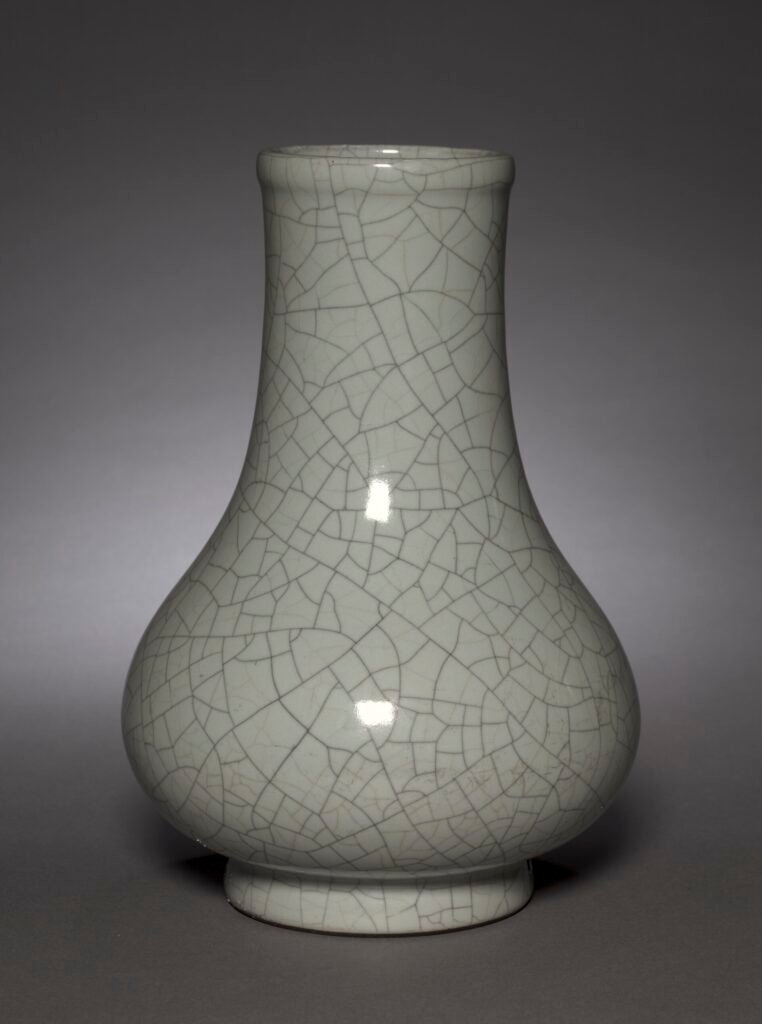
Guan and Ge are the two great crackled celadons of the Chinese tradition, and the terms are used loosely enough that a buyer should know what each is claiming. Guan means “official”: it was the ware of the Southern Song court at Hangzhou after 1127, and the British Museum describes it as a thin, dark clay body under a thick celadon glaze full of tiny bubbles and with a wide crackle. Ge is a related crackled ware whose origin and date are still argued — museums place it variously in the Southern Song, the Yuan or later — with a denser crackle, traditionally described as “iron wire and golden thread” where a coarse dark net is crossed by a finer amber one. Both were imitated at Jingdezhen from the Ming onward, and the Yongzheng and Qianlong imperial kilns made “Ge-type” and “Guan-type” porcelain in deliberate homage to the Song. Most crackled celadons on the market are those later types, and the honest description of an eighteenth-century vase is “Ge-type”, not “Ge”.
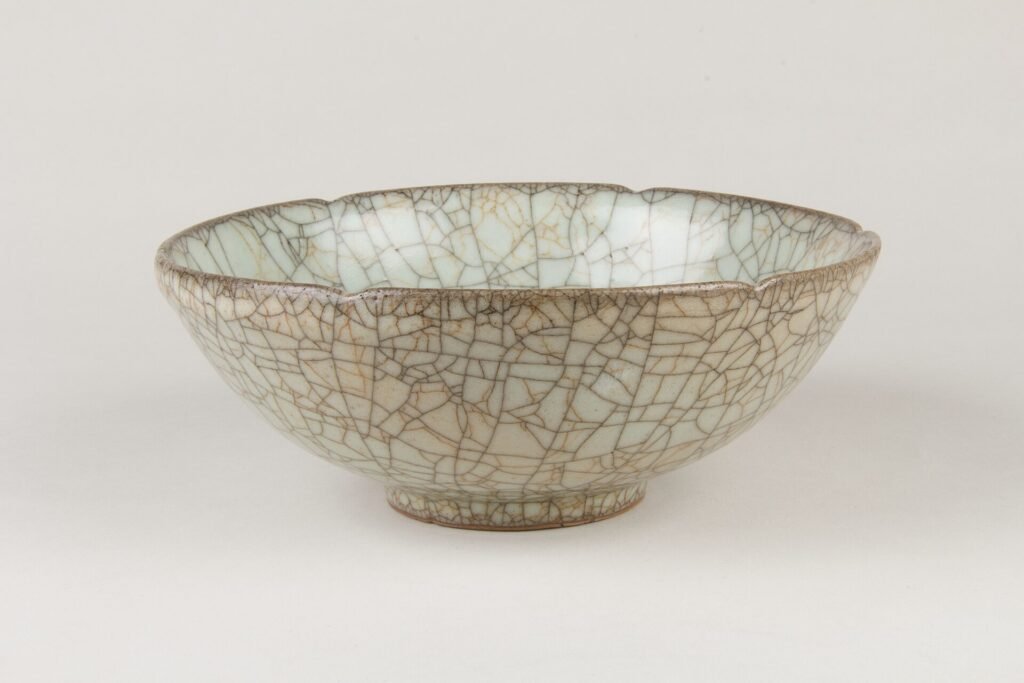
The crackle
Crackle is a glaze that has contracted more than its body on cooling and cracked into a network; on Guan and Ge it was cultivated as the whole beauty of the pot, and the cracks were often stained with ink or tea to darken them. It is not damage and it does not weaken the piece. What matters is its character: wide and irregular on Guan; doubled and finer on Ge; regular, even and mechanical-looking on many later copies. The journal explains Ge and Guan crackle in detail with museum examples.
Reading a piece
Body. Song Guan has a dark, almost black body that shows brown at the unglazed foot and dark at the thin rim — the “purple mouth and iron foot” of the old connoisseurs. Jingdezhen Ge-type wares have a white porcelain body, so the dark rim and foot are imitated with a brown dressing, and a scratch or chip reveals white underneath.
Glaze. Song glazes are thick, layered and soft-surfaced; eighteenth-century Ge-type glazes are thinner and glassier, and can be very beautiful; nineteenth-century and modern crackle is often too even.
Foot and mark. A Qianlong seal mark on a Ge-type vase is normal and is a claim of imperial manufacture that needs the foot, body and glaze to back it up. The reading the base and reign marks guides apply.
Condition
Because the surface is already cracked, a hairline through the body can hide in the crackle. We look with a lamp at a raking angle and tap the rim, and we describe what we find. Chips show the body colour and are informative as well as regrettable.
Read more
The Song ceramics guide covers Guan among the Song kilns; the Qing collection page covers the archaistic wares of the eighteenth century.