The Qing (1644–1911) is the period most likely to be sitting on a British mantelpiece, and the period about which the most confident wrong things get said. We will start with the one that matters most.
Guangxu was not the last emperor of the Qing. The last emperor was Puyi, who reigned as the Xuantong emperor from 1909 until his abdication in February 1912; Guangxu died in 1908. The British Museum’s own authority record for Puyi notes he is “widely known as the ‘Last Emperor’”. It matters commercially as well as historically: the National Palace Museum in Taipei marks the end of imperial “official ware” at exactly that abdication.
The reigns, and where the quality actually sits
| Reign | Dates | Character |
|---|---|---|
| Shunzhi | 1644–61 | With early Kangxi, what the Met calls the “Later Transitional Period” — little originality, late Ming habits carried over. |
| Kangxi | 1662–1722 | The golden age begins. Sapphire blue on near-faultless white; famille verte; the great monochromes. |
| Yongzheng | 1723–35 | Refinement, and the reign of famille rose. The Met: “the signal accomplishment of the Yongzheng period”. |
| Qianlong | 1736–95 | Peak and then decline within the reign — see below. |
| Jiaqing | 1796–1820 | Aesthetics maintained, vigour gone. |
| Daoguang | 1821–50 | The Met: “an obvious deterioration in the fabric of the porcelain and a totally lackluster approach to the decoration”. |
| Xianfeng | 1851–61 | The kilns burn. See below. |
| Tongzhi | 1862–74 | Mostly poor; the Cixi Dayazhai wares, ordered in 1874 and completed 1875–76 into the Guangxu reign, are the exception. |
| Guangxu | 1875–1908 | Large output, wide quality range, and enormous numbers of Kangxi and Qianlong marks. |
| Xuantong | 1909–11 | The end of official ware. |
The Qianlong nuance most guides miss. The Met locates the finest Qing wares in a comparatively short window — 1683 until about 1756 — under three capable supervisors of the imperial factory: Zang Yingxuan, Nian Xiyao and Tang Ying. The Met’s handbook suggests the end of Tang Ying’s supervision in 1756 was the milestone after which, in the majority of late Qianlong pieces, “the caliber of the body, potting, glaze, and decoration all begin to fail”. A late Qianlong piece and an early Qianlong piece are not the same proposition, and the mark cannot tell them apart.
1855: the year the imperial kilns burned
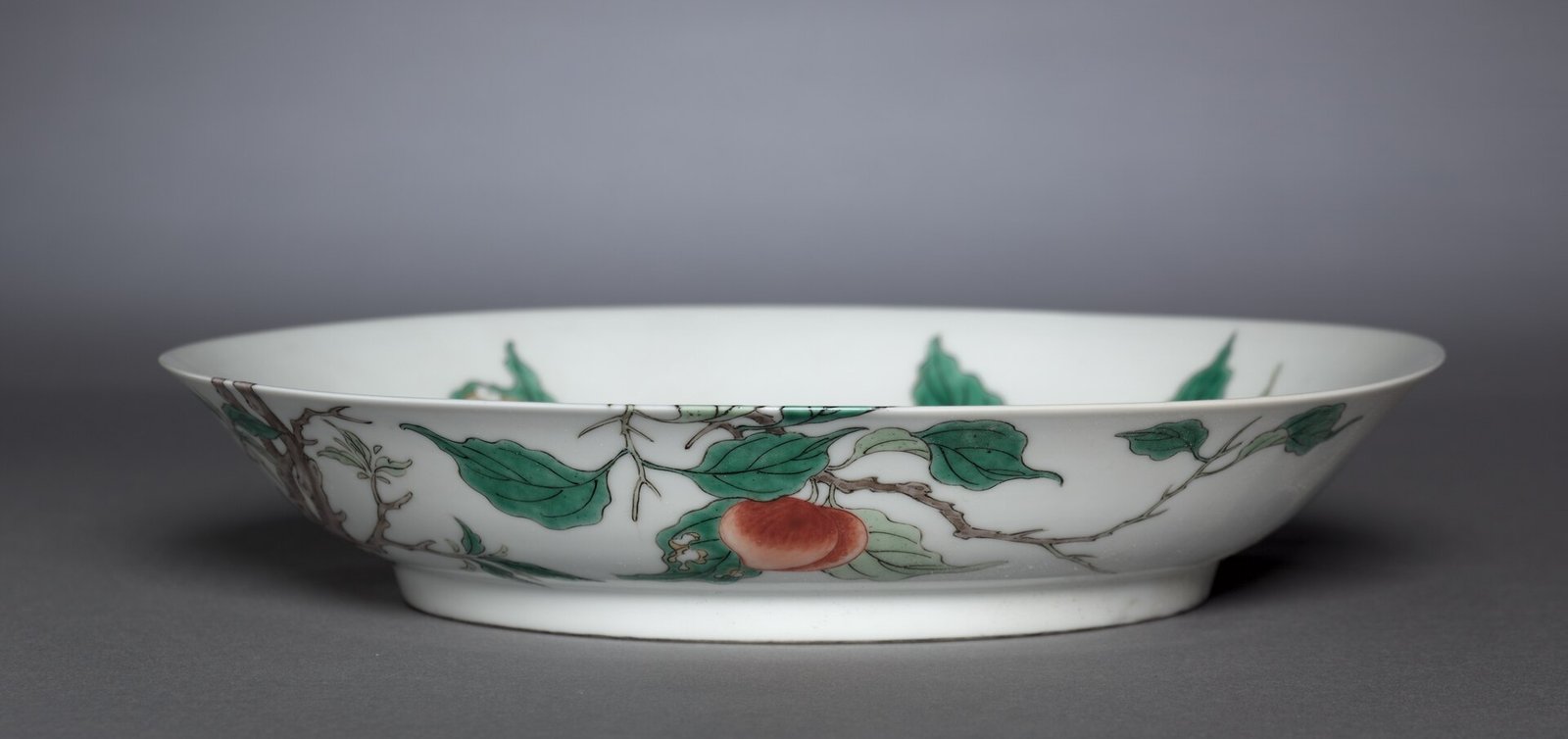
This is the fact that explains late Qing quality, and the trade usually gets the date wrong. Imperial kiln activity halted in 1855, when Taiping forces took Jingdezhen and burned the imperial factories to the ground. Not 1853 — that is when the Taiping took Nanjing.
And the Met adds something most accounts omit: it is not certain whether the imperial kilns were ever rebuilt. The imperial-quality wares of the Tongzhi and Guangxu reigns may well have been made at the larger commercial kilns. Do not accept “rebuilt under Tongzhi” as established fact.
The Met’s summary of the rest of the dynasty is worth quoting in full, because it is both harsh and commercially useful: the tendency is “to dismiss wares of the remainder of the Qing dynasty as ‘crockery,’ and in the majority of cases, this judgment is quite accurate” — but “there was, however, a thin strain of much better porcelains that ran through this period”. Good late Qing exists. It is simply not the default.
The famille palettes — and who really named them
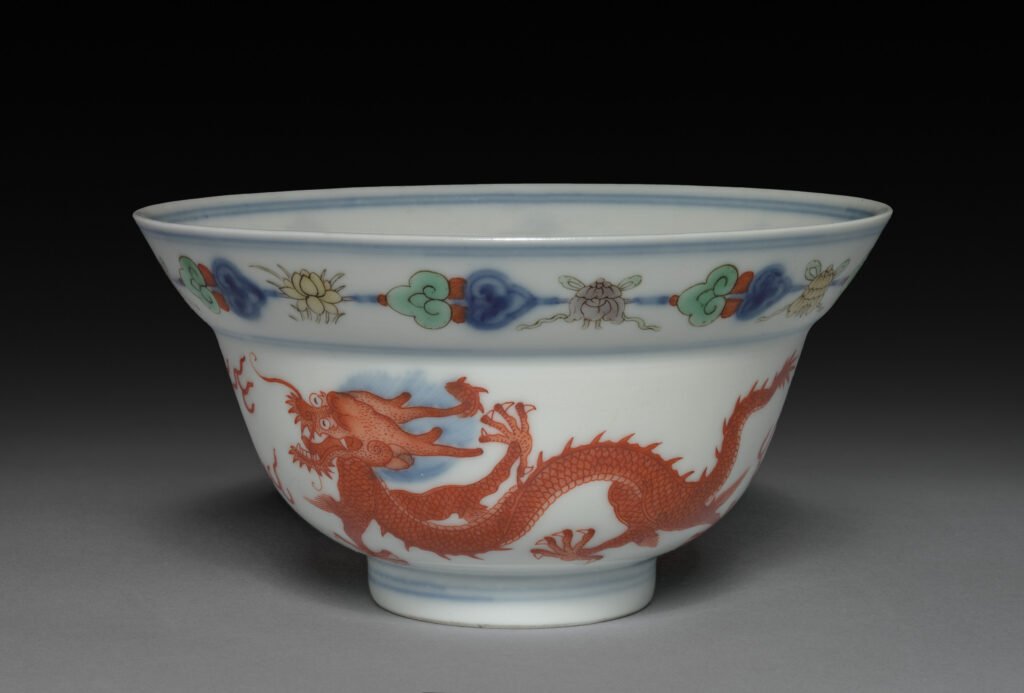
The terms are French and they are Victorian. Albert Jacquemart (1808–75), with Edmond Le Blant, set out the scheme in Histoire artistique, industrielle et commerciale de la porcelaine (Paris, 1862). His chapter heading names four families: famille archaïque, famille chrysanthémo-pæonienne, famille verte and famille rose.
Two things follow. The British Museum’s gallery label credits Jacquemart’s later Histoire de la Céramique of 1873 — but both terms are demonstrably in print eleven years earlier. And famille noire and famille jaune are not Jacquemart’s: neither appears in the 1862 text. They are later, and we have not identified who coined them.
| French term | Chinese | What it actually is |
|---|---|---|
| famille verte | 五彩 wucai, 硬彩 yingcai (“hard colours”) | Translucent overglaze enamels dominated by green. The Met: they “did not permit much gradation in color”. |
| famille rose | 粉彩 fencai, 軟彩 ruancai, 洋彩 yangcai | Opaque enamels including a rose pink. The reign of Yongzheng. |
| famille noire / jaune | — | Not separate palettes. They are famille verte enamels painted on the biscuit against a black or yellow ground. The trade routinely muddles this. |
What actually makes famille rose different
Two changes, and the Met states both:
- A rose pink derived from colloidal gold, used from the palest blush to deep ruby. The British Museum adds that the gold-pink technique “was introduced to China from Europe”, though Chinese and European craftsmen used different recipes.
- An opaque white opacified by lead-arsenic compounds, mixed into the other colours. This is the more important of the two: it let the painter shade, achieving “a range of color values for the first time”. Cleveland puts it the same way — opaque white “allowed painters to vary the value of pigments”.
That is why famille rose looks painted and famille verte looks drawn. Non-invasive Raman analysis of Qing palace enamels has since confirmed both instrumentally: colloidal gold nanoparticles in the red, orange and pink enamels, and lead arsenate in the whites and pale tints. We say “opacified by lead-arsenic compounds” rather than name a recipe, because the museum and the laboratory describe the mechanism slightly differently.
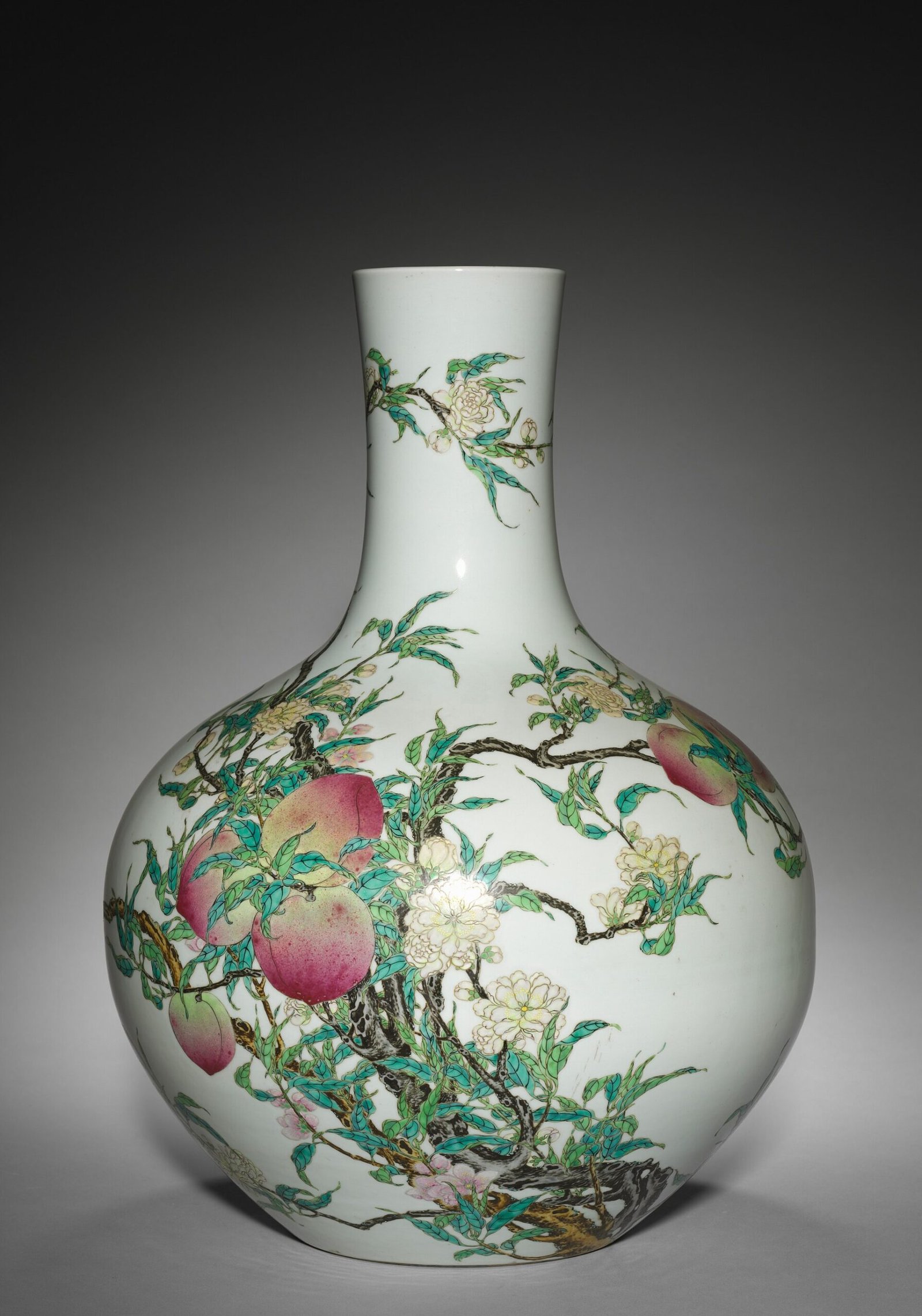
Dating it: rudimentary famille rose appears on armorial porcelain in the early 1720s, and the British Museum dates the new opaque palette to “around AD 1720” — but the Met judges the technique “not fully developed much before 1730”. A confident “Kangxi famille rose” attribution should make you look twice.
The monochromes
Surprisingly few colourants are involved. The Met: “essentially, they were iron, copper, cobalt, and manganese oxides.” What varies is the atmosphere in the kiln and the control of the glaze.
- Sacrificial red and blue. Not decorative names — ritual ones. The Smithsonian records a copper-red glaze as jihong you 祭紅釉, used at the Altar of the Sun because red was the colour of the sun; the Met holds dark blue ritual vessels made for ritual use at the Temple of Heaven. Note the same syllables are written two ways: 祭 (“sacrificial”) and 霽 (“clear sky”). Both are current; neither is an error.
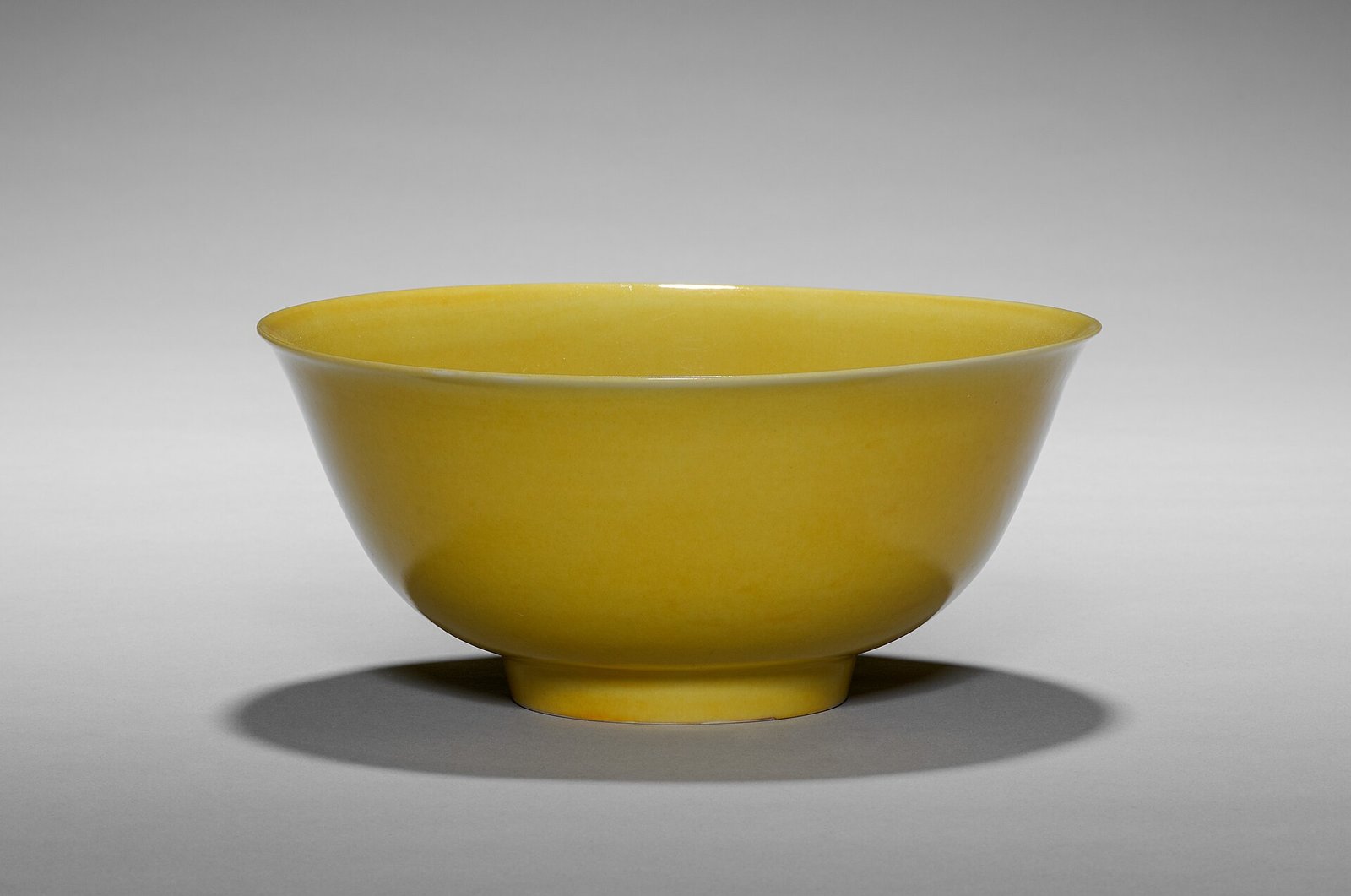
- Imperial yellow. Cleveland records that “most scholars believe” yellow monochrome was reserved for the imperial household or used as diplomatic gifts — hence the name. Note the hedge: no sumptuary law is cited, and we do not claim one.
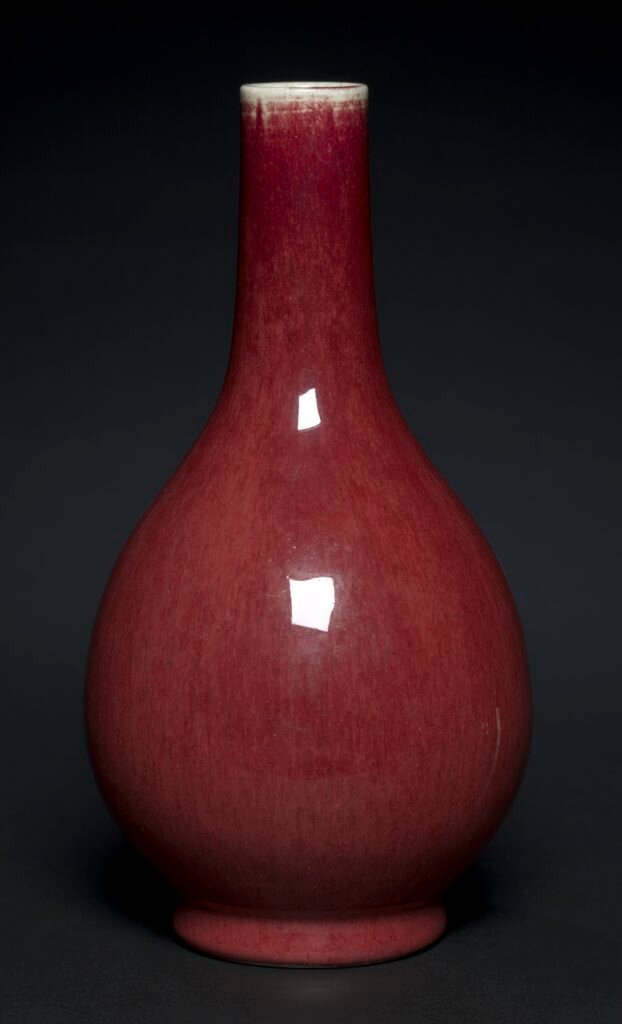
- Sang de boeuf / langyao. Copper oxide fired in reduction. The Met gives a real test: “a remarkable control of the thick glaze, which is checked in an even line where it stops above the foot, is considered to be a hallmark of genuine Kangxi sang de boeuf”.
- Peachbloom. Soft mottled pink-red with moss-green flecks, from copper possibly blown on between clear glaze layers. Used on a very limited group of small scholar’s-desk forms and, per the British Museum, “only used for a short period in the Kangxi reign”. Chinese connoisseurs call it 豇豆红 jiangdou hong, “cowpea red”.
- Qing celadons. Glossy, with tiny bubbles. Usefully, the British Museum notes that most Yongzheng and Qianlong copies of Song celadons carry six-character underglaze blue seal marks — so a Song-style celadon with a Qing seal mark is behaving exactly as it should.
Marks, briefly
Ming and early Qing marks are normally in regular script (kaishu); seal script (zhuanshu) is in use by Yongzheng and, in the British Museum’s careful phrasing, “predominated over” regular script throughout the Qianlong reign. Everything else — apocryphal marks, hall marks, the Kangxi edict that no museum can source — is in our guide to Chinese reign marks, which is where this subject properly belongs.
After the dynasty: Republic period, 1912–49
Museums treat this as a formal period, not a market label, and the British Museum runs its Jingdezhen enamel-ware labels straight through the divide: “Qing to Republican period, AD 1720–1949”. Continuity, not rupture.
Some of it is very good. Under Yuan Shikai — president in 1912, briefly emperor from December 1915, dead by June 1916 — Jingdezhen produced wares the Met calls “of surprisingly fine quality”, marked with his reign title Hongxian. And the Met has since re-dated one of its own Hongxian-marked pairs from 1915–16 to the 1930s–40s. If a great museum can be wrong about a mark for thirty years, so can a listing.
More on this in our guide to Republic-period porcelain.
Buying Qing
The practical shape of this market: early-to-mid Qing quality is genuinely exceptional and priced accordingly; late Qing is mostly modest but contains real things; and marks across the whole period are the least reliable evidence on the object. Buy the potting, the glaze and the painting.
See what we hold in Qing ceramics, famille rose, famille verte and monochromes.
Sources
- British Museum, Room 95 Chinese ceramics gallery guide
- British Museum, authority record for the Xuantong emperor
- Suzanne G. Valenstein, A Handbook of Chinese Ceramics, The Metropolitan Museum of Art
- The Metropolitan Museum of Art, List of Rulers of China
- Cleveland Museum of Art, famille rose vases 1944.184
- Cleveland Museum of Art, yellow-glazed bowl 2020.180
- Smithsonian NMAA, copper-red dish F2015.2a-b
- National Palace Museum, Taipei, Qing ceramics
- Colomban et al., “Investigation of the Pigments and Glassy Matrix of Painted Enamelled Qing Dynasty Chinese Porcelains”, Heritage 3(3), 2020
- Jacquemart & Le Blant, Histoire artistique, industrielle et commerciale de la porcelaine, 1862
Written by James Treacher.