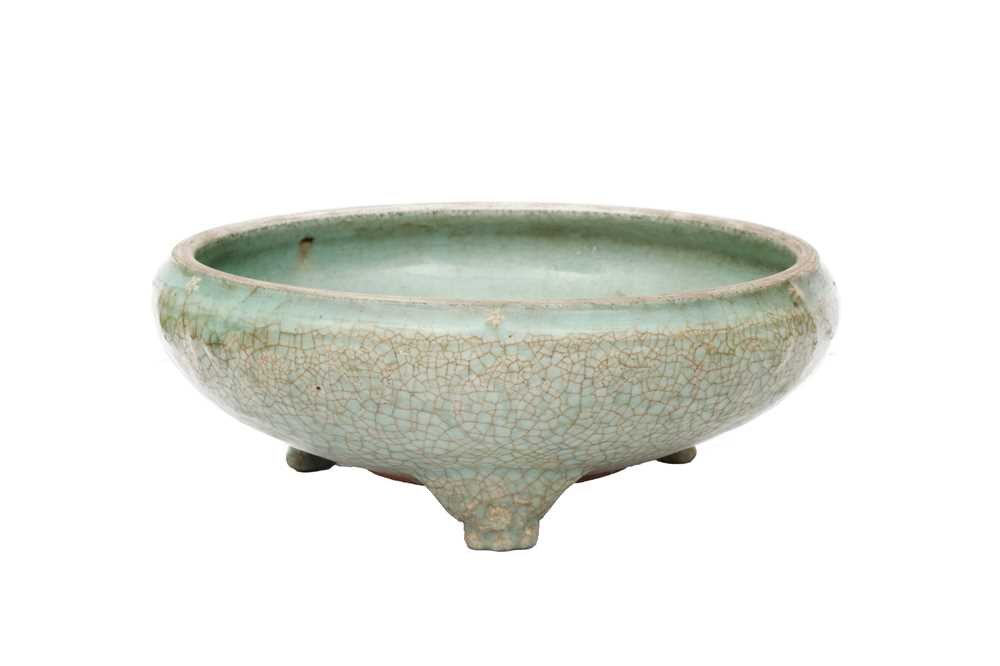
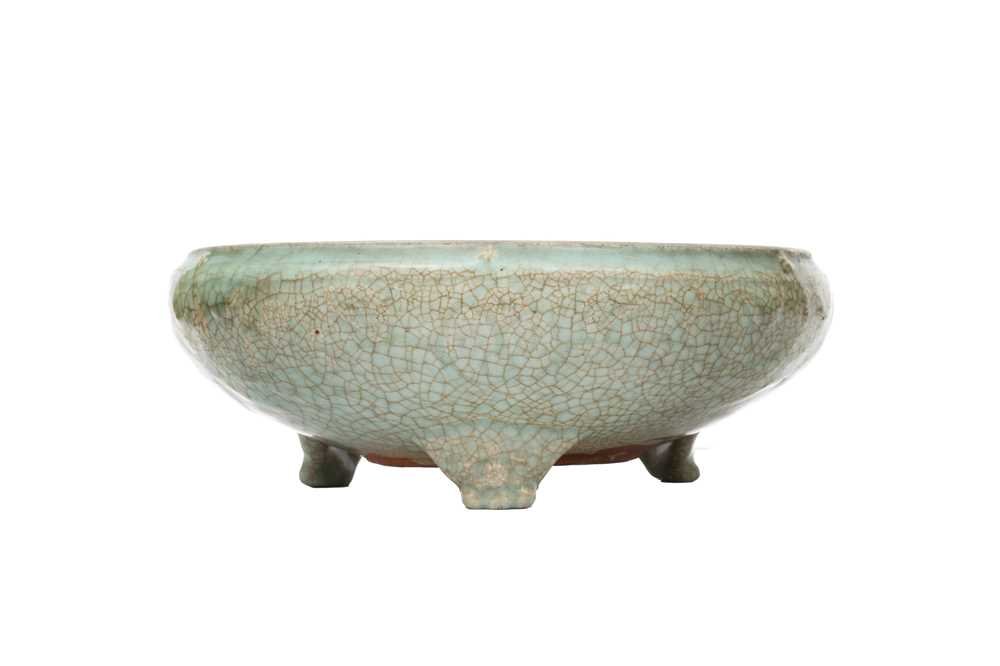
A tripod incense burner with a compressed circular body, the exterior carved with lotus heads and small blossom studs at the shoulder, raised on three short mask-shaped feet, under a crackled celadon glaze. Ming dynasty.
The form is archaistic. A three-footed censer of this shape descends from the ancient bronze ding, and making it in celadon was a deliberate act of quotation — Ming scholars valued objects that referred to a deeper past. Mask feet are a bronze idiom carried across into clay.
Listed on the old site under a slug describing a Qing brush washer. It is neither: it is a Ming incense burner, and the URL has been corrected accordingly.
The censer, and the crackle, in context
A tripod incense burner on three feet is a form borrowed from ancient bronze, and the Ming saw a strong taste for archaism — ceramics that quoted the shapes of Shang and Zhou ritual vessels. The crackled celadon glaze quotes the Song too: the Metropolitan Museum records of a Guan ware dish that its cracks were “made to resemble the accidental cracks that sometimes occurred during the firing” and are deliberate, and Ming and later potters continued to make crackle wares in that admired taste. On a piece like this the crazing is the decoration, not a fault.
This censer was wrongly listed on our old site as a Qing brush washer, under a duplicate-artefact slug; it is a Ming incense burner and is now catalogued as one. The correction is recorded here because a title that names the wrong object, form and dynasty is exactly what a buyer should not have to untangle.
Read more: when the crazing is the point and Ge and Guan crackle wares.
The object, up close
The finer
details.
Reference XA-0027
A question about this piece? Ask for measurements, close-up photographs or a condition report.
Discuss this piece- Dimensions
- 24 cm diameter
- Period
- Ming dynasty (1368–1644)
- Mark
- Unmarked
- Condition
- Very good