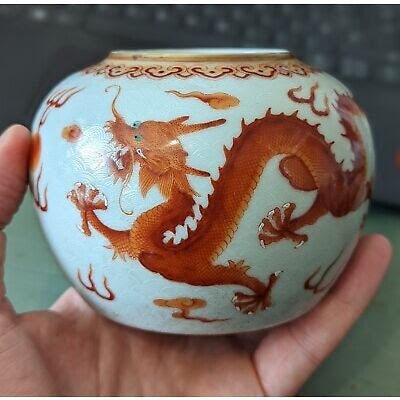
A small porcelain water pot for the scholar’s desk, painted in iron red with two five-clawed dragons chasing among incised, stylised clouds, with a repeating band at the shoulder. The palette is the late-Qing iron red — an overglaze enamel that sits on the surface rather than sinking into it, and which reads slightly granular under a lamp.
The base carries a Qianlong mark. The pot is not of the Qianlong reign. A nineteenth-century body under an eighteenth-century mark is the single most common configuration in Chinese porcelain, and it is not forgery: signing an admired earlier reign was ordinary workshop practice for centuries. Reading the object rather than the base is the whole skill, and this piece is a good, inexpensive place to learn it.
The water pot, and its mark, in context
A water pot is a scholar’s desk object: it holds the water used to grind the inkstick on the inkstone, and the desk — brush, ink, paper, inkstone, and the pots, washers and rests around them — was the apparatus of self-cultivation for the scholar-official class the Metropolitan Museum describes as selected by merit through the examination system. Small desk pieces in fine glazes were made for that market from the Song onward and are among the most sought-after objects in Chinese ceramics.
This pot carries a Qianlong mark and was made in the nineteenth century, and we say so in the title. The Metropolitan Museum describes apocryphal reign marks as “widespread” and often “a kind of salute to ceramics of an earlier time”; a Qianlong mark on a later scholar’s object is homage to the reign whose taste for the desk was most refined. The double dragon is the imperial motif. The piece is judged on its potting, glaze and painting, which are photographed, rather than on the six characters on its base.
Read more: the scholar’s studio and Chinese reign marks.
The object, up close
The finer
details.
Reference XA-0001
A question about this piece? Ask for measurements, close-up photographs or a condition report.
Discuss this piece- Dimensions
- Ask for measurements
- Period
- Qing dynasty (1644–1911), 19th century
- Mark
- Qianlong mark — apocryphal, not of the period
- Condition
- Excellent. No cracks or chips.