Everything I sell is guaranteed to be as described. This page sets out exactly what that means, because a guarantee that is not written down is not a guarantee.
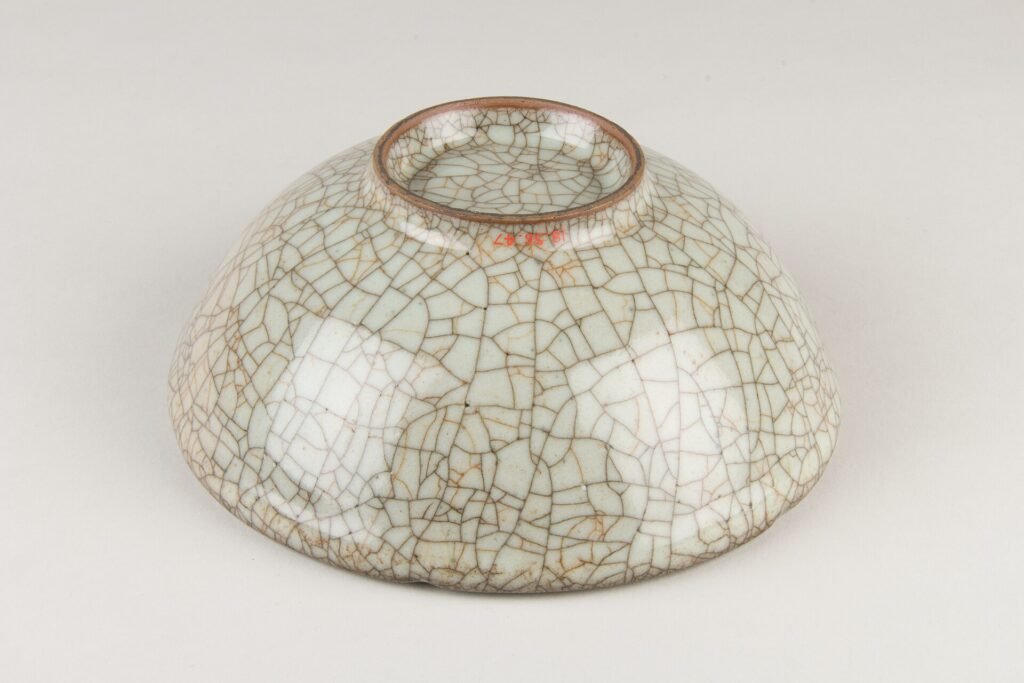
What is guaranteed
The attribution stated on the product page — culture, period, reign, ware and, where given, mark and period status. That statement is not marketing copy. Under section 11 of the Consumer Rights Act 2015 the description of the main characteristics of the goods forms a term of our contract, and I write every listing on that basis.
Where I am not certain, the listing says so in those words: “reading uncertain”, “possibly later”, “attributed to”. An honest “probably” is covered by this guarantee as a “probably”, not as a certainty, and it is priced as one.
The remedy
If a piece is shown to be materially misattributed, I will take it back and refund the full price paid, for as long as you own it. Not a credit note, not an exchange — the price paid.
What counts as evidence
A written opinion from a recognised specialist, auction house department, museum curator or thermoluminescence laboratory. I will meet the reasonable cost of a test that proves me wrong.
What is not covered
- Condition faults that were disclosed on the listing. Every fault I find is photographed and itemised.
- Age-appropriate wear consistent with the stated period.
- Differences of scholarly opinion where the listing already stated that the attribution was uncertain.
- Damage occurring after delivery.
How a piece is examined before it is listed
The order is always the same, and it is the order set out in the reading the base guide. The piece is turned over first. The foot ring shows the body unglazed, how the piece stood in the kiln and where the glaze stops; on Chinese porcelain that tells you more than any mark. Then the mark, if there is one, read against the script, the reign and the potting rather than taken at face value — most reign marks are apocryphal, and the reign marks guide explains why that is usually homage rather than fraud. Then the glaze under a lens for crackle, bubbles, wear and retouching, and the rim and handles for frit and re-gilding. Fillers, adhesives and over-paint that daylight hides show under long-wave ultraviolet; if you want a piece checked that way before you buy, ask.
Only then is the piece compared with the published record: the Metropolitan Museum, the British Museum and the Percival David Foundation, the V&A, Cleveland and the Smithsonian all publish base and mark photographs of dated examples, and the guides on this site are built from them. If a piece does not match what those records show for its stated reign, it is not listed as that reign.
What the condition grades mean
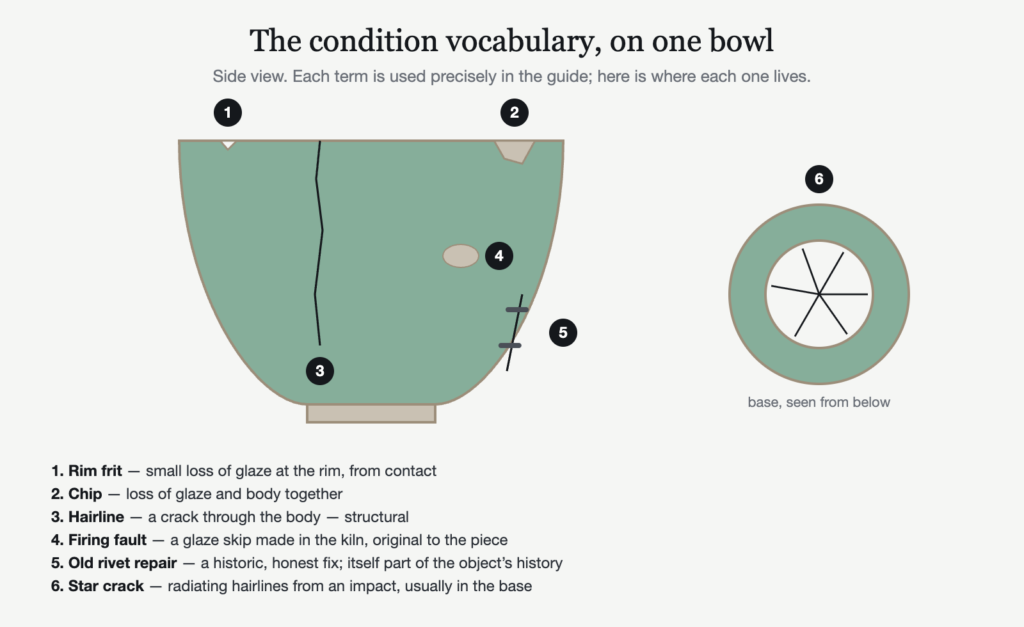
Every listing carries one of four grades, and they are used strictly. Excellent means no damage, no restoration and only the surface wear you would expect from age. Very good means no damage or restoration, but with something worth mentioning — light scratching to a soft glaze, rubbing to gilding, minor kiln grit. Good, minor faults means a small disclosed fault that does not affect the piece structurally: a rim frit, a shallow chip, a firing crack that opened in the kiln. Damage disclosed means a hairline, a star crack, a chip that has taken body, or restoration, itemised and photographed. What a hairline actually does to value, and why it varies so much by ware, is set out in its own guide.
Crazing in a glaze is not damage and is not graded as damage. On Ge and Guan wares and on Satsuma it is the point of the piece; the glossary separates crackle, crazing and hairline if the difference is new to you.
Condition reporting
Every listing carries a condition grade and an itemised list of faults with a photograph of each. If anything is unclear, ask for a full condition report before you buy — it is free and it is usually the same day. Use the enquiry form and choose “Request a condition report”; the piece reference fills itself in.
Why a lifetime guarantee is possible
Because the guarantee only ever promises what the listing actually says. A dealer who writes “Kangxi” on everything with a Kangxi mark cannot afford to guarantee it. A dealer who writes “Kangxi mark, nineteenth century” where that is what the foot and the cobalt show can guarantee that for as long as the pot exists. The 14-day cancellation right is separate and statutory; this guarantee sits alongside it with no time limit at all.