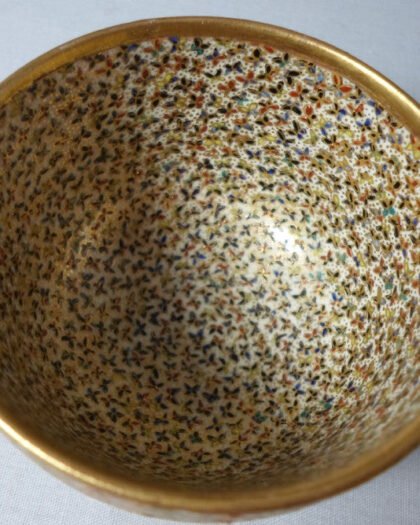
Satsuma is the best-known Japanese ware in the West and the most misdescribed. It is not porcelain. It is a low-fired, opaque, glazed pottery body — catalogued by museums variously as earthenware or stoneware — covered in a cream or ivory glaze that crazes into a fine network, and painted over that glaze in enamels and gold. The name comes from the Satsuma domain in southern Kyushu, where the tradition began with Korean potters brought back after Hideyoshi’s invasions in the 1590s; what most people mean by Satsuma is the export ware that followed the stoneware’s success at the Paris exposition of 1867, decorated not only in Satsuma but in workshops in Kyoto, Osaka and Tokyo, of which Kinkozan of Kyoto and Yabu Meizan of Osaka are the celebrated names (Bowers Museum). The journal sets out at length why Satsuma is earthenware and why the distinction matters.
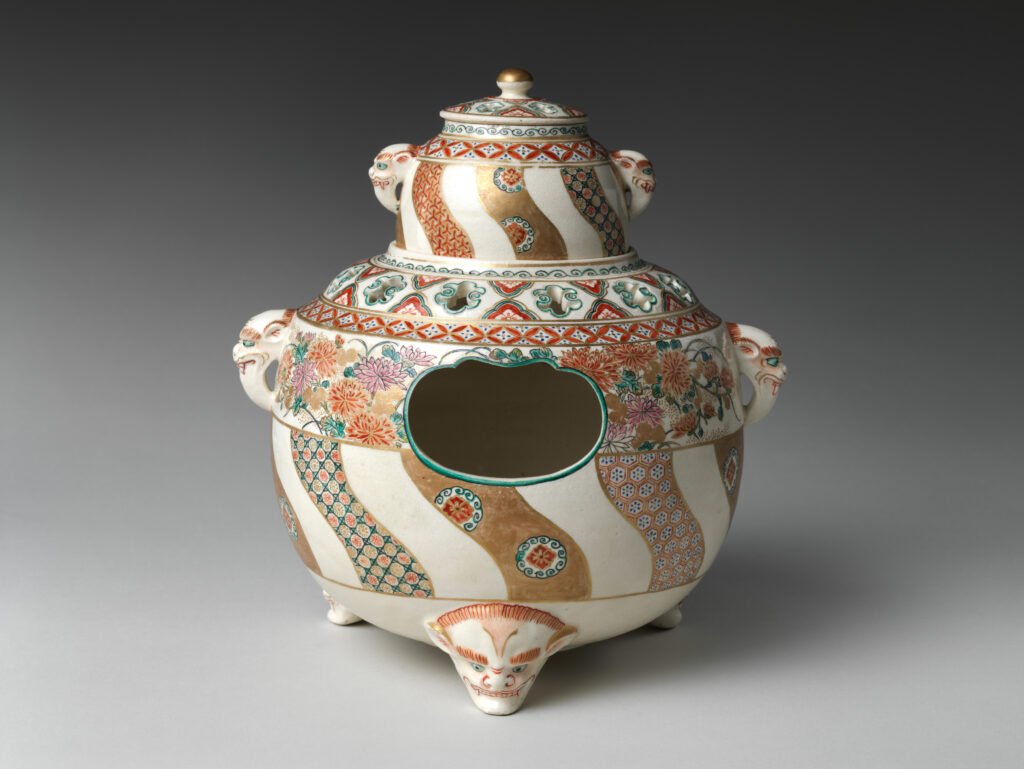
What was made
Bowls, vases, koro (incense burners), plates, tea sets and figures, in every size from thimble to floor vase, painted with processions, warriors, immortals, birds, flowers, brocade patterns and, on the best pieces, hundreds of minutely drawn figures. The Meiji period (1868–1912) is the great age; production continued through Taisho and Showa at a generally lower level, and a great deal of twentieth-century ware, some of it not Satsuma at all, carries the name.
How to judge a piece
The painting. Quality is in the line. Under a lens, a first-rate piece shows steady, hair-fine outlines, shaded faces, many separately mixed colours and gold applied with restraint and precision; a workshop piece shows heavier lines, fewer colours and gold used to cover rather than to draw.
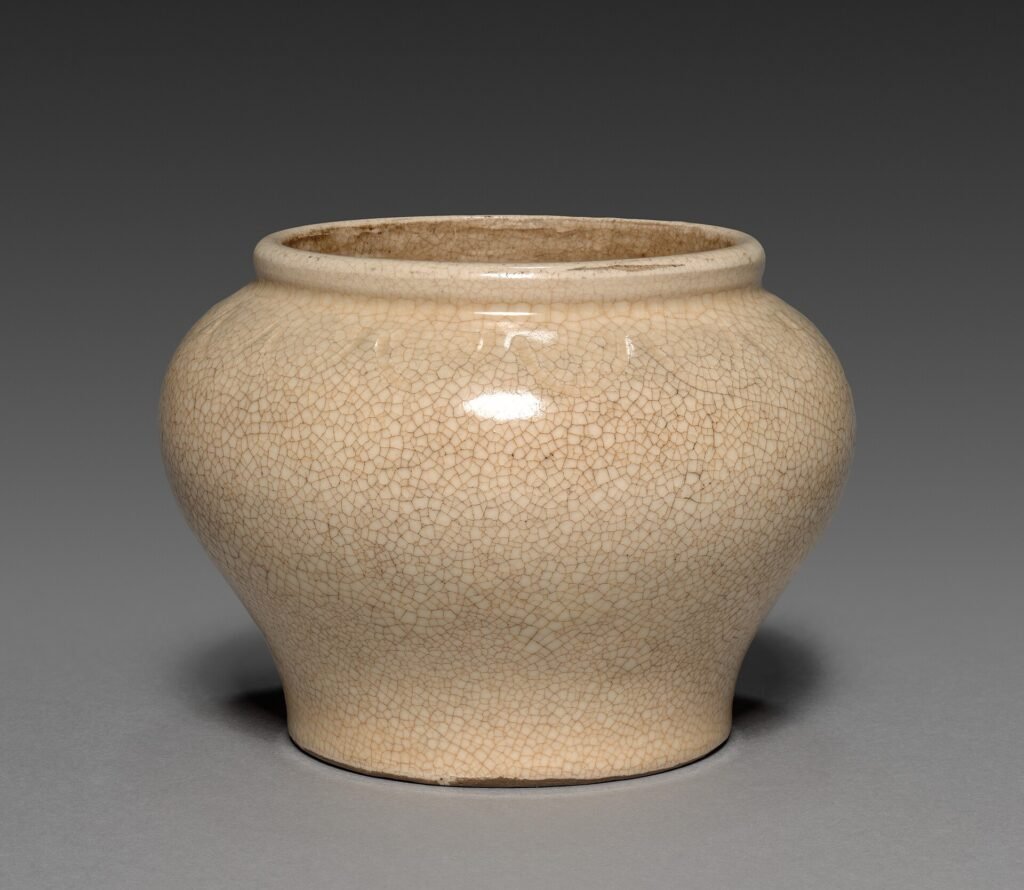
The glaze. It should be warm ivory with a fine, even crackle. Chalky white glaze with a coarse net of crackle, or a glaze that has been dirtied to look old, are warnings.
The body. Look at an unglazed foot or a chip: a buff or pale pottery body, not white translucent porcelain. If it rings like porcelain and is white through the chip, it is not Satsuma.
The mark. Satsuma marks range from workshop and decorator names, sometimes with Dai Nippon (Great Japan), to crests and single characters, and they were borrowed freely. The guide to Japanese marks explains what a mark can and cannot establish. We do not use the popular “Nippon / Made in Japan” dating chain, because we have not found a primary source for it.
Condition and care
The body is porous and the decoration sits on the surface. Gilding wears on rims and handles, enamels chip, and the glaze can stain from within if a piece has been soaked. Never put Satsuma in a dishwasher or leave it in water; dust it, and wipe with a barely damp cloth if you must. We photograph gilding wear and enamel loss and grade them; a chip or hairline in the body is itemised in the usual way.
Read more
The Meiji collection page sets Satsuma among the other export wares of the period; the Japanese page separates it from the porcelain traditions of Arita.
Pieces in this ware
Two things every buyer of Satsuma should know. First, it is not porcelain: museums catalogue it as earthenware (the Metropolitan Museum) or buff stoneware (the V&A) — a low-fired, opaque body under a crackled cream glaze, and that crazing is intrinsic rather than damage. Second, most of the densely gilded “Satsuma” on the British market was never made in Satsuma province at all. After the Chin Jukan workshop’s success at the 1873 Vienna International Exhibition started the Western craze, Kyoto workshops such as Kinkozan produced Kyō-Satsuma in quantity, and the style spread to Osaka, Yokohama and Tokyo. Our guide to Japanese ceramic marks sets out how to read the signatures, and why a Satsuma date mark is a claim rather than evidence.