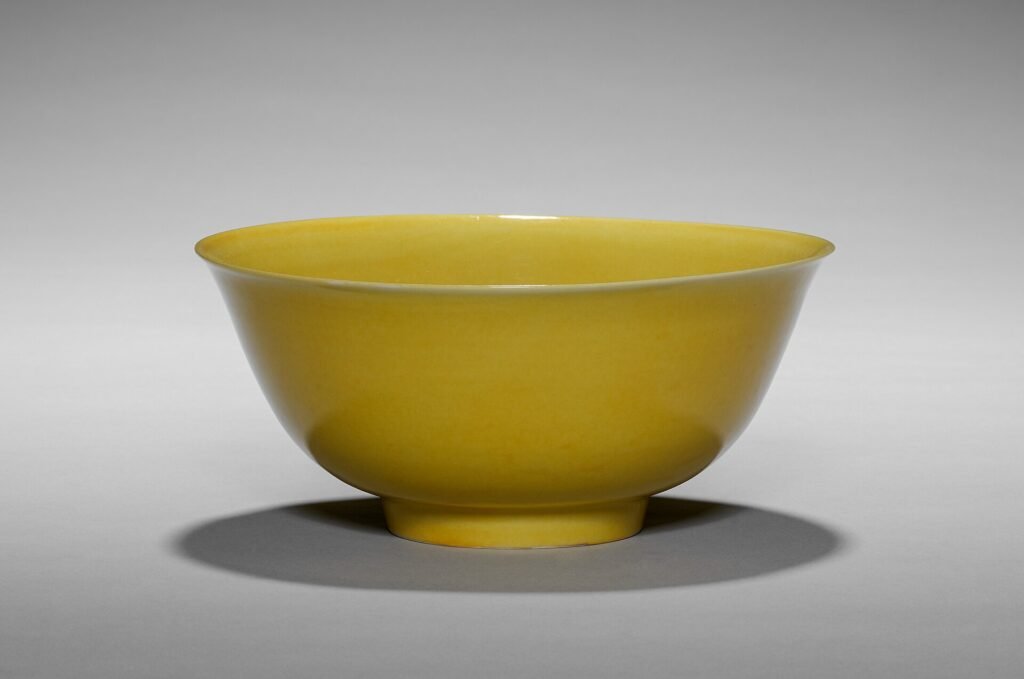
Start with the glaze, not the mark. An imperial yellow bowl is a white porcelain bowl with a thin, soft, low-fired yellow skin on it. That skin was coloured with iron, fluxed with lead and fired a second time at a much lower heat than the body beneath. Everything that matters follows from that: tone, evenness, where the yellow stops at the foot, how the surface has worn. The reign mark is the easiest thing on the piece to copy, and it was copied for two centuries.
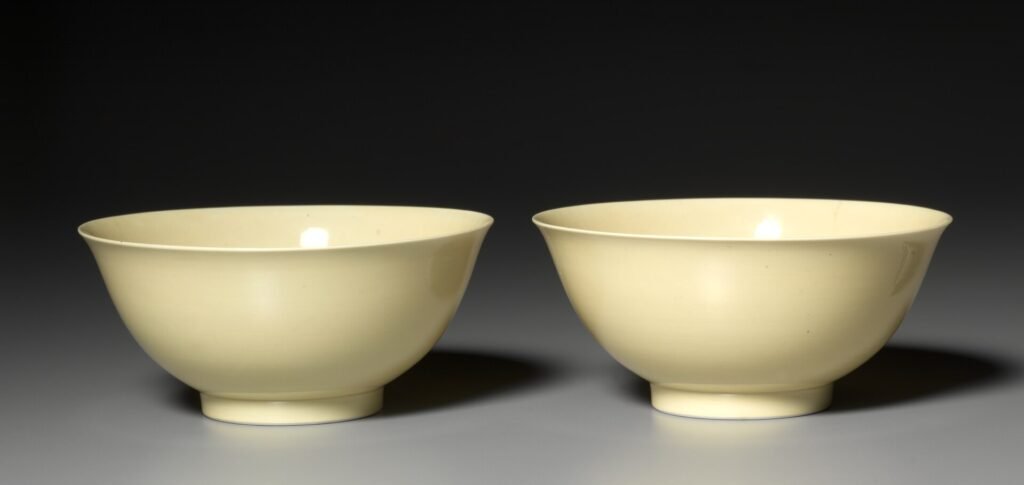
So we read a yellow bowl in this order: colour and surface, then foot and interior, then potting, and only then the mark. Where the trade repeats a rule we cannot find in a museum record, we say so. Our own monochrome stock includes two yellow pieces, a Qianlong-marked shallow bowl and a pair of rice bowls on hardwood stands, both in the Qing collection.
What the glaze is and how it was fired
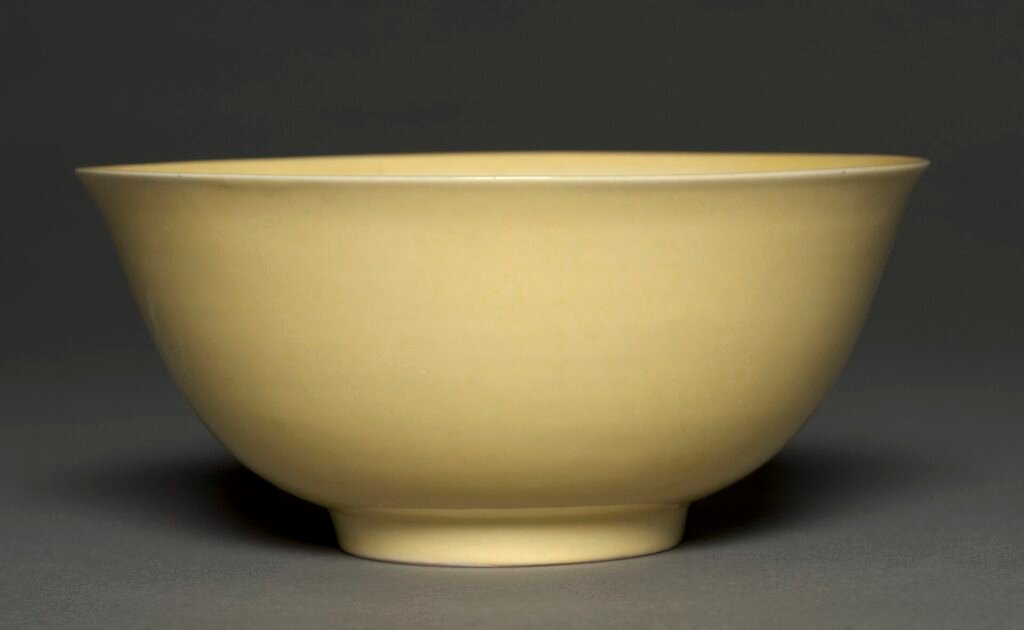
Monochrome yellow on porcelain begins at Jingdezhen in the early fifteenth century. The British Museum’s Percival David dish PDF.582 is described as “the first ever use of a monochrome yellow glaze at Jingdezhen”, made in the Yongle reign (1403–24); the same record says the colour then served court porcelain for some five hundred years. The gallery guide for that case is blunt about the chemistry: the glaze is “low-fired and pigmented with iron”.
There are two ways of putting that layer on a bowl, and both were used. The first is over the fired glaze. The Smithsonian’s Hongzhi dish FSC-P-949 is catalogued as porcelain with clear glaze and a “lead-rich, iron-yellow overglaze enamel”; the mark on the base sits in underglaze cobalt with no yellow over it. The V&A describes its Zhengde bowl C.51-1936 the same way: “first fired with a transparent glaze, and then covered with a yellow glaze” and re-fired at a lower temperature. The second method is on the biscuit, directly onto the once-fired body. The Percival David Zhengde jar in the form of a spittoon (zhadou), PDF,A.734, is “decorated all over with enamels on the biscuit”, incised dragons in green on yellow. In our experience biscuit-applied yellow reads flatter; yellow over a clear glaze has a little depth where it thins.
Who was allowed yellow
Museums are careful here. Cleveland’s record for its Zhengde bowl 2020.180 says that “most scholars believe that yellow monochrome ware was reserved” for the imperial household or for diplomatic gifts, and that reign marks could be applied only by workshops attached to the court. Cleveland says of its Yongzheng dish 2003.260 that it “was made for the imperial household”.
The finer rule the trade repeats is a table of rank: yellow inside and out for the emperor, empress or the emperor’s mother; yellow outside and white inside for the next rank of consort; and so on down through green and blue dragons. We found one museum record that states the top line. Bristol Museums says that “only the Emperor, Empress or the Emperor’s mother could use vessels” glazed yellow inside and out. No record we found at the Met, British Museum, V&A or the two Palace Museums sets out the lower ranks. Treat the full table as trade knowledge, not as something a museum has verified for you. Two of the records cited here, Bristol and the British Museum gallery guide, say yellow was used exclusively by the palace or court; neither addresses where it was made, and the V&A’s minyao bowl shows it was made outside the imperial kilns. The V&A catalogues a Guangxu mark-and-period bowl on a yellow ground, FE.14-1985, as “good-quality late Qing minyao”, a private-kiln piece.
Reign by reign
Reign dates follow the Met’s List of Rulers of China. For the marks themselves, see our guide to reign marks.
Chenghua (1465–87) and Hongzhi (1488–1505). The Ming yellow collectors chase. Cleveland holds a Chenghua mark-and-period yellow dish, 1989.288, and a Hongzhi mark-and-period deep bowl, 1989.289, 18 cm across. The British Museum’s Hongzhi dish 1947,0712.291 is finely potted with a tapering foot and a six-character mark in a double ring; the curator notes their “delicate yellow colour and the clarity of their glaze”, against the deeper glazes of Zhengde and Jiajing. Our Ming porcelain guide covers the bodies and feet of the period.
Zhengde (1506–21) and Jiajing (1522–66). Deeper and warmer. Cleveland’s Zhengde bowl 2020.180 is 18.9 cm with the mark in underglaze blue in a double circle. The Met’s Jiajing bowl 19.55.2 is 16.2 cm, mark and period. Jiajing also used yellow as a ground: the V&A’s C.849-1936 carries red enamel over the yellow, with “white glaze on the base and mark of the Jiajing period in blue”. A white base under a yellow bowl is the norm, not a fault.
Kangxi (1662–1722). The Qing revival. The Met’s bowl 79.2.961, Kangxi mark and period, 15.2 cm, is catalogued as porcelain with “canary yellow glaze”, and canary is a fair word for the brighter, slightly greener Kangxi tone. The Met also holds a jar, 14.40.325, with dragons incised under the yellow, a type still being made for the V&A’s Guangxu spittoon C.493-1910.
Yongzheng (1723–35). The most refined potting. Cleveland’s pair of Yongzheng mark-and-period bowls 2003.259 are 14.8 cm across and 6.7 cm high, the proportions of the standard palace bowl. The V&A’s Yongzheng bowl 587-1907, green and yellow with incised children, is said to be inspired by “similar Ming examples of the 16th century”, a taste for archaic shapes that the same record says ran on into Qianlong.
Qianlong (1736–95). Seal-script marks arrive. The V&A’s yellow bowls CIRC.1354-1926 and CIRC.318-1931 carry the six-character Qianlong mark in “underglaze blue on base” in seal script, with red dragons over the yellow. The Met’s dish 79.2.563 has enamels over a yellow glaze. Our Qianlong-marked shallow bowl belongs to the plainer group, yellow alone with a seal mark. Read these pieces with the Qing porcelain guide beside you.
Jiaqing to Guangxu (1796–1908). The type continues; quality varies. Cleveland’s Daoguang bowl 2003.263 is 14.7 cm across and 6.8 cm high, the same palace size as its Yongzheng pair; the V&A’s Daoguang bowl 730-1883 was bought from S. W. Bushell in Beijing and accessioned in 1883. The National Palace Museum notes that the imperial kilns were “destroyed and ceased functioning” in the Xianfeng reign and revived after the Taiping Rebellion, so Tongzhi and Guangxu yellow comes from a rebuilt factory. Our pair of rice bowls on stands sits in this later Qing world of plain yellow bowls for daily use.
The Republic (1912–49). The Met’s collection records date the period 1912–49. Plain yellow bowls with Qing reign marks went on being made after 1911. We have handled them, but found no museum record of one to cite, so this is our own observation: a thin, even, slightly acidic lemon; a very white, light body; a neat foot; and a mark that is often too neat.
| Reign | What the museums record | What to check |
|---|---|---|
| Hongzhi 1488–1505 | Pale, clear yellow (BM 1947,0712.291; Cleveland 1989.289, mark and period); six-character mark in a double ring; tapering foot (BM 1947,0712.291) | Is the colour genuinely pale and clear, or a deeper later tone under a Hongzhi mark? |
| Zhengde–Jiajing 1506–66 | Deeper glaze (Met 19.55.2, 16.2 cm); yellow over clear glaze or on the biscuit (V&A C.51-1936; BM PDF,A.734); white base, blue mark (V&A C.849-1936) | White glazed base; underglaze-blue mark left clear of yellow |
| Kangxi 1662–1722 | Bright “canary” yellow; dragons incised under yellow (Met 79.2.961, 14.40.325) | Greener, brighter tone; incising crisp under the glaze, not painted on top |
| Yongzheng 1723–35 | Palace bowl about 14.8 cm wide, 6.7 cm high; deliberate Ming revival (Cleveland 2003.259; V&A 587-1907) | Thin, even potting; a Ming-looking piece may be Yongzheng |
| Qianlong 1736–95 | Seal marks in underglaze blue; yellow as a ground for enamels (V&A CIRC.1354-1926; Met 79.2.563) | Seal mark well written; enamel wear consistent with glaze wear |
| Daoguang–Guangxu 1821–1908 | Palace sizes continue (Cleveland 2003.263); kilns rebuilt after Xianfeng; private-kiln yellow grounds exist (V&A FE.14-1985) | Evenness and quality; imperial kiln or minyao? |
| Republic 1912–49 | Period dated 1912–49 in the Met’s collection records; no plain yellow museum example found by us | Very white light body; too-neat mark; thin lemon tone |
How to read a piece
Tone. Put it beside something you trust. Ming yellow is pale and clear at its best. Kangxi is brighter and a shade greener. Later Qing tends warmer and heavier. A bright canary bowl with a Hongzhi mark is telling you something.
Evenness. Because the yellow was fired a second time at low heat, look for where it moved. Pooling above the foot, thinning at the rim and a darker band where the glaze gathered are normal on imperial pieces. A perfectly uniform, sprayed-looking surface with no movement is the thing to distrust.
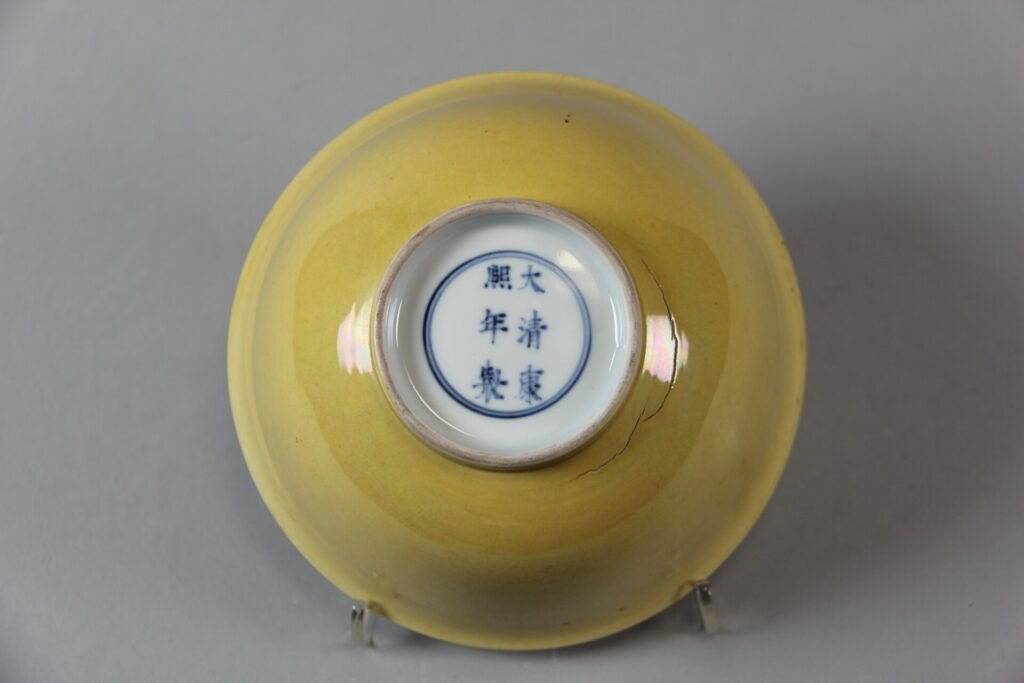
The stop at the foot. Turn it over. On the Ming and early Qing pieces cited above the base is glazed white or clear and the mark is in underglaze blue with no yellow over it; the Smithsonian records FSC-P-949 with a clear-glazed base and the mark left free of enamel. The yellow should end in a controlled line at or just above the foot rim, sometimes a little uneven where it was wiped. Our reading the base guide covers foot rims and kiln grit in general.
The interior. White inside or yellow inside changes the object. Yellow inside and out is the form the Bristol record ties to the emperor, empress or the emperor’s mother. Yellow outside and white inside is the commoner form, and the one the trade’s rank table assigns to lesser consorts, though no major museum record we found sets that out. The white inside should be a clean, glassy high-fired glaze, and the join at the rim should look like two glazes meeting, not paint stopping.
The mark. Typically six characters in a double ring, in underglaze blue on the examples that record it; seal script in underglaze blue from Qianlong. Cleveland records its Yongzheng dish with a six-character mark “enclosed by double ring”. The mark was the first thing forgers learnt. Weigh it last.
The potting. The palace bowl has a settled shape. Cleveland’s Yongzheng pair and its Daoguang bowl are within a millimetre of 14.8 cm wide and 6.7–6.8 cm high; Hongzhi bowls run larger, around 18 cm. Hold the rim to the light; a good Yongzheng wall glows faintly through the yellow. A heavy, thick, cold bowl with a fine mark is still a heavy, thick, cold bowl.
What is commonly copied or misdescribed
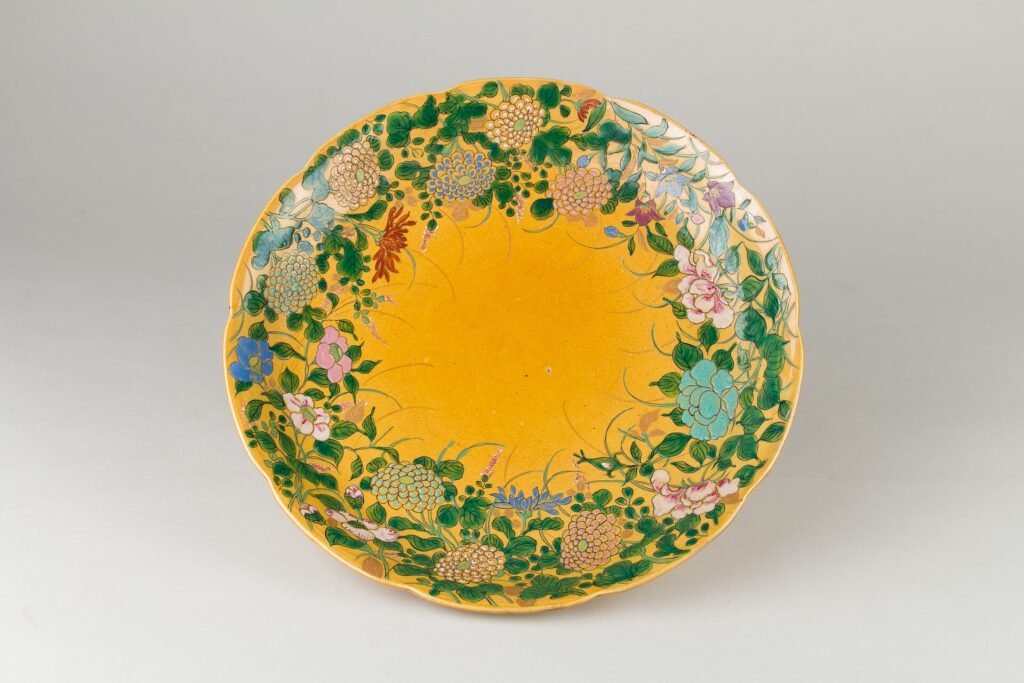
Three things recur. First, Hongzhi marks on later bowls: the pale clarity the British Museum describes is hard to fake, and a deep warm yellow under a Hongzhi mark is most likely later. Second, Yongzheng and Qianlong revivals of Ming types sold as Ming; the V&A record for 587-1907 is a reminder that the court did this on purpose. It is archaism, not deceit, but it must be described. Third, late yellow-ground enamelled wares called “imperial yellow” when they are private-kiln pieces, as the V&A’s Guangxu bowl FE.14-1985 shows. A yellow ground on a minyao bowl is a yellow ground, not a passport to the palace.
We also see “Qianlong mark and period” used loosely. If a seller cannot say why the potting, tone and base support the mark, the honest description is “Qianlong mark”, and the price should follow. That is how we describe our own shallow bowl.
Condition on a soft lead glaze
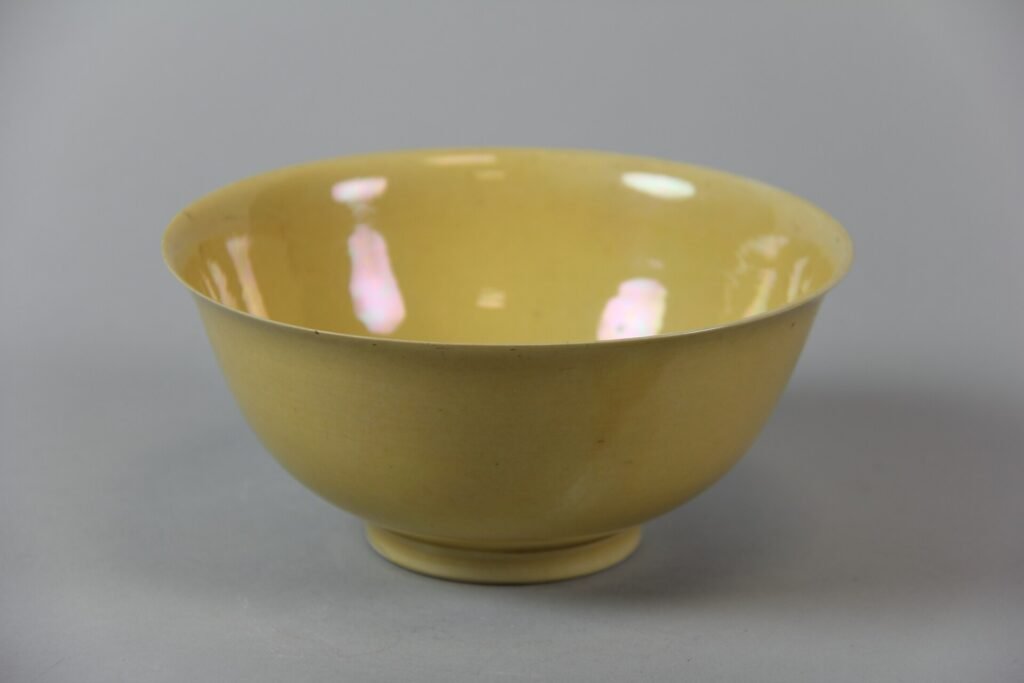
A lead-rich, low-fired surface wears like soft glass. Expect fine scratches on the interior of any bowl that was used, and a soft dulling outside where it was handled and stacked. It is honest, usually gentle, and hard to fake across a whole surface, which makes it evidence. What we look for is wear that makes sense: heaviest on the inside floor, lighter on the walls, almost none under the foot.
Iridescence is different. The Smithsonian’s note on the subject explains that when glazes “are wet for long periods of time” water interacts with the surface and forms thin layers. A faint rainbow sheen at the rim or in pooled glaze above the foot is consistent with long wetting or burial. Strong, all-over iridescence on a piece that is otherwise crisp deserves a harder look.
Old repairs are part of the story. The Smithsonian’s Hongzhi dish FSC-P-949 is catalogued as “repaired with iron staples”; riveting tells you a piece was valued enough to mend. What we will not accept without disclosure is overpainting. Because worn yellow is soft and matt, a resprayed patch reads too glossy and too even, and fluoresces differently under ultraviolet. Rim chips are the commonest fault, and a chip through the yellow shows white body beneath; that white edge is where restorers start.
Buying
Buy the glaze first. A plain, well-fired yellow bowl with an honest base and a mark that fits the potting is a better object than a spectacular mark on a doubtful bowl. Ask for photographs of the base, the interior floor and the rim edge-on, and check whether the interior is white or yellow against the description. Ask the seller to date the piece and say why, in terms of tone, potting and base rather than mark alone.
Pairs matter for rice bowls. A matched pair of the standard size that has stayed together is worth more than two singles, so check that the two really match in tone and height; later pairs are often assembled. Stands are pleasant but prove nothing. For the term itself and how we use it in our listings, see the glossary. If a piece is described as imperial yellow, the seller should be able to tell you which of the meanings above they intend.
Sources
- British Museum, Percival David Foundation, dish PDF.582, Yongle period
- British Museum, Room 95 Chinese Ceramics large print guide (PDF)
- British Museum, dish 1947,0712.291, Hongzhi mark and period
- British Museum, Percival David Foundation, jar in the form of a spittoon (zhadou) PDF,A.734, Zhengde
- Smithsonian National Museum of Asian Art, dish FSC-P-949, Hongzhi
- Smithsonian National Museum of Asian Art, Materials and techniques: Iridescence
- V&A, bowl C.51-1936, Zhengde mark and period
- V&A, bowl C.849-1936, Jiajing mark and period
- V&A, bowl 587-1907, Yongzheng reign, marked
- V&A, bowl CIRC.1354-1926, Qianlong seal mark
- V&A, bowl CIRC.318-1931, Qianlong seal mark
- V&A, bowl 730-1883, Daoguang mark and period
- V&A, spittoon C.493-1910, Guangxu
- V&A, bowl FE.14-1985, Guangxu mark and period
- Cleveland Museum of Art, dish 1989.288, Chenghua mark and period
- Cleveland Museum of Art, bowl 1989.289, Hongzhi mark and period
- Cleveland Museum of Art, Yellow-Glazed Bowl 2020.180, Zhengde mark and reign
- Cleveland Museum of Art, Pair of Bowls with Yellow Glaze 2003.259, Yongzheng mark and period
- Cleveland Museum of Art, Small Dish with Yellow Monochrome Glaze 2003.260, Yongzheng mark and reign
- Cleveland Museum of Art, Bowl with Yellow Glaze 2003.263, Daoguang mark and reign
- Metropolitan Museum of Art, bowl 19.55.2, Jiajing mark and period
- Metropolitan Museum of Art, bowl 79.2.961, Kangxi mark and period
- Metropolitan Museum of Art, jar with dragon and phoenix 14.40.325, Kangxi period
- Metropolitan Museum of Art, dish with flowers 79.2.563, Qianlong period
- Metropolitan Museum of Art, snuff bottle 50.145.203a, b, Republic period (1912–49)
- Metropolitan Museum of Art, Heilbrunn Timeline: List of Rulers of China
- National Palace Museum, Taipei, The Magic of Kneaded Clay: Qing dynasty
- Bristol Museums, narrative on yellow-glazed palace porcelain