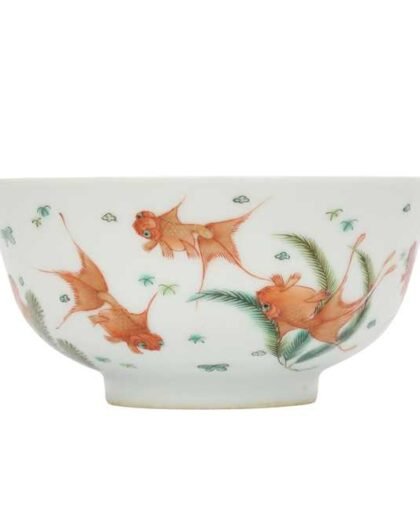
Famille verte is the overglaze enamel palette of the Kangxi reign (1662–1722), dominated by translucent greens with iron red, yellow, aubergine and a violet-blue, usually with black outlines. The name is French, from the classification of Chinese enamels by familles that Albert Jacquemart popularised in the 1860s and 1870s (British Museum, Room 95), and the trade has used it ever since. It grew out of the Ming wucai five-colour scheme, and it was superseded at court around 1720 by the opaque famille rose palette — which is why a genuine famille verte piece is, in most cases, a Kangxi piece, and why the many later examples matter to a buyer.
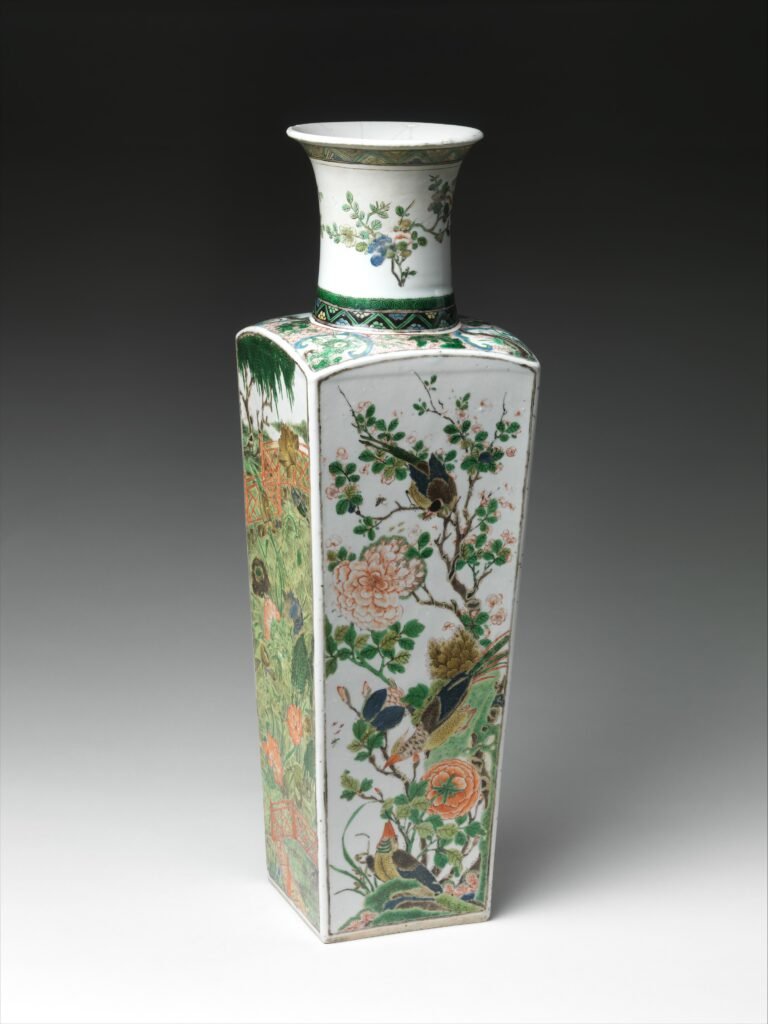
How it is made
Like all overglaze enamels, famille verte is painted onto fired, glazed porcelain and fixed in a second low firing. The greens are copper-based and translucent, so they show the white porcelain through them and lie thin and glassy on the surface; a good Kangxi green has a jewel-like depth under a lamp. The blue is an overglaze enamel too — the innovation that distinguishes famille verte from earlier wucai, which used underglaze cobalt for its blue. Kangxi famille verte also appears on coloured grounds: green, yellow and, in the rarest and most copied form, black — see famille noire.
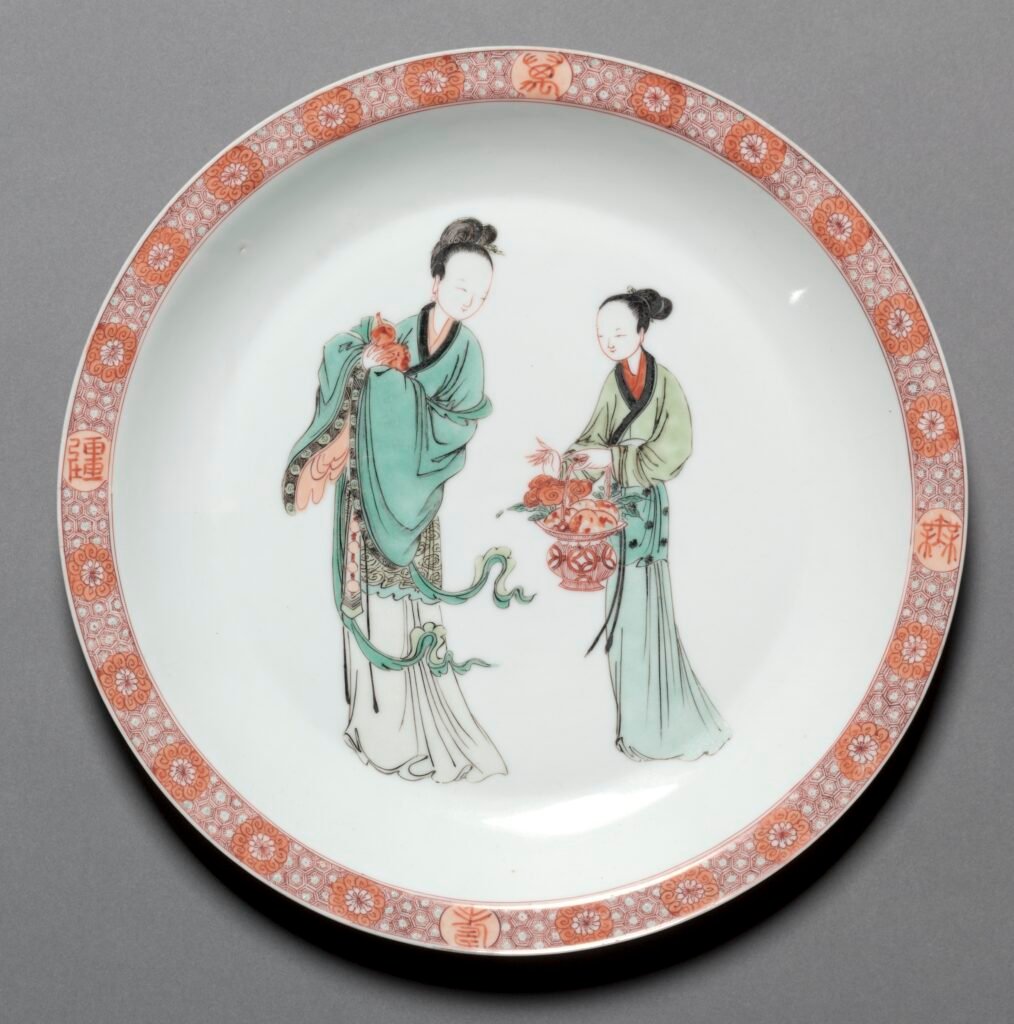
Reading a piece
On a Kangxi piece the porcelain is fine and white, the enamels thin and precisely placed, the drawing confident, and the iron red a clear orange-red. Wear is honest: gilding rubbed on the rim, the highest points of the enamel dulled by handling. Many Kangxi famille verte pieces are unmarked or carry a symbol or a Chenghua mark in a double ring rather than a Kangxi reign mark — the base of the Met’s famille verte plate 14.40.160, which the museum catalogues as Kangxi mark and period, shows a symbol within a double ring rather than six characters — so the absence of a reign mark proves nothing either way. The reign marks guide explains the Kangxi habit of substitute marks.
Later famille verte exists in quantity. Nineteenth-century Jingdezhen revived the palette for the Western market, often on heavier porcelain with thicker, duller greens, a brownish red and a Kangxi mark written in a hand that is too neat; Republic and modern copies go further. Iridescence around the enamels — a halo visible when the piece is tilted to the light — is often cited as a Kangxi sign; it does occur on genuine pieces, but it can be induced, and we do not rely on it.
Condition
The greens are glassy and chip; the black outlines flake; the gilding wears. All of that is graded and photographed. Restoration to enamels is common and we check under ultraviolet. See what a hairline does to value.
Read more
The journal on the three palettes explains how verte, rose and noire relate; the Qing porcelain guide covers the Kangxi reign.
Pieces in this ware
Famille verte is the Chinese wucai or yingcai — “hard colours” — a palette of translucent overglaze enamels dominated by green, at its height in the Kangxi reign (1662–1722). The Metropolitan Museum notes that these enamels “did not permit much gradation in color”, so the modelling had to be done in fine drawn outline: famille verte is drawn where famille rose, with its opaque white, is painted. The terms themselves are French and Victorian, set out by Albert Jacquemart in 1862. Our Qing porcelain guide covers the reign-by-reign development, and the palettes explained note gives the technical difference.