Three French terms, two of them coined by a nineteenth-century French writer, used daily in the British trade to describe Chinese porcelain. They are useful, they are not Chinese, and two of the three are routinely misapplied.
Who named them, and when
Albert Jacquemart (1808–75), with Edmond Le Blant, set out the scheme in Histoire artistique, industrielle et commerciale de la porcelaine, Paris, 1862. His chapter heading names four families: famille archaïque, famille chrysanthémo-pæonienne, famille verte and famille rose.
Two consequences worth knowing. The British Museum’s gallery label credits famille verte to Jacquemart’s later Histoire de la Céramique of 1873 — but both verte and rose are demonstrably in print eleven years earlier. And famille noire and famille jaune are not Jacquemart’s at all: neither appears in the 1862 text. They came later, and we have not identified who coined them.
Famille verte — and what the Chinese call it
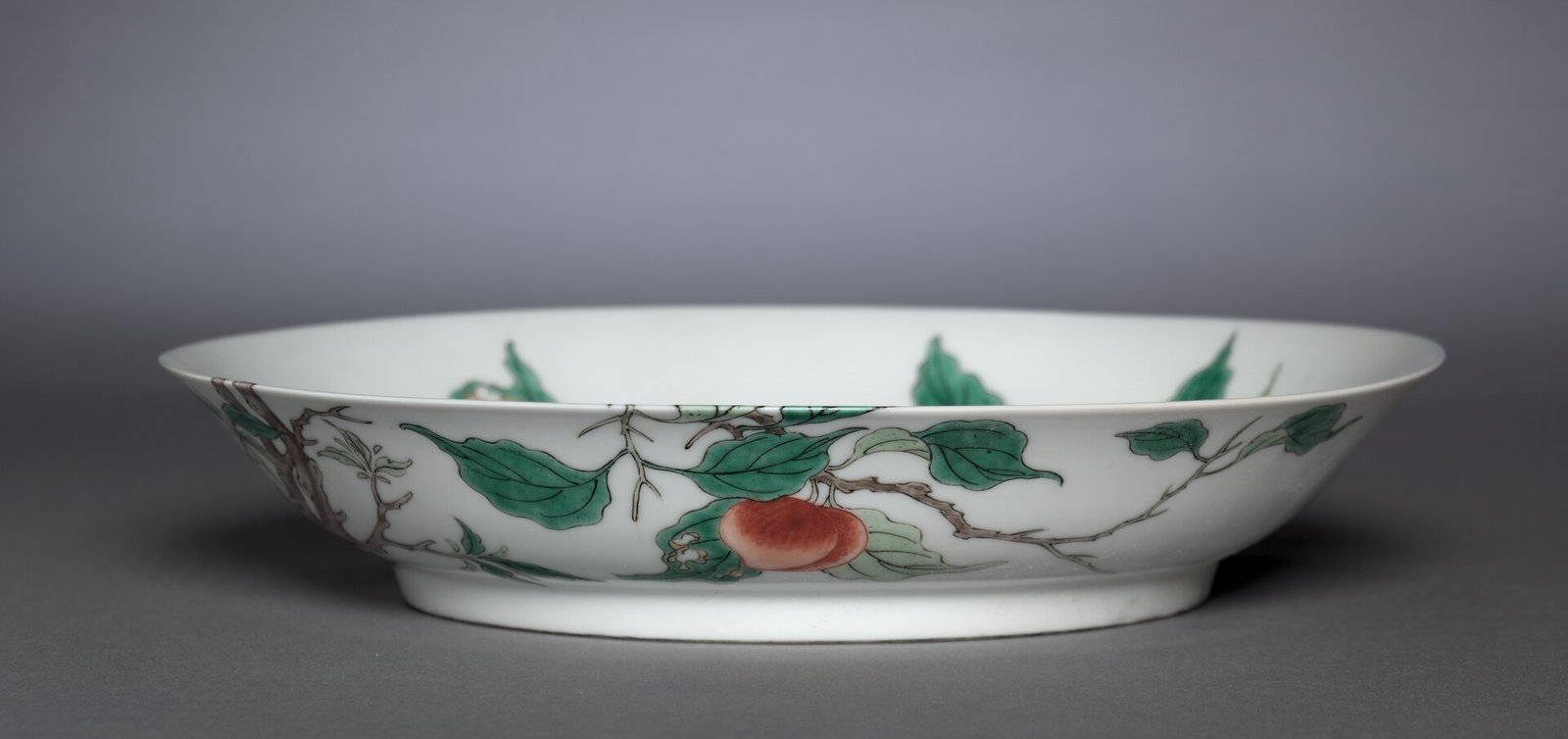
Translucent overglaze enamels dominated by green. In Chinese, 五彩 wucai (“five colours”) and 硬彩 yingcai — which the Met translates as “hard colours”, and which is the more descriptive of the two.
Hard, because they would not blend. The Met’s handbook (Suzanne Valenstein, A Handbook of Chinese Ceramics, 1989): these translucent enamels “did not permit much gradation in color, and the effects of shading had to be relegated to finely penciled lines in the preliminary drawing”. Famille verte is drawn, with the modelling done in line rather than tone. Its great period is the Kangxi reign.
Famille rose — two changes, and the second is the important one
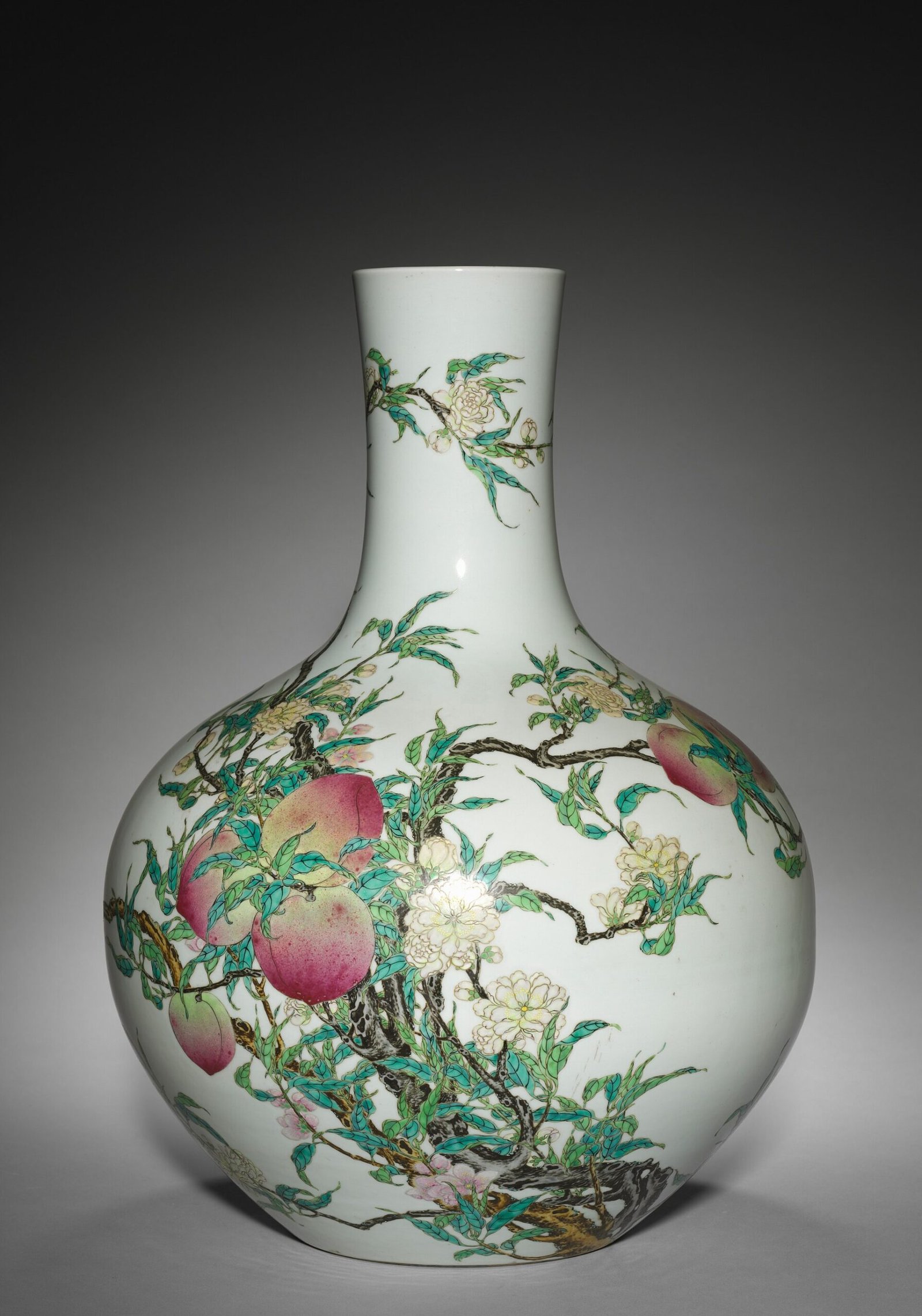
In Chinese, 粉彩 fencai (“pale colours”), also ruancai (“soft colours”), yangcai (“foreign colours”) and falangcai. Note that current museum usage increasingly reserves falangcai for the palace-enamelled wares specifically, so it is not a clean synonym.
The Met sets out both technical changes:
- A rose pink derived from colloidal gold, used from the palest blush to deep ruby. The British Museum adds that the gold-pink technique “was introduced to China from Europe”, though Chinese and European craftsmen used different recipes.
- An opaque white, opacified by lead-arsenic compounds, mixed into the other colours — and the Met calls this “perhaps even more important” than the pink, because it enabled the painter “to achieve a range of color values for the first time”. Cleveland puts it identically: opaque white “allowed painters to vary the value of pigments”.
So the pink gave the palette its name, but the white gave it its capability. That is why famille rose looks painted and famille verte looks drawn, and it is the single most useful thing to know when telling them apart across a room.
Non-invasive Raman analysis of eighteenth-century Qing enamelled porcelains in French collections has since confirmed both instrumentally — colloidal gold nanoparticles in the red, orange and pink enamels, and lead arsenate opacifiers (Colomban et al., Heritage 3(3), 2020). We say “opacified by lead-arsenic compounds” rather than name a recipe, because the museum and the laboratory describe the mechanism slightly differently.
Dating it
Rudimentary famille rose appears on armorial porcelain in the early 1720s, and the British Museum dates the new opaque palette to “around AD 1720”. But the Met judges it “not fully developed much before 1730”. Its high point is the Yongzheng reign (1723–35), and the Met’s handbook calls famille rose porcelain “the signal accomplishment of the Yongzheng period”. A confident “Kangxi famille rose” attribution should make you look twice.
The mistake almost everyone makes
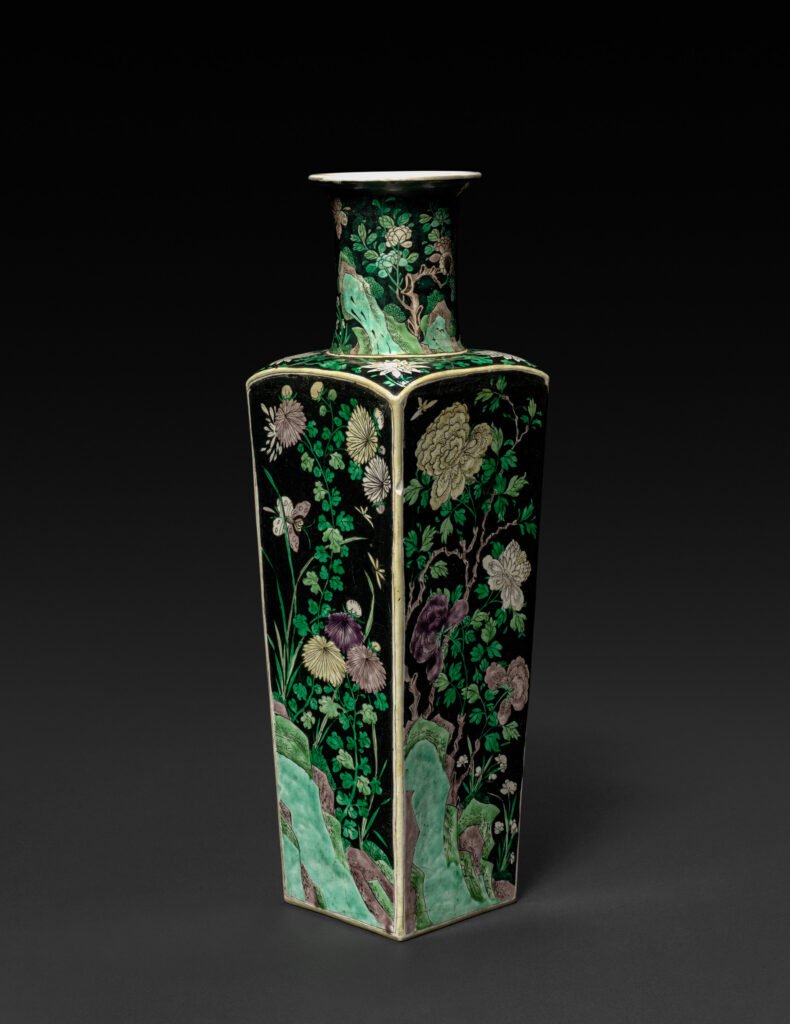
Famille noire and famille jaune are not separate palettes. They are famille verte enamels painted on the biscuit against a black or a yellow ground. The Met’s handbook is explicit: famille verte decoration is often set against a solid ground of black, yellow, green or aubergine, and “the first two groups are frequently placed in the subcategories of famille noire and famille jaune”.
So a famille noire piece is technically famille verte. If you are told a black-ground vase is “famille noire, a rare fourth palette”, the seller has repeated something they read rather than something they know.
Two firings, and why the enamel is the weak layer
Both palettes sit on top of a finished glaze. The Fitzwilliam’s conservation account of three Kangxi famille verte vases (C.17.1–3 & A-1948, dated 1680–1720) sets out the sequence: a hard-paste body and glaze “fired in a kiln to a very high temperature (1200-1450°C)”, then “a lower temperature firing for the overglaze enamels”. The porcelain is made once; the colour is added afterwards and fixed in a second, cooler firing.
Enamel is the vulnerable layer. The Fitzwilliam’s conservators had to keep their tape off “flaking enamels”, some pieces had “completely disintegrated, leaving holes”, and on the largest jar only the inner wall survived in usable pieces. The same account notes that quality varies within a single group: on the largest jar the enamels are “thick and clumsily applied”, on the lid and the yan yan vases they are “skilfully painted”. Kangxi is not a guarantee of finesse.
For condition, we look at raised areas first. Rims, handles and the high points of relief take the knocks, and a famille rose piece with its opaque white rubbed back to the glaze has lost the very thing that made the palette possible. We treat enamel loss as loss, not as patina.
Made in Jingdezhen, painted in Canton
The second, cooler firing had a commercial consequence. To meet European demand and cut transport and production costs, the museum says, the enamelling moved to the port. The Guangzhou Museum puts it plainly: merchants began “transporting the porcelain from inland Jingdezhen to Guangzhou”, painted it to foreign order, then fired it “again” before shipping. The museum dates the emergence of the practice to the late Kangxi and Yongzheng reigns, its diversification to Qianlong, and a change of style from Jiaqing onwards.
The V&A catalogues the division of labour object by object. A famille rose cup and saucer of about 1728 with the arms of Holland and a VOC cipher (645&A-1907) is recorded as Jingdezhen made, Canton decorated. The five months between sailings, the museum says, gave “enough time to the enamellers at Canton” to copy the design onto undecorated pieces. It adds that enamelling on metal was already established there, and the process “is not far removed from enamelling on porcelain”. A dish of about 1750–90 with a “gallant” scene (C.74-1963) is likewise “produced in Jingdezhen” and “decorated in Canton”, on a subject the V&A says is found only on porcelain sent to Europe.
So “Canton famille rose” is not a different palette. It is the same enamel, on Jingdezhen porcelain, applied in a different city for a different customer. The Met’s export essay explains why the enamel was wanted: polychrome overglaze decoration grew with the taste for armorials, and “the trade in armorial porcelain became the defining aspect” of the eighteenth-century export business.
The American turn
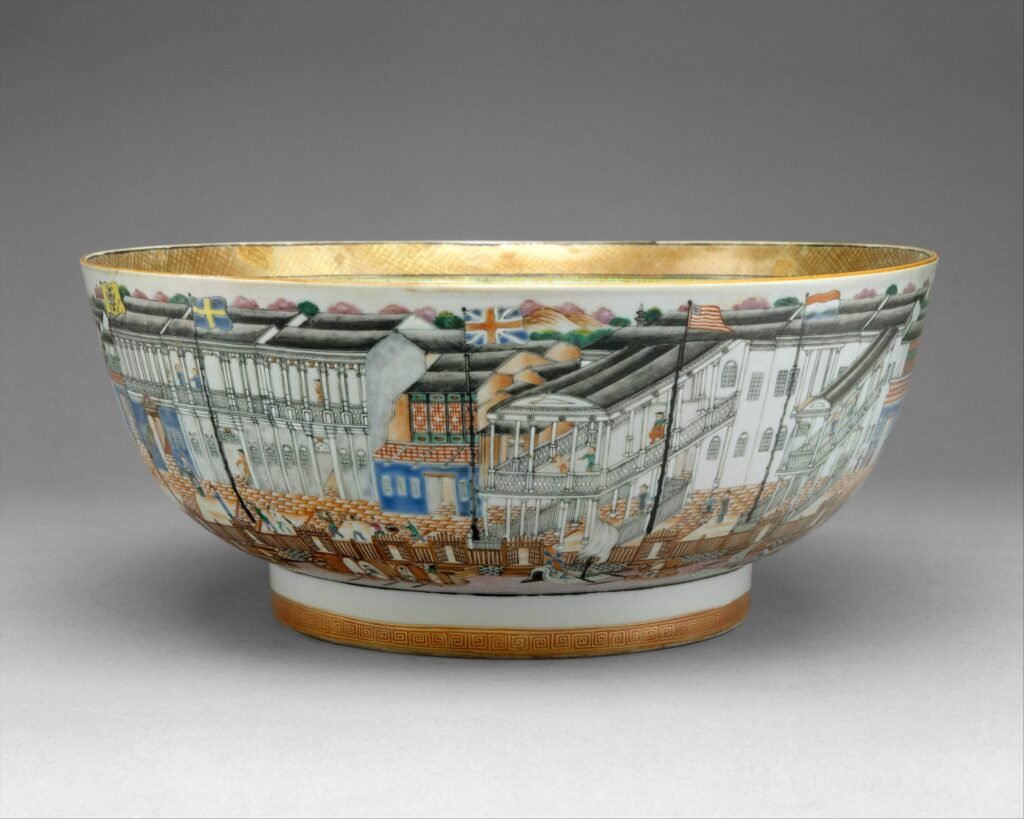
The Met dates America’s official entry into the China trade to 1784. The British Museum’s famille rose punch-bowl of about 1780–90 (Franks.746.+), painted with the foreign trading stations on the Canton waterfront, records that in 1785 “Captain Green of ‘The Empress of China’” brought at least four such bowls home. The Guangzhou Museum states that by the late eighteenth century the United States had become the primary market for Canton porcelain.
For the buyer, this matters in one practical way. Where a piece was painted is a matter of evidence, not of palette. We say “Canton” when a museum comparison supports it, and “famille rose” alone when it does not.
Quick reference
| You see | It is | Period |
|---|---|---|
| Green-dominated, translucent enamels, modelling done in fine outline | Famille verte / wucai | Chiefly Kangxi, 1662–1722 |
| Pinks and opaque pastels, visible shading and tonal modelling | Famille rose / fencai | From c. 1720–30; peak Yongzheng–Qianlong |
| Black ground with green-family enamels on the biscuit | Famille noire — a famille verte subcategory | Kangxi and later, with many later copies |
| Yellow ground with green-family enamels on the biscuit | Famille jaune — also famille verte | As above |
More in our Qing porcelain guide. Browse famille rose, famille verte and famille noire.