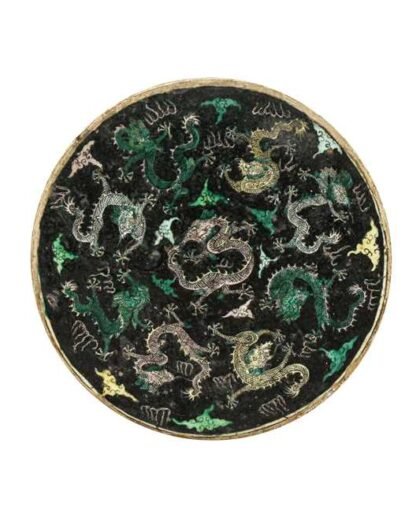
Famille noire is famille verte on a black ground: the design is reserved in the usual Kangxi greens, yellows and aubergines, and the background is then filled with a black enamel, itself normally washed with a translucent green that gives the black its depth and its faint greenish sheen. Genuine Kangxi famille noire is rare. The black-ground vases that fill auction catalogues are, in the great majority, nineteenth-century work, and the Met dates one of its large famille noire vases (61.200.9) simply to the nineteenth century.
The history
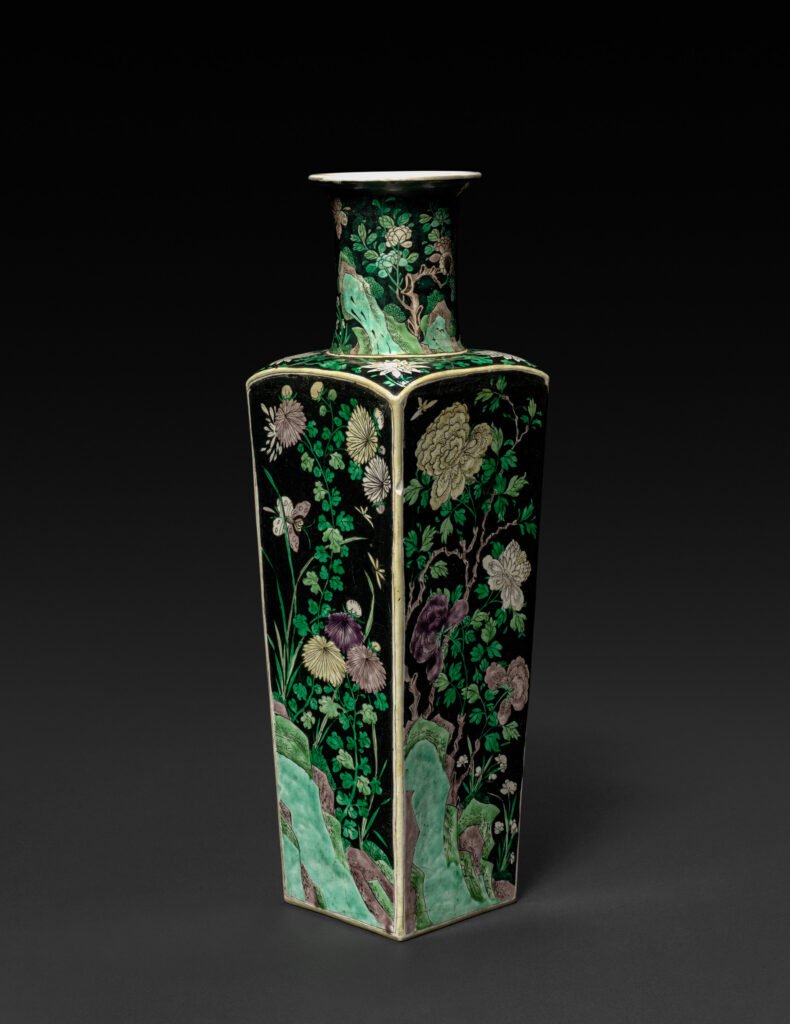
How old famille noire is remains an open question, and the Met states it openly. Its square famille noire vase 14.40.428 is dated 18th–19th century with the note that it is likely an example made before the late nineteenth century, “when some individuals believe such vessels were first created for the Western market”, and the museum cites comparable pieces documented in England by 1854. Black grounds certainly appear on Kangxi porcelain alongside green and yellow grounds; the palette became a European craze at the end of the nineteenth century, when American and British collectors paid enormous sums for large famille noire vases, and Jingdezhen supplied the demand. A buyer should therefore assume that the porcelain and the black ground of any given piece may not be of the same date until the object itself says otherwise.
Reading a piece
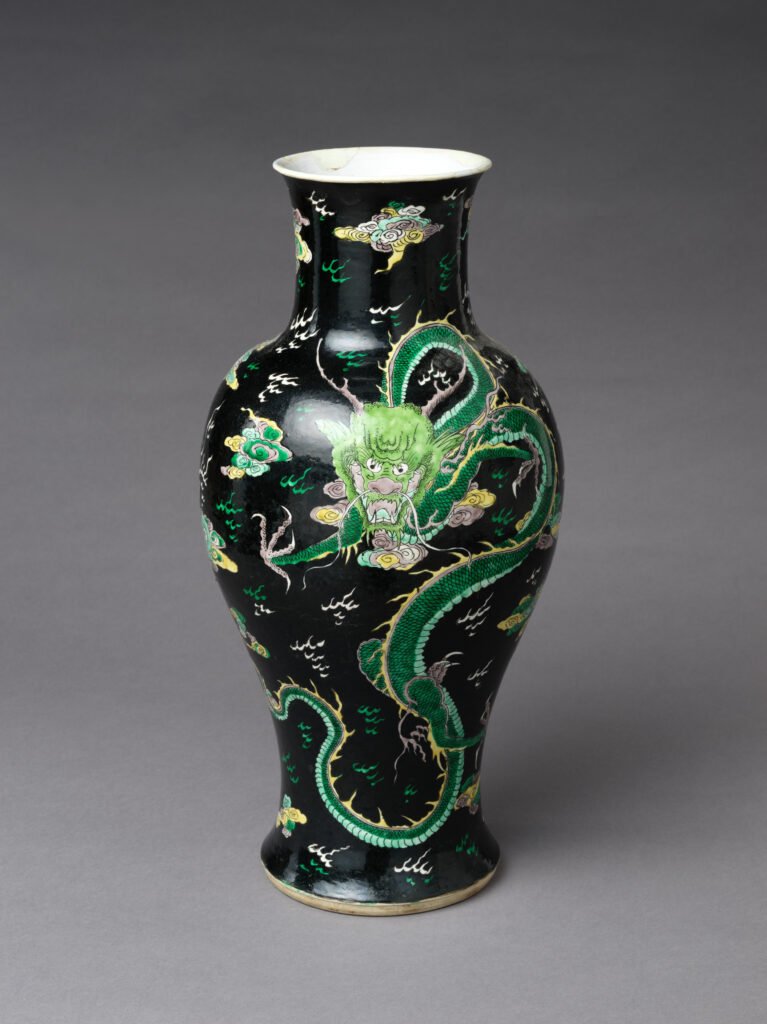
Start, as always, with the body and foot: a Kangxi biscuit or porcelain body with a period foot is the first requirement, and the reading the base guide shows what that looks like. Then look at the black under a lens and a lamp. On period pieces the green wash over the black is even and the reserved design sits cleanly inside its outlines; on re-enamelled or later pieces the black often laps over earlier enamel, the greens are heavier and duller, and there can be a mismatch in wear between decoration and ground. Iridescence and an old, honest pattern of gilding wear help but are not decisive. A Kangxi reign mark on a famille noire vase is a warning rather than a reassurance, for the reasons the reign marks guide explains.
Condition and honesty
Because so much famille noire has been worked on, we describe the enamels and the body separately, say what we can and cannot confirm about their relationship, and disclose damage in full. A large plaque or vase with disclosed faults and an honest description is a better buy than a “perfect” one whose black ground is a century younger than its body.
Read more
The journal on the rose, verte and noire palettes sets the three side by side; the Qing collection page carries the Kangxi context.
Pieces in this ware
A correction the trade routinely gets wrong: famille noire is not a separate palette. The Metropolitan Museum describes famille noire and famille jaune as subcategories of famille verte — the same translucent “hard colour” enamels, painted on the biscuit against a black or a yellow ground. Genuine Kangxi-period examples exist and are rare; the type was also copied extensively in the nineteenth century, when the black-ground vase became a fashionable export form, so the ground colour alone tells you very little about date. Judge the enamels, the potting and the foot. See our journal note on the famille palettes for how the three relate.