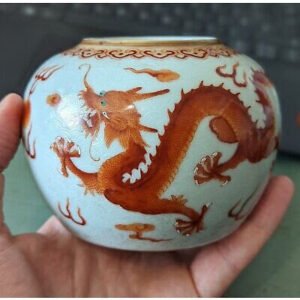
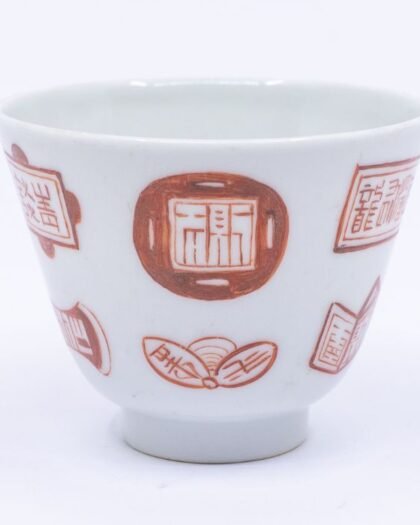
Iron red is an overglaze enamel: iron oxide in a lead flux, painted onto fired and glazed porcelain and fixed in a second, low-temperature firing, producing an orange-red that sits on the surface and reads slightly granular under a lamp. It was the practical red of Chinese porcelain from the Ming onward — the British Museum notes of sixteenth-century imperial dishes that potters mostly substituted overglaze iron red for the much harder underglaze copper red, because it was easier to control and caused less wastage when completing imperial orders — and it became ubiquitous in the nineteenth century, often combined with gilding.
Where you meet it
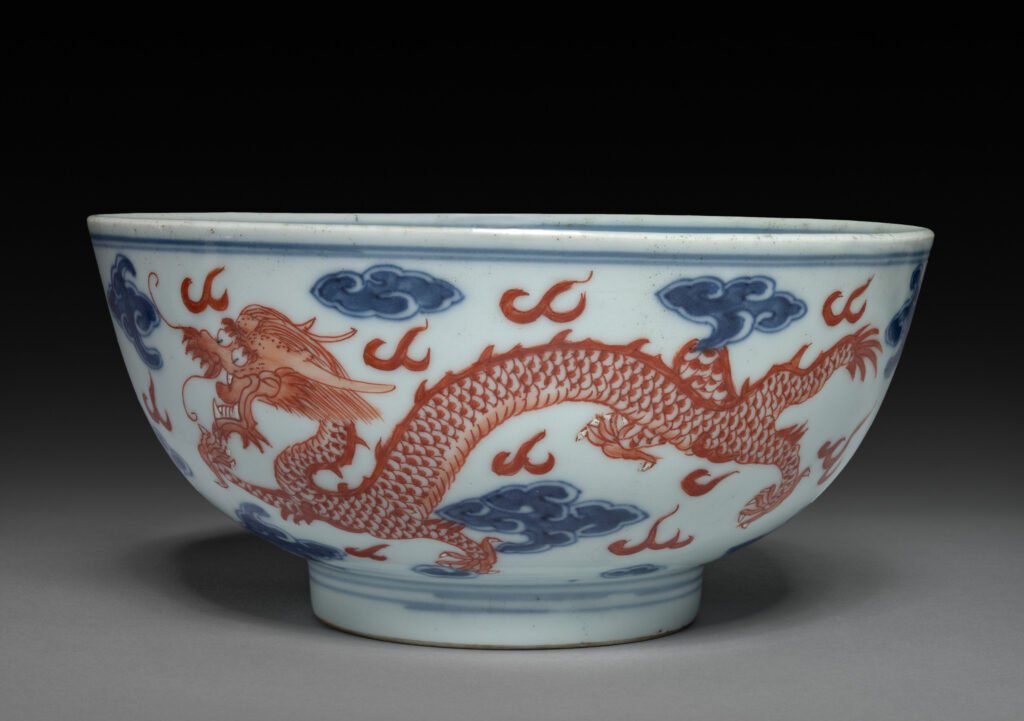
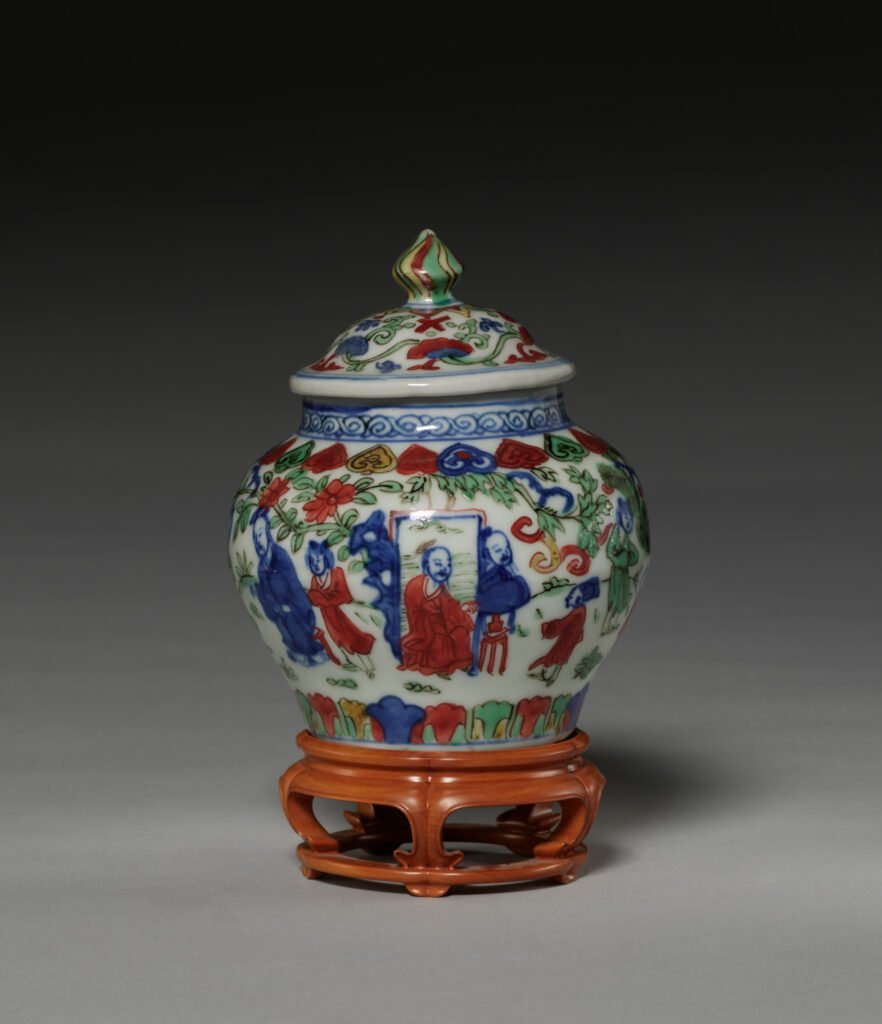
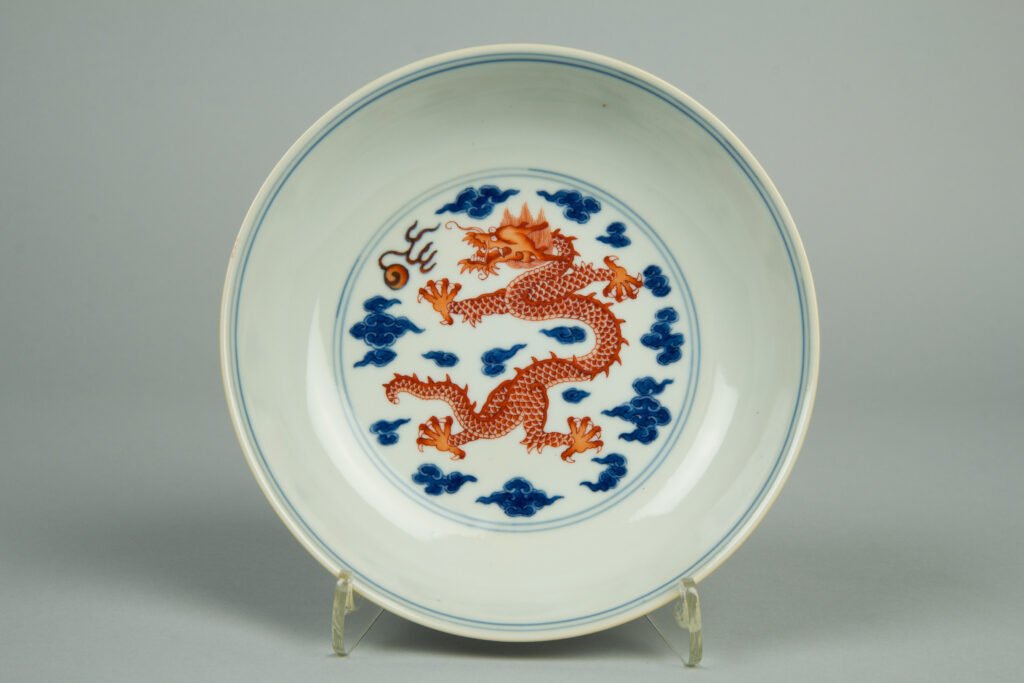
Iron red appears on its own, as a monochrome-decorated ware, and as the red in every enamel palette: the red of Ming wucai, of Kangxi famille verte, and of famille rose at every date. Painted alone it is at its best on the imperial dragon bowls and dishes of the Qing, where five-clawed dragons in iron red chase flaming pearls across white porcelain; the Tongzhi and Guangxu court ordered these in quantity and they are a distinct, well-documented category with reign marks that are usually of the period. It is also the red of “iron-red and gilt” export wares, of the Japanese Imari palette that Jingdezhen imitated in the eighteenth century, and of countless late-Qing and Republic tea bowls, jars and dishes.
Reading a piece
Colour and surface. A good eighteenth-century iron red is a clear orange-red laid thin enough to show brush texture; nineteenth-century red is often thicker, darker and more brownish; some modern red is a flat, opaque tomato colour. Under a lens the surface is very slightly matt and granular, unlike the glassy translucent enamels around it.
Wear. Because it sits on the glaze, iron red wears where hands touch it — rims, handles, the high points of a dragon’s scales — and honest wear is a good sign. Pristine enamel on a piece claiming two centuries of use is a question to ask.
Marks. Iron-red reign marks, painted over the glaze, become common in the nineteenth century and the Republic, and are easier to add later than an underglaze blue mark. A Tongzhi or Guangxu mark in iron red on a piece of that quality is normal; a Qianlong mark in iron red usually means the nineteenth century or later. The reign marks guide explains why.
Why it is a good ware to learn on
The pieces are generally inexpensive, the enamel is easy to identify by touch and by eye, and late-Qing examples are plentiful enough to compare side by side. Buy a Guangxu iron red dragon bowl with a period mark and an honest condition report and you have a reference piece for every other enamelled pot you look at.
Condition
Rubbed enamel and gilding are graded, not hidden; flaking is a fault; body damage — chips, hairlines, star cracks — is itemised as on any other piece. See what a hairline does to value.
Read more
The Qing porcelain guide covers the late-Qing court wares on which iron red is most often found; the Qing collection page has the current pieces.